Tag: #books

  • Author Erik Larson offers compelling acount of the start of the Civil War
    Author Erik Larson offers compelling acount of the start of the Civil War

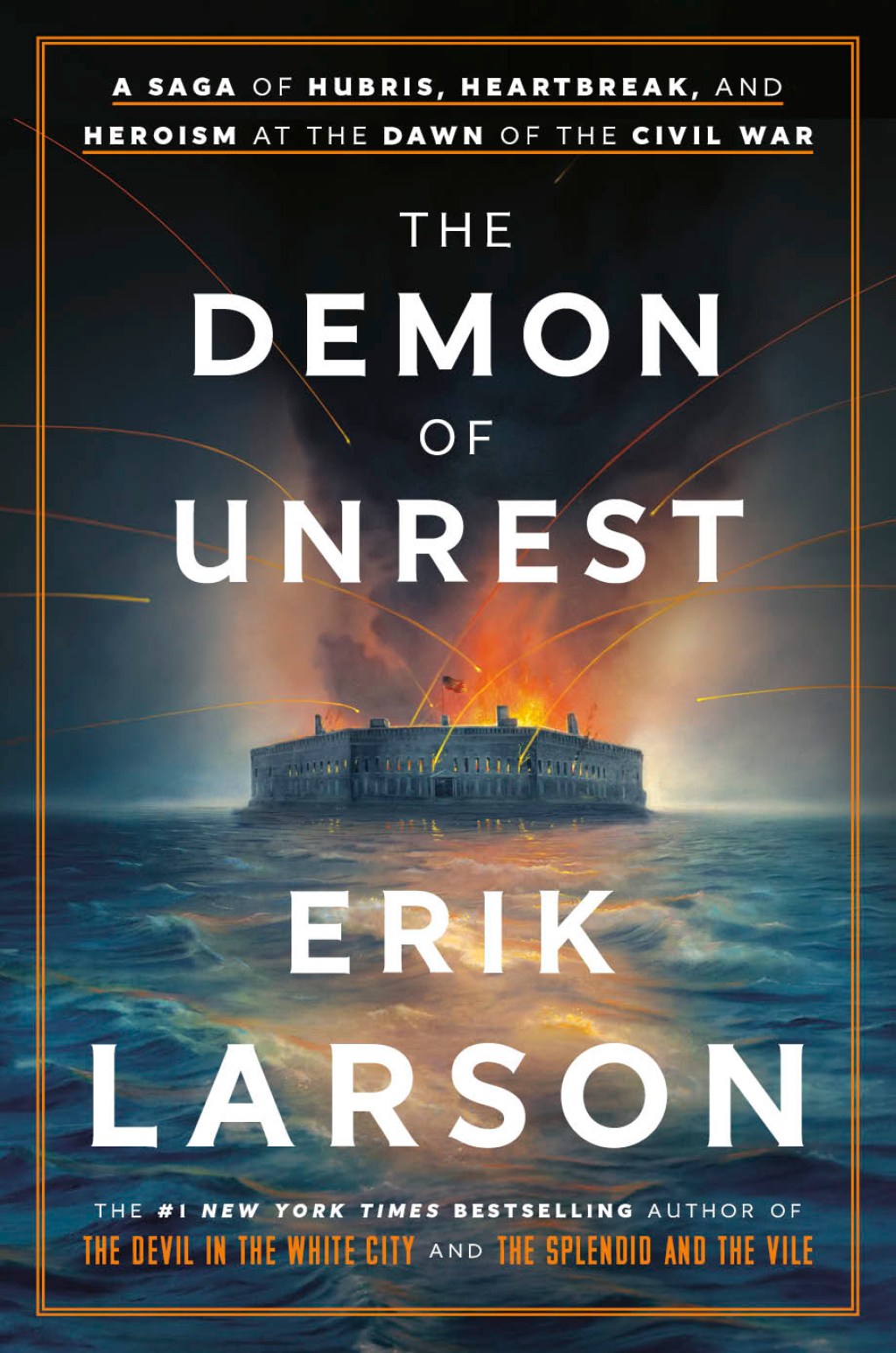
    Only a master storyteller like Erik Larson could turn the five tumultuous months leading up to the Civil War into “The Demon of Unrest: A Saga of Hubris, Heartbreak, and Heroes at the Dawn of the Civil War” (Crown), a compelling, page-turning read, chock full of anecdotes, psychological profiles and obscure but compelling tidbits of history all set against a relentless march towards a conflict that would kill over 620,000 soldiers and devastate a nation.

    Larson, the author of six New York Times bestsellers whose previous works include “The Devil in the White City: Murder, Magic, and Madness at the Fair That Changed America,” about a mass murderer and the 1893 Chicago’s World Fair, writes in a novelistic style that makes history come alive. He does so through his ability to weave together the familiar facts of history with information that can only be gleaned through relentless and extensive research.

    Yes, most of us know that the Civil War began with the firing on Fort Sumter, which was located in Charleston Harbor and under the command of U.S. Army Major Robert Anderson. But did you know that Anderson had owned enslaved people and was a defender of slavery? That Lincoln often misspelled Sumter as Sumpter? Or, more importantly, South Carolina did not have to succeed because of Lincoln’s election, as he had no intention of outlawing slavery in the Southern states?

    “When I started out doing this, one concern I had was that the Civil War has not exactly been underwritten,” Larson told me during a phone conversation earlier this week, noting that a quick Google indicated around 65,000. “I had vowed over the years never ever to write about the Civil War.”

    That changed when, as he was looking for the topic of his next book and watching the events of the Jan. 6, 2021 assault on the U.S. Capitol, he began to consider the deep divide and unrest of our own times.

    Faced with what he describes as an intimidating world of previous scholarship, Larson says “What I really wanted to do was to provide a rich sense, on an intimate level, of what the forces were and the motivations for the start of the Civil War.”

    The magic of his writing is that he accomplishes this by immersing the reader in details, descriptions, and personalities mostly unknown to many of us, including “eight typical characters” such as Charleston society doyenne Mary Boykin Chestnut, who kept a detailed diary, and James Henry Hammond, a Charleston planter who was a leader of the secessionist movement and who later became a U.S. senator despite public knowledge of his sexual relationships with four nieces ages 13 to 19.

    He also includes information about resolving issues regarding dueling, from “The Code of Honor or Rules for the Government Principals and Seconds in Dueling” and instructions for the “proper” way of whipping slaves as well as the going prices for selling human beings.

    The Southern mindset among the owners of enslaved people of the time is best summed up in a letter written to President James Buchanan, president before Lincoln, by Arthur Peronneau Hayne, a U.S. senator from Charleston. In it, he writes that without slavery “our every comfort would be taken from us. Our wives, our children, made unhappy — education, the light of knowledge — all lost and our people ruined forever. “

    “White southerners had persuaded themselves that slavery was a good thing for all concerned, especially for the enslaved blacks,” said Larson. He also notes that many of these same men were devoted readers of writers like Sir Walter Scott, author of “Ivanhoe,” and believed fervently in honor and the code of chivalry.

    As outrageous and hypocritical as that seems today, Larson says when writing about a different era it’s important to consider the point of view of those times to accurately reflect how events unfolded.

    “It gives a better sense of what the forces were that did lead to states like South Carolina succeeding from the Union and the Civil War,” he said, noting that understanding is not condoning, but historic context provides a lesson for the present and future as we struggle with political division today.

    This article previously appeared in the Northwest Indiana Times.

  • Castle Gormenghast: Revisiting Gothic Fantasy

    Castle Gormenghast: Revisiting Gothic Fantasy

    A crumbling castle, an eccentric and slightly mad family, and intricate plotting in a Medival fantasy series about a remote earldom is the perfect antidote to stressful holidays.

    Need to escape into a different world after talking politics over the Thanksgiving table–or even harder, avoiding talking politics across the Thanksgiving table? Then it’s time to visit Gormenghast, the ancestral home of the ancient Groan family who lived in a wild and isolated landscape. Written by author and artist Mervyn Peake, the books in the series are Titus Groan, published in 1947, Gormenghast (1950), and Titus Alone (1959). Peake died while writing Titus Awakes, the fourth book. His widow, artist Maeve Gilmore, completed the book sometime in the 1970s but the manuscript wasn’t discovered and published until 2011.

    According to its Wikipedia citation, “The series has been included in Fantasy: The 100 Best BooksModern Fantasy: The 100 Best Novels and 100 Must Read Fantasy Novels as one of the greatest fantasy works of the twentieth century. Literary critic Harold Bloom has praised the series as the best fantasy novels of the 20th century and one of the greatest sequences in modern world literature.”

    Available on Amazon, find a cozy corner to escape contemporary 21st post-election American angst and whisk yourself away to Castle Gormenghast.

    The books are also available on Kindle and Audible.

  • Where Are You, Echo Blue?

    Where Are You, Echo Blue?

    “In those years, the hardest of my childhood, Echo felt like a kindred spirit. I memorized her lines in Slugger 8. I practiced her stance on the field in the mirror. I cut out snapshots from Teen Beat magazine. I bought four copies of her cover issue of Sassy, the one where she wore a red cropped T-shirt with big lips smacked across her flat chest. I made a collage, carefully glued images of her together, draped it with a heart garland, and hung it over my bed. My favorite was a photo of Echo and her also-actor dad, Jamie Blue, leaving a restaurant, his arm slung over her shoulders, protecting her, the way I wished my father did.”

    From Where Are You, Echo Blue? by Haley Krischer (Penguin Random House).

    Goldie Klein, a writer for Manhattan Eye, has it bad when it comes to Echo Blue, the famous child actress. The obsession that worried her parents when she was growing up still has a hold on her even now. And when she learns that Echo, who was scheduled to appear on MTV’s New Year’s Eve Y2K special, one that will help her regain her foothold on stardom, hasn’t shown, Goldie knows it has to be more than just a relapse and stint in rehab. Echo has really disappeared.

    Currently, Goldie is writing the kind of stories she hates and that her father, an overly critical professor loves, including her most recent article on boxing. But Goldie’s aspirations are to cover subjects much hipper and more compelling. And she sees Echo’s vanishing as just the ticket. She manages to talk her editor into sending her to Los Angeles to track down the missing star. But it’s going to be difficult. Even those close to Echo have no idea where she is, and they’re upset that Goldie is looking for her.

    But in her adoration of the Echo, Goldie has spun a mythology in her own mind. She saw Echo as the only friend she had during her early teens. The boy-crazy girls in her class intimidated her with their talk about sex while Goldie was still playing with dolls. She tried to connect but it just didn’t happen despite the best efforts of her mother who planned slumber parties to help her make friends. And so, Goldie further immersed herself into Echo’s world—or the world she thought Echo inhabited.

    But Echo’s life was also difficult. Her mother, a washed-up television actress, is a depressive who has locked herself away in their house. To escape that environment, Echo opted to live with her movie star father who was always away on location hoping to become an Academy-award winning actor and never had time to talk on the phone, changed girlfriends monthly and really wasn’t that concerned with his daughter’s well-being. Echo had handlers that raised her and like Goldie she was terribly lonely with just one friend. Stardom couldn’t make up for not having the type of normal life most teenagers have.

    Goldie manipulates herself into the lives of people who know Goldie, including Jamie Blue. Accompanying an actor to his house, she eats a marijuana-laced cookie at the door and becomes completely stoned.

    “Don’t you know not to eat cookies at a stranger’s house without asking what’s in them?” her editor asks incredulously when Goldie calls to tell her as if that’s a basic fact everyone should know. And though Goldie wants to leave, her editor tells her that she’d better get in the hot tub with Jamie, even though he’s likely to be naked.

    Welcome to Hollywood.

    Goldie begins to get the idea of what Echo’s life was like as she continues to hunt for the missing star. The story cuts back and forth between 2000 and the 1990s, capturing the era precisely and what life was like for Echo as she became an Oscar-winning child star. In her pursuit of her story, Goldie realizes that it’s time to chart a new course in her own life.

    This article originally appeared in the New York Journal of Books.

    Book Club Kit.

  • “The Wildes” by Louis Bayard Book Signing

    “The Wildes” by Louis Bayard Book Signing

    On Thursday, Oct. 3rd at 6:30 PM,  Louis Bayardauthor of The Pale Blue Eye and Jackie and Me, will be in conversation with novelist Lori Rader-Day at The Book Stall. They will discuss Bayard’s new novel, The Wildes, a profoundly empathetic story about Oscar Wilde’s wife Constance and their two sons in the aftermath of the famous playwright’s imprisonment, told against Victorian England and World War I. 

    This program is free, but registration is required. CLICK HERE to reserve your spot.

    Benjamin Dyer, New York Times bestselling author of Dreyer’s English, says, “It requires a novelist of great audacity to dare to attempt to bring Oscar Wilde back to life, and it requires a novelist of great skill, to say nothing of wit, to manage the feat persuasively. Happily, Louis Bayard is both of those novelists.

    “As if that were not enough, The Wildes also presents us with a portrait of Oscar’s wife, Constance, that is little short of breathtaking in its vibrant depth, and a recounting of the heartbreaking tragedy of the Wildes that is eloquent and fully compassionate to all its characters, certainly to the Wildes’ sons, Cyril and Vyvyan, and even to (almost astonishingly) that feckless instrument of destruction Lord Alfred Douglas. I read The Wildes in an improbable state of breathless suspense, so wonderfully well has Bayard presented us with real people pressing, often excruciatingly, toward fateful decisions. This is an intoxicatingly gorgeous novel.” 

    Louis Bayard is the critically acclaimed bestselling author of nine historical novels, including Jackie & Me and The Pale Blue Eye, which was adapted into the global Netflix release starring Christian Bale. His articles, reviews, and recaps have appeared in the New York Times, the Washington PostSalon, and the Paris Review. His work has been translated into more than a dozen languages.

    Lori Rader-Day is the Edgar Award-nominated and Anthony, Agatha, and Mary Higgins Clark Award-winning author of Death at Greenway, The Lucky One, Under a Dark Sky, The Day I Died, Little Pretty Things, and The Black Hour. She lives in Chicago, where she is co-chair of the mystery readers’ conference Midwest Mystery Conference and teaches creative writing at Northwestern University. She served as the national president of Sisters in Crime in 2020.

  • Camino Ghosts by John Grisham

    Camino Ghosts by John Grisham

    “what could be better than a cursed island, some supernatural happenings, and the righting of centuries of social wrongs?”

    “It was a ship from Virginia, called Venus and it had around 400 slaves on board, packed like sardines,” bookstore owner Bruce Cable tells Mercer Mann, a writer who is looking for a new book subject. “Well, it left Africa with 400 but not all made it. Many died at sea. The conditions on board were unimaginable, to say the least. Venus finally went down about a mile to sea near Cumberland Island. Since the slaves were chained and shackled, almost all of them drowned. A few clung to the wreckage and washed ashore in the storm on Dark Island, as it became known. Or  Dark Isle. It was unnamed in 1760. They were taken in by runaways from Georgia, and together they built a little community. Two hundred years went by, everybody died or moved away and now it is deserted.”

    One of the many facets of John Grisham’s enthralling fiction is his ability to take complex social issues and weave them into the fabric of his novels so that they make for a compelling read.

    In Camino Ghosts, the third book in the Camino series, he does it again with his compelling story of Lovely Jackson, an 80-year-old Black woman who is determined to save Dark Isle, the now deserted island once settled by both shipwrecked Africans kidnapped into slavery and escaped slaves. Lovely is the last of those who settled on the island, and she stopped living there when she was 15, only returning to tend to the cemetery where her ancestors are buried.

    For years no one wanted the island, an inaccessible and unfriendly barrier island of impenetrable jungle, poisonous snakes, and prowling panthers. But Hurricane Leo has changed the island’s topography and rabid land developers with politicians in their pocket see Dark Isle as the place to build a sprawling casino and resort complex.

    But Lovely is determined, believing she is the sole owner of Dark Isle and the protector of her ancestors’ history and graves. She also happens to be the only one who can lift the curse of her great, great, great grandmother, Nalla, a woman who was kidnapped from her village in Africa, taken away from her husband and only child, chained in the hold of a ship as it crossed the Atlantic, and raped repeatedly by the crew members. No white man who has stepped on the island has survived.

    Camino Ghosts is the third in the series about bookstore owner Bruce Cable, who likes fine wine, good food, pretty women (he and his wife, an importer of French antiques, have an open marriage), and books. But he is more than a bon vivant and purveyor of tomes, he likes to intervene in the island’s business to produce the best outcomes and is extremely supportive of his writers. Good at pulling strings, he is the force uniting the factions fighting the development and is also helping his former lover, Mercer Mann, a bestselling author with writer’s block, find her next subject. And what could be better than a cursed island, some supernatural happenings, and the righting of centuries of social wrongs?

    This article originally appeared in the New York Journal of Books and the Northwest Indiana Times.

  • The Next Mrs. Parrish by Liv Constantine

    The Next Mrs. Parrish by Liv Constantine

    “’You’ll never own any White Orchard designs, you murderer!’ Her voice cut through the room and there was dead silence. Everyone was staring at them.

    “Remi gasped, and Rory’s brows knitted in a frown. ‘Daisy Ann, what’s going on?’

    “Amber froze, her heart banging in her chest, as her eyes darted around the room, desperate for a way to disappear before things went any further.

    “A bitter laugh escaped Daisy Ann.

    “’This, this . . . gold digger, she’s the one who tricked my father into marrying her and then shot him point-blank. She got away with murder.’”

    From the The Next Mrs. Parrish by Liv Constantine.

    Amber Patterson lied and seduced her way to displace Jackson Parrish’s wife Daphne, snagging the rich and ruthless millionaire to become his wife. But the passion that fueled their relationship barely lasted past the birth of their son Jax and by the time Jackson is sent to prison for tax evasion, and the money needed to fund their ultra-glamorous lifestyle has almost run out, Amber is plotting the next phase of her life. And it doesn’t include either Jackson or Jax, who she finds adorably cute but rather obnoxious in all his demands for her time and attention. But then what are live-in nannies for?

    When Amber discovers the valuable diamonds Jackson had hidden away she thinks all her problems are solved. Even with an unknown provenance—these very rare stones net Amber $14 million and she still has a few secreted away for a rainy day.

    That day may be coming sooner than she expects. She has her ticket to Paris booked and is planning on leaving the country before Jackson is released from prison. Unfortunately for her, Jackson gets home days early and discovering her plans, blackmails her into staying and helping him win back Daphne who has moved across country to protect their two daughters from their father.

    But Jackson isn’t Amber’s only problem. She has risen from her blue-collar roots by guile and murder. She tried to trick a wealthy local man to marry her by getting pregnant and when he refused, she sets him up for a rape charge and sends him to prison. Stealing money from her parents, she jettisons the care of her young son (yes, her maternal instincts are nil) and finagles her way into marrying a rich older man who dies shortly afterward in a mysterious hunting accident. “I thought he was a deer,” she told the authorities. They believe her, but the man’s daughter, Daisy Ann, is on the hunt for evidence that it was no accident.

    As if that wasn’t enough to fuel bad blood between the two women, Daisy Ann had her father change his will to protect the family fortune from his new wife. All that plotting for nothing. So when she snags Jackson, her next step is break into the high society of Bishop’s Harbor where Daphne reigned as queen. But when she is publicly humiliated by Daisy Ann who owns an exclusive line of handcrafted jewelry based upon her mother’s artistic designs, Amber becomes determined to acquire the business.  

    As if all this conniving isn’t enough, Amber and Jackson have set Daphne up to look like an addict who can’t adequately care for her children. When Jackson wins temporary custody, he forces Daphne to move back into the home they once shared. When she refuses to sleep with him, he makes it clear that her life depends upon her changing her mind.

    Though The Next Mrs. Parrish is a sequel to the million-copy, bestselling Reese’s Book Club pick The Last Mrs. Parrish (also available on Audible), it also is a stand-alone novel. Full of the plot twists and turns that fans of Liv Constantine, the pen name of sisters Lynne Constantine and Valerie Constantine, have come to expect and they deliver.

    The two sisters have produced a plethora of bestselling novels like The Stranger in the Mirror and The Wife Stalker. And like those, this is a page turner and immensely readable.

    This article previously ran in the New York Journal of Books.

  •  Local author to appear at bookstore for book signing of new “Lost East Chicago and Indiana Harbor” history book

     Local author to appear at bookstore for book signing of new “Lost East Chicago and Indiana Harbor” history book

    Award-winning author and journalist Joseph S. Pete will appear at a Northwest Indiana bookstore to sign copies of his new history book, “Lost East Chicago and Indiana Harbor.”

    Pete, a Lisagor Award-winning reporter and columnist, will do a book signing from 11:30 a.m. to 3 p.m. Saturday, July 20 at Miles Books at 2819 Jewett Avenue in Highland.

    He will sign copies of his latest history book about East Chicago and copies of his other books “Lost Hammond, Indiana,” “Secret Northwest Indiana” and “100 Things to Do in Gary and Northwest Indiana Before You Die.” Pete also will sign copies of University of Arizona Professor and East Chicago native Gloria McMillan’s “Children of Steel” anthology about life in steel mill towns, which he contributed a short story to.

    “Lost East Chicago and Indiana Harbor” chronicles the Indiana steel town on the shore of Lake Michigan in north Lake County just outside of Chicago that was a melting pot, drawing immigrants from all over the world to work at its bustling steel mills. As the population boomed in the early 20th century, East Chicago was home to more than 100 nationalities who came for the opportunities in a highly industrialized city that earned nicknames like “The Workshop of America,” the “Arsenal of America” and the “Industrial Capital of the World” while forging the steel that built up 20th-century America.

    Home to one of the most storied basketball rivalries in the state, East Chicago was also known as “The City of Champions” as it produced several high school football and basketball championship teams, including the only two back-to-back undefeated basketball teams in state history and the only two athletes to compete in both the Final Four and World Series. East Chicago gave the world many greats like the NBA’s all-time winningest coach Gregg Popovich, the Milwaukee Bucks star and later corporate magnate Junior Bridgeman, the baseball speedster Kenny Lofton, the actress Betsy Palmer, the boxing legend Angel “El Diablo” Manfredy and the Academy Award-winning screenwriter Steve Tesich, who penned the classic sports film “Breaking Away.”

    Pete’s new book is based in large part on interviews, including with Bridgeman, the state champion who went on to lead the Louisville Cardinals to the Final Four, get his number retired by and Bucks, and build a business empire that made him one of the wealthiest former athletes of all time.

    “Lost East Chicago and Indiana Harbor” takes a fond look back at bygone landmarks like Washington and Roosevelt High Schools, Inland Steel Christmas parties, the Washington Park Zoo, Taco Joe’s, the Mademoiselle Shoppe, movie palaces like the Voge and the gym where Michael Jordan played his first Bulls game. It recounts planned worker communities like Sunnyside and Marktown, the English village designed by noted architect Howard Van Doren Shaw where people park on the sidewalks and walk in the street and that’s featured in Ripley’s Believe It or Not and enshrined on the National Register of Historic Places.

    Pete, who has covered East Chicago for a decade for The Times of Northwest Indiana, relates stories about the Katherine Home, St. Joseph’s Carmelite Home, Big House, bolita, the Wickey Mansion, the Tod Opera House, the Patrick machine and the Crazy Indiana Style Artists graffiti crew, which hung out with the acclaimed artist Keith Haring, appeared on network television, and went on to exhibit their artwork internationally. His book also explores industrial pollution, political corruption, and unsolved mysteries like the deaths of Jay Given and Henry Lopez and the disappearance of the soccer great William “Wee Willie” McLean.

    “Lost East Chicago and Indiana Harbor” looks back at fondly remembered East Chicago intuitions like Albert’s, Dominic’s, Puntillo’s, Shrimp Harbor, Los Burritos, and El Patio Restaurant, as well as curiosities like the East Chicago Hermit and a mummy a local funeral home used to let kids see for a nickel. It also examines the city’s impact, such as producing Indiana’s first Latino elected official, the Hoosier State’s first and longest-running Mexican Independence parade, and the Midwest’s longest-running Mexican American–owned business, as well as the steel that helped shape America and countless other products.

    Pete is an Indiana University graduate, a combat veteran and a board member of the Indiana Society of Professional Journalists and the Chicago Headline Club. He is a playwright and literary writer whose work has appeared in more than 100 literary journals, earning Pushcart Prize and Best of the Net nominations. He’s received many journalism awards, including from the Inland Press Association, the Hoosier State Press Association, the Chicago Journalists Association, Columbia University and the National Association of Real Estate Editors as well as local honors from the Indiana Small Business Development Center and the Duneland Chamber of Commerce.

    For more information or an interview, contact Joseph S. Pete at 219.841.1030 or jpete@alumni.iu.edu.