Category: Gastronomy

  • Japan: The Vegetarian Cookbook

    Japan: The Vegetarian Cookbook

    Nancy Singleton Hachisu dives deep into the Japanese food scene, having married a Japanese farmer and learning the intricacies of cooking various vegetables and other ingredients that most of us aren’t familiar with.

    The author of several cookbooks including Japanese Farm Food, winner of the Gourmand World Cookbook Awards 2012: USA Winner for the Best Japanese Cuisine Book, Preserving the Japanese Way: Traditions of Salting, Fermenting, and Pickling for the Modern Kitchen, and Food Artisans of Japan, Hachisu is meticulous in her receipt development and helping us understand the intricacies of Japanese gastronomy. Her latest is Japan: The Vegetarian Cookbook (Phaidon 2023).

    For those who want to learn, Hachisu’s recipes require attention to detail and buying foods we may have trouble sourcing. But the results, for those who like a kitchen challenge, are well worth it and as someone who has been following Hachisu and using her cookbooks for years, I can assure you it gets much easier.

    It’s a fascinating take on Japanese cuisine from Hachisu, a native Californian who moved to Japan to stay there just for a year and immersed herself in Japanese food culture. Love intervened and after meeting an organic farmer, she married and moved to the rural Saitama Prefecture.

    That was more than 30 years ago, time enough for Hachisu to raise a family in an 85-year-old traditional Japanese farmhouse and become proficient in both culture and cooking.

    The book is so very niche that it’s almost like being in her kitchen and on her farm, giving us an amazing insight into a tiny slice of Japanese farm culture.

    CHILLED UME-TOFU SQUARES IN DASHI

    • Preparation time: 30 minutes, plus 2-3 hours pressing and chilling
    • Cooking times: 10-15 minutes
    • Serves: 4 squares
    • Vegan, Dairy-free, Nut-free

    Junsai, harvested from ponds from May to September, are baby water lily buds called “water shield” in English. They have a natural gelatinous covering so add a cool, slippery element to summer dishes. They might be available at Japanese markets, otherwise, just omit or substitute with blanched julienned green beans or cooked edamame. Salted sour “plums” have been prepared in Japan for a millennium, since the Heian period (794–1185), and are purported to have many health-improving qualities, including aiding digestion and combatting summer fatigue during the rainy season. The combination here makes a subtle, but lovely little bite.

    INGREDIENTS

    • 101⁄2 oz (300 g) cotton tofu or Japanese-style soft block tofu • 1 tablespoon hon kuzu
    • 2 medium umeboshi
    • Canola (rapeseed) oil, for greasing the pan
    • Generous 3/4 cup (63/4 fl oz/200 ml) Konbu Dashi
    • 1⁄2 tablespoon shoyu
    • A pinch of flaky sea salt
    • Scant 1⁄2 cup (31⁄2 fl oz/100 ml) baby water lily buds
    • Boiling water

    DIRECTIONS

    Place the tofu on a dinner plate and weight with a small cutting board for 1 hour.

    Smash the kuzu to a fine powder in a Japanese grinding bowl (suribachi, see page 354). Squeeze the tofu by handfuls to express excess moisture  and drop into the suribachi. Mash into the kuzu until well incorporated.

    Cut out the umeboshi pits (stones) and discard. Finely chop the umeboshi and fold into the smashed tofu.

    Dampen a folded-up piece of paper towel with the oil and grease the bottom and sides of
    a 5 1⁄2 × 4 1⁄2 × 2-inch (14 × 11 × 4.5 cm) nagashikan mold (see page 353) or a 4 3⁄8 × 8 1⁄2-inch (11.5 × 21 cm) loaf pan (bottom lined with parchment paper). Scrape the ume-tofu mixture into the pan and rap smartly on the counter to eliminate air pockets and make sure the tofu is evenly distributed into the pan.

    Set a bamboo steamer over a large wok filled one-third of the way with water and bring to a boil. Place the pan in the steamer, cover, and steam over high heat for about 10 minutes until set. Remove from the steamer, blot off accumulated moisture, and lay a piece of plastic wrap (cling film) on the surface. Refrigerate for at least 2 hours to chill.

    In a small saucepan, stir the dashi, shoyu, and salt together over medium heat to dissolve the salt. Transfer to a small bowl and refrigerate for 1 hour to chill.

    Place the junsai in a wire-mesh sieve and pour boiling water over for 10 seconds. Refresh
    by running the sieve under cold water. Shake off excess water and set the sieve over a bowl to drain. Store in the fridge for 1 hour to chill.

    Unmold the umedofu, cut into 4 squares, and place each on a small shallow individual dish. Stir the junsai into the cold dashi and spoon around the umedofu. Serve immediately as a light, palate-cleansing bite.

    Extracted from JAPAN: The Vegetarian Cookbook © 2023 by Nancy Singleton Hachisu. Photography © 2023 by Aya Brackett. Reproduced by permission of Phaidon. All rights reserved.

  • Islas: A Celebration of Tropical Cooking
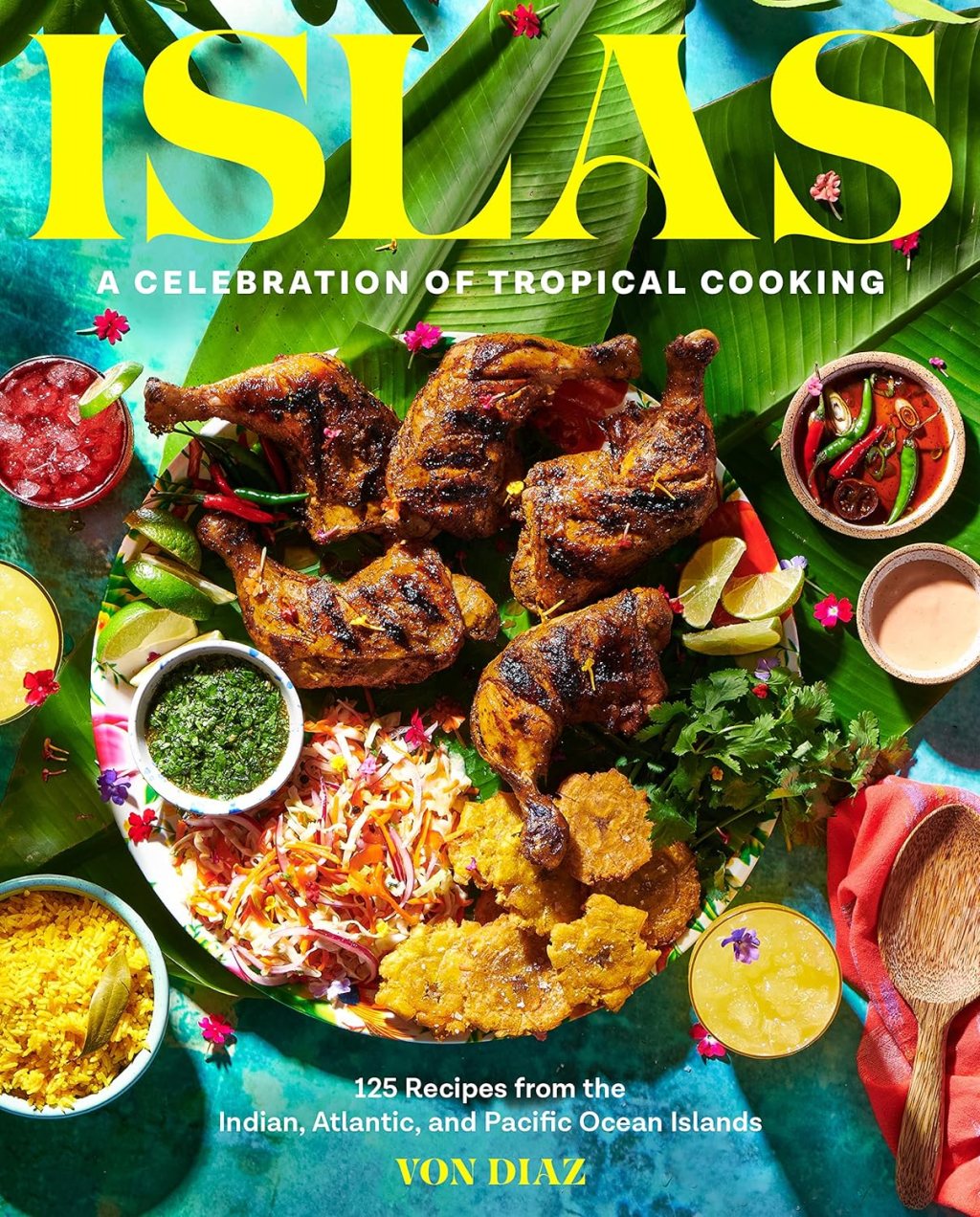
    Islas: A Celebration of Tropical Cooking

    “Whatever you cook or don’t cook, this book is a trip to the islands or islas of the world.”

    A beauty of a book, all lively colors, and wonderful photos, Islas: A Celebration of Tropical Cooking (Chronicle Books) takes us from island to island through the Indian, Atlantic, and Pacific Oceans.

    “The people who live on tropical islands are among the toughest, scrappiest, most resilient people of the planet,” writes author Von Diaz, an Emmy Award-winning documentarian, food historian, and author of Coconuts to Collards: Recipes and Stories from Puerto Rico to the Deep South (University Press of Florida) . “Storms have always been unpredictable, and generations of islanders have cultivated ancestral knowledge around how to survive and, importantly, how to feed themselves despite it all. With limited ingredients, they cook in ways that are soul-nourishing and emphasize flavor. Making magic out of what’s available.”

    Her cookbook is about preserving the wisdom and values of island people who live in what Diaz describes as the most volatile and vulnerable places on the planet. She follows their histories and how the grapple with their new realities, combining legacy, adaptability, culture, and fortitude.

    She tells and shows us cooking techniques and recipes from faraway places such as Santo, Vanuatu’s largest island. Here we meet Primrose Siri who shares such recipes as Laplap, the national dish with its alternative layers of starch such as cassava or yam, seafood or chicken, herbs, spices, and fresh coconut milk cooked oven an earth oven heated with hot rock. Closer to home, there’s Pasteles de Masa, a Puerto Rican Christmas traditional dessert.

    Even those who may never cook Arroz Negro Con Pulpo y Calamares (Black Rice with Octopus and Squid) with its rice blackened with squid ink, will be intrigued by this Puerto Rican dish that is definitely eye-catching.

    Keshi Yena’s history dates back to the first Dutch colonial period in Curaçao, a bustling island some 30 miles off the coast of Venezuela. It is the food of enslaved people, as Curaçao was a slave port, who out of necessity took the rinds of cheeses such as Gouda that were discarded by their masters and stuffing it with meat scraps and other scavenged ingredients.

    Some recipes are simple and easy to make at home without a lot of extra ingredients such as Ensalada Talong (Grilled Eggplant and Vegetable Salad) from the Philippines. Others, such as Monfongo Con Guiso, a common dish of green plantains and chicharron or fried pork skins in Puerto Rico are more time consuming but within reach of any cook who wants to give it a try.

    The book is arranged by the chapters including the island’s cooking techniques: Marinating, Pickling + Fermentation, Braising + Stewing, Steaming + In-Ground Cooking, Frying, Grilling, Roasting + Smoking, as well as pantry staples, and sauces, spice blends, and condiments that can easily be made.

    Whatever you cook or don’t cook, this book is a trip to the islands or islas of the world.

    This review originally appeared in the New York Journal of Books.

  • The French Ingredient: Making a Life in Paris One Lesson at a Time

    The French Ingredient: Making a Life in Paris One Lesson at a Time

    The Book Stall (811 Elm Street in Winnetka) is delighted to host author Jane Bertch on Thursday, April 11 at 6:30 pm for a discussion featuring her new book, The French Ingredient: Making a Life in Paris One Lesson at a Time, the inspiring and delicious memoir of an American woman who had the gall to open a cooking school in Paris. A true story of triumphing over French naysayers and falling in love with a city along the wayThe French Ingredient is the story of a young female entrepreneur building a life in Paris. As she established her school, Jane learned how to charm, how to project confidence, and how to give it right back to rude waiters. Having finally made peace with the city she swore to never revisit, she now offers a love letter to France, and a master class in Parisian cooking and living.

    To register for this free event, please visit their website or CLICK HERE. Space is going fast!

    More About the Book: When Jane Bertch was eighteen, her mother took her on a graduation trip to Paris. Thrilled to use her high school French, Jane found her halting attempts greeted with withering condescension by every waiter and shopkeeper she encountered. At the end of the trip, she vowed she would never return. Yet a decade later she found herself back in Paris, transferred there by the American bank she worked for. She became fluent in the language and excelled in her new position. But she had a different dream: to start a cooking school for foreigners like her, who wanted to take French cuisine classes in a friendly setting, then bring their new skills to their kitchens back home.

    Predictably, Jane faced the skeptical French, as well as real-estate nightmares, and a long struggle to find and attract clients. Thanks to Jane’s perseverance, La Cuisine Paris opened in 2009. Now the school is thriving, welcoming international visitors to come in and knead dough, whisk bechamel, whip meringue, and learn the care, precision, patience, and beauty involved in French cooking.

    More About the Author: Jane Bertch has spent more than two decades living and working in Europe. In 2009, she started La Cuisine Paris, which has become the largest nonprofessional culinary school in France. She holds a BA in English, an MA in labor and industrial relations from the University of Illinois, and an executive MA from the French business school INSEAD. The French Ingredient is her first book. Follow her on her blog.