Tag: Tony Burton

  • Western Mexico, A Traveler’s Treasury: Notes from the Road from the 16th Century On
    Western Mexico, A Traveler’s Treasury: Notes from the Road from the 16th Century On

    Once called Coatlan after the earthenware vessels that were coiled like a serpent and used for storing pulque, a white wine made from the Mexcal tree and used as an offering to a stone idol, Cuiseon was a small village on The Nine Rivers which flowed into Lake Chapala. 

    This and other food traditions, according to The Geographic Account of Poncitlán and Cuiseo del Río dated March 9, 1586, showed their typical fare as venison, fish, and rabbit, a thin kind of porridge to drink hot with powdered chile that was broken up and sprinkled on top, and Izquitl—corn toasted on a comal and seasoned with salt. The villagers harvested chia, huauhtli, and cocotl, the latter a mustard-like seed that is ground up and mixed with corn and water to drink both before and after eating.

    As it relates to the foods we eat today, we still consume corn and fish and season with salt and powdered chiles. We’re less likely to dine on venison or rabbit while cocotl is so obscure that even a Google search doesn’t come up with a hit. But both chia and huauhtli, a species of amaranth, an ancient grain, are recognized as beneficial to our health. And so, the foods of this village still play a part in our lives.

    This is an obscure slice of everyday life, a glimpse into the past that would be lost to time, confined to dusty archives, and/or shelved away to be forgotten in libraries or museums, if not for the work of Tony Burton, an award-winning writer whose books include “Lake Chapala: A Postcard History” (2022), “Foreign Footprints in Ajijic: Decades of Change in Mexican Village” (2022), “If Walls Could Talk: Chapala’s historic buildings and their former occupants” (2020), “Mexican Kaleidoscope: myths, mysteries and mystique” (2016), and “Western Mexico, A Traveler’s Treasury” (4th edition, 2013).

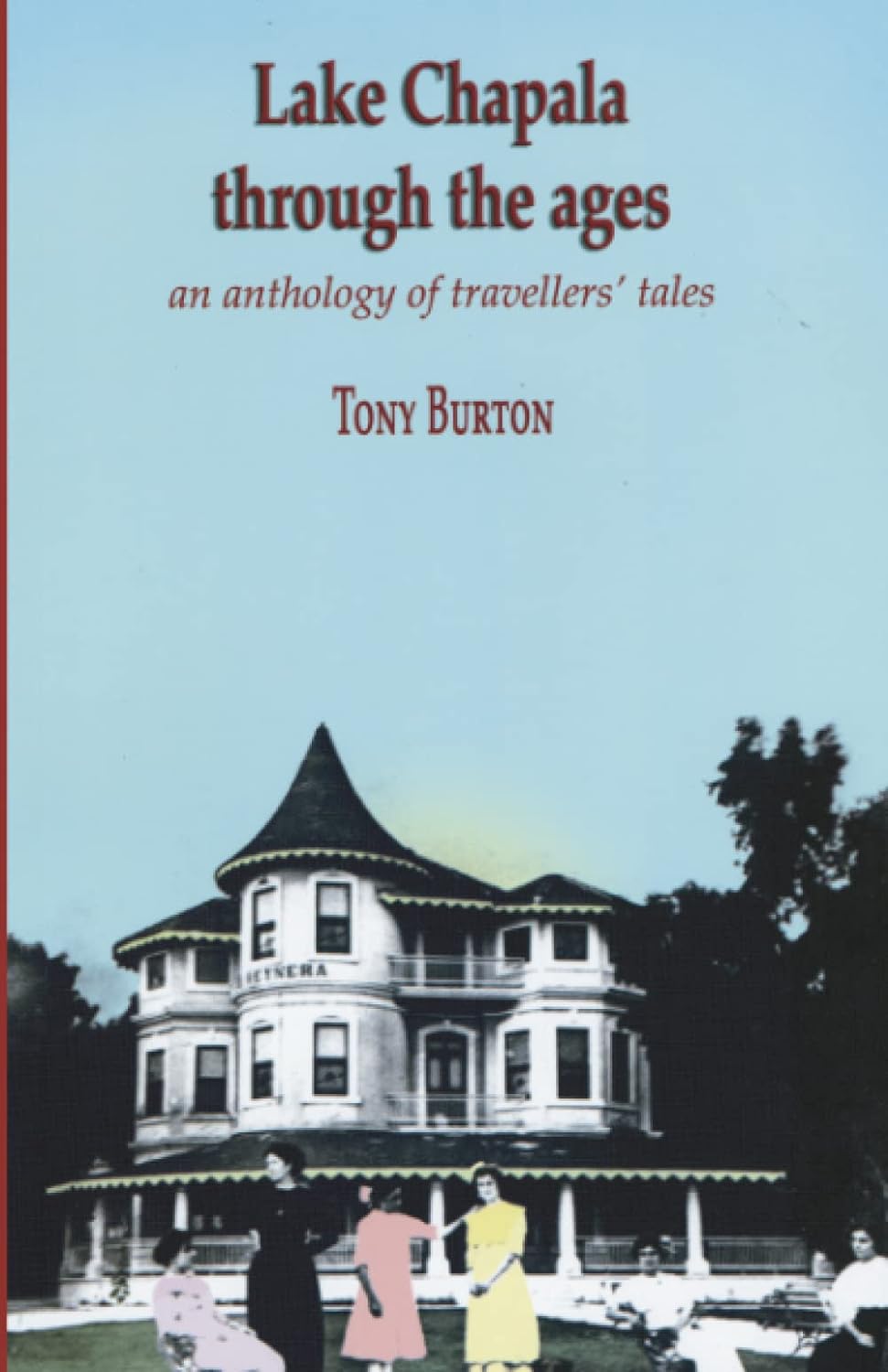
    Reading through a unique collection of extracts from more than fifty original sources, many never previously available in English, Burton’s book, “Lake Chapala Through the Ages; an anthology of travelers’ tales,” is a fascinating look at the region's formative years from the arrival of conquistadors in the early 1500s to the start of the Mexican Revolution in 1910, as told through the eyes of an assortment of travelers-- poets, friars, exiles, government officials, geographers, historians, explorers, and scientists.

    What they saw in their journeys is fascinating, as are the people who traveled and then shared their observations.

    "My inspiration was really curiosity about the documentary basis for things I’d heard about the history of the area, some of which struck me as highly imaginative," says Burton. "I began working on the book way before the development of online search engines or digitized books, so it took me almost a decade to track down originals of the 50+ published works, excerpts from which appear in the final book. It would have been impossible without the support of an excellent inter-library loan system, personal visits to libraries in the USA and England, and the generous contributions of a small army of people I thank in the book’s acknowledgments.

    "I still remember the shivers that ran down my spine when I first handled the leather-bound Belgian journal from the 1830s containing an article about Lake Chapala by Henri Galeotti. I knew that article existed because some parts had been translated into Spanish and published in Mexico. The challenge of finding the original proved to be well worth the effort—in my opinion, Galeotti’s masterful, illustrated, systematic, scientific coverage of the area's geology and natural history has no equal."

    Barrister and seasoned traveler William Henry Bullock Hall (1837–1904), who was born in Essex, England, and educated at Balliol College, Oxford visited Mexico taking a route that began in Veracruz and took in Mexico City, Tepic, San Blas, Guadalajara, Querétaro and Tampico."

    Looking for boiling water while staying at the hacienda of Buena Vista, he made the following observation:

    “In one of the recesses of the building, I discovered, over her earthenware pots, the old woman, upon whom you are sure to stumble, sooner or later, in Mexican houses, if you only persevere. As good luck would have it, this old crone was in the act of trying to blow into a sufficient glow to boil a jug of water, the bits of charcoal which, laid in a square receptacle sunk in the face of a solid brick counter, do the duty of a fire all over Mexico. From this old lady I obtained not only boiling water, but a couple of poached eggs, so that I fared sumptuously.”

    English women often were intrepid travelers, journeying to places remote and probably most uncomfortable. How joyous to meet Rose Georgina Kingsley (1845–1925), the oldest child of the Rev. Charles Kingsley, a celebrated English clergyman and novelist, who contributed the prologue to her book” South by west or winter in the Rocky Mountains and spring in Mexico,” published in 1874 and digitized by Harvard University in 2006.

    Rose crossed the Atlantic to Colorado Springs in November 1871 to join her brother, Maurice, who was assistant treasurer of the company developing Colorado Springs writes Burton, noting that, even by 1872, there were fewer than 800 residents, so both Kingsleys were pioneer settlers. Her writings and sketches were published by General William Jackson Palmer, the founder of Colorado Springs, a railway entrepreneur and owner of the newspaper Out West.

    When Palmer decided that same year to examine possible routes for a railway linking Texas to Manzanillo, Rose accepted the invitation to join him along with his wife, Queen, and General William Rosencrans on a trip that took them first to Manzanillo and then inland to Colima, Guadalajara, Guanajuato, Querétaro, and Mexico City. Her descriptions of the sights and interactions along the way are fascinating.

    “At San Pedro [Tlaquepaque] we stopped and got three men as escort, and at 9.30 came to San Antonio, a hacienda where we changed mules, and had breakfast in a hut by the roadside,” she writes. “The women in the hut, which was only made of sticks and thatch, gave us eggs, frijoles, tortillas, and carne seca, in chilli Colorado sauce, which for hotness almost beat the mole de guajalote at Atenquique. But besides these native viands we got capital chocolate, made from some cakes we had brought with us. So, on the whole, we fared well.”

    They arrived at La Barca, on the Rio Lerma, on market day and ate a very good meal in a dirty fonda (restaurant) where the walls were covered with broken bits of pottery in decorative patterns. There they learned they had barely missed being robbed the night before—all of which Rose, in her writings at least, takes in stride.

    Burton, the editor-in-chief of MexConnect, Mexico’s top English-language online magazine, spans time and place to take us into one of his favorite regions of Mexico where he lived for over a decade, bringing the past alive and introducing us to an interesting cast of characters.


  • If Walls Could Talk: Lake Chapala’s historic buildings and their former occupants

    If Walls Could Talk: Lake Chapala’s historic buildings and their former occupants

    Now one of the most popular retirement area for Americans and Canadians, the Lake Chapala Region, nestled in a valley almost a mile high in Mexico’s Volcanic Axis,  has long been a draw for ex-pats and vacationers, lured by its almost perfect climate and beauty.

    In his book If Walls Could Talk: Chapala’s historic buildings and their former occupants about Mexico‘s earliest international tourist destination (also available in Spanish), award-winning author Tony Burton shares his knowledge and interest in a region where he has spent more than two decades. Burton, a Fellow of the Royal Geographical Society who was born and educated in the United Kingdom, first visited Mexico in 1977. That visit was obviously a big success as he returned and for almost 18 years lived and worked full-time in Mexico as a writer, educator and ecotourism specialist.

    He met his wife, Gwen Chan Burton who was a teacher of the deaf and then director at the Lakeside School for the Deaf in Jocotepec, one of the three main towns lining the shores of Lake Chapala. Though they now reside on Vancouver Island, British Columbia, the Burtons continue to revisit Mexico regularly and he is currently editor-in-chief of MexConnect, Mexico’s top English-language online magazine.

    The other two towns, each with its own distinctive vibe, are Ajijic and Chapala, native villages resettled by the Spanish Conquistadors in the 1500s. “This book looks at how Chapala, a small nondescript fishing village in Jalisco, suddenly shot to international prominence at the end of the nineteenth century as one of North America’s earliest tourist resorts,” writes Burton. “Within twenty years, Chapala, tucked up against the hills embracing the northern shore of Mexico’s largest natural lake, was attracting the cream of Mexican and foreign society. Thus began Lake Chapala’s astonishing transformation into the vibrant international community it is now, so beloved of authors, artists and retirees.”

    The book, organized as a walking tour, covers not only existing buildings but also pinpoints the spots where significant early buildings no longer stand but their histories still weave a story of the town. It’s only a partial guide, explains Burton, noting that an inventory prepared by the National Institute of Anthropology and History identified more than eighty such buildings in Chapala including many not easily visible from the road but hidden behind high walls and better viewed from the lake.

    Among the famous people who lived in Chapala at some point in their careers was author D.H. Lawrence, probably best remembered for his risqué (at the time) novel, Lady Chatterley’s Lover.

    In 1923, Lawrence and his wife, Frieda, rented Casa de las Cuentas (House of Rosary Beads), a house that dates back to the 1800s. At the time, a one-story abode with a half-moon entrance and heavy wooden gates, it was located at 307 Calle Zaragoza, a street formerly known as Calle de la Pesquería (“Fishing street”) so named as it was where the local fishermen repaired their nets and hung them out to dry. It was while living on Calle Zaragoza that Lawrence wrote the first draft of The Plumed Serpent, published in 1926. The novel is described asthe story of a European woman’s self-annihilating plunge into the intrigues, passions, and pagan rituals of Mexico.”

    Over the decades, after the Lawrences moved out, subsequent changes were made to Casa de las Cuentas including  the addition of a swimming pool in the mid-1950s when artist Roy MacNicol and his wife, Mary, owned the home.

    While Lawrence’s writings were considered by some as scandalous, MacNicol’s life had its scandals as well. Burton describes him as “colorful” in that he was married multiple times and was involved in many escapades as well as lawsuits.

    Mary, embracing the local culinary traditions including the use of flowers in cooking, authored Flower Cookery: The Art of Cooking With Flowers.

    It wasn’t the work of a dilettante as reviews of her book such as this one on Amazon shows.

    “Flower Cookery is recipes, but far more than recipes,” writes one reviewer. “The book is organized by the popular name of the flower in question. Each section is introduced with quotations from literature, philosophy, and poetry that feature the blossom. This is followed by the recipes, interwoven with mythology, stories, and aphorisms about the flower, the plant from which it grows, its symbolism, and the culture or society in which humans discovered the value of the plant or blossom. The recipes include original favorites as well as recipes collected from historical sources and contemporary sources around the world. Here is just the tiniest sampling of the riches in the book.”

    Burton shares her Christmas Cheer recipe from when she lived at Casa de las Cuentas.

    Christmas Cheer

    10-12 squash blossoms with stems removed

    2 eggs, beaten

    2 to 3 tablespoons water

    Flour, enough to thicken mixture about one tablespoon

    Salt and pepper

    1 cup neutral oil such as grapeseed, canola, or safflower

    Wash and dry squash blossoms on paper towels, making sure to remove all the water. Mix remaining ingredients except oil to make a smooth batter. Place oil in a large, heavy skillet to 350-375°F. Dip blossoms in batter and fry in oil until golden brown. Drain on paper towels. Serve hot.

    As for the house, it was renovated again in the early 1980s and is now Quinta Quetzalcoatl, a lovely boutique hotel.

    If Walls Could Talk is one of four books that Burton has written on the Lake Chapala region. The other three are Foreign Footprints in Ajijic: decades of change in a Mexican Village; Lake Chapala Through the Ages: an anthology of travelers’ tales  (2008), and the recent Lake Chapala: A Postcard history. All are available as print and ebooks on Amazon.

    The above maps, both copyrighted, show Chapala 1915 [lower map] and 1951 [upper map].

    In all, he’s planning on adding several more to what he currently calls the Lake Chapala Quartet, these focusing on the writers and artists associated with the area.  I asked him  to describe the region so readers who have never been there can get an idea of what it is like, but it turns out the Burton is NOT a traveler who meticulously plots every moment of a trip before he arrives. Instead, he tells me that part of the fun when traveling is to not know in advance what places are like and instead to see and experience them for yourself.

    “That said,” he continues, “the various villages and towns on the shores of Lake Chapala are all quite different in character. The town of Chapala, specifically, is a pretty large and bustling town. It is growing quite rapidly and has added several small high end boutique hotels in recent years, as well as some fine dining options to complement the more traditional shoreline ‘fish’ restaurants. The many old–100 years plus–buildings in Chapala give the town a historic ‘air’ where it is relatively easy to conjure up images of what it was like decades ago. By comparison, Ajijic, now the center of the foreign community on Lake Chapala, has virtually no old buildings and more of a village and artsy feel to it, though it also has very high quality accommodations and more fine restaurants than you can count.”

    Other structures still standing include the Villa Tlalocan, completed in 1896 and described by a contemporary journalist as “the largest, costliest and most complete in Chapala… a happy minglement of the Swiss chalet, the Southern verandahed house of a prosperous planter and withal having an Italian suggestion. It is tastefully planned and is set amid grounds cultivated and adorned with flowers so easily grown in this paradisiacal climate where Frost touches not with his withering finger…”

    Also still part of the landscape is Villa Niza. One of many buildings designed by Guillermo de Alba, the house, according to Burton, was built in 1919 and looks more American than European in style. Located at Hidalgo 250, it takes advantage of its setting on Lake Chapala and has a mirador (look out) atop the central tower of the structure, which affords sweeping panoramic views over the gardens and lake. De Alba’s strong geometric design boasts only minimal exterior ornamentation.

    Burton, who specializes in non-fiction about Mexico, related to geography, history, travel, economics, ecology and natural history, has written several fascinating books about the history of the Lake Chapala region.

    In If Walls Could Talk, Burton invites you to walk with him through time as you explore the city.