Tag: “Lake Chapala: A Postcard History”

  • Western Mexico, A Traveler’s Treasury: Notes from the Road from the 16th Century On
    Western Mexico, A Traveler’s Treasury: Notes from the Road from the 16th Century On

    Once called Coatlan after the earthenware vessels that were coiled like a serpent and used for storing pulque, a white wine made from the Mexcal tree and used as an offering to a stone idol, Cuiseon was a small village on The Nine Rivers which flowed into Lake Chapala. 

    This and other food traditions, according to The Geographic Account of Poncitlán and Cuiseo del Río dated March 9, 1586, showed their typical fare as venison, fish, and rabbit, a thin kind of porridge to drink hot with powdered chile that was broken up and sprinkled on top, and Izquitl—corn toasted on a comal and seasoned with salt. The villagers harvested chia, huauhtli, and cocotl, the latter a mustard-like seed that is ground up and mixed with corn and water to drink both before and after eating.

    As it relates to the foods we eat today, we still consume corn and fish and season with salt and powdered chiles. We’re less likely to dine on venison or rabbit while cocotl is so obscure that even a Google search doesn’t come up with a hit. But both chia and huauhtli, a species of amaranth, an ancient grain, are recognized as beneficial to our health. And so, the foods of this village still play a part in our lives.

    This is an obscure slice of everyday life, a glimpse into the past that would be lost to time, confined to dusty archives, and/or shelved away to be forgotten in libraries or museums, if not for the work of Tony Burton, an award-winning writer whose books include “Lake Chapala: A Postcard History” (2022), “Foreign Footprints in Ajijic: Decades of Change in Mexican Village” (2022), “If Walls Could Talk: Chapala’s historic buildings and their former occupants” (2020), “Mexican Kaleidoscope: myths, mysteries and mystique” (2016), and “Western Mexico, A Traveler’s Treasury” (4th edition, 2013).

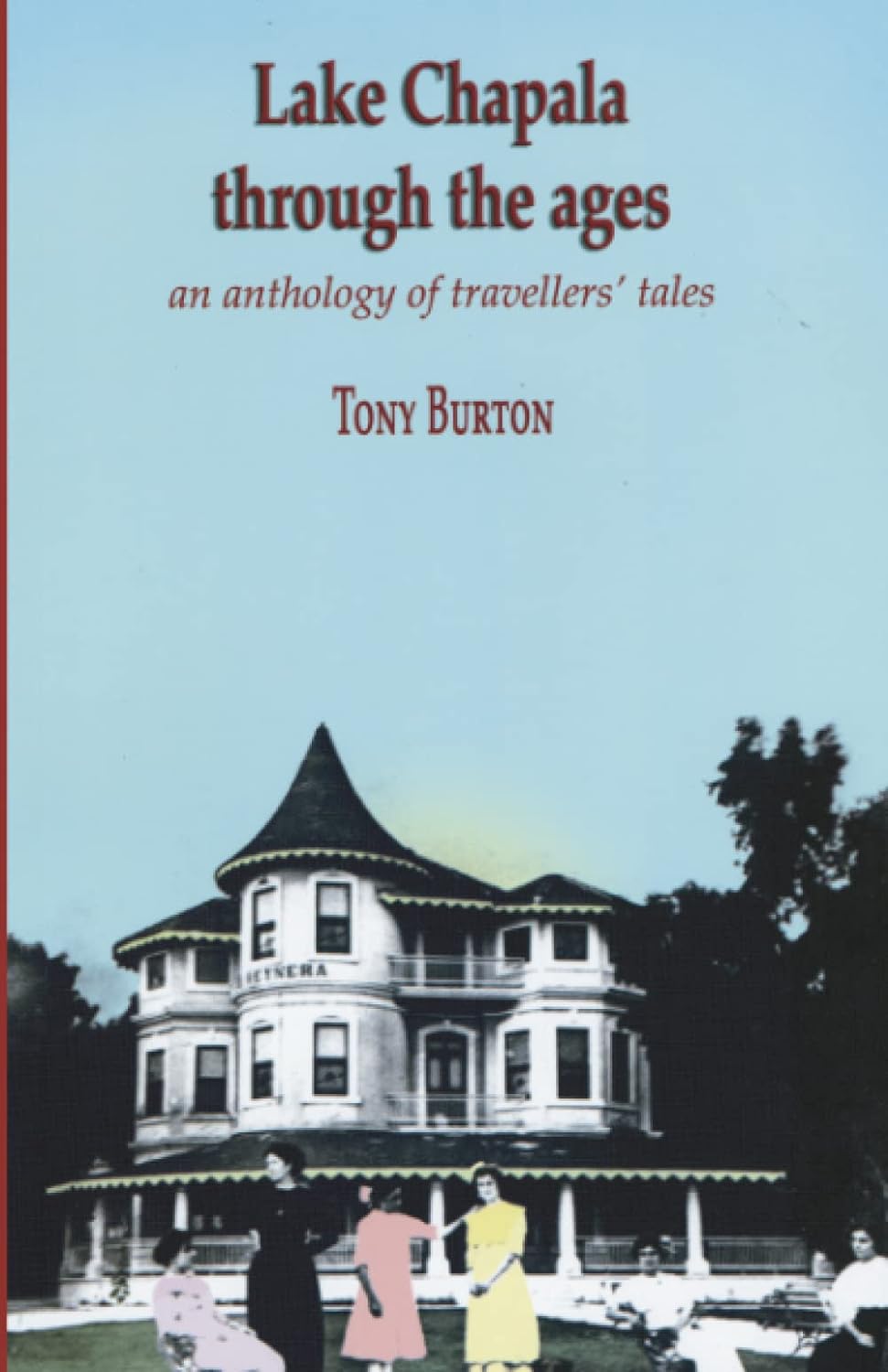
    Reading through a unique collection of extracts from more than fifty original sources, many never previously available in English, Burton’s book, “Lake Chapala Through the Ages; an anthology of travelers’ tales,” is a fascinating look at the region's formative years from the arrival of conquistadors in the early 1500s to the start of the Mexican Revolution in 1910, as told through the eyes of an assortment of travelers-- poets, friars, exiles, government officials, geographers, historians, explorers, and scientists.

    What they saw in their journeys is fascinating, as are the people who traveled and then shared their observations.

    "My inspiration was really curiosity about the documentary basis for things I’d heard about the history of the area, some of which struck me as highly imaginative," says Burton. "I began working on the book way before the development of online search engines or digitized books, so it took me almost a decade to track down originals of the 50+ published works, excerpts from which appear in the final book. It would have been impossible without the support of an excellent inter-library loan system, personal visits to libraries in the USA and England, and the generous contributions of a small army of people I thank in the book’s acknowledgments.

    "I still remember the shivers that ran down my spine when I first handled the leather-bound Belgian journal from the 1830s containing an article about Lake Chapala by Henri Galeotti. I knew that article existed because some parts had been translated into Spanish and published in Mexico. The challenge of finding the original proved to be well worth the effort—in my opinion, Galeotti’s masterful, illustrated, systematic, scientific coverage of the area's geology and natural history has no equal."

    Barrister and seasoned traveler William Henry Bullock Hall (1837–1904), who was born in Essex, England, and educated at Balliol College, Oxford visited Mexico taking a route that began in Veracruz and took in Mexico City, Tepic, San Blas, Guadalajara, Querétaro and Tampico."

    Looking for boiling water while staying at the hacienda of Buena Vista, he made the following observation:

    “In one of the recesses of the building, I discovered, over her earthenware pots, the old woman, upon whom you are sure to stumble, sooner or later, in Mexican houses, if you only persevere. As good luck would have it, this old crone was in the act of trying to blow into a sufficient glow to boil a jug of water, the bits of charcoal which, laid in a square receptacle sunk in the face of a solid brick counter, do the duty of a fire all over Mexico. From this old lady I obtained not only boiling water, but a couple of poached eggs, so that I fared sumptuously.”

    English women often were intrepid travelers, journeying to places remote and probably most uncomfortable. How joyous to meet Rose Georgina Kingsley (1845–1925), the oldest child of the Rev. Charles Kingsley, a celebrated English clergyman and novelist, who contributed the prologue to her book” South by west or winter in the Rocky Mountains and spring in Mexico,” published in 1874 and digitized by Harvard University in 2006.

    Rose crossed the Atlantic to Colorado Springs in November 1871 to join her brother, Maurice, who was assistant treasurer of the company developing Colorado Springs writes Burton, noting that, even by 1872, there were fewer than 800 residents, so both Kingsleys were pioneer settlers. Her writings and sketches were published by General William Jackson Palmer, the founder of Colorado Springs, a railway entrepreneur and owner of the newspaper Out West.

    When Palmer decided that same year to examine possible routes for a railway linking Texas to Manzanillo, Rose accepted the invitation to join him along with his wife, Queen, and General William Rosencrans on a trip that took them first to Manzanillo and then inland to Colima, Guadalajara, Guanajuato, Querétaro, and Mexico City. Her descriptions of the sights and interactions along the way are fascinating.

    “At San Pedro [Tlaquepaque] we stopped and got three men as escort, and at 9.30 came to San Antonio, a hacienda where we changed mules, and had breakfast in a hut by the roadside,” she writes. “The women in the hut, which was only made of sticks and thatch, gave us eggs, frijoles, tortillas, and carne seca, in chilli Colorado sauce, which for hotness almost beat the mole de guajalote at Atenquique. But besides these native viands we got capital chocolate, made from some cakes we had brought with us. So, on the whole, we fared well.”

    They arrived at La Barca, on the Rio Lerma, on market day and ate a very good meal in a dirty fonda (restaurant) where the walls were covered with broken bits of pottery in decorative patterns. There they learned they had barely missed being robbed the night before—all of which Rose, in her writings at least, takes in stride.

    Burton, the editor-in-chief of MexConnect, Mexico’s top English-language online magazine, spans time and place to take us into one of his favorite regions of Mexico where he lived for over a decade, bringing the past alive and introducing us to an interesting cast of characters.


  • Three Charming Villages on the shores of Lake Chapala

    Three Charming Villages on the shores of Lake Chapala

    Born in the United Kingdom, Tony Burton, a Cambridge University-educated geographer with a teaching certificate from University of London, first traveled to Mexico after spending three years as a VSO [Voluntary Service Overseas] volunteer teaching geography, and writing a local geography text, on the Caribbean island of St. Kitts. From there his travels took him to Mérida in summer 1977, where he spent several weeks backpacking around southern and central Mexico, returning two years later to teach at Greengates School in Mexico City.

    Over the next seven years, Tony traveled extensively throughout Mexico, visiting every state at least once, and organizing numerous four-day earth science fieldwork courses for his students. He co-led the school’s extensive aid efforts following the massive 1985 earthquake.

    From Mexico City, he moved to Guadalajara, where he continued to organize short, residential fieldwork courses for a number of different schools and colleges and began organizing and leading specialist eco-tours for adult groups to destinations such as Paricutín Volcano, the monarch butterfly sanctuaries, and Copper Canyon.

    An award winning author, he’s written numerous books about Mexico including his latest Lake Chapala: A Postcard History (Sombrero Publishing). It’s part of a series he’s written on this region which is located about an hour south of Guadalajara. The 417-square-mile lake, Mexico’s largest, located in the states of Jalisco and Michoacán is situated at an elevation of  5,000ft in the middle of the Volcanic Axis of Mexico and is known for its wonderful climate, laid-back ambience, and is a popular destination for both travelers and ex-pats looking for a charming, low-key place to relocate. The three main towns along the lake are Chapala, Ajijic and Jocotepec. In an intriguing aside, Tony met his wife Gwen Chan Burton when she was working as at the director of the pioneering Lakeside School for the Deaf in Jocotepec. Gwen writes about the school and all that it has accomplished in her book, New Worlds for the Deaf, also published by Sombrero Books.

    Tony’s other books about this region include Western Mexico A Traveler’s Treasury, illustrated by Mark Eager, now in its fourth edition; Mexican Kaleidoscope: Myths, Mysteries and Mystique, illustrated by Enrique Veláquez, and Foreign Footprints in Ajijic: Decades of Change in a Mexican Village. I’ll be covering them in upcoming posts.

    Because I’m always interested in foodways, Tony was kind enough to share a copy of an undated Spanish language project put together by students from the Instituto Politécnico Nacional School of Tourism titled “Gastronomy of Jalisco.”  It includes numerous recipes from the region including one for the famous Caldo Michi of Chapala (the recipe is below).

    I had the chance to ask Tony, who currently is the editor of MexConnect, Mexico’s leading independent on-line magazine, about Lake Chapala: A Postcard History as well as the time he spent in this beautiful region of Mexico.


    How did you first become familiar with Lake Chapala?

    I first visited Lake Chapala in early 1980, on my way back to Mexico City from the Copper Canyon and Baja California Sur. Little did I imagine then that it would be where I would later fall in love, get married, and have two children!

    What inspired you to write Lake Chapala: A Postcard History?

    There is no single overwhelming inspiration. I realized, while living at Lake Chapala and writing my first books about Mexico, that a lot of what had been previously written was superficial and left many unanswered questions. In the hopes of finding answers, I decided to trawl through all the published works (any language) I could find, which resulted in Lake Chapala Through the Ages (2008), my attempt to document and provide context to the accounts of the area written between 1530 and 1910.

    My next two books about Lake Chapala—If Walls Could Talk: Chapala’s Historic Buildings and Their Former Occupants, and Foreign Footprints in Ajijic: Decades of a Change in a Mexican Village—focused on the twentieth century history of the two main centers for the very numerous foreign community now living on ‘Lakeside.’ Part of my motivation was to dispel some of the myths that endlessly recirculate about the local history, as well as to bring back to life some of the many extraordinary pioneering individuals indirectly responsible for the area becoming such an important destination for visitors.

    Lake Chapala: APostcard History is my attempt to widen the discussion and summarize the twentieth century history of the entire lake area. Its reliance on vintage postcards makes this a very visual story, one which I hope will appeal to a wide readership, including armchair travelers.


    What were some of the challenges you encountered in writing this book? Was it difficulty finding the numerous postcards you included? And doing the extensive research that went into the book? Are there any intriguing stories about hunting down certain postcards and any “aha” moments of discovery when writing your book?

    The main challenge was in deciding how best to structure the material. Because of the originality of what I’m doing, it is impractical to follow the advice that writers should start with a detailed plan and then write to that plan! In my case, after collecting the information and ideas that exist, the challenge is to select what can be teased and massaged into a coherent and interesting narrative.

    Because the postcard book is the product of decades of research, I had ample time to build my personal collection of vintage postcards, through gifts, auctions and online purchases.

    There were many significant “aha” moments in the process: some concerned the photographers and publishers responsible for the postcards and some the precise buildings or events depicted. While I’m saving some of these “aha” moments–because they are central to a future book–one was when it suddenly dawned on me that wealthy businessman Dwight Furness was the photographer of an entire series of cards (Figs 6.3, 6.4, 6.5, etc.) that relate to my next response.


    If you could go back in time to visit one of the resorts that is no longer there that you featured in your book, is there one that stands out and why is that?

    Ooohhh; I’d love to go back to about 1908 and stay at the Ribera Castellanos resort (Chapter 6) during its heyday. While staying there, perhaps I could interview owner Dwight Furness, his wife and a few guests? Apart from a few ruined walls, Furness’ postcards of the resort are pretty much the only remaining evidence of the hotel. And perhaps one night I could invite local resident and prolific professional photographer Winfield Scott and his wife to dinner to hear their stories?

    How long did it take to write Lake Chapala?

    The writing took less than a year; but only because of the many prior years of research.

    Since I often talk about food and travel, are there any culinary specialties in the Lake Chapala region?

    Long standing culinary specialties of the area include (a) Lake Chapala whitefish (b) charales (c) caldo michi. And, when it comes to drinks, there is a very specific link to postcards. The wife of photographer José Edmundo Sánchez, who sold postcards ( Figs 7.5, 7.6 and 7.7) in the 1920s from his lakefront bar in Chapala, is credited with inventing sangrita, still marketed today as a very popular chaser or co-sip for tequila. (Chapter 7, page 74).

    Is there anything else you’d like readers to know about your book?

    I hope readers find the book as fun and interesting to read as it was to write!

    MICHI BROTH

    Ingredients:

    • 2 tablespoons corn oil
    • ¾ kg of tomato seeded and in pieces
    • ¼ onion in pieces
    • ½ kg carrot, peeled and cut into diagonal slices
    • ½ kg of sliced ​​zucchini
    • 4 or 6 chiles güeros
    • 100 gr. chopped coriander
    • 2 sprigs of fresh oregano
    • Salt to taste
    • 2 ½ liters of water
    • 1kg well washed catfish, yellow carp or red snapper

    PREPARATION: Heat the oil and stew the vegetables in it, add water and salt to taste, let it simmer over low heat until the vegetables are well cooked, then add the fish and leave it for a few minutes more until it is soft.

    Sangrita

    I had the opportunity to stay at Tres Rios Nature Park, a 326-acre eco-resort north of Playa del Carmen and was first introduced to sangrita during my stay. I took several cooking lessons and learned to make a dish with crickets, but that is a different story. Chef Oscar also talked to us about the history of sangrita. The Spanish name is the less-than-appetizing “little blood” but hey, when you’re learning to grill crickets, you can deal with a name like that. The drink, as Tony writes in his postcards book, originated in Chapala in the 1920s.

    Here is the excerpt:

    ”In the same year the Railroad Station opened, Guillermo de Alba had become a partner in Pavilion Monterrey, a lakefront bar in a prime location, only meters from the beach, between the Hotel Arzapalo and Casa Braniff,” he writes. “The co-owner of the bar was José Edmundo Sánchez. Regulars at the bar included American poet Witter Bynner, who first visited Chapala in 1923 in the company of D H Lawrence and his wife, Frieda. Bynner subsequently bought a house near the church. When de Alba left Chapala for Mexico City in 1926, Sánchez and his wife—María Guadalupe Nuño, credited with inventing sangrita as a chaser for tequila—ran the bar on their own. After her husband died in 1933, María continued to manage the bar, which then became known as the Cantina de la Viuda Sánchez (Widow Sánchez’s bar).”

    Sangrita is typically used as accompaniment to tequila, highlighting its crisp acidity and helping to cleanse the palate between each peppery sip. According to Chef Oscar, the red-colored drink serves to compliment the flavor of 100% agave tequila. The two drinks, each poured into separate shot glasses, are alternately sipped, never chased and never mixed together.

    Here is Chef Oscar’s recipe and below is one from Cholula hot sauce which originated in Chapala. Tony has a great story about that as well. More in my next post on his books.

    For one liter of Sangrita:

    • 400 ml. orange juice
    • 400 ml. tomato juice
    • 50 ml. lemon juice
    • 30 ml. Grenadine syrup
    • 20 ml. Worcestershire sauce
    • Maggi and Tabasco hot sauce (mixed up) to taste
    • Salt and pepper to taste

    Mix together all the ingredients and serve cold. Suggested duration of chilling : 3 to 4 days.

    Cholula’s Sangrita

    • 1/4 cup (2 ounces) fresh orange juice
    • 1/4 cup (2 ounces) fresh grapefruit juice
    • 2 tablespoons fresh lime juice
    • 20 pomegranate seeds
    • 3 fresh sprigs of cilantro or to taste
    • 1/2 stalk celery
    • 3 teaspoons smoked coarse sea salt or sal de gusano, divided
    • 1 tablespoon Cholula® Original Hot Sauce

    Place all ingredients except salt in blender container, with about 1 cup ice cubes. Puree until smooth.Strain twice though a fine mesh sieve, discarding any solids.

    Rim shot glasses with sea salt. Serve sangrita cold in rimmed shot glasses alongside your favorite tequila.