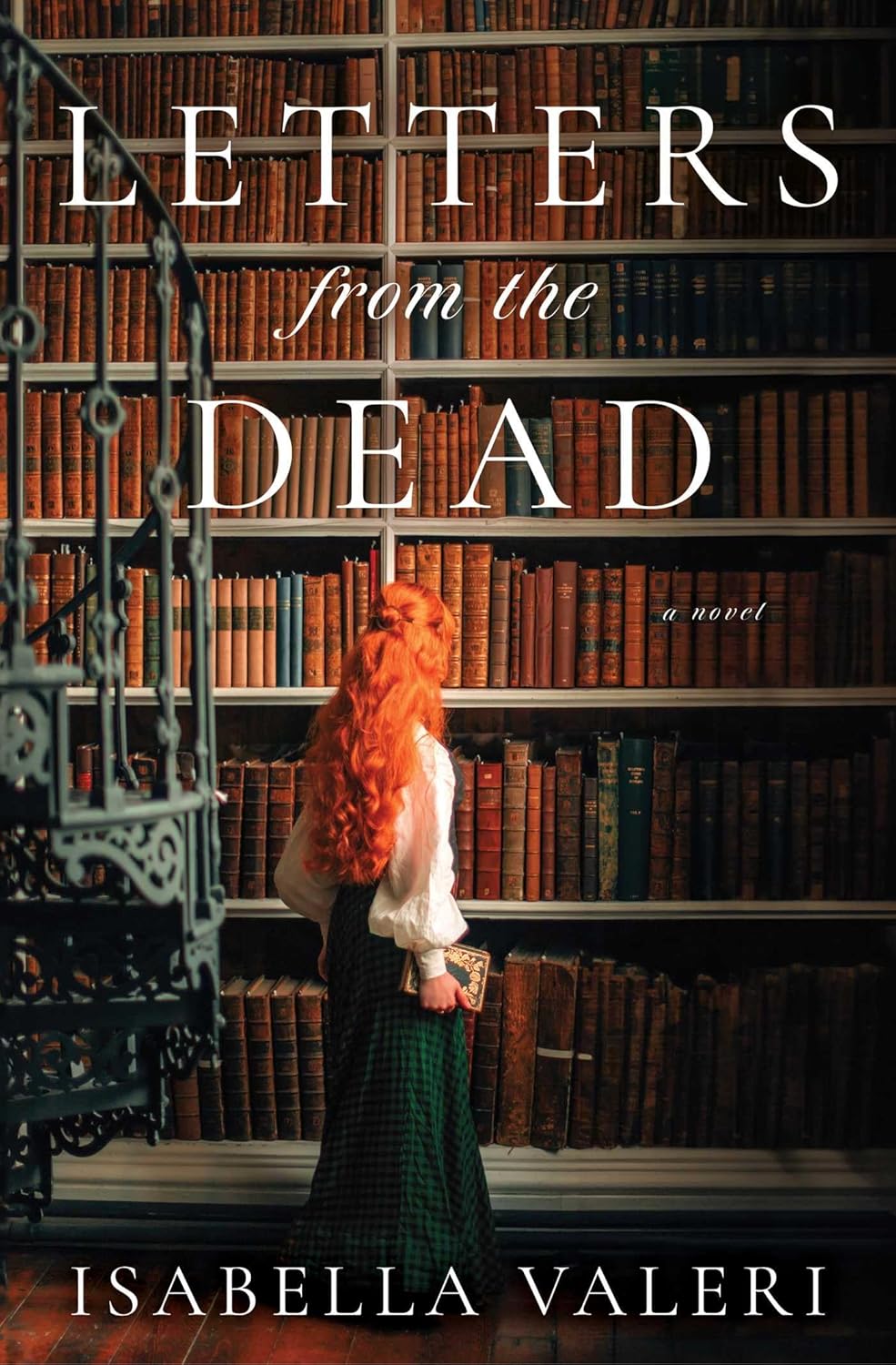
Mesmerizing, atmospheric, Gothic, and lyrical, Isabella Valeri’s first novel in a trilogy, took me into an opaque and lawless world of ancestral and deadly family dynasties beholden to no nation and no one but themselves. Valeri, who writes and lives under an assumed name and in an undisclosed Alpine location, is described as an avid markswoman, skier, equestrian, and pilot. I had the chance to interview her as she was writing the upcoming sequel, The Prodigal Daughter due out July 7, 2026.
Q. What inspired you to write Letters from the Dead (Atria/Emily Bestler Books/Simon & Schuster)and explore the world of old European dynasties and how much impact they have on the world?
A. I had rather an unusual childhood and when I was quite young I read The Fate of Empires and Search for Survival a work written by the British military officer Sir John Glubb. Glubb describes a set of phases that empires go through during their rise and decline.
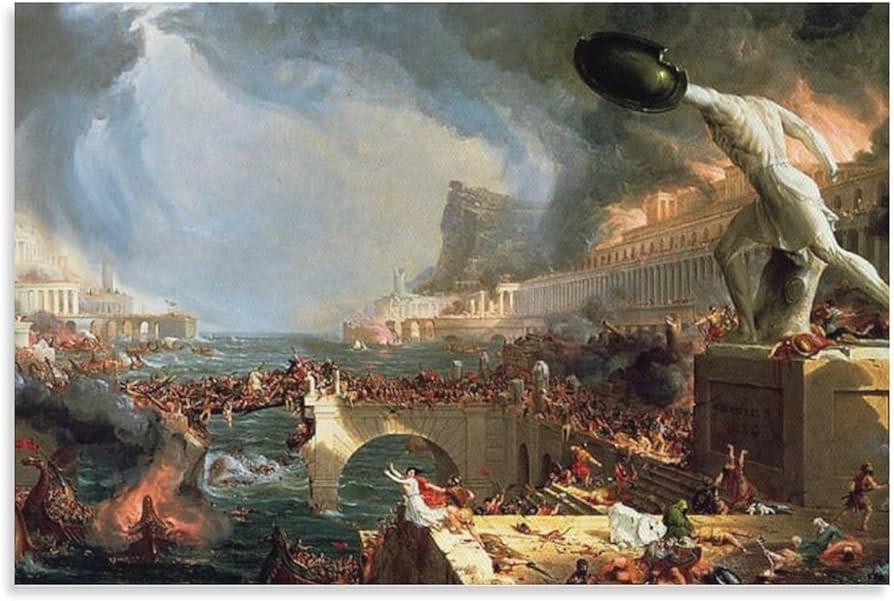
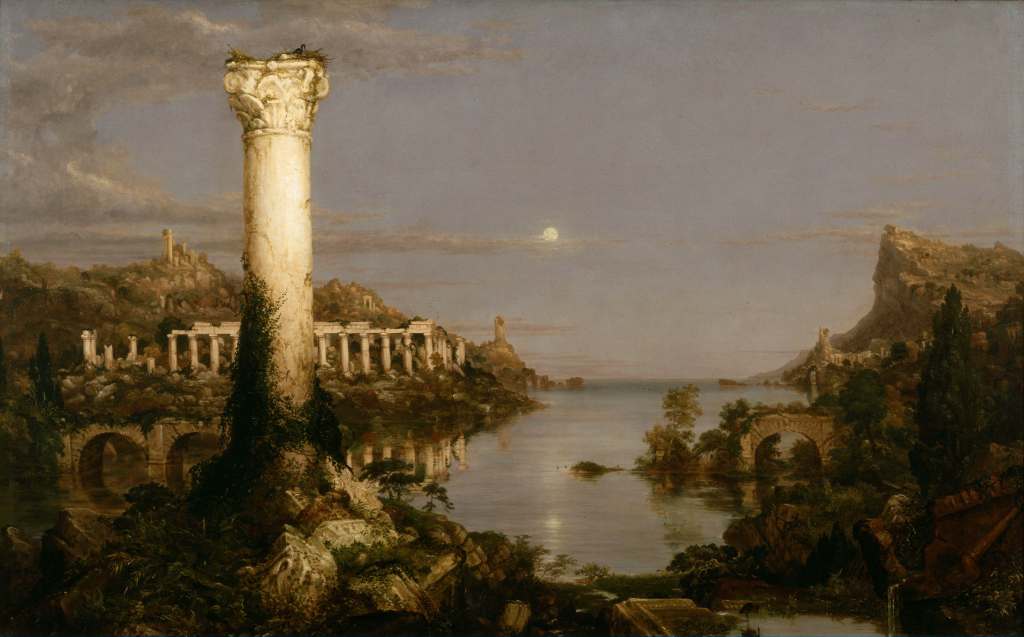
I was also fascinated by the “Course of Empire” series of paintings by Thomas Cole, and I remember being saddened by the fifth and last in the series “Desolation” that Cole himself describes thus: “The gorgeous pageant has passed – the roar of battle has ceased – the multitude has sunk in the dust – the empire is extinct.”
But dynasties, particularly the hereditary variety, I realised, can outlast empires. The Yamato Imperial House of Japan endured for more than 2,500 years. This made me wonder what sort of properties permitted dynasties to endure for so long.
When I began to write Letters from the Dead, it seemed the perfect theme for my young anti-heroine to explore: the way that dynasties subsume their members, and inevitably corrupt them so that the dynasty itself can survive. How does one fight such an entity, particularly as the youngest and the only girl of a generation?
I won’t spoil it, but I hope that the Letters from the Dead series answers that question.

Q. Did any real-life families or historical events influence the creation of the protagonist’s family and their legacy? Or is some or all of it based upon your own experiences?
A. Certainly the House of Hapsburg and its fate after the First World War provided some inspiration. Their influence was of such concern that the “Hapsburg Law” of 1919 stripped the family of power, seized all its property, and banished its memebers from Austria unless they renounced all their titles and claims.
Some refused and went into exile. In fact, the Imperial family was later deported from Switzerland when the authorities discovered that Charles I was, for the second time, trying to mount a coup, restore the monarchy to power, and install himself on the Hungarian throne.

The fate of the House of Habsburg-Lorraine (and the murder of the Russian Imperial Romanov family at the hands of the Bolsheviks a year earlier) certainly provided an incentive for dynastic families to adopt rather a lower profile. Concepts like exile and secret power structures and the clandestine machinations they wield are certainly rich ground for an author to mine, and so themes like secret societies, banking secrecy, and the goings on in shadowy halls of power play central roles in Letters from the Dead and the rest of the series.
Q. The Alpine estate feels almost like a character itself. How did you create such a vivid and atmospheric setting? And did the remote estate mpact the people who live there?
A. I worked very hard to imbue my prose with that feeling I’m very glad to know that this comes through in the book. In a way, the dynasty that my anti-heroine is born into is a living, breathing thing. It has wants, needs, and desires. What are the dynasty’s ancestral lands and the “family seat,” the centre of the family’s power, but the physical manifestations of the dynasty itself?
Certainly my anti-heroine, who knows nothing of the outside world for the first twelve years of her life, finds herself born as part of that ecosystem. There’s always a hint of the supernatural in my books and the suggestion that the family’s ancestors do their best to wield their influence from beyond the grave.
This concept was a fairly central tenant of belief in Ancient Rome and the title Letters from the Dead certainly alludes to the influence of “those who have gone before.” The estate is their only connection with the living so it does take on life of its own now and again, and for good or for ill, has a seductive influence over everyone who walks on those lands.

Of course, it helps that the Alpine foothills and the High Alps, where large portions of my books are set, are breathtakingly beautiful. My writing retreat is far up in the mountains and the descriptions of the hills, valleys, fogs, mists, and clouds on the estate were some of the first passages I wrote while looking down from there.
Q. I loved how you meshed the intellectual with a high-paced thriller.Was that difficult to do?
A. It was, in fact, very, very difficult. Early on I was repeatedly warned that it was nearly impossible to publish longer books. I am beyond grateful that Emily Bestler, my publisher, proved that untrue.
I think and hope that longer form fiction is making a comeback and that even younger readers have tired of the quick dopamine fix of social media. I set out to write the books I wanted to read and almost all my favourites are longer works shot through with texture and detail and with very intellectual themes. Donna Tartt’s The Secret History, perhaps my very favourite novel and a huge inspiration for me, is nearly 200,000 words.
Hilary Mantel’s Wolf Hall, an absolutely beautiful book, is longer than that. A.S. Byatt’s wonderful Possession is also nearly 200,000 words.

I think it’s hard to fully appreciate The Secret History unless you understand quite a bit about Dionysus and the Eleusinian Mysteries. But Tartt gives that to her readers in rather a clever way by bringing them along for her main character’s lessons where those concepts are discussed.
There are so many deeper themes in Letters from the Dead that I also felt as if I needed to show my readers how my anti-heroine uncovers them, and how, at a young age, she develops the skills and tools she needs to embrace her destiny.
Moreover, I cannot abide the tendency of female characters to devolve into “Mary Sue”s, young women who apparently sprung from the womb as already accomplished international jewel thieves with incredible gymnastic abilities and an innate immunity to cyanide (that conveniently saves their life in the middle of Act II).
To me it was very important to let my readers learn how my anti-heroine acquires what she needs to follow her character arc, and maybe even to learn along with her.
You can’t fight an old world dynasty, after all, unless you understand something about trusts and estates law. I’m still not sure that I struck the right balance between the intellectual concepts in the book and the pace of the story, but I’m told that all authors fret about such things even well after publication.
Q. Without spoilers, what was the most difficult plot twist or revelation to write?
A. The dynasty my anti-heroine is born into obviously uses violence, even murder, to its own ends. But, such a structure would not survive long if such acts were perpetrated in the open.
So, much of the violence in Letters from the Dead occurs “off-camera” so to speak, hidden in the shadows, hinted at in ways that cause my anti-heroine to speculate, even if she cannot be sure what is and isn’t true. There is one plot twist, however, that sparks a terrible act of violence that has horrible and long-lasting consequences and one that I knew that, as an author, I could not shy away from.
That was a very difficult scene to write because elements of it were deeply personal to me. I also knew that this scene would be critical not just to Letters from the Dead, but the whole series and therefore it had to hit a certain tone perfectly.
I revisited and revised the scene maybe a dozen times which was deeply traumatic and prose quickly became so visceral that even to this day the scene upsets me. But, I really felt that I had to inflict that pain on myself and to really pour that agony into the passage or I would always feel like I had cheated my readers somehow.
Q. Did you always know how the story would end, or did it evolve as you wrote?
A. I started off as a “pantser,” a writer who writes by the seat of her pants, but a very unusual thing happened to me that turned me into a devoted “plotter,” committed to mapping out the entire work in advance.

I was amazingly lucky to be hosted by director David Leitch and his wife and producer Kelly McCormick at the famous Shepperton Studios in Surrey, England. One of my favourite movies of all time, Alien, was filmed there.

They were astoundingly gracious with me even though they were busy filming Hobbs & Shaw at the time and I got a complete tour of the shoot. What really stuck with me was the “war room” where they had just taken over a whole conference room and laid out the entire film on every surface with photos, magazine cutouts for costume concepts, and detailed dioramas of sets.

You could sit in a swivel chair in the middle and spin around and see the entire concept of film unfold. I was so taken by that idea that the moment I got home I turned one of the conference rooms in my own offices into the “war room” for Letters from the Dead.
Before I was done I had covered the walls with detailed scene-level timelines of every book in the series complete with full-colour pictures of the characters, settings, key events. Some of the timelines four feet tall and twenty feet long. So, yes. All the way at the end of the timeline for the last book the last scenes in the series are depicted (and readers will finally learn her name).
Q. Your life sounds almost as mysterious-and maybe as fraught with danger– as the lives of those in the book. Do you have any comments about that?
A. I have a friend who likes to speculate that I’m a “retired Bond girl” and that my writing retreat in the Alps is a “Bond villian’s lair” obviously references to the old James Bond movies. I always jest back with her and say: “Who’s retired?” Certainly, I’ve had an unusual life, but I don’t want that to distract from my books and I think there is something at least mildly distasteful about the post-modern urge to make “the messenger,” so to speak, so much of the “story.”
Jack Carr has a wonderful discussion about such things in the preface of his debut novel The Terminal List. Of the book’s main character he writes: “I am not James Reece. He is more skilled, witty and intelligent than I could ever hope to be. Though I am not James Reece, I understand him.”
Similarly, I am not my anti-heroine. But I certainly understand her. Of course, Jack Carr has a good reason to write that disclaimer: he was a Navy SEAL and many of his missions were classified. There is an element of “write what you know” in my novels, as there must be. Thankfully, however, my life is quite a bit less exciting than Jack Carr’s.
Q. Letters from the Dead is the first in a series. Can you give us any hints about what’s to come in The Prodigal Daughter?
A. Gillian Flynn, the author of Gone Girl, wrote some comments about female main characters that always resonated with me to the effect that many of them are boring. Of course, her own female characters can be downright evil and I think that’s a refreshing change from books with those happy endings where the female protagonist ends up with the man of her dreams just as he inherits the winery in France and they live together happily ever after (and in such cases the author has clearly not realised how much work a vineyard is).
It is one reason that I write anti-heroines instead of female protagonists. One of the major themes in the Letters from the Dead series is the conflict between freedom and duty or loyalty.
The Prodigal Daughter is about a return from exile, discovering the dark plans the dynasty she was born into has in store for my anti-heroine, and the trials she must, at the greatest personal cost, go through first to understand what her destiny is, and eventually realise it. In Letters from the Dead her grandfather tells her: “My dear, sometimes the patriarch must embrace total amorality, even immorality, in order to grant to his family the luxury of morality.”
In The Prodigal Daughter she must come to terms with the true implications of that advice, and what it will take to either accept or reject it.
Q. Besides a great read, what else would you like readers to take away from your book?
A. Another major theme in Letters from the Dead is secrecy and hidden worlds. I hope that my readers will be inspired by the book to look into the shadows they are normally discouraged from investigating. Letters from the Dead is also a coming of age story focused on the youngest sibling and the only girl of her generation and the non-traditional things she becomes interested in that shape her destiny in unexpected ways.
I would love someday to hear that the novel inspired a young woman to investigate forbidden mysteries and undertake strange and unusual pursuits that opened up new worlds for her (though hopefully not by angering a powerful and potentially murderous dynasty along the way).
 Shelf Life
Leave a comment