
In 1956, there were baby dolls for little girls to play with but the idea of an eleven-and-a-half-inch tall grown women with feet permanently arched to wear high heels was a totally alien concept to the men at Mattel when Ruth Handler presented the idea for Barbie.
Because the times were more “Mad Men” than they are now, there were derogatory comments about the doll’s hourglass figure along with dismayed looks that Handler, a take-no prisoners type when she had an idea, would even suggest Mattel should consider making this doll.
“She looks like a hooker,” one of the men said.
Well, we know how this turned out. According to recent statistics, three Barbie dolls are sold every second, totaling about one billion dolls having sold since Barbie was introduced in 1959.
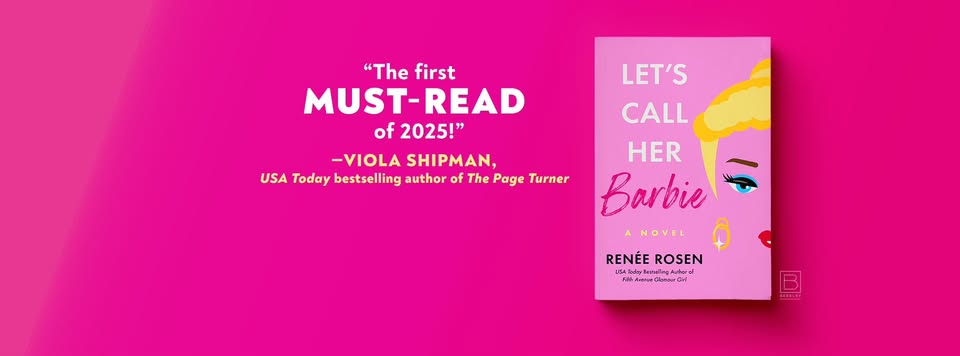
How this all came to be is the delightful tale told by bestselling Chicago author Renee Rosen in her latest novel, titled simply “Let’s Call Her Barbie” (Berkley January 2025), reinforcing Mattel’s estimation that Barbie has 99% worldwide brand reorganization.

“I’ve never had more fun writing a novel,” Rosen told me recently in a phone interview. “I wanted to do this long before the “Barbie” movie came out.”
Learning the story behind the creation of Barbie while participating on a panel of feminism in 2019, Rosen knew this was the perfect novel and subject for her. She specializes in writing novels about important figures such as Helen Gurley Brown who changed the magazine world as editor of Cosmopolitan magazine in “Park Avenue Summer,” the long term love affair of the founder of Marshal Field’s in “What the Lady Wants,” and the feud between two super rich women, Mrs. Astor and Mrs. Vanderbilt, vying for social status supremacy in “The Social Graces.”
Writing about Barbie would have to wait. Rosen already had two books in the pipeline that she needed to complete. But once she had the time—and the book contract—in her typical way she hit the ground running. A deep dive into the world of Barbie led her to meet Barbie influences (yes, there are Barbie influences including one who has over half-a-million followers) and took her to a Barbie collectors convention in Chicago.
“I was lucky to get in, admission was almost sold out,” she says.
There she met 90-year-old Carol Spencer, one of the original Barbie designers.
“She’s Mattel royalty,” says Rosen who wishes she could have been a fly on the wall when Handler was taking on Mattel in trying to persuade them to spend the big bucks it would take to develop Barbie.
As for Barbie’s figure, Rosen tells me her shape, which was somewhat scandalous in the late 1950s, was necessary so her clothes would fit.
“Barbie is a 1/6th scale of a real woman but there’s no such thing as 1/6th scale fabric so in order to make waistbands with zippers, hooks and eyes– all that detail adds bulk,” explains Rosen. “So, if Barbie didn’t have an abnormally slender waist, which is the equivalent of an 18-inch waist on a woman, her waist would have been bigger than her hips when she was dressed.”
I told you; she dives deep.
It got to the point where she unearthed her own collection of Barbies and displayed them in the home she shares with her partner, John, who though he’s a finance guy, was willing to put on a pink shirt for the Barbie convention. It should be pointed out though that John might not be totally cool about the display of Barbies.
I did a quick check on how in sync Rosen and I are when to comes to Barbies by asking her what her favorite Barbie outfit is. She replies “probably “Solo in the Spotlight.” That’s Barbie as a chanteuse dressed in a black skintight floor length gown with a flared ruffled bottom and a microphone.
“Mine too,” I say. “I wanted that one so badly.”
And then I mention my sad story of woe. My mother, the librarian, insisted on making outfits for my Barbie so my doll never got to wear that sparkly sleepless dress. I don’t know what they cost at the time, but there’s one for sale on eBay for $500.
“Barbie is the most collected toy after baseball cards,” Rosen tells me which explains the cost.
And, of course, there was the movie which so far has earned $1.446 billion globally.
There was a time when the name Barbie was used as pejorative and dismissed as a shallow and anti-feminist throwback. Poor Ken was frowned upon too when people would dismiss a couple by saying “they look like Barbie and Ken.”
But really this is a woman’s story. Handler worked in a mostly male world at a time when there were plenty of toys for boys to play with and baby dolls that needed burping and diaper changes for girls. She transformed all that, making it a Barbie world.
Rosen’s book takes us back to that time and shows us how it happened.
For more events, visit reneerosen.com.
 Shelf Life
Leave a comment