Tag: Renee Rosen

  • “Let’s Call Her Barbie” by Renee Rosen

    “Let’s Call Her Barbie” by Renee Rosen

    In 1956, there were baby dolls for little girls to play with but the idea of an eleven-and-a-half-inch tall grown women with feet permanently arched to wear high heels was a totally alien concept to the men at Mattel when Ruth Handler presented the idea for Barbie.

    Because the times were more “Mad Men” than they are now, there were derogatory comments about the doll’s hourglass figure along with dismayed looks that Handler, a take-no prisoners type when she had an idea, would even suggest Mattel should consider making this doll.

    “She looks like a hooker,” one of the men said.

    Well, we know how this turned out. According to recent statistics, three Barbie dolls are sold every second, totaling about  one billion dolls  having sold since Barbie was introduced in 1959.

    How this all came to be is the delightful tale told by bestselling Chicago author Renee Rosen in her latest novel, titled simply “Let’s Call Her Barbie” (Berkley January 2025), reinforcing Mattel’s estimation that Barbie has 99% worldwide brand reorganization.

    “I’ve never had more fun writing a novel,” Rosen told me recently in a phone interview. “I wanted to do this long before the “Barbie” movie came out.”

    Learning the story behind the creation of Barbie while participating on a panel of feminism in 2019, Rosen knew this was the perfect novel and subject for her. She specializes in writing novels about important figures such as Helen Gurley Brown who changed the magazine world as editor of Cosmopolitan magazine in “Park Avenue Summer,”  the long term love affair of the founder of Marshal Field’s in “What the Lady Wants,” and the feud between two super rich women, Mrs. Astor and Mrs. Vanderbilt, vying for social status supremacy in “The Social Graces.”

    Writing about Barbie would have to wait. Rosen already had two books in the pipeline that she needed to complete. But once she had the time—and the book contract—in her typical way she hit the ground running. A deep dive into the world of Barbie led her to meet Barbie influences (yes, there are Barbie influences including one who has over half-a-million followers) and took her to a Barbie collectors convention in Chicago.

    “I was lucky to get in, admission was almost sold out,” she says.

    There she met 90-year-old Carol Spencer, one of the original Barbie designers.

    “She’s Mattel royalty,” says Rosen who wishes she could have been a fly on the wall when Handler was taking on Mattel in trying to persuade them to spend the big bucks it would take to develop Barbie.

    As for Barbie’s figure, Rosen tells me her shape, which was somewhat scandalous in the late 1950s, was necessary so her clothes would fit.

    “Barbie is a 1/6th scale of a real woman but there’s no such thing as 1/6th scale fabric so in order to make waistbands with zippers, hooks and eyes– all that detail adds bulk,” explains Rosen. “So, if Barbie didn’t have an abnormally slender waist, which is the equivalent of an 18-inch waist on  a woman, her waist would have been bigger than her hips when she was dressed.”

    I told you; she dives deep.

    It got to the point where she unearthed her own collection of Barbies and displayed them in the home she shares with her partner, John, who though he’s a finance guy, was willing to put on a pink shirt for the Barbie convention. It should be pointed out though that John might not be totally cool about the display of Barbies.

    I did a quick check on how in sync Rosen and I are when to comes to Barbies by asking her what her favorite Barbie outfit is. She replies “probably  “Solo in the Spotlight.”  That’s Barbie as a chanteuse dressed in a black skintight floor length gown with a flared ruffled bottom and a microphone.

    “Mine too,” I say. “I wanted that one so badly.”

    And then I mention my sad story of woe. My mother, the librarian, insisted on making outfits for my Barbie so my doll never got to wear that sparkly sleepless dress. I don’t know what they cost at the time, but there’s one for sale on eBay for $500.

    “Barbie is the most collected toy after baseball cards,” Rosen tells me which explains the cost.

    And, of course, there was the movie which so far has earned $1.446 billion globally.

    There was a time when the name Barbie was used as pejorative and dismissed as a shallow and anti-feminist throwback. Poor Ken was frowned upon too when people would dismiss a couple by saying “they look like Barbie and Ken.”

    But really this is a woman’s story. Handler worked in a mostly male world at a time when there were plenty of toys for boys to play with and baby dolls that needed burping and diaper changes for girls. She transformed all that, making it a Barbie world.

    Rosen’s book takes us back to that time and shows us how it happened.

    For more events, visit reneerosen.com.

  • Windy City Blues

    In her fun very readable Windy City Blues (Berkley 2017; $16), Chicago author Renee Rosen again takes another slice of the city’s history and turns it into a compelling read.

    Rosen, who plumbs Chicago’s history to write such books as Dollface, her novel about flappers and gangers like Al Capone, and What the Lady Wants which recounts the affair between department store magnate Marshall Field and his socialite neighbor, says she and her publisher were racking their brains for her next book which encompassed Chicago history.

    “She suggested the blues,” says Rosen, who didn’t have much interest in the subject.

    But Rosen was game and started her typical uber-intensive research.

    “When I discovered the Chess brothers, who founded Chess Records, I fell in love,” she says, noting that when researching she was surprised about how much she didn’t know about the subject despite her immersion in Chicago history for her previous books. “I thought this is a story.”

    “As part of my research, I drove the Blues Highway from New Orleans to Chicago,” she says. “I also met with Willie Dixon’s grandson and with Chess family members.”

    Combining fact and fiction, Rosen’s story follows heroine Leeba Groski, who struggling to fit in, has always found consolation in music. When her neighbor Leonard Chess offers her a job at his new Chicago Blues label, she sees this as an opportunity to finally fit in. Leeba starts by answering phones and filing but it soon becomes much more than that as she discovers her own talents as a song writer and also begins not only to fall in love with the music industry but also with Red Dupree, a black blues guitarist.

    Windy City Blues was recently selected for Chicago’s One Book project, a program designed to engage diverse groups of Chicagoans around common themes. Rosen says she is very honored to be a recipient.

    “I put my heart and soul into this book,” she says. “I think it’s a story with an important message. In it are lessons of the Civil Rights movement, what it was like for Jews and people of color along with the history of the blues and the role of Jews in bringing the blues to the world. After all, as the saying goes: Blacks + Jews = Blues.”

  • Chicago Writer Takes Us Back to the Gilded Age in New Novel

    Chicago Writer Takes Us Back to the Gilded Age in New Novel

    Renee Rosen. Photo by Charles Osgood.

             Chicago author Renee Rosen is again taking us on a trip to the past. In her previous novels, she’s explored the city’s jazz roots (Windy City Blues), the Chicago Fire and the founding of the city’s iconic department stores (What the Lady Wants: A Novel of Marshall Field and the Gilded Age), and Prohibition-era Chicago (Dollface). Now, in The Social Graces we meet two mega-wealthy women—Alva Vanderbilt and Caroline Astor who starting in the 1870s vied to become the leader of high society.

             If that meant spending $10 million in today’s money to stage a ball at the Waldorf Hotel, so be it.

             “Think the original ‘Real Housewives of New York City’ but in Worth gowns,” says Rosen about the competition which in many ways also sounds like middle school. “They had plenty of balls such as the circus ball with a live elephant. Entertaining was the only arena where women could exert some influence. After all they had few rights, they couldn’t even vote, so they literally created this high society where they made the rules and determined who belonged and who didn’t.”

             At first Caroline Astor ruled New York and Newport, Rhode Island society. She was old money while Vanderbilt was one of the nouveau riche and after all, no matter how much new money you had it wasn’t as good as the old.

             “Mrs. Astor was the gate keeper, the reigning queen, she decided who was invited to her annual ball,” says Rosen, noting that only 400, the number her ball room could hold, were invited to this ball and thus they were deemed to be the elitist of the elite. “If you weren’t invited, you either left town or turned off all your lights and pretended you were out of town.”

             Determined to replace Caroline, Alva hosted her famous Masquerade Ball at her Fifth Avenue mansion, inviting  1200  though not Caroline who finally was able to get an invitation. It was so excessive, it helped catapult her to the top.

              Rosen didn’t want to just write about these women, she wanted to know them.

             “I admired both Caroline and Alva for several reasons and I disliked them for several reasons,” she says. “Alva certainly wouldn’t have been mother of the year.”

      And yes, it is true. Alva locked her daughter Consuelo in her room so she couldn’t marry the man she loved and instead forced her to wed the impoverished Charles Spencer-Churchill, the 9th Duke of Marlborough. He in turned just wanted her vast fortune to restore his very outdated palace which didn’t even have central heating or hot water. The marriage, by the way, made Consuelo a relative of Winston Churchill and the yet-to-be-born Princess Diana.

             “Alva was such a trail blazer,” says Rosen. “This was a time when so many men had mistresses and women had to put up with it. But when Alva’s husband Willie K. started canoodling with other women, she put her foot down and divorced him. She became a suffragette. She wasn’t a licensed architect, but she knew all about building. There was something really vulnerable about Caroline. I  think she was very lonely. She was at the top of society but at some level she knew that none of it really mattered. There was a whole lot of wealth but very little substance.”

    Renee Rosen Virtual Events

    April 27 6PM CST / 7PM EST

    A virtual evening at the Newport Mansions & the Newport Preservation Society

    Hosted by An Unlikely Story. Register Here

    April 29 12PM CST / 1PM EST Hosted by Bookends and Beginnings

    Literary Lunch Break with Karen White. Register Here

    May 5 4PM CST / 6PM EST A Special Virtual Gilded Age Event

    Featuring Chanel Cleeton, Marie Benedict & Renee Rosen Hosted by InterContinental New York Barclay Hotel & Berkley Publishing. Signature cocktail recipe & special VIP raffle gift, courtesy of Pomp & Whimsy! General & VIP tickets Register Here

    May 10 7PM CST / 8PM EST Hosted by Blue Willow Bookshop

    In Conversation with Chanel Cleeton. Register Here

    June 22 7PM CST Literature Lovers’ Night Out

    Please check back for details & registration.

    This story previously appeared in the Northwest Indiana Times.

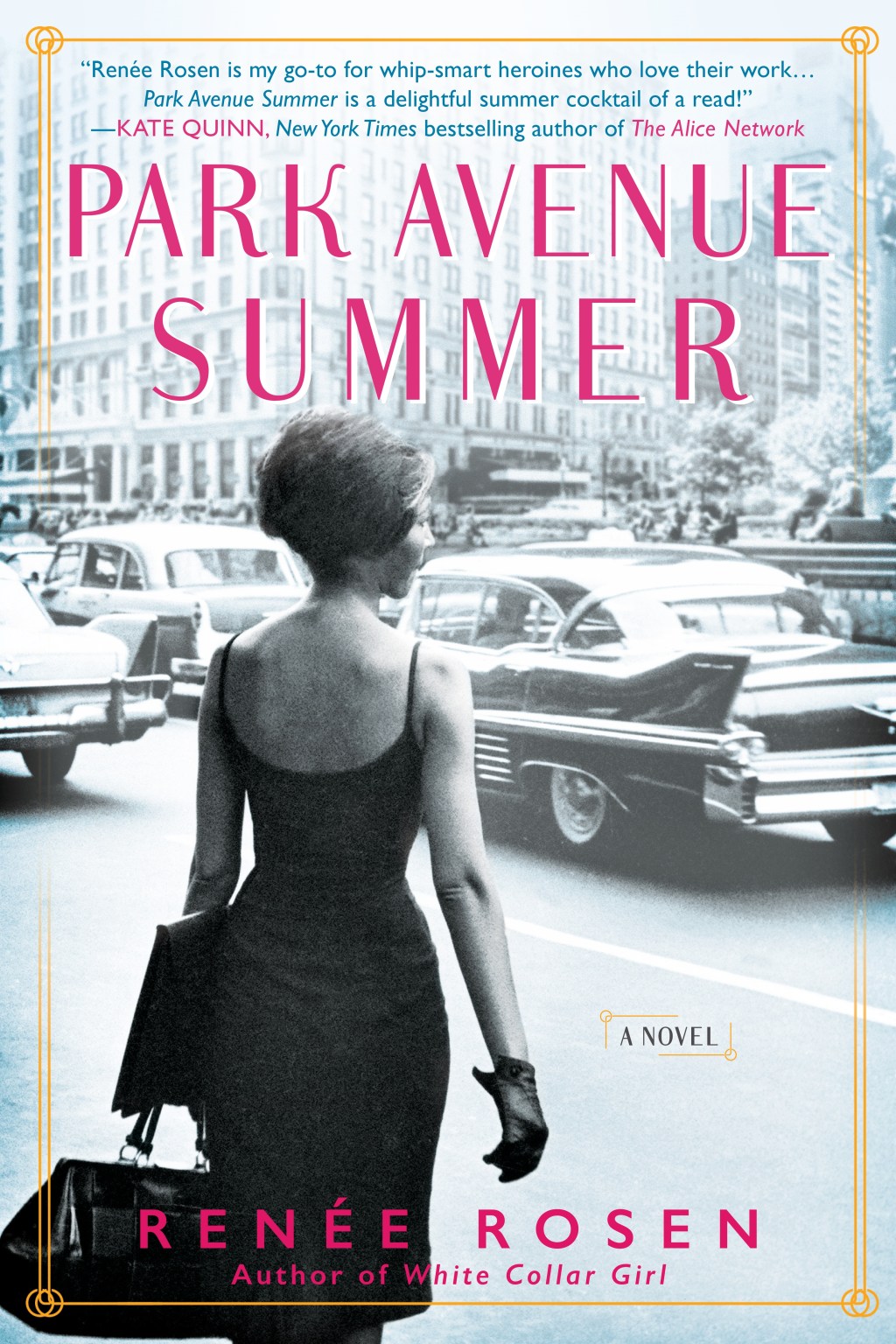
  • Park Avenue Summer

    Park Avenue Summer

    Chicago-based author Renee Rosen typically writes novels about historic periods and people in Chicago, such as Windy City Blues; White Collar Girl and Dollface.

                  But in Park Avenue Summer, her latest novel, which she describes as “Mad Men Meets The Devil Wears Prada,” she takes us to New York City during the era of Helen Gurley Brown, first female editor-in-chief of Cosmopolitan magazine and the author of the scandalous ’60s best-seller, Sex and the Single Girl.

    Like many of us, Rosen read Cosmo when she was young. Rosen remembers quickly flipping to the “Bedside Astrologer” column.

    Author Renee Rosen

    “I was looking for guidance on my 16-year-old love life,” she says, noting that all the time she spent poring over the glossy pages of Cosmo essentially shaped her view of female sexuality and female empowerment. “She changed the face of women’s magazines,” she said of Brown.

    “Park Avenue Summer” tells the story of Alice (Ali), who moves to New York City after breaking up with her boyfriend and ends up getting her dream job, working for Cosmo.

    Like she does for all her books, Rosen threw herself into full research mode, wanting to convey the story through Alice’s eyes.

    “I even went down to the Port Authority to get the feel of what Alice would have seen and felt when she arrived,” Rosen says.

    Because Rosen had lived on the Upper West side in New York for a year, she knew where Ali, as a single working girl, would live — an area in the East 60s called “the girl’s ghetto.” She walked the streets until she found the exact apartment she had envisioned for Ali.

    All in the name of research, she visited Tavern on the Green, 21 Club, St. Regis and the Russian Tearoom, all swank places still in business that were popular back then. But best of all, a friend introduced her to Lois Cahall who had worked for Brown.

    “Helen Gurley Brown was like a second mother to Lois,”  Rosen says.

    “She and I became good friends, and she vetted the book for me. It was like a gift from the gods, because she knew so much about Brown and Cosmo and that time.”

    Rosen is very much an admirer of Brown and what she accomplished.

    “She really wanted to help women be their best,” she says. “She wanted them to know that they could get what they want even in what was then a man’s world.”

  • Park Avenue Summer

    Park Avenue Summer

                  Chicago-based author Renee Rosen typically writes novels about historic periods and people in Chicago such as the age of jazz (Windy City Blues); mid-20th century journalism (White Collar Girl) and the Roaring Twenties (Dollface). But in Park Avenue Summer, her latest novel which she describes as “Mad Men the Devil Wears Prada,” she takes us to New York City during the era of Helen Gurley Brown, first female Editor-in-Chief of Cosmopolitan Magazine and the author of the scandalous best seller, Sex and the Single Girl.

                  Like many of us, Rosen read Cosmo (as it was known) when young.

                  Rosen remembers quickly flipping to “Bedside Astrologer” column.

                  “I was looking for guidance on my 16-year-old love life,” she says, noting that all the time she spent poring over the glossy pages of Cosmo essentially shaped my view of female sexuality and female empowerment, too. “She changed the face of women’s magazine.”

                  Park Avenue Summer tells the story of Alice (Ali), who moves to New York City after breaking up with her boyfriend and ends up getting her dream job, working for Cosmo.

                  Like she does for all her books, Rosen threw herself into full research mode, wanting to convey the story through Alice’s eyes.

                  “I even went down to the Port Authority to get the feel of what Alice would have seen and felt when she arrived,” says Rosen.  

                  Because Rosen had lived on the Upper West side in New York for a year she knew where Ali, as a single working girl would live—an area in the East 60s called “the girl’s ghetto.” She walked the streets until she found the exact apartment she had envisioned for Ali.

                  All in the name of research, she visited Tavern on the Green, 21 Club, St. Regis and the Russian Tearoom, all swank places still in business that were very popular back then. But best of all, a friend introduced her to Lois Cahall who had worked for Brown.

                  “Helen Gurley Brown was like a second mother to Lois,” says Rosen. “She and I became good friends and she vetted the book for me. It was like a gift from the gods, because she knew so much about Brown and Cosmo and that time.”

                  Rosen is very much an admirer of Brown and what she accomplished.

                  “She really wanted to help women be their best,” she says. “She wanted them to know that they could get what they want even in what was then a man’s world.”

    Ifyougo:

    What: Rene Rosen has several book signing events in the Chicago area.

    When & Where: Tuesday, April 30th at 7 p.m.  Launch party at The Book Cellar Launch Party, 4736 N Lincoln Ave, Chicago, IL.

    When & Where: Wednesday, May 1 at 11:30 a.m., Luncheon at The Deer Path Inn, 255 East Illinois St., Lake Forest, IL. $55 includes lunch and book. Seating is limited and reservations are required. Sponsored by Lake Forest Bookstore. 847-234-4420; lakeforestbookstore.com

    When & Where: Wednesday, May 1 at 6:30 p.m. The Book Stall, 811 Elm St, Winnetka, IL 847-446-8880; thebookstall.com.  In conversation with Susanna Calkins who is celebrating the release of Murder Knocks Twice, the start of a new mystery series set in the world of Chicago speakeasy in the 1920s.

    When & Where: Monday, May 13 at 7 p.m. The Book Table’s Authors on Tap series with author Jamie Freveletti. Beer Shop 1026 North Blvd., Chicago, IL. 847- 946-4164; beershophq.com

  • White Collar Girl

    Even if you weren’t addicted to the black and white movies about newspaper gals such as Katherine Hepburn in “Woman of the Year” and Glenda Farrell in the Torchy Blane series like I was, Renee Rosen’s latest book, “9780451474971 (2)” about a Chicago reporter in the 1950s, is still a great read.

    Rosen, who plums Chicago’s history to write such books as “Dollface,” about flappers and gangers like Al Capone, and “What the Lady Wants” about the affair between department store magnate Marshall Field and his socialite neighbor, tells about a time not that long ago when women reporters were almost always relegated to covering soft news and society items.

    In her latest, Jordan Walsh wants to break out of her role as a society reporter and sees her chance when she finds a deeply connected source in the mayor’s office. But despite her source and ambition as well as family connections to such great Chicago writers as Mike Royko, Nelson Algren and Ernest Hemingway, Jordan must still contend with the attitude of it’s a man’s business.

    To research her book, Rosen spent a lot of time talking to reporters to find out what it was like back in the day.

    “I think what I found most surprising was how the female reporters back then were called ‘Sob Sisters’ because they were assigned the sentimental stories or stories intended to tug at the readers’ heartstrings,” Rosen says about what she found when she began her extensive research. ”Sexism in the newsroom was blatant back then. Also in terms of sexual harassment, back in the day that phrase wasn’t in anyone’s vocabulary. Of course career women didn’t like it, but there was no one to turn to, no one to complain to.”

    Rosen, who lives in Chicago, says she often will find herself walking down a street and thinking this is where Dion O’Banion worked (one of the gangsters featured in “Dollface”) or this is where Delia Caton and Bertha Palmer shopped (“What the Lady Wants”).

    “Or in the case of ‘White Collar Girl,’ I’ve been to some of the watering holes where a young Mike Royko or a Nelson Algren would have frequented,” says Rosen, noting that she’s watched “All the President’s Men” about “a million times.”

    “I can go to City Hall and walk the very hallways that Mayor Daley walked. Call me a history nerd, but for me that’s a thrill. Sometimes I do get so obsessed with a subject matter that I do find I have to pull myself back to the present time.”