A Norwegian farm girl, her family so poor, they often went hungry, is seduced by a rich landowner’s son. But despite her dreams, he has no plans to make her his wife. Abandoned, she sees only one path forward or she’ll sink into the black hole of her family’s poverty. But her first goal is revenge and after the landowner’s son dies a horrid death amidst whispers of poison, she boards a boat and sails to America. Norway’s gain is America’s loss.
Her name changed through the years but after the mysterious deaths of two husbands, numerous men, women, and children, she goes down in his as Belle Gunness. An entrepreneur whose business was murder, Gunness felt no qualms seducing men for their money and dispatching them with her axe—filling her farmland with her victims.
As her crimes were about to be discovered, her solid brick home burnt to the ground and workers battling the smoke and flames discovered the bodies of her three children and a woman without a head. Was it Belle or did she get away with one more murder, absconding with close to a million dollars. It’s a question the world has been asking since 1908.
What people are saying about America’s Femme Fatale.
Ammeson uses astute research and punchy prose to chronicle Belle’s transformation from destitute farm girl to one of history’s most egregious female serial killers. . . . Compact and captivating, this salacious tale of murderous greed during the early twentieth century will be devoured quickly by true-crime fans.– Michelle Ross ― BOOKLIST / Amer Library Assn
It’s a mesmerizing cautionary tale I had to keep reading despite the late-night hour. . . . Ammeson writes narrative nonfiction with a sense of drama to propel us along the unbelievable.– Rita Kohn ― NUVO
America’s Femme Fatale is the detailed story of Belle Gunness, one of the nation’s most prolific mass murderers. Ammeson recounts the horrific events with dry wit and corrects many errors found in previous accounts. Gunness stands out in an infamous crowd because she was a woman; she killed men, women and children rather than choosing from among one narrow section of victimology; and her murders seem to have been rooted in greed rather than lust, the serial killer’s usual motive.– Keven McQueen, author of Murderous Acts: 100 Years of Crime in the Midwest
Jane Ammeson will be on Hoosier History Live talking to the show’s host Nelson Price about Belle Gunness. The show airs live from noon to 1 p.m. ET each Saturday on WICR 88.7 FM in Indianapolis. Or stream audio live from anywhere during the show. For those who miss the show, it’ll be available by podcast as well.
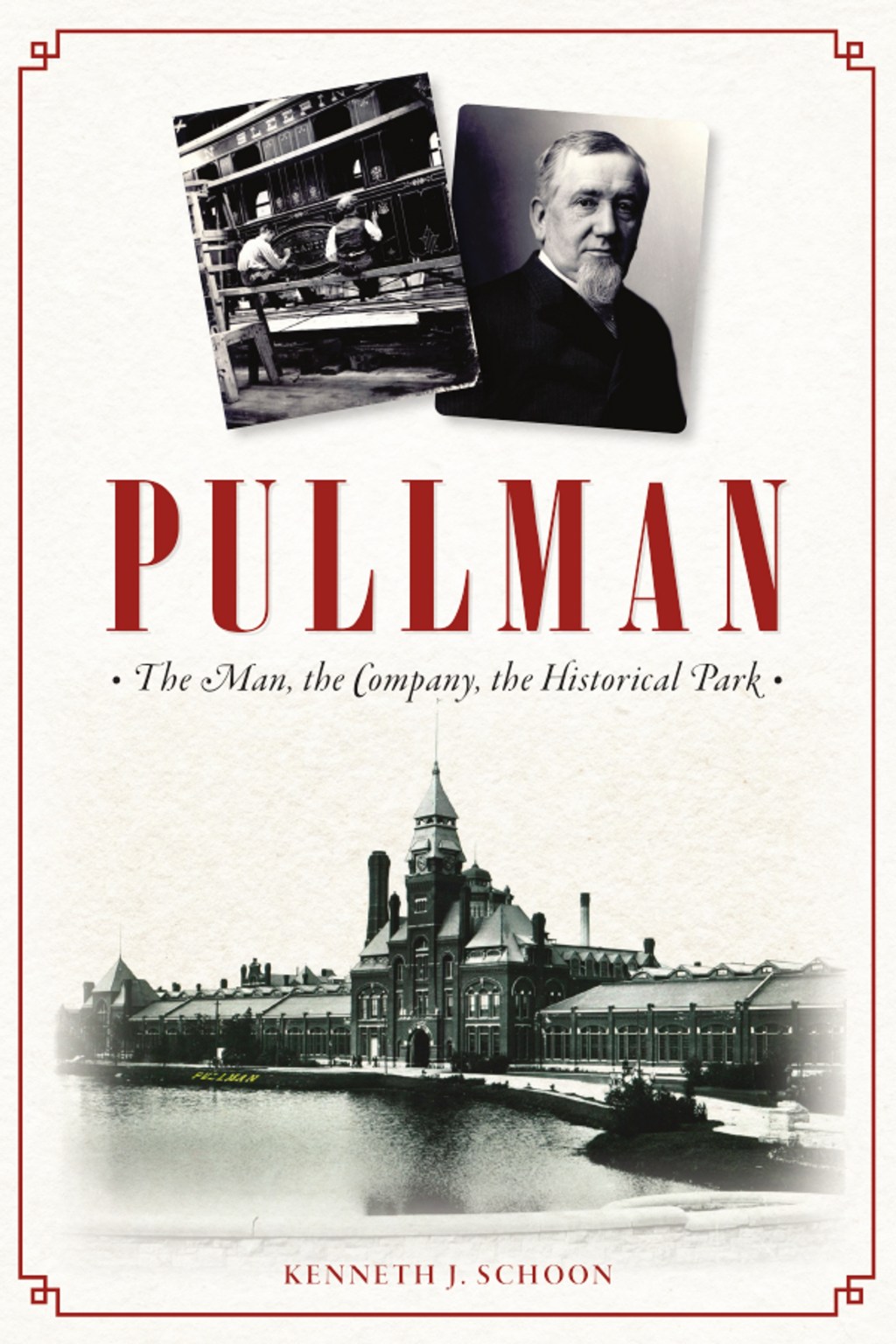
In his latest book, “Pullman: The Man, the Company, the Historical Park” (History Press 2021; $21.99), he showcases what once was among the ultimate company town and is now a Chicago neighborhood. George Pullman, whose last name became synonymous with plush railroad sleeper cars, believed that happy workers were productive workers and so developed his town along the western shore of Lake Calumet in the late 1800s.
I thought I knew company towns having grown up in East Chicago, Indiana my friends whose parents worked at Inland Steel lived in Sunnyside in Indiana Harbor. On the East Chicago side there was Marktown built in 1917 by Clayton Mark, for those employed at the company he owned, Mark Manufacturing.
But they’re different Schoon tells me. Both Marktown and Sunnyside were residential neighborhoods. But Pullman was an actual town with its own schools, library, churches, Masonic Hall, businesses, and even a band. Garbage and maintenance was paid for by the company.
Though I vaguely knew about the town of Pullman, it had never been on my radar as a place to visit even though it was less than eleven miles from where I lived.
“The same with me,” says Schoon who remembered going to the Florence Hotel, one of the fanciest structures in town, to eat when young never to return until hired by the Historic Pullman Foundation to write about the history of the town for their brochure.
Today we talk about experiences, but that’s what Pullman was all about back then. His sleeper cars were luxurious, but the brand also meant great service. After the Civil War, he hired recently emancipated African American men, to work as porters becoming the largest employer of Blacks in the U.S. Their jobs were to attend to passengers needs by serving food and drink, shining shoes, tidying up the train, making sure the temperature was just right and that lighting fixtures worked. Black women were hired as maids to take care of women guests on the most expensive cars—babysitting children, helping with their baths, giving manicures, and fixing their hair.
Pullman was no dinky little town. The Arcade Theatre could accommodate 1000 people and Schoon says it was, for a time, the finest theater west of the Hudson River.
With the advent of automobiles and highways, the need for sleeper cars lessened. But luckily many of Pullman’s historic buildings remain including the Florence Hotel which is currently closed for renovations but expected to open within a few years.
“The old stable is now a store,” says Schoon. “The old fire station is still there and of the 600 residential buildings all but three are still standing.”
In an interesting tidbit, Schoon notes that Pullman was originally dry because George Pullman was a Prohibitionist. Luckily for those who wanted to imbibe, Kensington, the town next door had 23 taverns at the time.
Kenneth Schoon will be signing copies of his book during the Labor Day Weekend at the Grand Opening of Pullman National Monument Visitor Center and Pullman State Historic Site Factory. For more information about times and other events, visit www.pullmanil.org
In 1924, Peter Levant’s opened what was one of Whiting’s famous “perch palaces,” a place that served freshly caught perch right from Lake Michigan. They also advertised such menu items as steak, chicken, and, of course, this being The Region, frog legs—mostly likely from nearby Lake George.
Indeed, frog legs were so in demand that Vogel’s—which was just down the street and totally classy—raised their own frogs for legs in the lake. But that’s a different story.
Located at 1247 Calumet Avenue, Levent’s became the home of Juster’s Charcoal Broiled Steaks and then later George Diamond’s. Though my mom liked to cook, my parents were totally into eating out as well and though its been years and years, I remember going with them to George Diamond’s. It was the kind of place where everything was overlarge—the steaks, the salads, the charcoal flames, and even the menus.
That Diamond (yes, there was a George Diamond) even opened a place in Whiting shows the town’s status as a food destination. Indeed, around that time, there were a lot of great restaurants–and I’m sure I’m leaving a lot of places out–Vogel’s, Phil Smidt’s, Margaret’s Geneva House, Al Knapp’s Restaurant and Lounge, and the Roby Café. But Diamond was international. Besides his flagship restaurant at 630 S. Wabash Avenue in Chicago that was said to have cost over $1 million to renovate in a style I call 1950s swank, all red velvet and red upholstery, he had places in Las Vegas, Palm Springs, Antioch, Illinois on a golf course, and Acapulco, Mexico.
What I remember most was the house salad dressing which they bottled and sold on the premises. It was so unique that even now it has a cult-like online following with people searching for the recipe. It wasn’t Russian and it certainly wasn’t French or at least not the orangish French dressing we buy in bottles now. Diamond’s dressing was an almost translucent reddish pink. And if the recipe I found online is close to the original, it’s main ingredient was tomato soup.
There’s nothing left of Diamond’s empire today. Diamond died in 1982 at age 80 and the building housing the Wabash Avenue restaurant went up in flames in 2006. But people still remember that dressing.
George Diamond’s salad dressing
1 (10-ounce) can condensed tomato soup
2/3 cup oil
1/2 cup each: white vinegar, sugar
1 small onion, peeled and grated
1 clove garlic, peeled and halved
1 tablespoon dry mustard
1/4 teaspoon each: salt, ground black pepper
Place undiluted soup, oil, vinegar, sugar, mustard, salt, pepper, onion and garlic in a blender or food processor fitted with a metal blade. Cover and blend or process on high speed until pureed, about 2 minutes. Serve chilled. Store covered leftovers in refrigerator.
I’ll be signing copies of my book Classic Restaurants of The Region at Miles Books. 2819 Jewett Avenue in Highland on Saturday, August 21st from 11:30-3pm. For more information, 219-838-8700.
Carrie Muskat, who started covering the Chicago Cubs in 1987, has written The Big 50: The Men and Moments That Made the Chicago Cubs (Triumph Books 2021; $16.95).
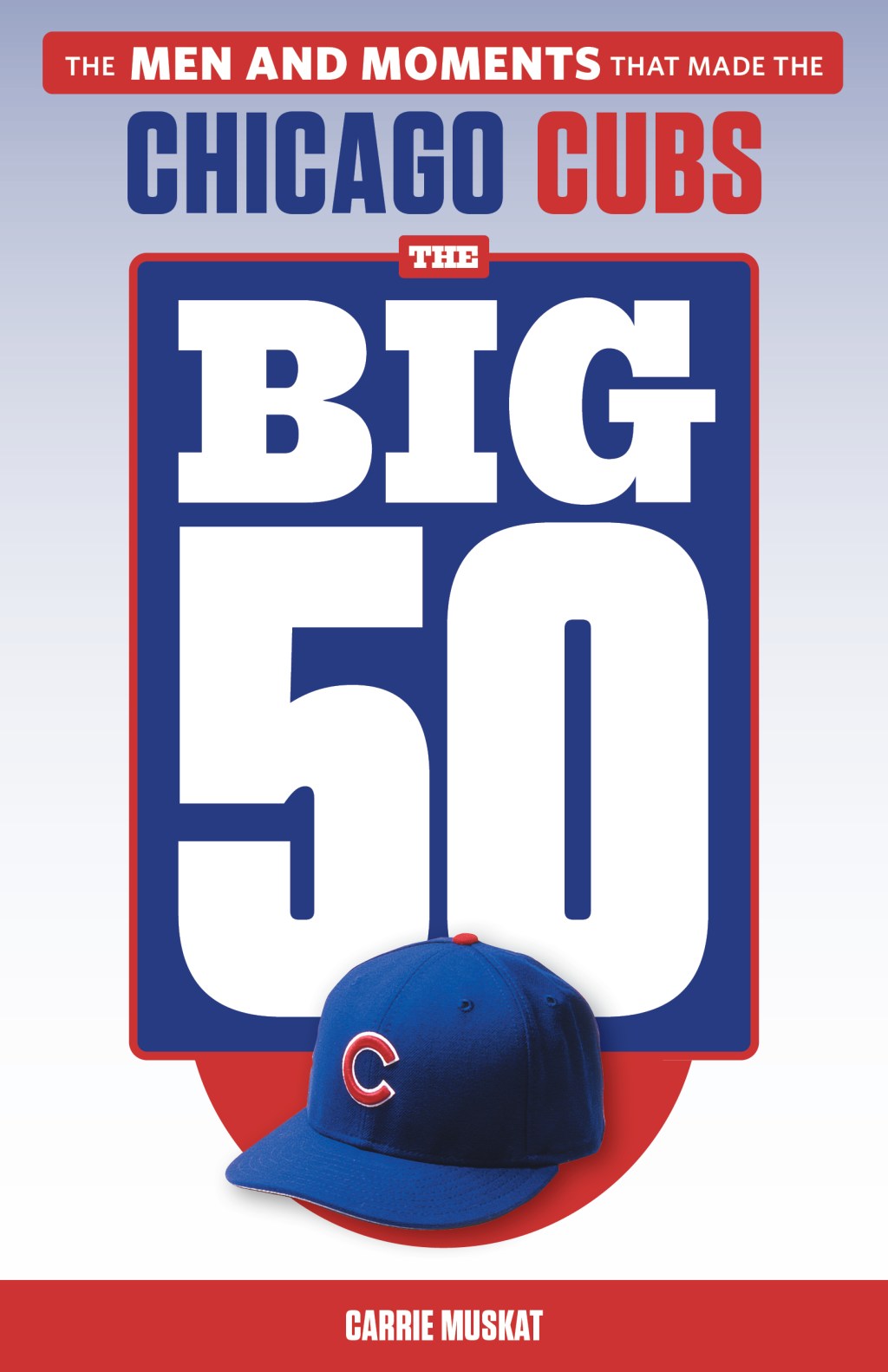
“Really there are more than 50 moments because it was hard to limit them so it’s 50 plus,” Muskat tells me in an early morning phone interview. “I always say I’m bad at math.”
Totally immersed in baseball and the Cubs, Muskat’s latest book has an introduction by Anthony Rizzo, the first baseman for the Chicago Cubs and a three-time All-Star who in 2016 helped the Cubs win their first World Series title since 1908. Her other books include Banks to Sandberg to Grace: 5 Decades of Love & Frustration with Chicago Cubs.
Carrie Muskat
Described as “the perfect primer for new Cubs fans and an essential addition to a seasoned fan’s collection,” the book recounts the living history of the team and features such greats as Ryne Sandberg, Ron Santo, Anthony Rizzo, and Ernie Banks among others.
Muskat, who has conducted numerous interviews with players, at times takes a different approach in her book by not only relying upon her own interactions but also by talking to people who worked behind the scenes about the moments included in The Big 50. It was a way to gain a new perspective on some of the players such as Sammy Sosa that she knew so well.
“I talked to broadcaster Craig Lynch about Pat Hughes, the radio play-by-play announcer for the Chicago Cubs and got his insights,” she says, as a way of giving an example.
In some ways, the those decades covering the Cubs was like being part of a large family. In her time writing about Major League Baseball—she started in 1981—Muskat says she’s watched players like Kerry Woods, the two-time All Star former Cubs pitcher who is now retired, grow. The same goes for Anthony Rizzo.
“I’ve enjoyed talking to people’s families, like Anthony’s, just talking about things,” she says. “I covered Shawon Dunston and then his son.”
In her book, Dunston shares his insight on Andre Dawson in Moment 16 of titled “The Hawk.” Dunston recalls having a locker between Dawson and Ryne Sandberg, who he describes as the quietest guys in the world. “Combined, they didn’t say more than 20 words a day, and I’m not exaggerating.”
At the time, Dunston says he was “talk, talk, talk, talk, talk, talk.” But by being between them, he learned to be quiet and think about the game before the game. “I learned how to be a professional because of Andre Dawson and Ryne Sandberg.”
These scenes from the book support Muskat’s contention that players are really just people.
“That’s one of the biggest things,” she says. “Even if they’re superstars, they’re just people when you get to know them.”
There have been changes. Reporters used to sit in the dugout but not anymore.
“It’s not as relaxed,” she says. “My favorite time is spring training which is more relaxed.”
Muskat is freelancing now but she still is on the sports beat.
“There’s always a story, every player has one,” she says.
When Rebecca Graff, a PhD student at the University of Chicago in need of a dissertation, was told by a professor that the view before them from the school’s Ida Noyes Hall was “a hundred years ago the center of the world,” she didn’t see the bucolic splendor of Jackson Park hugging the Lake Michigan shoreline. Instead her sights went to what lay beneath and that was the 1893 World’s Columbian Exposition, an unexcavated but huge part of Chicago’s history. Held in celebration of the 400th anniversary of Christopher Columbus arrival in the New World, the exposition attracted 27 million people who paid 21.5 million for admission in a six-month period. Designed by noted landscape architect Frederick Olmsted, the 630-acre park had more than 65,000 exhibits from 46 countries and introduced to the public such new inventions as a 250-foot Ferris Wheel, Aunt Jemima’s Pancake syrup and Wrigley’s Juicy Fruit Gum. Electricity, still rare back then, was used to light up the expo at night.
Surprisingly what seemed an almost guaranteed bureaucratic nightmare in terms of permits and permissions all fell into place but then Graff was told she couldn’t start without a million dollars in liability insurance. Not likely for a graduate student.
“I needed to turn the excavation into a job,” she says. And so she did, teaching a field class at the University of Chicago where she and her students excavated the site.
View from the 1893 World’s Columbian Exposition’s South Canal looking northeast. The Machinery Building, the Columbian Fountain, and the Electricity Building are on the left, with the Agriculture and the Manufactures and Liberal Arts Buildings on the right. The Illinois State Building’s dome is in the center, and the flatter dome of the California State Building is to its left. Image is by an anonymous photographer, 1893. From the Smithsonian Institution Archives
Expecting to find those things that archaeologists love—pottery shards, a coin here and a twisted spoon there—Graff and her team were stunned to unearth a section of the Ohio Building, a stately Beaux Arts-style edifice with an elaborate portico entranceway that served as a meeting place for Ohioans. It was among the best of all the other findings they uncovered such as a collar stud, religious medal, cruet tops indicating that food was made on site, and lots of pipes. Though to hear Graff describe them, they’re all treasures and keys to the past.
As for the building, contemporary sources said it no longer existed.
“Even the New York Times wrote it had been thrown into the lake,” says Graff, who instead found segments in a ditch where it might have been used as landfill.
Coincidentally, Graff later discovered she wasn’t the only family member to dig at the site, so had her great grandfather, Morris Graff, a Russia immigrant who dug ditches at the fair.
Graff would like to return to Jackson Park for further exploration but was denied a permit the second time around. She says it’s surprising that Chicago doesn’t have a city archaeologist as other big cities do. But she’s certainly doing her fair share of uncovering urban remains. She is currently excavating the Charnley-Persky House Museum, a National Historic Landmark located on Astor Street in the Gold Coast designed Chicago architect, Louis Sullivan and his young draftsman Frank Lloyd Wright.
Cover image from Disposing of Modernity: The Archaeology of Garbage and Consumerism during Chicago’s 1893 World’s Fair by Rebecca S. Graff. Gainesville: University Press of Florida, 2020.
“This isn’t getting the work of the world done,” my mother used to tell me when I was young and talking on the phone to friends instead of cleaning my room or putting away the dishes or whatever else needed to be done. I still don’t know exactly what the work of the world is, but it sounds so ominously important it made me believe that my laziness was in some ways contributing to world failure.
Her words still echo through my life. Even now, though I know that world will go on even if I watch a whole night’s worth of “Downtown Abbey” episodes, I remember what my mother said and I turn off the T.V.
Now, after reading “Laziness Does Not Exist” (Atria 2020; $27) by Devon Price, PhD, a Clinical Assistant Professor, Loyola University Chicago, I may reconsider that long ago lesson.
“Laziness does not exist means there is no slothful, shameful feeling inside of us called laziness that is to blame when we fail or disappoint someone or simply lack motivation,” says Price after I ask him to define the book’s title. “There are always structural, external factors as well as inner personal struggles that explain why someone is not meeting goals.”
Instead, Price says that often when someone is written off as lazy, the problem is actually that they’ve been asked to do far too much, and not given credit for the immense work that they are doing.
“Fighting depression is a full time job,” he says. “Raising children in a global pandemic is a full-time job. Taking a full course load while working a job is too much to deal with flawlessly. So many people are overwhelmed and overworked, yet because they have been asked to do more than they can handle, these incredibly ambitious people are branded as lazy.”
So how do we deal with these feelings?
Price recommends first observing the situation neutrally while trying to determine where the feeling is coming from and what do you have to learn from it.
“Sometimes, we lack motivation to do something because the task just does not matter to us — so ask yourself, do I really have to do this task? Does it matter to me, or have I just been told that I should do it? When someone is feeling lazy and beating themselves up for it, that is almost always a sign they need to cut a bunch of obligations out of their life, so they have time to rest and reorient themselves, to focus on their true priorities. “
Self-efficacy, a confidence in one’s own ability to get things done, also comes into play.
Price describes this as a very grounded form of confidence — the confidence in one’s own capabilities.
“When a person has high self-efficacy for a particular skill or task, they trust their instincts, and know how to break a large task down into smaller parts, so they’re way less likely to get stuck in doubt, perfectionism, or inhibition,” he says. “A lot of times when someone is struggling or procrastinating such as failing to write a paper for class, for example, it’s because they don’t trust themselves to do it well enough, or they don’t know how to take the big project and divide it into tiny bites. Unfortunately, we live in a very perfectionistic culture where lots of teachers and managers micro-manage and nitpick the people they are supposed to be mentoring, so we actually destroy a lot of people’s self-efficacy in the process. “
Price believes that we also need to act like all human lives have equal value and deserve equal support with no proof needed.
“On a more personal level, we need to approach other people with generosity and trust,” he says. “I don’t need proof that a person on the corner asking for change deserves my money. I can trust that if he’s in that spot, he clearly needs it, and I don’t get to decide what his needs at that moment look like or how he lives his life. In general, we need to stop policing one another and viewing all needs and limitations as suspicious.”
There was a time when electric railroads, called interurbans, crisscrossed the state, connecting the small villages and large cities of Indiana.
“I was about 10 when my mother first started letting me take the interurban on my own,” recalls Lorraine Simon, who was born in East Chicago in 1911. “My mother would put me on the train and I’d go to Chicago and get off and walk to where my grandmother worked sewing linings into hats for a millinery company.”
With names like the Marion Flyer and the Muncie Meteor, the electric-powered interurban railway was the first true mass transit in Indiana in the 20th century. Coined interurban by Anderson, Ind., businessman and politician Charles Henry in the early 1900s, the name meant between towns or urban areas.
“Before the interurban, public transportation in central Indiana relied upon mules or horses to pull crudely fashioned passenger wagons,” says Robert Reed, author of “Central Indiana Interurban” (Arcadia, 2004, $19.95). The interiors of these passenger wagons were piled high with straw for warmth in the winter and candles were used after sunset to light the interior. It was, as can be imagined, less than an optimal way to travel.
“The genius at work was the idea of using electrical power, on the pavement beneath the tracks or on overhead lines, to power existing traction cars,” writes Reed in his book.
Though the book’s title would seem to indicate a focus on the interurbans in Central Indiana, Reed points out that it encompasses many of the interurban lines that ran through Northwest Indiana.
“Indianapolis may have had the busiest interurban terminal in the world early in the 20th century but Chicago laid claim to the busiest corner in the world at State and Madison streets,” he writes. “Clearly interurban and cars were jammed in with all other traffic. The Chicago and Indiana Air Line Railway was established in 1901 at a cost of $250,000. Through reorganizations and acquisitions it grew from just over three miles of coverage in the beginning to nearly 70 miles of routes as the Chicago, Lake Shore and South Bend Railway, a decade and a half later. Eventually, encircled by its transportation lines were East Chicago, Indiana Harbor, Gary, Michigan City and Hammond.”
The Gary and Interurban Railroad provided 50-minute service between Gary and Hammond, according to Reed, and 60-minute service between Gary and Indiana Harbor. “In the years before the 1920s,” writes Reed, “one of their major routes began at Hammond and continued on to Indiana Harbor, Gary, East Gary, Garyton, Woodville Junction, Chesterton, Sheridan Beach, Valparaiso, Westville and LaPorte. Variations of the Gary and Interurban Railroad routes commenced at Valparaiso, Chesterton and LaPorte. Typically more than 20 different interurban cars from that line arrived and departed from Gary each day.”
To highlight the popularity of the interurban throughout the state, Reed mentions how in 1908 the French Lick and West Baden Railroad Company connecting the West Baden Springs Hotel and the French Lick Resort & Springs, about a one mile route, carried 260,000 passengers.
The book, filled with black-and-white photos from the interurban era as well as timetables and postcards from the routes, came about after Reed, a former magazine editor, wrote a book called “Greetings from Indiana” which showed the state’s history through early postcards. As Reed collected the postcards, he noticed that many were of the towns on the interurban route. “
It made sense that people riding the interurban would send postcards of their stops and that these postcards were often of the interurban terminals,” says Reed who specializes in writing about antiques and collectibles. “I really became fascinated with interurbans because they were so much a part of Indiana.”
Laying tracks for the interurban was an expensive proposition. “It eventually got to where it was about $144,000 a mile,” Reed says. “And they reached a point where it was too expensive to expand.” Besides, by then Henry Ford had introduced his Model T and people were starting to drive more and more. “A lot of old timers say that if the interurban had survived until after World War II, they would be popular today,” Reed says. The one interurban to survive, the South Shore Railroad, did so because Samuel Insull, the utility magnate whose holdings included Commonwealth Edison and the Northern Indiana Public Service Company, also owned the South Shore.
In other words, he helped usher the South Shore into the era of public subsidies for passenger transport. That is considered to be the reason why the electric train, which still travels from Chicago to South Bend and back on a regular schedule, is the only interurban that successfully made the transition to a commuter railroad.
All the others are now just vestiges of history — abandoned track lines here and there, faded black-and-white or sepia-colored postcards, a few timetables and even fewer fragile memories.
Beverly Shores Depot. Courtesy of Steve Shook Collection.Beverly Shores, Indiana today. Jane Simon Ammeson.
A decade ago, five teenagers living in Chicago, albeit a post-apocryphal dystopian version of the Windy City, risked everything to confront and defeat the Dark One, stopping him from destroying the world. Now, as adults the world around them has returned to normal but they haven’t. After all, when it comes to second acts, what can beat saving civilization?
“What do you do when you finally obtain what you wanted to do?” says Chicago author Veronica Roth about her first adult novel, Chosen Ones, a continuation of sorts based on the characters from her bestselling Divergent series. “It’s like when you graduate college, you wonder is this it?” Of the five, Sloane, the leader of the group Sloane is having the most difficult time adapting—some say it’s Post Traumatic Stress Disorder, others credit her attitude—but whatever, she’s struggling big time.
“Chosen Ones is about learning that the battles you fought to get where you are aren’t over,” says Roth who grew up in Barrington and attended Northwestern University. “They’re never really over, but you get to fight them differently when next time comes.”
The next time is now. The celebration of the tenth anniversary of their victory is overtaken by the tragedy of the death of one of their group. But it gets worse. As they gather for the funeral, they learn the battle may not be over. The Dark One may still live and that means the prophecy forecasting his death wasn’t true.
Roth’s attention to detail is meticulous. In the book, Sloane submits a Freedom of Information Act to obtain documents about the government’s involvement in what happened ten years ago.
“I wanted to know everything I could,” she says. “It’s my life and they have all these…records of it.”
To make the book realistic, or as realistic as fantasy and magic can be and to understand and recreate the FOIA records Sloane received, Roth studied hundreds of declassified government documents that she found on the CIA website and other Internet sites.
“I read a lot about UFOs, propaganda and Project MK Ultra which is the government’s research on the effects and use of LSD,” she says.
That’s not all that went into the novel. Roth’s characters inhabit an alternate Chicago, one she had to create. It was a complex undertaking to make the unreal seem real.
“World building is very humbling,” she says, noting that her editor encouraged her to deep dive into devising the Chosen Ones’ city. “Chicago’s architecture is such a significant part of the story because architecture reveals history and also, just aesthetically, the skyline is so important to my experience of the city and what I love about it.”
While supplies last, Anderson’s Bookshop locations have autographed copies of I’ll Show You, by former Chicago Bulls star Derrick Rose. A unique gift for any Bulls fan!
I’ll Show You was written by Rose with award-winning sportswriter Sam Smith. From a kid raised in one of Chicago’s roughest neighbors, Derrick Rose showed himself to be capable of ruling the basketball universe! D-Rose’s inspiring story is candid, difficult at times and illuminating.
About the Book: In 2012, Derrick Rose was on top of the world.
After growing up in Chicago’s Englewood neighborhood, Rose achieved an improbable childhood dream: being selected first overall in the NBA draft by his hometown Chicago Bulls. The point guard known to his family as “Pooh” was a phenom, winning the Rookie of the Year award and electrifying fans around the world. In 2011, he became the youngest MVP in league history. He and the Bulls believed the city’s first berth in the NBA Finals since the Jordan era was on the horizon. Rarely had a bond between a player and fans been so strong, as the city wrapped its arms around the homegrown hero.
Six years and four knee surgeries later, he was waived by the Utah Jazz, a once surefire Hall of Fame career seemingly on the brink of collapse. Many speculated his days in the NBA were over.
But Derrick Rose never doubted himself, never believed his struggles on and off the court were anything other than temporary setbacks. Rather than telling the world he had more to give, he decided to show them.
I’ll Show You is an honest, intimate conversation with one of the world’s most popular athletes, a star whose on-court brilliance is matched only by his aversion to the spotlight. Written with New York Times bestselling author Sam Smith, Rose opens himself up to fans in a way they’ve never seen before, creating a document that is as unflinching—and at times as uncomfortable—as a personal diary.
Detailing his childhood spent in one of his city’s most dangerous neighborhoods; his relationships with both opponents and teammates; the pain and controversies surrounding his career-altering injuries; his complicated relationship to fame and fortune; and his rise, fall, and reemergence as the player LeBron James says is “still a superhero,” I’ll Show You is one of the most candid and surprising autobiographies of a modern-day superstar ever written.
About the Authors:Derrick Rose currently plays for the Detroit Pistons of the NBA. He played one year of college basketball for the Memphis Tigers before being drafted first overall by his hometown Chicago Bulls in the 2008 NBA draft. After being named the NBA Rookie of the Year, Rose, at age 22, became the youngest player to win the NBA Most Valuable Player Award in 2011.
Sam Smith has been covering the Chicago Bulls and the NBA for more than three decades, as reporter and columnist for the Chicago Tribune for 28 years, and currently for Bulls.com. Recipient of the prestigious Curt Gowdy Media Award from the NBA Hall of Fame, he also received the Professional Basketball Writers Association Lifetime Achievement award in 2011. He is the author of the classic bestselling book The Jordan Rules, for which he had unparalleled access to Michael Jordan and 1991-92 Chicago Bulls. He has written extensively for media outlets around the world, including ESPN.com, ESPN Magazine, NBC Sports, Basketball Digest, The Sporting News, and for major publications in Japan and China.
Anderson’s Bookshops are located at 123 W. Jefferson Ave., in the heart of Naperville (630) 355-2665; 5112 Main St., Downers Grove (630) 963-2665; or 26 S. La Grange Rd., La Grange (708) 582-6353. On visit online at www.andersonsbookshop.com.