Category: Uncategorized

  • Getting to Calm: Cool Headed Strategies for Parenting Tweens + Teens

    Getting to Calm: Cool Headed Strategies for Parenting Tweens + Teens

    Been there, done that and hate it.

    A serious conversation with our child suddenly devolves into a fight worthy of an elementary school yard. Instead of being able to settle the issue, we instead find ourselves upset and angry and our children feeling the same.

    That’s not the way to work things out. But how do we get back on track?

    Laura Kastner, PhD, author of Getting to Calm: Cool-Headed Strategies for Parenting Tweens + Teens and Wise Minded Parenting: 7 Essentials for Raising Successful Tweens + Teens, suggests that first we need to get control of our own feelings.

    “In my first book, Getting to Calm, I talk about emotional regulation,” says Kastner, a clinical psychologist and clinical professor in both the psychology department and the department of psychiatry and behavioral sciences at the University of Washington. “When our kids push our buttons, we end up with what’s called emotional flooding. It’s where we have neurons fire in the emotional part of our brains. Our heart rate jumps, our thinking ability gets distorted and often we’re only thinking in very simple black and white terms—like I’m good; you’re bad. Unfortunately, our kids are probably at the same point and nothing is going to get resolved while you’re both in that state.”

    What to do?

    It’s all about gaining emotional regulation. First calm yourself down–unless your heart beat slows you can’t get into your thinking brain to evaluate how to handle the situation—take deep breaths, step out of the room for a moment or focus on serene thoughts. In other words do whatever it takes to get your feelings under control and return to a rational state of mind.

    “Once you get to calm, then you can decide how to handle the problem whether it’s having just discovered marijuana in your kid’s sock or they’ve been drinking and can’t understand why you’re so upset,” says Kastner, noting that one of her favorite mantras for getting control is repeating “the only person you can control is yourself. You want to connect before you correct, if it’s not going well, back off.”

    But getting to calm doesn’t make the original issue go away. Now a parent has to use their cognitive skills to be wise minded, to know their values and what they believe is right.

    Just as importantly, no matter the behavior, Kastner says we need to listen with empathy and create a connection by understanding your child’s emotions.

    “Maybe they want to go to an overnight party but you’ve just learned no adults will be there,” she says.  “Say something like I know you really want to go to that party, but no you can’t. Another of my mantras is you might be right but is that effective? If you are sympathetic and kind, there’s a higher likelihood that it will work than if you become a tyrant and just say no. Teenagers have their own moral reasoning and can really believe that it’s okay for them to do things they shouldn’t.”

    When a teenager or a child is flooding to the point where they’re having a melt down, it’s not a good time to talk, says Kastner who compares that situation to trying to reason with a drunk.

    “Touch them gently, shoot some hoops, look at animal videos but don’t try to talk about the issue,” she says. “Don’t leave the room without saying you’ll be right back because that feels like abandonment. And if you’ve gotten too upset, use I statements—say I was so angry, I really regret what I said, I wish I hadn’t. Tell them you’re going to hate my jurisdiction; I get it but I’m saying no. Validation is not giving in. It just lets them know we understand.”

    Sidebar: Wise-Minded Mantras

    In Wise-Minded Parenting, Laura Kastner suggests repeating these mantras to yourself the next time you’re losing emotional control.

    • My teen is doing the best she can, given her age and stage.
    • Good character does not guarantee good behavior full-time.
    • My love messages really matter, even if my teen can’t resist expressing disgust or irritation.
    • My goal is to demonstrate emotional intelligence, not to control my teen’s reactions.
    • I will not cave when faced with high emotions.
  • An Anonymous Girl

    An Anonymous Girl

    Writing team Greer Hendricks and Sarah Pekkanen’s latest book, An Anonymous Girl (St. Martin’s Press 2018; $27.99), another psychological chiller and follow up to their best selling The Wife Between Us, tells the story of Jessica Farris who, thinking that all she has to do is answer a few questions to earn, some money, signs up for a psychology study. But as the sessions take on a scary intensity, she starts to believe the enigmatic doctor  conducting the study has somehow learned too much about her and the secrets she is hiding.

                  The authors recently collaborated with Times correspondent Jane Ammeson on the following Q&A.

    What was the inspiration for your latest novel?
    It’s tricky for us to answer this because our ideas percolate over a long period of time. Every day, when we are brainstorming our plot, we throw out about a hundred suggestions – and the next day, we reject 99 of them. But there are a few key elements we can point to that inspired part of the foundation of An Anonymous Girl.

    We wanted to create a sense of intimacy for the reader, so, in addition to having Dr. Shields’ voice be in the second person, we structured the ethics and morality quiz that Jessica took in a way that allows readers to consider how they would answer the same questions. This interactive element was really appealing to us, and we’ve heard from a lot of early readers that they loved answering the ethics questions and learning how their friends or book group participants would respond.


    Sarah Pekkanen

    Did you have to do much research in the field of psychology to write An Anonymous Girl?
    One of our favorite parts of writing An Anonymous Girl was researching the psychology experiments we incorporate into the novel. Greer was a psychology major (and English minor) and her mother was a practicing psychotherapist for many years, so this is an area of keen interest for her. And Sarah majored in journalism, with a minor in psychology.

    Greer Hendricks

    In fact, in college, Sarah was actually a guinea pig in a bunch of experiments through NIH (the National Institutes of Health) to earn extra money. At first, she did pretty innocuous tests, but the ones that paid the best were a little more invasive. The final one she did involved being given something that made her super groggy–then her dad found out about it, and that was the end of her time as a guinea pig!

    What’s it like co-writing? I understand you share many of the same interests and talk together all the time about ideas, characters, etc. How does that translate into the actual plotting and writing?
    We absolutely love working together, and we are a co-author team for life. We write every single line of our novels together, which is highly unusual – but we can’t imagine doing it any other way. Perhaps our biggest challenge was figuring out the logistics of co-authoring a book, since we live in different cities. There was a learning curve to setting up our systems – we needed to become familiar with Google Docs in order to write together in real time, and Google Hangouts so that we could simultaneously talk.

    Recently, we added in something new. We now meet in Philadelphia, midway between our home cities, for a 48-hour marathon work session every month or so. We stay in a hotel that has restaurants and a gym and we usually only leave the hotel for one brief walk outside. Otherwise, we work around the clock and through every meal. We bring along giant Post-It notes and cover the walls with them – detailing character notes, ideas for scenes, and the narrative arc of the book.

    One difference between us – Sarah likes the walls so messy that Greer has nicknamed her “Carrie” from the show, Homeland, whereas Greer prefers them to be neat. We get an enormous amount of writing done during our getaways – but as usual, our only enemy is time. We never have enough of it!


    Do you ever have disagreements about which way the novel should go or what the characters would/should do?
    We share strikingly similar narrative instincts, but occasionally we do have different opinions about the direction of the novel or traits of our characters. This turns into a discussion, not a disagreement. We have an important rule: If something in the book isn’t working for one of us, it isn’t working. We talk through it until we find a solution that makes us both happy. The foundation of our relationship is deep friendship, support, and respect, and that lends itself to a collaborative writing process. We have a saying we love so much we had it printed on matching shirts: Better Together. That sums up how we feel about each other.


    Did you scare yourselves at all when writing An Anonymous Girl? It certainly kept me on edge.
    Thank you! We take this as the ultimate compliment. During our brainstorming sessions, one of our favorite phrases is What if… One of us will come up with a chilling idea and then the other one will up the ante. We definitely try to creep each other out and love it when we give each other chills. That “goosebump” moment tells us we are onto something good and scary. Our goal is to create books with visceral, palpable tension.

    https://www.youtube.com/watch?v=5xnbs1XodQs


    Ifyougo:

    What: Greer Hendricks and Sarah Pekkanen talk and book signing
    When: Tuesday, January 29 @ 7 pm
    Where: The Book Cellar, 4736-38 N Lincoln Ave., Chicago, IL
    Cost: Free
    FYI: (773) 293-2665; bookcellarinc.com

  • Brian Gruley’s Bleak Harbor

    Brian Gruley’s Bleak Harbor

                Life is indeed bleak for many of the town’s residents in Bryan Gruley’s newest mystery, Bleak Harbor (Thomas & Mercer 2018; $24.95). Carey Peters’ autistic son is missing, lured away by the offer of a milkshake and his mother and stepfather need to come up with $5.145 million to get him back.  Carey, frantic about her son, also has other secrets. After receiving a promotion to executive assistant, finance, at Pressman Logistics in Chicago, she ends up in bed with her boss, Randall Pressman, after the two share a celebratory dinner. It gets even more complicated. She turns down future intimate opportunities with Randall– she is married, after all. When Randall retaliates by harassing her at work, Carey steals incriminating documents proving his involvement in illegal activities and blackmails him for their return. 

                But that’s just part of the many ominous doings in Bleak Harbor. Pete, Carey’s husband, runs a medical marijuana dispensary and was buying cheap supplies from a Detroit drug ring. Besides her blackmail scheme, Carey’s mother, the malevolent family matriarch, Serenity Meredith Maas Bleak, has her own hidden past. Yes, Carey is related to the founder of the town which Gruley based upon a darker version of Saugatuck, a lovely waterfront destination in southwest Michigan.

                Gruley, who shared in the Pulitzer Prize awarded to the Wall Street Journal in 2002 for its coverage of the 9/11 terrorist attacks and is now a staff reporter for Bloomberg News and Bloomberg Businessweek, draws upon his investigative journalism for ideas.

                “As a journalist, I’ve written stories from a lot of small towns,” says Gruley. “What I often discovered was that, whatever the larger theme of the story I was writing, be it an antitrust investigation or telecom deregulation, the real story was rooted in small ‘p’ politics—vendettas, rivalries, and grudges between the locals.”

                Gruley took a liking to Saugatuck as a model for Bleak Harbor while reporting a story there for The Wall Street Journal some years ago. Part of the interest is because of the lost village of Singapore, a boom town near Saugatuck during the rebuilding of Chicago after the Great Fire.

    “I learned about Singapore when I was reporting that WSJ story, and it fascinated me. A timber town buried in the dunes—what’s not cool about that,” says Gruley. “As for Pete and Carey, I started from a premise that they each had secrets they were hiding from each other and that those secrets might have put their son in danger. I had no idea at the start what those particular problems might be, but they came to me as I wrote. In Pete’s case, his struggles with the legal marijuana business stemmed in part from my reporting on a medical marijuana entrepreneur for a Bloomberg Businessweek story.”

    Gruley added mystery writing to his resume with his Starvation Lake trilogy (also based in Michigan). His first, Starvation Lake won the Strand Magazine Critics Award and was an Edgar Award nominee and his second, The Hanging Tree not only was the No. 1 IndieNext Pick for August 2010, a Michigan Notable Book for 2011 and a Kirkus Reviews Best Mystery of 2010 but has also optioned for a movie by writer-director John Gray. Even before its December 2018 release, Bleak Harbor became a bestseller through the Amazon First Reads program.

    Gruley, who lives in Chicago, says Bleak Harbor isn’t quite as nice as the Saugatuck he and his wife enjoy visiting.

    “But that’s OK, because I’m writing about dark deeds and dark people, and I think the title should indicate that,” he says.” I don’t think of myself as a dark person–except, perhaps, when the Red Wings aren’t playing well. But I do gravitate to the sad, the brooding, the melancholy, the menacing, in the stuff I read, watch, and listen to: for instance, Lehane’s Mystic River, the film “Manchester on the Sea,” the twisted lyrics of Richard Thompson. I love the Star Wars movies, but my favorite is probably the darkest, “The Empire Strikes Back.”

    Given that penchant and the doings in Bleak Harbor, Gruley says the name Happy Harbor just wouldn’t have worked.

    Ifyougo:

    What: Bryan Gruley book events

    When & Where:

    Book Signing & Meet and Greet

    January 8 @ 7:00 pm – 9:00 pm

    Cook Memorial Library

    Cook Memorial Library

    413 N. Milwaukee Ave.

    Libertyville, IL

    (847) 362-2330; cooklib.org

    Authors on Tap

    In conversation with Jonathan Eig

    Wednesday, January 16 @ 7 pm

    The Beer Shop

    1026 North Blvd

    Oak Park, IL

    (847) 946-4164; beershophq.com

    Conversation with Gregg Hurwitz

    Friday, February 1 @ 7:00 pm

    Volumes Bookcafe

    1474 N. Milwaukee Ave.

    Chicago, IL

    (773) 697-8066; volumesbooks.com

  • Chicago by the Book: 101 Publications That Shaped the City and Its Image

    The Caxton Club of Chicago, founded in 1895, has dedicated itself to the field of book arts—the creation of volumes using the structural, creative and craft disciplines such as design, typography, printing, papermaking and bookbinding needed to produce books that are more than readable; they’re also beautiful works of art.

    Courtesy of Grove Atlantic

                The little-known organization has grown from the 15 original members to over 300, but its focus remains the same.Over the last 123 years, in addition to sponsoring regular programs and occasional symposia devoted to the book arts, the club has published 60 books,each uniquely lovely—almost sensual in a way. And that is true of its latest, Chicago by the Book: 101 Publications That Shaped the City and Its Image (University of Chicago Press, 2018; $35), Its glossy pages, smooth to the touch, feature beguiling visuals of book and magazine covers, inside spreads, photos, song sheets and architectural plans and perspectives (by such notables as Frank Lloyd Wright and Ludwig Mies van der Rohe) spanning more than a century and a half. 

                 “We don’t do a book every year, but maybe a book or two every decade,” says Susan Rossen, editor of Chicago by the Book and former publisher at the Art Institute of Chicago, because, as she explains, the work required is done by members pro bono, and time is needed for fundraising. Rossen became a Caxtonian in the early 1980s in order to meet other book lovers. She collects early twentieth-century volumes for adults illustrated by woodcuts and wood engravings.

    Illustration from Narrative of the Massacre at Chicago courtesy WikiCommons.

     “One of our major focuses is the book arts of the Midwest, and this book is an example.  It’s a book of books about Chicago—101 titles that reveal Chicago and its image as seen through the lenses of many different disciplines.”  The first entry in Chicago by the Book is Narrative of the Massacre at Chicago, written in 1844 by Juliette Kinzie.  The last is Sara Paretsky’s crime novel Brush Back.,published in 2015. In between, there are titles we might expect as exemplifying the city, such as  Upton Sinclair’s The Jungle; Gwendolyn Brooks’s A Street in Bronzeville; Norman Mailer’s Miami and the Siege of Chicago,; Mike Royko’s Boss: Richard J. Daley and David Mamet’s Sexual Perversity in Chicago and The Duck Variations, as well as  lesser knowns—A Portfolio of Fine Apartment Homes and The International Competition for a New Administration Building for the Chicago Tribune.

    Cover courtesy of Amazon.com

    Each title is partnered with a narrative by writers,academics, and book aficionados. For example, Alex Kotlowitz, whose groundbreaking There Are No Children Here is included among the 101, writes the commentary for Nelson Algren’s Chicago: City on the Make. Andplaywright Regina Taylor discusses Lorraine Hansberry’s Pulitzer–prizewinning Raisin in the Sun.

                Amazingly, of all these publications,even those published in the late nineteenth or early twentieth century, just a handful are out of print. Most of those  can be found online and at local libraries.The very rare ones are available for viewing at such places as the Newberry Library, the Ryerson  and Burnham Libraries at the Art Institute of Chicago, the Chicago Public Library, and the libraries of local universities. 

    Chicago by the Book is less specialized than most of the books we’ve done in the past,” says Rossen. “We believe it will appeal widely to lovers of books and lovers of Chicago. It represents current scholarship, but the writing isaccessible and engaging. And we believe the book’s reasonable price–$35—will be attractive too.  This  is a book you don’t need to read from cover to cover. It’s arranged chronologically, but you can pick and choose what appeals to you. Hopefully, the entries and illustrations will introduce you to new reading experiences and/or inspire you to reacquaint yourself with books your ead long ago.”

  • Goodreads Giveaway for Lincoln Road Trip: The Back Roads Guide to America’s Favorite President

    Indiana University Press is running a Goodreads giveaway for my new book Lincoln Road Trip (due out this spring) from now until December 19th. If anyone is interested, here is the link:
    https://www.goodreads.com/giveaway/show/286632-lincoln-road-trip

    Lincoln dined at the Log Inn in 1844 when he returned to Indiana to campaign for Henry Clay. The inn, once a stagecoach stop has been in continuous operation since opening in 1825. You can dine in the room where Lincoln ate. 

    America’s favorite president sure got around. From his time as a child in Kentucky, as a lawyer in Illinois, and all the way to the Oval Office, Abraham Lincoln toured across the countryside and cities and stayed at some amazing locations.

    In Lincoln Road Trip: The Back-Roads Guide to America’s Favorite President, Jane Simon Ammeson will help you step back into history by visiting the sites where Abe lived and visited. This fun and entertaining travel guide includes the stories behind the quintessential Lincoln sites, but also takes you off the beaten path to fascinating and lesser-known historical places. Visit the Log Inn in Warrenton, Indiana (now the oldest restaurant in the state), which opened in 1825 and where Lincoln stayed in 1844, when he was campaigning for Henry Clay. You can also visit key places in Lincoln’s life, like the home of merchant Colonel Jones, who allowed a young Abe to read all his books, or Ward’s Academy, where Mary Todd Lincoln attended school.

    Pierre Menard House SHS

    Along with both famous and overlooked Lincoln attractions, Jane Simon Ammeson profiles nearby attractions to round out your trip, like Holiday World & Splashin’ Safari, a third-generation family-owned amusement park that can be partnered with a trip to the Lincoln Boyhood National Memorial and Lincoln State Park. Featuring new and exciting Lincoln tales from Springfield, IL; Beardstown, KY; Booneville, IN; Alton, IL; and many more, Lincoln Road Trip is a fun adventure through America’s heartland that will bring Lincoln’s incredible story to life.

    The Old Talbott Tavern in Bardstown, KY where the Lincoln family stayed when Abe was about six. Still in operation, it’s one of the oldest stagecoach stops in the country.
    The dining room at the Mary Todd Lincoln House, now a museum, in Lexington where Lincoln ate with his wife’s family when he visited.

    Jane Simon Ammeson is a freelance writer and photographer who specializes in travel, food, and personalities.She writes frequently for many newspapers, magazines, websites, and apps and is the author of 13 books, including Hauntings of the Underground Railroad, Murders that Made Headlines, and How to Murder Your 3 Wealthy Lovers and Get Away With It.

  • Art Deco Chicago: Designing Modern America
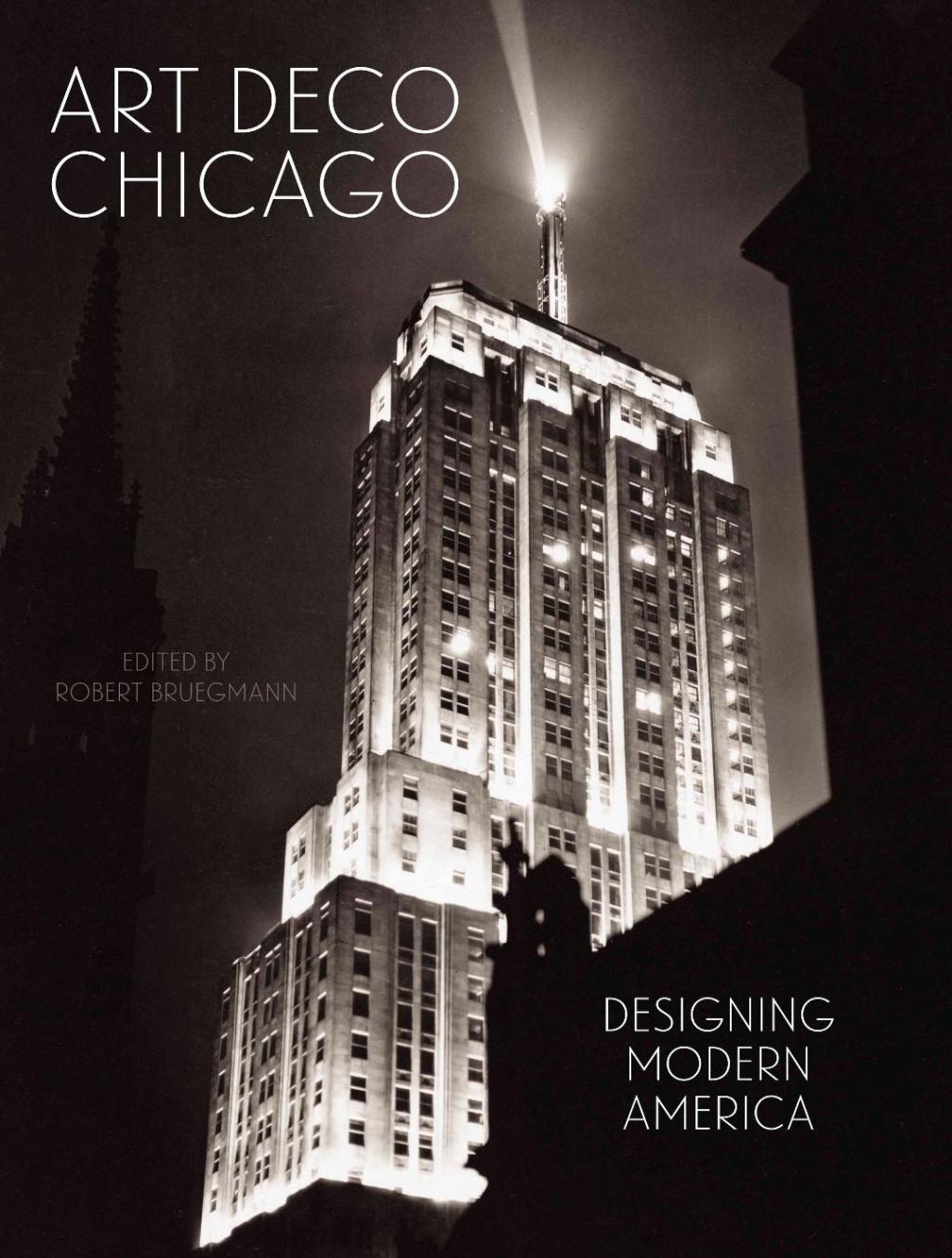
    Art Deco Chicago: Designing Modern America


    sleek and glorious as any Art Deco masterpiece whether it be the grand Palmolive Building built in 1922 or the much lowlier but still spectacular Bell telephone Model 302 designed not by a noted artist or architect but instead by George Lum, a Bell Labs engineer in 1937,  Art Deco Chicago: Designing Modern America (Yale Press 2018; $47.75 on Amazon) showcases 101 key works coupled with more than 300 photos as well as critical essays and extensive research. Altogether, they comprise a wonderful, extensively curated and chronologically organized tome about the many facets–architecture, advertising, household objects, clothing, and food design–of a style that has fascinated so many of us for more than a century.

    Robert Bruegmann, a distinguished professor emeritus of architecture, art history, and urban planning at the University of Illinois at Chicago, was first asked to write the introduction to the book

    thought I’d knock it out in a week,” says Bruegmann, a historian of architecture, landscape and the built environment.

    That was back in 2011 and Bruegmann, author of several other books including The Architects and the City: Holabird & Roche of Chicago, 1880-1918 (Chicago Architecture and Urbanism), quickly realized that it would take much more than that. He ended up editing and shaping this complex book, a task which included overseeing 40 writers and researchers, helping to find and collect photos and defining Art Deco and its impact on the city through design. He would spend the next five years, working 50 to 60 hours a week to do so.

    One of the first questions we asked is how do we define Art Deco recalls Bruegmann.

    “Should it be narrowly like the French-inspired luxury goods, which is the narrowest to the big tent which we ended up doing,” he says noting that many products (think as blasé as refrigerators, bicycles, radios and mixmasters) created in Chicago by companies like Motorola, Sunbeam and Schwinn, changed the world in a way that other forms of Art Deco didn’t.

    It many come as a surprise that the term Art Deco wasn’t invented until the 1960s and came about because of its association with the Decorative Arts Fair Exposition of 1925 in Paris. But in Chicago, Art Deco, even before it was so named, was often about both beauty and usefulness.

    “If I had to pick a single object to suggest what we tried to do in Art Deco Chicago, I would probably choose the Craftsman brand portable air compressor sold by Sears starting in 1939,” says Bruegmann about the cast iron aluminum machine which used, as described in the book, “a series of cooling fins that functioned as a heat sink while adding a streamlined visual flair to the product…This product alluded to themes of speed, transportation, and movement while remaining stationary.”

    “It was related to the avant garde work of the Bauhaus who thought they were going to save the world through their designs,” says Bruegmann. “But they were too expensive. But Sears on the other hand made things affordable.”

    Indeed, Bruegmann says that companies like Sears and Montgomery Ward did change the world.

    “Up until the Sears catalogue, a lot of clothes outside of big cities, were handmade,” says Bruegmann. “Because Sears sold so many outfits through their catalogue, they could afford to send their designers to Paris to study the latest design and then come back and change them so they were less expensive, creating one of the most important social and political movements by making  designs for the masses. For a $1.99 a woman working in a packing plant or a farmer’s wife could wear a knockoff of a Paris dress.

    Art Deco Chicago serves as the companion publication to the exhibition “Modern by Design: Chicago Streamlines America” organized by the Chicago History Museum, which runs October 27, 2018–December 2, 2019. Proceeds from sales of and donations to Art Deco Chicago, which explores and celebrates Chicago’s pivotal role in the development of modern American design, will be used to support ongoing public education, research, and preservation advocacy of this critical period of modern American design.

    Ifyougo:

    What: Newberry Library presents Meet the Author: Robert Bruegmann, Art Deco Chicago

    When: Thursday, November 29 from  to 7:30 p.m.

    Where: Newberry Library, 60 West Walton Street, Chicago, IL

    Cost: Free and open to the public

    FYI: 312-943-9090; newberry.org

    8/18/06 University Scholar- Robert Bruegmann
  • Pure: Inside the Evangelical Movement that Shamed a Generation of Young Women and How I Broke Free

    Pure: Inside the Evangelical Movement that Shamed a Generation of Young Women and How I Broke Free

    An important must read to understand a significant segment of our society.

    Jane Simon Ammeson's avatarShelf Life

    Inside the purity culture, girls and women are not only responsible for their own sexual thoughts and actions but also those of the boys and men around them says Linda Kay Klein, author of Pure: Inside the Evangelical Movement that Shamed a Generation of Young Women and How I Broke Free (Touchstone 2018 $26).

    Linda Kay Klein Author Photo by Jami Saunders Photography            “Because women are seen as the keepers of sexual purity which is a necessary part of their living out their faith, when men or boys have lustful thoughts about them, then it’s about what they were wearing, were they flirting,” says Klein, who grew up in the evangelical movement in the 1990s before breaking free. “It creates a tremendous amount of anxiety because your purity is assessed by others around you. It makes you worry about when you’re going to fall off the cliff and no longer be considered pure and no longer part of…

    View original post 469 more words

  • Chefs, Drugs and Rock & Roll: How Food Lovers, Free Spirits, Misfits and Wanderers Created a New Profession

    Chefs, Drugs and Rock & Roll: How Food Lovers, Free Spirits, Misfits and Wanderers Created a New Profession

    Author Photo. Andrew Friedman. Photo Credit Evan SungAndrew Friedman calls himself a chef writer because, as much as he loves food, he’s passionate about the stories chefs have to tell.

    “My point of view is writing not so much about the food but about the chefs, that’s why I say I’m a chefie not a foodie,” he says. “I think too many well-known chefs are almost portrayed as cartoon characters and in a broad stroke. I wanted to spend time with them and really get to know their stories, who they really are and their impact on how we eat now. Like Wolfgang Puck. He’s a tremendous cook but people call him the first celebrity chef. He’s so much more than that.”

    To accomplish this, Friedman interviewed over 200 chefs and food writers and others who were leading the food revolution against processed and packaged foods.

    “I’m such a geek I would spend three hours with someone just to get a nugget or two,” he says.

    The results? An accumulation of tens of thousands of transcript pages and his latest book,  Chefs, Drugs and Rock & Roll: How Food Lovers, Free Spirits, Misfits and Wanderers Created a New Profession (Ecco 2018; $27.99), where he recounts how dedicated and imaginative men and women in the 1970s and the 1980s, who were willing to challenge the rules, revolutionized America’s food scene.

    Now chefs are like rock stars, often known just by one name, commanding their own empires of cookbooks, TV shows, restaurants, cookware and food products. But Friedman points out that up until 1976, the United States Department of Labor categorized cooks as domestics. It took lobbying by the American Culinary Federation, at the urging of Louis Szarthmary, the late Hungarian American chef who owned The Bakery in Chicago and wrote The Chef’s Secret Cookbook, a New York Times bestseller, to change the classification into a profession.

    “I wanted to show how this became a viable profession,” he says. “I was talking to Jody Buvette, owner of Buvette in New York and she remembers sitting her father down and  saying ‘I have two bad things to tell you. I’m gay and I want to be a cook.’ It was like telling your upper middle-class parents that you wanted to be a coal miner.”

    Friedman, whose knowledge about restaurants, culinarians and food seems delightfully endless, chose three cities to focus on—San Francisco, Los Angeles and New York. What does he think of Chicago’s food scene?

    “It’s great,” he says. “I love dining in Chicago and you have some brilliant chefs but I think much of the beginnings started in those three cities.”

    Besides, he has those piles of transcripts. There’s surely more than a few Chicago stories in all those pages.  In the meantime, Friedman gives us a wonderfully written read about a defining time—one that in some ways separates frozen TV dinners and what many restaurants are serving today.

    Ifyougo:

    What:  5 course 80s-era dinner inspired by Chefs, Drugs and Rock & Roll with wines selected by Sommelier Rachael Lowe and conversation at Spiaggia Restaurant

    When: Tues. October 2, 7 pm

    Where: Spiaggia Restaurant, 980 North Michigan Ave., Chicago, IL

    Cost: $150 per person

    FYI: 312-280-2750; spiaggiarestaurant.com


    What: Talk with Andrew Friedman about Chefs, Drugs and Rock & Roll

    When: Wed, October 3, 6:30 to 8:30 pm

    Where: Read It & Eat, 2142 North Halsted St., Chicago, IL

    Cost: Purchase a ticket and book combo for $36.45 or 2 tickets and a book combo for $46.45

    FYI: 773-661-6158; readitandeatstore.com


  • Young Lincoln: Growing Up in Southern Indiana

    Young Lincoln: Growing Up in Southern Indiana

    Many people aren’t aware that Abraham Lincoln spent his formative years in Southern Indiana, moving there from Kentucky with his family at age seven, leaving with them when he was 21.Jan Jacobi head shot

    It’s these years that Jan Jacobi, an avid Lincoln enthusiast and an award-winning educator who currently is teaching at St. Michael School of Clayton in St. Louis, chronicles in Young Lincoln (Reedy Press $16.95), his recently released book for readers ages 12 to 16.

    Growing up in New York, Jacobi moved to St. Louis in 1992 to take a teaching job and says he quickly realized how close his new home was to areas where Lincoln had lived including Southern Indiana and Springfield, Illinois, inspiring him to read book after book about the president.

    “One of my students asked me if there was a book he could read about young Lincoln,” recalls Jacobi who because of his towering height is frequently asked to portray the president.  “I said there really wasn’t one for his age range. And he told me that I should write one then.”

    Jacobi’s publisher agreed but with one more stipulation. He should write it in first person, using the voice of Lincoln as a youngster.

    “I thought no one can do that,” says Jacobi. “But then gradually the voice came to me—I just had to marinate in it.”

    Spending time in Spencer County, Indiana where Lincoln grew up, Jacobi talked to some of the residents whose ancestors had been friends of the Lincoln family. They shared with him their views of the Lincolns that had been passed down generation after generation.

    Thomas Lincoln has always been somewhat of a cipher—the youngest and least successful of three brothers who all witnessed the death of their father, another Abraham Lincoln, who was shot and killed by a Native American . When the future president was a youngster, Thomas Lincoln was a harsh father but that wasn’t unusual in pioneer days. Thomas also thought his son was wasting his time reading and learning and tried to discourage it. Young Lincoln, in turn, was contemptuous of his father’s illiteracy and failures to get ahead in life and sought the mentorship of other men  in the community who were learned and successful. Southern Indiana at that time was a wilderness where cougars and bears were always a menace, food was often scarce and life was harsh and often deadly. Lincoln’s mother died after contracting milk sickness as did a friend she’d been nursing for the same disease; his sister died in childbirth.

    As an adult, when his father was on his deathbed, Lincoln, now a successful lawyer, refused to visit him despite the appeals of his step-mother with whom he was exceptionally close and his step-brother. When Thomas died, Lincoln didn’t attend his funeral.

    “People in Southern Indiana are kinder to his father,” says Jacobi. “I’m a little harder on him.”

    How did Lincoln develop the resiliency that would allow him to overcome his early adversity to lead the country during one of its most tumultuous periods is a question that Jacobi says he has longed tried to answer.

    “Lincoln is a remarkable human being,” he says. “There are so many dimensions to him. We have to be careful not to turn him into a saint; but his essential goodness speaks to me.”

    So much so, that Jacobi is planning his next book about Lincoln’s time in Springfield.

    “Lincoln is endlessly fascinating,” says Jacobi. “He is the quintessential American. The only other person I put in that category is Mark Twain.”

    Ifyougo:

    What: Jan Jacobi discusses Young Lincoln. He will be joined in conversation by syndicated columnist Steve Chapman. A Q&A and signing will follow the discussion.

    When: Saturday, September 22 at 3 p.m.

    Where: 57th Street Books, 1301 E 57th St, Chicago, IL

    Cost: Free

    FYI: 773-684-1300; semcoop.com


  • Lake Success

    Lake Success

    “I’ve always wanted to travel the country by Greyhound bus,” says Gary Shteyngart, the New York Times bestselling author about Lake Success, his latest book Gary Shteyngart © Brigitte Lacombe(PenguinRandom House 2018; $28) which tells the story of Barry Cohen, a hedge fund millionaire who, unable to deal with all the issues impacting his life, jumps on a bus to find his college girlfriend.

    “I know, I’m nuts. But I thought it would be a very visceral way to see the country at a difficult time in its history,” continues Shteyngart.  “And it sure was.  As for the hedge fund part, I guess I realized there were so few people left in New York who weren’t connected to finance one way or another. Everyone else had been priced out.”

    You might think that Cohen, a man worth millions who is married to a beautiful, exotic and intelligent wife, has, if not it all, at least a lot more than most of us. But beneath the surface, it’s all breaking into pieces for Cohen, a self-made man who overcame the intense insecurities he had as a boy. His only child is severely autistic, his wife is drifting away having fallen in love with a married neighbor and the Feds are opening an investigation into how his hedge fund lost a billion or so.

    Chucking it all including his Black Amex card, cell phone and access to his millions, Cohen has only a couple hundred dolalrs and his expensive watch collection which emotionally means more to him at the time he starts his journey than anything else in his life.

    Shteyngart was able to nail down the personalities of his characters by immersing himself in their world.

    “I spent three years hanging out with hedge fund people and their spouses and sometimes children,” he says. “A strange alternate reality began to take shape in my mind. I started jotting down the little tics and conversations, but mostly the fact that the real world of the 99.9 percent was no longer available to them. They had moated themselves in to an almost feudal level. In fact, large parts of Manhattan started to seem like a series of gated communities.”

    There’s a parallel to Shteyngart and Barry’s upbringing. Both grew up poor and saw Wall Street as a way to make up for the huge amounts of insecurity they felt.

    “In our country, being poor is almost considered a moral failing, though often to get rich requires a true moral failing,” he says.

    Unlike Barry, Shtenyngart, who immigrated with his parents from Leningrad at age seven, turned to writing dark comedic novels such as Super Sad True Love Story (winner of the Bollinger Everyman Wodehouse Prize) and The Russian Debutante’s Handbook (winner of the Stephen Crane Award for First Fiction and the National Jewish Book Award for Fiction). It’s humor, based in part upon his parents who he says have a very satirical approach to reality honed in the Soviet Union, where laughter was the only defense against a very stupid system.

    “Being an immigrant is also a nice way to observe a society because you have to learn it from scratch,” he adds.

    To learn how to become a hedge fund manager, watch this video by Shtenygart and Ben Stiller: http://bit.ly/2x084Iz

    Ifyougo:

    What: A conversation and book signing with Gary Shteyngart

    When: Friday, September 21 at 6:30 p.m.

    Where: KAM Isaiah Israel Congregational,1100 E Hyde Park Blvd, Chicago, IL

    Cost: $30 tickets include admission for one and one copy of Lake Success

    FYI: 773-684-1300; semcoop.com