Category: Uncategorized

  • The Wellness Lifestyle: A Chef’s Recipe for Real Life.

    The Wellness Lifestyle: A Chef’s Recipe for Real Life.

             It’s a place many of us have been in–counting calories, obsessing about what we ate and shouldn’t have and still seeing the scale tip higher and higher. There’s a different way according to Chef Daniel Orr, owner of FARMbloomington, an award winning restaurant in downtown Bloomington, Indiana and Kelley Jo Baute, owner of A Splendid Earth Wellness, a company she runs offering wellness coaching to individuals and businesses and workplace ergonomics consulting in Seymour, Indiana. The two, who are friends, melded their skills in creating MyTendWell Lifestyle Plan, a program focusing on eight different wellness factors — social, occupational, intellectual, physical, emotional, spiritual, environmental, and nutritional. That in turn led to writing The Wellness Lifestyle: A Chef’s Recipe for Real Life.

    Daniel Orr and Kelley Jo Baute

             “We’re really unique because there are no books where there’s really an exercise scientist working with an international chef,” says Baute.

             When she says international, she means it. Orr, a graduate of Johnson & Wales University, a culinary school in Providence, Rhode Island, has worked in France at such restaurants as Auberge des Templiers, Restaurant Daguin and three-star L’Esperance, and Belgium’s three-star Restaurant Bruneau. After that he worked as an executive chef at several high end New York restaurants and becoming executive chef of the Cuisinart Resort & Spa in Anguilla, BVI in the Caribbean.

             For her part, Baute was working on her PhD at Indiana University Bloomington when she was diagnosed, at age 41, with Stage 2 breast cancer and embarked upon a rigorous regime of chemotherapy and a year of Herceptin treatments. Doctors also removed a tumor and surrounding lymph nodes and she underwent a bilateral mastectomy. Though ongoing tests showed her to be cancer free, for the next five years she had further biopsies, a hysterectomy, and other surgeries. Despite this, she managed to complete her PhD in kinesiology and start her own business. In other words, she says, she wasn’t going to let cancer define her.

             Pulling on their diverse backgrounds, Baute and Orr created an easy-to-follow book designed for those who want to enjoy food and also have a healthy and fulfilling life.

             “It’s about taking care of yourself and taking care of each other, reaching a handout to help others,” Baute says.

             “The Wellness Lifestyle is an all-in-one life-long wellness plan,” says Orr.  “Dr. K and I wanted to create something that was a one size fits all in both understanding health and enjoying life. A lot of that is food. The fresher your food is the more nutritious it is. Many of the antioxidants are most available in the whole raw ingredient of fresh fruit and vegetables. Growing and cooking your own food is the number one thing you can do to live a healthier lifestyle.”

             If you can’t grow your own, you can still cook fresh foods found at supermarkets and farm stands.

             It’s important to plan a schedule of exercise, wellness and eating healthy and stick to it says Baute.

             “Wellness is a lifestyle, so get started and stay committed,” she continues. “Encourage others to join you. Just keep moving.”

             “And just keep eating healthy,” adds Orr.

  • Dopesick: Dealers, Doctors and the Drug Company that Addicted America
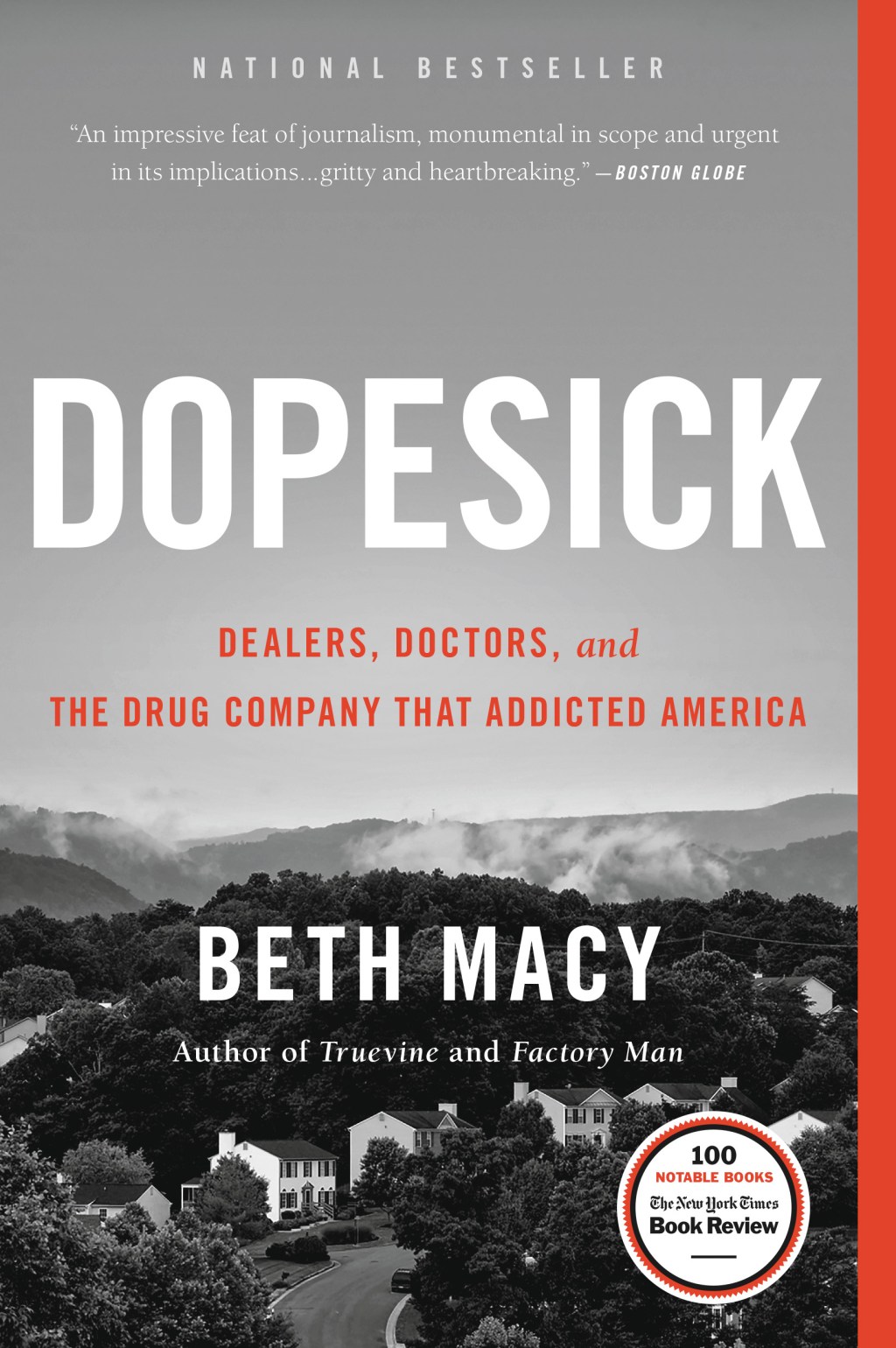
    Dopesick: Dealers, Doctors and the Drug Company that Addicted America

              “How do you meet a mother at her son’s grave near the football field where he had once made the crowds roar and not want to help her figure out what happened to her kid?” asks Beth Macy, author of the New York bestseller  Dopesick: Dealers, Doctors and the Drug Company that Addicted America (Back Bay Books).

    Beth Macy

    To answer her question, Macy, an investigative journalist, takes readers into board rooms and pharmaceutical laboratories, dying rural communities and the seemingly perfect lives of those living in suburban McMansions. She visits a prison for a follow-up interview with a convicted drug dealer and meets with parents who have lost their children. She talked to doctors, read trial transcriptions in case of big pharmaceutical companies accused of hiding information about the addictiveness of their drugs and conferred with law enforcement. As she was doing all this research, she had a nagging thought—would it all be out of date by the time her book was published?

    “I thought by then there would be a good chance we would have solved the opioid crisis,” says Macy.

     But we hadn’t and still haven’t. Between 1999 and 2017, 702,000 people died from opioid overdoses. According to data from the National Center for Health Statistics, Centers for Disease Control and Prevention, provisional data for 2018, adjusted for delays in reporting, showed a slight decrease. Unfortunately the decline was so light that it’s questionable whether it’s even the beginning of a trend or just a blip. After all this time the data proves just one thing, opioid death rates are still extremely high.  

    “It was all happening fast,” says Macy, noting at times she was typing up her interviews with sources only to learn that they had overdosed and died. “I listened to the stories of how people became addicted–sadly so many stories were typical. People were injured or in pain from surgery, were over-prescribed opioids and became addicted.”

              Indeed, Macy talked to one woman who had lost her job in the coal fields.

    “She had gall bladder surgery and became addicted because she was over-prescribed and in the end no doctor would write her a prescription,” says Macy. “Her neighbor had surgery and had also lost her job and needed money to pay for her high blood pressure medicine and her rent, so she sold her medicine to her.”

    Over-prescribing often started a downward spiral—lost jobs, broken marriages, families finally worn out from helping addicts over and over again, homelessness and finally death. Mothers told her of daughters who used sex to get meds. Stress communities, those where the addiction and death rates are high, are everywhere though Macy notes that in upper income areas people are “still cloaked in this sense of stigma and shame.”

    It’s a crisis that impacts us now but will continue to do so in the future.

    “We’ve lost generations in some of these stress communities—there’s a county in Tennessee where I’m told that 90% of the children are being raised by someone else,” she says.

    What can be done? Macy says law enforcement officials tell her that educating people is an important part of the solution. And so that has become her goal.

    “I want to get the stories out,” she says, “in order to help.”

    Dopesick is the winner of the following awards:

    The 2019 Library of Virginia People’s Choice Award in Nonfiction

    LA Times Book Prize for Science & Technology Winner
    American Society of Addiction Medicine Annual Media Award Winner
    2018 Kirkus Prize Finalist
    2019 Library of Virginia People’s Choice Award for Nonfiction finalist
    2019 Ohioana Book Award in nonfiction finalist
    Andrew Carnegie Medal shortlist
    800-CEO-READ 2018 Business Book Awards Longlist

  • The Dearly Beloved: A Novel

              Two couples meet when the husbands are hired to serve at the historic Third Presbyterian Church in New York City’s Greenwich Village. Charles Barrett and James MacNally both have a calling, but they have little else in common, having come from vastly different backgrounds. Their wives differ as well. Lily met Charles when they were both in college and immediately told him she was an atheist. Instead of being the helpmate of a minister, she moves in academic and activist circles. Nan, who is married to James, is the opposite—perfectly content to support her husband’s career and finding comfort in religion.

              Thus, Cara Wall, in her debut novel, The Dearly Beloved (SimonandSchuster 2019), writes about the two couples as they move through the tumultuous time of a changing world of the 1960s.  It’s also about the relationship between husbands and wives and those they encounter in their lives. The phrase “The Dearly Beloved” is part of the Christian marriage liturgy.

              Wall, who spent 15 years writing the novel which has received great reviews, grew up going to First Presbyterian Church.

     “It was a very liberal church for the time in New York City and it was a very community based church,” she says, describing how she developed her plot. “We did have two pastors and they were not difficult characters to place.”

    Indeed, Wall, a graduate of the Iowa Writer’s Workshop and Stanford University, says that the characters came to her first, already pretty much fully formed. And though they’re ministers, Wall says it’s not a story about men of faith discussing how to be good Christians.

    “That’s not what interests me,” she says, noting the book also explores the challenges of raising children and making marriages work.  “The biggest misconception about churches is that everyone gets along but that is not true.  A church is like a co-op building–it has a board and voting members. It’s a hierarchy, which causes power struggles. For every member, church is one of the most important places in their lives, which means they’re intensely invested in how it’s run.”

  • Honoring Chicago’s South Side Architecture

    Honoring Chicago’s South Side Architecture

    Foster House & Stable home designed by Frank Lloyd Wright located in the West Pullman area.

    World famous for its architecture, Chicago boasts works by such greats ranging from the Frank Lloyd Wright to William LeBaron Jenney, designer of the world’s first skyscraper. No other city in the world has more Ludwig Mies van der Rohe buildings than Chicago. Yet for many, the largest landmass in the city is like an uncharted territory when it comes to outstanding architectural design.

     “60% of Chicago is the South Side,” says noted photographer and journalist Lee Bey. “It’s geographic area that is twice the size of Brooklyn and the size of Philadelphia. But over the years it’s been ignored by many Chicagoans as well as the architectural press, architectural tours and lecturers.”

    Chicago Vocational High School at 2100 E. 87th Street—the largest Art Deco building that’s not a skyscraper in Chicago

    Bey, who is considered an architectural expect, grew up on the South Side and has long appreciated the treasures found there.  He shares this passion in his recently releases book Southern Exposure: The Overlooked Architecture of Chicago’s South Side, which he describes as a wake-up call.

    Author and photographer Lee Bey

    “You can’t have anything that big and ignore it,” says Bey who is also a lecturer at the School of the Art Institute. “Chicago can’t be a world class city if they overlook the South Side and the West Side.”

    Because I grew up in Northwest Indiana, I am familiar with the South Side and some of its architectural marvels such as the sprawling Chicago Vocational High School at 2100 E. 87th Street—the largest Art Deco building that’s not a skyscraper in Chicago  and the Middle Eastern/Moorish/Persian-style building with a  towering minaret at 79th and Stony Island that’s on the right when turning on to Stony Island from the Chicago Skyway.

    But I didn’t know about The National Pythian Temple, The Overton Hygienic Building and The Chicago Bee Building or that there was a Frank Lloyd Wright home that was over a century old for sale in the West Pullman area. Known as the Foster House and Stable, it was designated a Chicago landmark in 1996 and can be had for around $200,000.

    “That house would sell for a lot more in other parts of Chicago,” says Bey, noting the home is in good condition.

    Even Bey sometimes comes across an unknown find.

    “I was caught by surprise when I saw Stony Island Church of Christ at1600 E. 84th,” he recalls. “It looked like it was designed by Ray Stuermer and I went home and looked it up and it was,” says Bey.

    While watching a documentary of Eero Saarinen and discovering they’d left out his buildings for the University of Chicago, Bey knew he had to rectify the neglect of architect on the South Side.

    “If they could leave out Eero, then something needed to be done,” he says, writing in his book that “for decades


    ” For decades, most of the buildings in that vast area have Bey writes.

    most of the buildings in that vast area have been flat-out ignored by the architectural press, architectural tours, and lectures — and many Chicagoans.”

    It’s a call to action, he says noting that Bowen High School would be a city landmark and on the National Register if it were located on the North Side. After all, the Carl Schurz High School on the Northside were built the same year and both were designed by the same architect, Dwight Perkins, chief architect of the Chicago Board of Education between 1906 and 1909. But Schurz has been a city landmark since 1978 and made the National Register of Historic Places in 2011. Bowen, located in a mostly black and Latino South Side community, has neither.

    “It’s astounding what’s there, he says. “There’s architecture on the South Side by architects that people would immediately recognize. People should care about them and get out and see them,”

    Ifyougo:

    What: Ley Bey talks and book signings.

    When & Where: Epstein Global is hosting Lee Bey on November 7th from 5:30 to 7:30 pm. Bey will be speaking in their offices, 600 West Fulton, Chicago, IL.

    Anyone interested in attending, please contact Noel Abbott at Epstein. (312) 429-8048; nabbott@epsteinglobal.com.

    When & Where: November 12 at 6:30 pm at the Evergreen Park Public Library, 9400 S. Troy, Evergreen Park, IL

    708-422-8522; evergreenparklibrary.librarymarket.com

  • 1000 Places to See Before You Die: The World As You’ve Never Seen It Before

    1000 Places to See Before You Die: The World As You’ve Never Seen It Before

    Patricia Schultz and I had only been on the phone together for five minutes before we decided to make the trip to New Zealand—neither of us had been and both of us wanted to go. And no, I haven’t bought my ticket yet but that’s how mesmerizing Schultz, who introduced the concept of bucket list travel when she wrote the first edition of her New York Times bestseller 1000 Places to See Before You Die in 2003. It was so popular that over the years more than 3.5 million copies have been sold.

    Now Schultz has updated her book with a new twist, her words accompanied by mesmerizing and amazing handpicked photos of some of the most beautiful places in world.  The book itself, weighing six pounds with 544 pages, is oversized eye candy—compelling us to pack our bags and head out to explore.

    1,000 Places to See Before You Die (Deluxe Edition): The World as You’ve Never Seen It Before was years in the making—after all Schultz had to travel to all those places.

    Calling her new book, a veritable scrapbook of her life, she says she became teary eyed when choosing the photos. In its pages she takes us to destinations so exotic many might have remained unknown to most of us if not for her writing. One such is Masai Mara, the world’s greatest animal migration that takes place each May when hundreds of thousands of wildebeests travel north from the Serengeti in Tanzania to the grasslands of Kenya’s Masai Mara. It’s a two to three month journey and the wildebeests are joining by other migrating herds including antelope, zebras and gazelles swelling the animal population to a million or so. There’s also ballooning over Cappadocia, a Byzantine wonderland encompassing a natural and seemingly endless landscape of caves and peaks of shaped by eons of weather with wonderfully colored striations of stone. Even better, Schultz points out, you can take a side trip to Kaymakli, an ancient underground city just 12 miles away.

    For those less inclined for such travels or whose pocketbooks don’t open that large, Schultz features closer to home destinations that are still special such as Mackinac Island where cars were banned in the mid-1890s, New York City (where Schultz resides when not on the road) and one of my favorites, Stowe, Vermont. And, of course, the majestic Grand Canyon.

    While Schultz’s parents weren’t world travelers, they encouraged her to find her way to what she loved. But for her, it’s not just the road, it’s the people she meets as well. When the first editor of her book proved so successful, she treated herself to a trip to Machu Picchu in the Urubamba Valley of the Cuzco Region of Peru often known as the Lost City of the Incas. Located 7800-feet above sea level, it’s isolated at the top of a mountain surrounded by jungles and other peaks. There she met a 90-year-old woman who had been inspired by her book to travel there.

    “She asked me if I had heard of the book,” says Schultz. “Peru was the first stamp in her first passport.”

    This venturesome woman who had traveled outside the U.S. for the first time in her ninth decade, offered the seasoned travel writer a pearl of wisdom that has remained with her for the last16 years.

     “She told me to make sure to see the difficult places first,” recalls Schultz. “You can see the easy ones when you’re not as active or energetic.”

              Is Schultz burned out by travel? Has she reached the point of been-there-done-that?

              Schultz answers with an emphatic no.

    “There are still so many places I want to visit,” she says, noting that her list remains long. “I doubt if I’ll get to do them all, but I will try to do as many as I can.”

    Ifyougo:

    What: Authors Group Presents Patricia Schultz, 1000 Places to See Before You Die; Luncheon

    When: Tue, Oct 29, 2019 from 11:30 a.m.-1:30 p.m.

    Where: Union League Club of Chicago, 65 W. Jackson Blvd., Chicago, IL

    Cost: $35 per ticket

    FYI: 312-427-7800; ulcc.org

    What: Cocktails with Patricia Schultz & Lake Forest Bookstore

    When:  Tue., Oct. 29. 6 p.m.

    Where: North Shore Distillery, 13990 Rockland Rd, Libertyville, IL

    Cost: $65 for individual or $75 per couple (includes 1 book, 1 drink and appetizers)

    FYI: RSVP required. Call 847-234-4420; lakeforestbookstore.com

    What:

    When’ Wed. Oct 30 at 7 p.m.

    Where: Anderson’s Bookshop La Grange, 26 S La Grange Rd, La Grange, IL

    Cost: This event is free and open to the public. To join the signing line, please purchase the author’s latest book, 1,000 Places to See Before You Die Deluxe Edition, from Anderson’s Bookshop. To purchase please stop into or call Anderson’s Bookshop La Grange (708) 582-6353 or order online andersonsbookshop.com

    FYI: 708-582-6353

  • The Pretty One

    The Pretty One

              Born with cerebral palsy, for much of her life Keah Brown longed for normalcy, hating the disability which she believed defined her in the eyes of others as well as herself.

              “It’s very painful when people treat me differently,” says Brown, author of the recently released The Pretty One:  On Life, Pop Culture, Disability, and Other Reasons to Fall in Love with Me. “Black people with disabilities are all but invisible. We simply don’t exist.”

              Brown, whose cerebral palsy impacts the right side of her body, also suffers from seasonal depression, chronic migraines and anxiety. But despite all this, she also learned not to stand down.

              “I never gave anybody the chance to say anything to me, I showed I wouldn’t back down,” she says, “I put forth a front that if you say anything to me, I’m going to say it back.”

              She also, encouraged by her mother, started writing her thoughts and emotions into poems and short stories at a young age.

              “My mom was really adamant that I finish school and also making sure I had every opportunity to just be a kid,” she says.

              All this helped Brown discover her place in the world and an acceptance of herself and a way of dealing with others.  It’s a journey of growth and shedding feelings of powerlessness.  For most of her life she hated mirrors but now that she embraces who she is, she no longer avoids them. Such empowerment led her to create the hashtag #DisabledAndCute. She also is a contributor to such magazines as Harper’s Bazaar, Marie Claire and Teen Vogue.

              Brown describes her book as a collection of essays about the idea that we’re on a journey to joy.

    “With this book, people can see my journey and I really hope people can take things from I and to look at their own lives,” says Brown. “I wanted to be sure to tell the whole story, to create a kinship with others. By reading books like these outside of our experiences, we could learn so much about other people and to open us up.”

    Cerebral palsy sometimes impacts Brown’s ability to write on certain days.

    “Sometimes I don’t have the energy, I have pain, so when I have those days, I take breaks or I’ll write on my phone using an app,” she says.  “But I try to get something done every day.”  

    Brown is already focusing on her next book. She’d like to write fiction which Brown describes as her first love.

    In the meantime, she encourages all of us to listen to people, whether they’re disabled or not. And always continue on despite the odds.

    “We all have bad days—all of us,” she says. “I try to go forward though, no matter what.”

    Ifyougo:

    What:

    When: September 25 at 6:30 p.m.

    Where: American Writers Museum,180 N. Michigan Avenue, 2nd Floor, Chicago, IL

    Cost: Free for members; $12 for non-members.

    FYI: ASL Interpretation will be provided at this event; let the museum know how they can make event more comfortable by contacting them or RSVP at general@americanwritersmuseum.org or (312) 374-8790.

  • Jeremiah Wasn’t Just a Bullfrog: A Tale of Passion, Pursuit, Perseverance…and Polliwogs
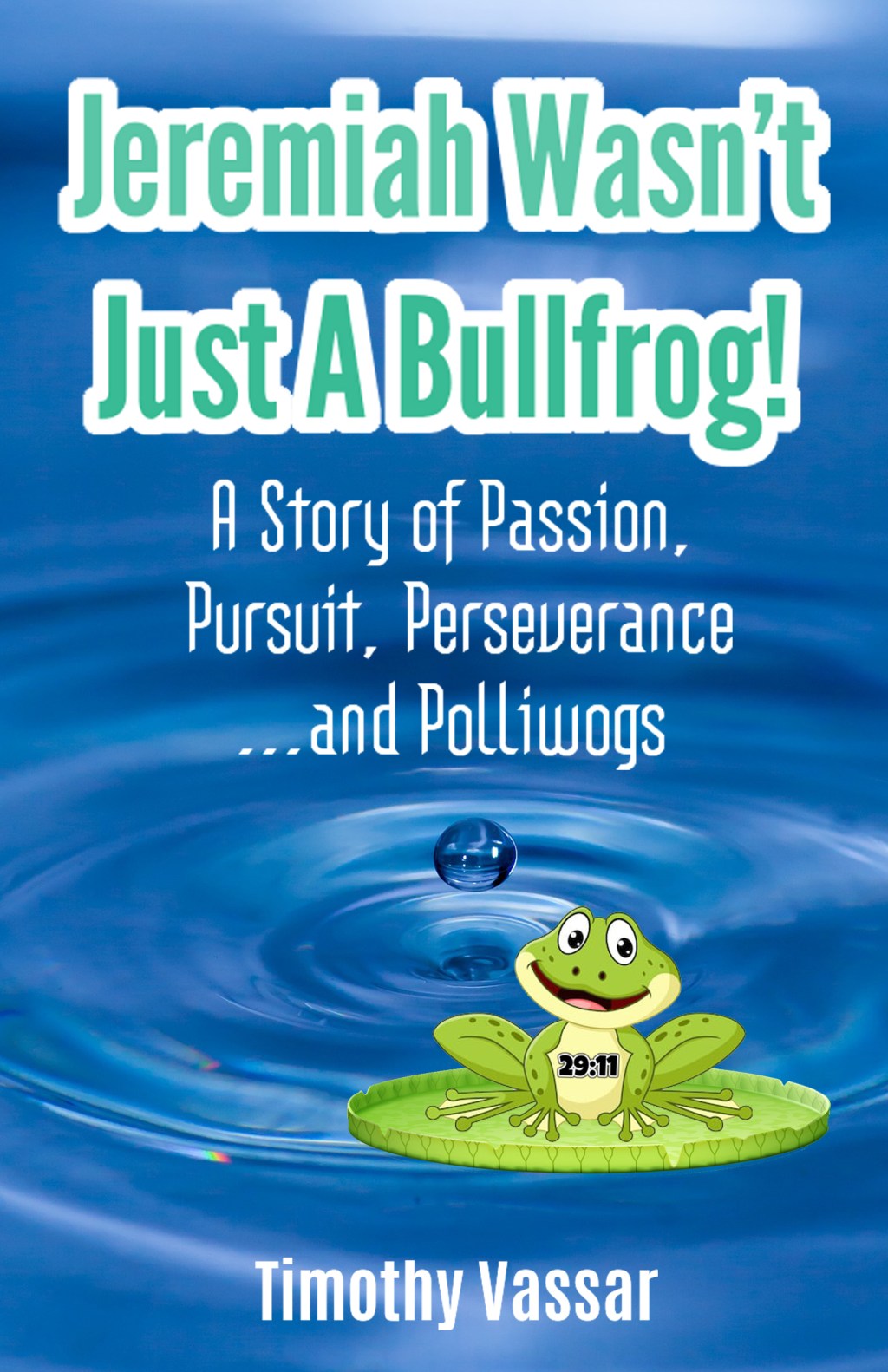
    Jeremiah Wasn’t Just a Bullfrog: A Tale of Passion, Pursuit, Perseverance…and Polliwogs

    The inspiration behind Tim Vassar’s new book, Jeremiah Wasn’t Just a Bullfrog: A Tale of Passion, Pursuit, Perseverance…and Polliwogs, began when his wife Mary asked about his experiences as a track and field athlete and coach.

    “I was still talking after three hours,” says Vassar, a former teacher and track coach at Lake Central High School, “when my wife said you should put this in a book.”

    So, he did, the words flowing but taking him in a different direction than he expected.

    “I’d started writing—and writing–about track and field,” says Vassar, who participated in track and field when he attended Highland High School as well as college. “Then I realized the book wasn’t just about track and field, but also about the people who came into my life and my experiences beyond just sports.”

    In all, says Vassar, now the Director of Student Teaching at Indiana University Northwest who also served as principal at Colonel John Wheeler Middle School in Crown Point, his writing was an eye opener.

    “It connected the dots, showing me how people in my life were there and helped me along, students, colleagues, others,” he says, terming his writing as a “stream of faith.”

    The book starts when Vassar was in fifth grade, with some segues back to kindergarten.

    “It brings back a lot of memories not only for me but others who’ve read it,” says Vassar. “People tell me I remember that.”

    Looking back, Vassar is thankful for the chance to draw all these memories together turning them into a coherent narrative, one that shows how his passion for track and working with students, his pursuit of his career and his commitment to helping others and his perseverance in achieving his passions will be inspirational to others.

    As for the title of his book, it comes from his faith.

    “I was in the shower, humming the song ‘Jeremiah was a Bullfrog,’ and I thought how the passage in Jeremiah 29:11, one of my favorites, applied to my life,” he says, noting that he sees now it was all part of a plan for his life.”

    But no matter how you read the book—and Vassar says it’s also a love story chronicling his long relationship with his wife Mary—there’s something for most people including sports lovers, educators, those interested in life growing up in Northwest Indiana and as an inspirational guideline.

    Vassar’s book is available at Amazon.com and other online booksellers.

    FYI: timothy.vassar@icloud.com

  • The Ghosts of Eden Park: The Bootleg King, the Women Who Pursued Him, and the Murder that Shocked Jazz-Age America

    The Ghosts of Eden Park: The Bootleg King, the Women Who Pursued Him, and the Murder that Shocked Jazz-Age America

              George Remus came to America as an impoverished German immigrant who continually re-invented himself, until he rose to the top, becoming the most successful bootlegger in this country’s history, owning 35 percent of all the liquor in the United States and earning the title as “King of Bootleggers.” But his story, as told by Karen Abbott in her new book, The Ghosts of Eden Park: The Bootleg King, the Women Who Pursued Him, and the Murder that Shocked Jazz-Age America, isn’t about machine guns and Al Capone-style executions.

    Remus, a teetotaler who spoke of himself in the third person, didn’t believe in violence to enforce his business. Instead, he was an oddball intellect and pharmacy school dropout who at 19 was peddling his self- branded patent medicines like Remus’s Nerve Tonic which contained, among other less toxic ingredients, henbane, a hallucinogenic plant. By age 24 he was a defense attorney practicing in Chicago. Married, he fell in love with Imogene Holmes, the woman who cleaned his office, offered to handle her divorce and set her up in apartment in Evanston. His wife didn’t like that one bit and filed again for divorce; their divorce settlement in 1919 was a lump sum of $50,000, $25 a week in alimony and $30,000 in trust for their daughter at a time when an average US worker made between $200 and $400 per year, an accountant about $2,000 per year, a dentist $2,500 per year and a veterinarian between $1,500 and $4,000.

              Seeing all the money being made in selling bootlegged booze, Remus decided to go big time and, spotting a loophole in Title II, Section 6 of the Volstead Act allowing buying and using liquor for medicinal purposes, he developed a master plan that included using his pharmacy license to acquire wholesale drug companies, purchasing distilleries and organizing a transportation company as well as bribing officials to look the other way. It worked fantastically until it didn’t.

    He was brought down by Mabel Walker Willebrandt, a pioneer prosecutor at a time when there were few women in the field and his own gold digging wife who fell in love with Franklin Dodge and divulged many of her husband’s secrets. Dodge, it turned out was Willebrandt’s best investigator, assigned to dig up dirt on Remus and so he did. But that, in ways, was just the beginning of the story.

              Abbott, the New York Times bestselling author of Sin in The Second City, American Rose and Liar Temptress Soldier Spy, named one of the best books of 2014 by Library Journal, the Christian Science Monitor, and Amazon, says she typically gets her story ideas when researching. But she discovered Remus when watching the HBO series, Boardwalk Empire.

              “Remus was a very minor figure on the show, and I wondered if he was a real person,” says Abbott, who also serves on the National Advisory Board for the Chicago Brewseum, the country’s first non-profit museum dedicated to telling the story of beer. “His real story was so much more fascinating and dramatic than the show involving a love triangle, betrayal, murder and a sensational trial. He was a brilliant strategist and I loved the way he spoke in the third person. My favorite is ‘Remus’s brain exploded.’”

              Abbott was also very intrigued by Imogene (“a classic villain”) and Mabel (“Inhumanely tough”).

              “You have this woman who could was allowed to vote for nine months—along with every other adult female in the country–when President Harding put her in office to be the assistant attorney general of the U.S. and had hearing problems and spent an hour each day styling her hair to hide her hearing aids, going up a brilliant attorney like Remus,” says Abbott, noting that her appointment had less to do with an advancement for women as her as her bosses, many of whom were being bribed by Remus, thinking she was fail. “And, of course, she had her own betrayal when she discovered that Dodge and Imogene were plotting to ruin Remus and take over his business.”

              Abbott who spent four months in the Yale University Law Library, researching including reading the 5000 page transcript of the trial, had 85,000 pages of notes when she was done, described her endeavor as “the most fun researching I’ve ever had.”

              Among her many discoveries was that Imogene and George, who lived life very large, had a gold piano in their home.

              “So did the Everleigh sisters,” she says about the two Chicago madams who she chronicled in her book Sin in the Second City. “Who have thought that I’d end up researching two books where people owned gold pianos.”

  • The Wisconsin Cheese Cookbook: Creamy, Cheesy, Sweet, and Savory Recipes from the State’s Best Creameries

    The Wisconsin Cheese Cookbook: Creamy, Cheesy, Sweet, and Savory Recipes from the State’s Best Creameries

    “Some people say that the French have the best cheese but I think Wisconsin cheese is the best and I can say that because I wrote the book on cheese” says Kristine Hansen, who actually did write The Wisconsin Cheese Cookbook: Creamy, Cheesy, Sweet, and Savory Recipes from the State’s Best Creameries (Globe Pequot Press 2019; $24.95). “Wisconsin is not just about cheddar; we have a large variety of cheeses which consistently win awards.”

    With over a million cows, the state turns out more than 2.8 billion pounds of cheese per year. Hansen focused on the growing artisanal cheese producers in the state and though her cookbook has 60 recipes (as well as beautiful, lush photos), it’s as much of a travel guide—call it a cheesy road trip if you can excuse our pun–to 28 of the state’s creameries.

    “A lot of my friends, when they come to visit, want to know the best cheese places I’ve discovered and ask for directions,” says Hansen, a Milwaukee-based journalist covering food/drink, art/design and travel whose articles have appeared in many magazines and websites including Midwest Living, Vogue and on Travel + Leisure and Conde Nast Traveler.

    Writing the book meant lots of time on the road, visiting corners of the state where she’d never been and learning the intricacies of cheese making.

    So, what makes Wisconsin cheese so great? After all, there are cows throughout the Midwest, but Indiana, Illinois and Michigan don’t have nearly the same amount of small batch hand crafted cheesemakers as the Badger State.

                   “A lot of Swiss immigrants settled here, particularly in Green county,” says Hansen about the home of Green County Cheese Days, the oldest and largest food fest in the Midwest. The festival honors the area’s Swiss heritage (their Swiss credentials are such that there’s also Wilhelm Tell and Heidi festivals) cheesemaking tradition. The later includes a dozen creameries producing over 50 varieties of award-winning cheeses as well as the only domestic maker of Limburger and the only U.S. factory making 180-pound wheels of Old World Emmenthale.  

                   Other creameries mentioned in Hansen’s book include the Door County Creamery in Sister Bay in scenic Door County, where visitors where visitors can not only sample cheese and take a farm tour but also participate in a 40-minute goat yoga session.

     “ClockShadow is one of only two urban creameries in the country,” says Hansen about this Milwaukee cheeserie which offers tours. “One of the reasons they opened is they wanted people in Milwaukee to be able to get fresh cheese curds without having to drive very far.”

    As an added plus, adults can also combine the experience by taking a tour of the Milwaukee Brewing Company which is just across the street.

    “People think the best Gouda comes out of Holland, but Marieke Gouda is wonderful,” says Hansen.

    Located in Thorp, Marieke Gouda has a product store, newly opened Café DUTCHess and features tours. Across the street, Penterman Farm where the milk for Marieke Gouda is provided by Brown Swiss and Holstein cows, there’s a viewing room and tours as well.

    Bleu Mont in Blue Mounds is one of several cheeseries in the state with a cheese cave.  

    Asked what’s the most unique Wisconsin cheese she’s sampled—and she’s tried a lot, Hansen mentions Carr Valley’s Cocoa Cardona, a mild, sweet, caramel flavored cheese balanced by a slight nuttiness that’s dusted with chocolate.

    “There are about 500 varieties of cheese of so in Wisconsin, so there’s a lot to choose from” says Hansen. “And the cheeses here are not just for those who live in Wisconsin. Uplands Pleasant Ridge cheese costs $26 a pound and sells in New York City. That says a lot about the state’s cheeses.”

  • Patrick Butler Writes About Chicago Neighborhoods!

    Patrick Butler Writes About Chicago Neighborhoods!

    As a fifth generation Chicagoan with roots in the city’s political world as well as long-time newspaperman who grew up or spent time in such neighborhoods as Ravenswood, Lake View, Uptown and Edgewater, Patrick Butler always knew that at some time in his life he would explore the what he terms “a kind of curio shop of people and places that time forgot,”

    “Many of the stories I heard growing up in the neighborhoods,” says Butler, a natural born storyteller and author of both Hidden History of Uptown and Edgewater and Hidden History of Ravenswood and Lakeview both published by History Press. “Some I reported on and some I discovered as I was researching other stories.”

    Illustrated with vivid black and white vintage photos, Butler takes us deep into the neighborhoods, telling us stories of the denizens of these streets and the buildings out of which they operated.

    A favorite he says is Sunnyside, which began first as a stage coach stop and then a resort where the likes of Abraham Lincoln and xxx Douglas could relax and discuss politics. But by the 1860s, under the ownership of Cap Hyman, a Chicago gangster who liked to wave his gun around and wasn’t averse to shooting it either, and his wife Annie Stafford, known as the fattest brothel keeper in Chicago.  

    “They called her Gentle Annie,” says Butler noting the term was sarcastic because Annie carried a bullwhip which she used to keep the girls and their customers in line.

    “If there’s any place in Chicago that’s been all things to all men, it has to be the corner of the city that is occupied by Edgewater and Uptown,” writes Butler in the Introduction to the Hidden History of Uptown and Edgewater.  “Babe Ruth and Mahatma Gandhi found a place of refuge at the Edgewater Beach Hotel, but the locale has also been a sanctuary for Appalachian coal miners and Japanese Americans released from internment camps.”

    Al Capone makes an appearance here as well, reportedly moving booze via underground tunnels (there really are tunnels and it’s not that much of a stretch to imagine Al using them) including one connecting the Aragon Ballroom and the Green Mill which now is an upscale cocktail lounge with live jazz and blues. The tunnels are now used for storage, but the booth at the Green Mill where Al and his gang used to hang out still remains.

    Butler’s raconteur style makes it even more of a pleasure to read about this slice of Chicago history.