Category: Food

  • Wine Country Table

    Wine Country Table

    Taking us on a road trip that meanders from northern to southern California, James Beard award winner Janet Fletcher shows us how diverse the state’s growers and growing regions are in her latest book, The Wine Country Table: With Recipes that Celebrate California’s Sustainable Harvest. Accompanied by lush photographs by Robert Holmes and Sara Remington, the book was commissioned by the Wine Institute — a California wine advocacy group that received a grant to promote California’s specialty crops.

                  “What really came home to me was that there are so many different climates here in California,” says Fletcher who not only visited a plethora of wineries but also cherry orchards and avocado farms. She also learned about the sustainable practices that growers are incorporating in a state previously hit with a long-running drought.

                  Her recipes include suggested pairings with different wines and shows you how to recreate this type of casual but delicious dining at home.

    Golden Beet, Pomegranate, and Feta Salad

    SERVES 4

    WINE SUGGESTION: California Gewurztraminer or Pinot Gris/Grigio

    4 golden beets, about 1 1⁄2 pounds (750 g) total, greens removed

    2 tablespoons white wine vinegar 6 fresh thyme sprigs

    3 allspice berries

    1 whole clove

    1 clove garlic, halved

    DRESSING:

    11⁄2 tablespoons white wine vinegar

    1 tablespoon finely minced shallot

    3 tablespoons extra virgin olive oil Kosher or sea salt

    1⁄4 head radicchio, 3 ounces, thinly sliced 1⁄2 cup chopped toasted walnuts

    12 fresh mint leaves, torn into smaller pieces

    2 to 3 ounces Greek or French feta

    1⁄3 cup pomegranate arils (seeds)

    Preheat the oven to 375°F.

    Put the beets in a small baking dish and add water to a depth of 1∕4 inch. Add the vinegar, thyme, allspice, clove, and garlic. Cover and bake until the beets are tender when pierced, about 1 hour, depending on size. Remove from the oven and peel when cool enough to handle. Let cool completely, then slice thinly   with a sharp knife.

    Make the dressing: In a small bowl, combine the wine vinegar and shallot. Whisk in the olive oil. Season with salt and let stand for 15 minutes to allow the shallot flavor to mellow.

    In a bowl, toss the beets and radicchio gently with enough of the dressing to coat lightly; you may not need it all. Taste for salt and vinegar and adjust as needed. Add the walnuts and half the mint leaves and toss gently. Transfer to a wide serving platter. Crumble the feta on top, then scatter the pomegranate arils and remaining mint leaves overall. Serve immediately.

    Little Gem Lettuces with Olive Oil–Poached Tuna

    This dish requires a lot of olive oil for poaching, but you won’t waste a drop. Use some of the flavorful poaching oil in the salad dressing; strain and refrigerate the remainder for cooking greens or for dressing future salads. The strained oil will keep for a month.

    WINE SUGGESTION: California rose or Sauvignon Blanc

    1 albacore tuna steak, about 10 ounces) and 3⁄4 to 1 inch thick

    3⁄4 teaspoon ground fennel seed

    3⁄4 teaspoon kosher or sea salt

    1 large fresh thyme sprig

    1 bay leaf

    1 clove garlic, halved

    6 black peppercorns

    1 3⁄4 to 2 cups extra virgin olive oil

    DRESSING:

    6 tablespoons extra virgin olive oil (from the tuna baking dish)

    3 tablespoons red wine vinegar

    1 tablespoon salt-packed capers, rinsed and finely minced 1 teaspoon dried oregano

    1 small clove garlic, finely minced

    Kosher or sea salt and freshly ground black pepper

    11⁄2 cups cooked chickpeas (drain and rinse if canned)

    1⁄2 pound Little Gem lettuce or romaine hearts 1⁄4 pound radicchio

    1⁄2 red onion, shaved or very thinly sliced

    3⁄4 cup halved cherry tomatoes

    1⁄4 cup chopped fresh flat-leaf parsley

    Preheat the oven to 200°F. Remove the tuna from the refrigerator 30 minutes before baking.

    Season the tuna on both sides with the fennel seed and salt. Put the tuna in a deep ovenproof baking dish just large enough to hold it. Add the thyme, bay leaf, garlic, and peppercorns. Pour in enough olive oil just to cover the tuna.

    Bake until a few white dots (coagulated protein) appear on the surface of the fish and the flesh just begins to flake when probed with a fork, 30 to 40 minutes. The tuna should still be slightly rosy inside. Remove from the oven and let cool to room temperature in the oil.

    Make the dressing: In a bowl, whisk together the olive oil, vinegar, capers, oregano, garlic, and salt and pepper to taste. Add the chickpeas and let them marinate for 30 minutes.

    With a slotted spatula, lift the tuna out of the olive oil and onto a plate.

    Put the lettuce in a large salad bowl. Tear the larger outer leaves in half, if desired, but leave the pretty inner leaves whole. Tear the radicchio into bite-size pieces and add to the bowl along with the onion, tomatoes, and parsley.

    Using a slotted spoon, add the chickpeas, then add enough of the dressing from the chickpea bowl to coat the salad lightly. By hand, flake the tuna into the bowl. Toss, taste for salt and vinegar, and serve.

    Seared Duck Breasts with Port and Cherry Sauce

    SERVES 4

    Cooking duck breasts slowly, skin side down, helps eliminate almost every speck of fat. After about 20 minutes, the skin will be crisp and the flesh as rosy and tender as a fine steak. Serve with wild rice.

    Duck breasts vary tremendously in size; scale up the spice rub if the breasts you buy are considerably larger.

    WINE SUGGESTION: California Cabernet Sauvignon or Merlot

    SEASONING RUB:

    8 juniper berries

    2 teaspoons minced fresh thyme 2 teaspoons kosher or sea salt

    1 teaspoon black peppercorns

    4 boneless duck breasts, about 1⁄2 pound each

    SAUCE:

    1 cup Zinfandel Port or ruby port

    1 shallot, minced

    3 fresh thyme sprigs

    1 strip orange zest, removed with a vegetable peeler 1 tablespoon balsamic vinegar

    24 cherries, pitted and halved

    1⁄2 cup strong chicken broth, reduced from 1 cup 

    1⁄2 teaspoon sugar

    Kosher or sea salt and freshly ground black pepper 1 tablespoon unsalted butter

    Make the seasoning rub: Put the juniper berries, thyme, salt, and peppercorns in a mortar or spice grinder and grind to a powder.

    Slash the skin of each breast in a crosshatch pattern, stopping short of the flesh. (The slashes help render the fat.) Sprinkle the seasoning rub evenly onto both sides of each breast. Put the breasts on a flat rack and set the rack inside a tray. Refrigerate uncovered for 24 to 36 hours. Bring to room temperature before cooking.

    Choose a heavy frying pan large enough to accommodate all the duck breasts comfortably. (If necessary, to avoid crowding, use two frying pans.) Put the breasts, skin side down, in the unheated frying pan and set over medium- low heat. Cook until the skin is well browned and crisp, about 15 minutes, frequently pouring off the fat until the skin no longer renders much. (Reserve the fat for frying potatoes, if you like.)

    Turn the duck breasts and continue cooking flesh side down, turning the breasts with tongs to sear all the exposed flesh, until the internal temperature registers 125°F on an instant-read thermometer, about

    3 minutes longer. Transfer the breasts to a cutting board and let rest for 5 minutes before slicing.

    While the duck cooks, make the sauce: In a small sauce- pan, combine the port, shallot, thyme, orange zest, vinegar, and half of the cherries. Bring to a simmer over medium heat and simmer until reduced to 3∕4 cup. Add the broth and sugar and simmer until the liquid has again reduced to 3∕4 cup Remove from the heat and, with tongs, lift out the thyme sprigs and orange zest and discard.

    Puree the sauce in a blender. Set a very fine-mesh sieve over the saucepan and pass the sauce through the sieve, pressing on the solids with a rubber spatula. Return to medium heat, season with salt and pepper, and simmer until reduced to 1∕2 cup. Stir in the remaining cherries and remove from the heat. Add the butter and swirl the saucepan until the butter melts.

    Slice the duck on the diagonal. Spoon some of the sauce on each of four dinner plates, dividing it evenly. Top with the sliced duck. Serve immediately.

    The above recipes are Wine Country Table: With Recipes that Celebrate California’s Sustainable Harvest by Janet Fletcher in cooperation with the Wine Institute, Rizzoli, 2019.

    Jane Ammeson can be contacted via email at janeammeson@gmail.com or by writing to Focus, The Herald Palladium, P.O. Box 128, St. Joseph, MI 49085.

  • Save Me the Plums: Ruth Reichl’s Memoir
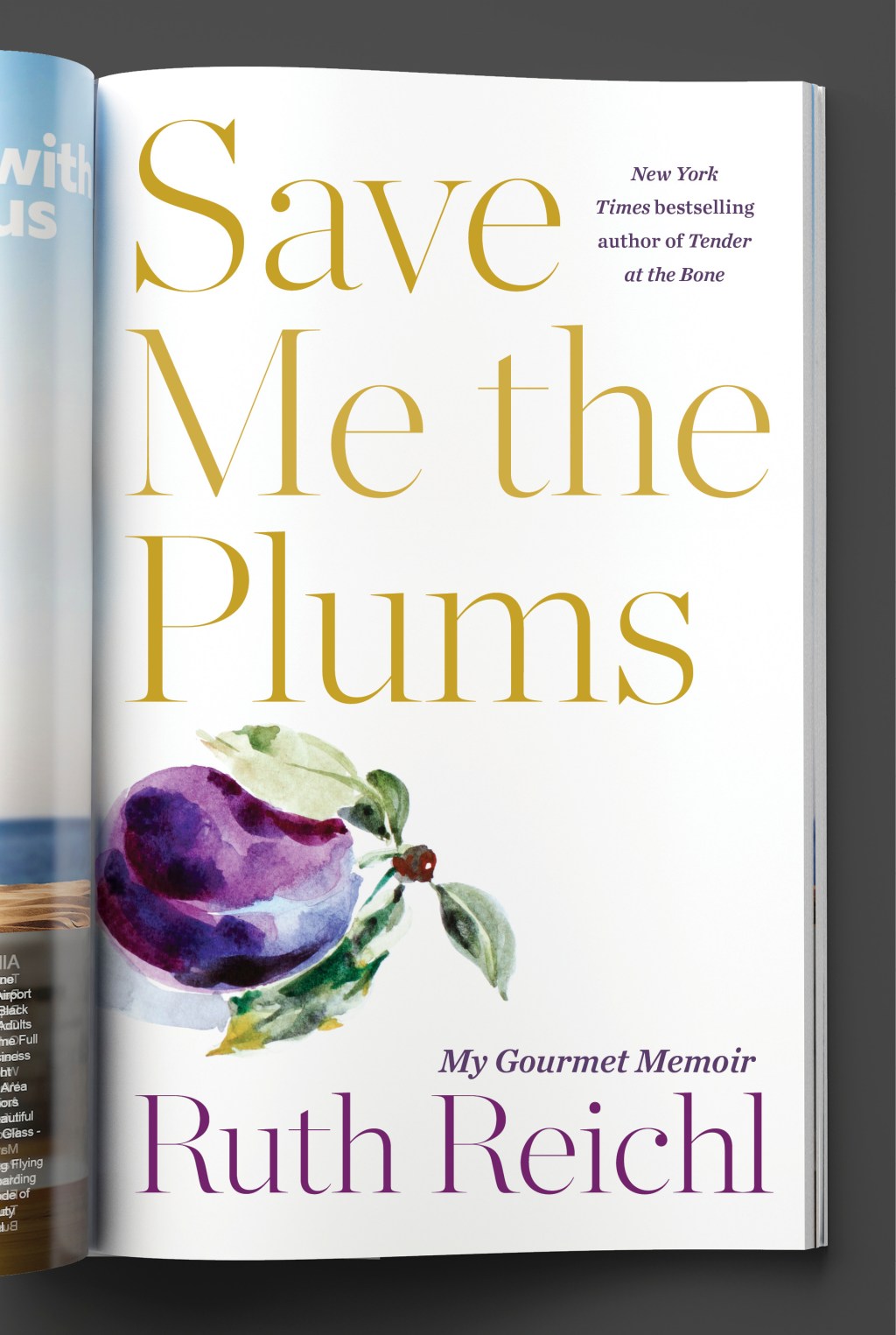
    Save Me the Plums: Ruth Reichl’s Memoir

                A decade ago, out of all the food magazines published, the most famous was Gourmet, which offered a sophisticated look at culinary trends and cookery. And Ruth Reichl, who formerly had been the food critic for the New York Times, a job that entailed wearing disguises because her photo was plastered on a large number of kitchen walls in the city’s restaurants, was the editor-in-chief of the magazine. It’s a story she recounts in her latest book, Save Me the Plumst (Random House; 2019 $27). You don’t need to be a serious foodie to enjoy her take on what she calls “the golden age of magazines.”

                Reichl didn’t want the job and though she had collected Gourmet magazines starting when she was eight, she saw it as old fashioned and stuffy and at first said no. But the publisher wanted to take the magazine in a different direction and saw Reichl as the person to be able to make that happened. So, she signed on to a job that included a limousine service, first class airfare and a lavish expense account. The selling point after turning it down the first time was that she would be home in the evenings with her son, not critiquing restaurants.

                “I never wanted to become that person,” says Reichl about the luxuries and perks. She recalls flying coach and seeing two of her colleagues boarding the same flight as they were going to the same place and they looked at her in wonderment as they headed to the first class section. She took the bus until a limo driver shamed her into using his service on a regular basis.

                 Despite being the food editor and restaurant critic at the Los Angeles Times, the experience of being Gourmet’s editor-in-chief made Reichl quickly learned how much she didn’t know. She recalls freaking her first day when the staff started talking about TOCs and she had to desperately call a friend and ask what that meant as she didn’t want to look ignorant in front of her employees.

                “Table of Contents,” she was told. How simple but it shows the type of learning curve Reichl was encountering in her new career.

                Being Reichl, multiple James Beard-winning and bestselling author, she also includes a few recipes in her book.

                “All of my books have recipes, so I had to have some,” she says. That includes the turkey chili she and her staff used when the gathered in the Gourmet test kitchen on 9/11 and cooked for the first responders.

     “I still love cooking and get an enormous amount of pleasure from it,” she says. “And I like to cook for other people. Every morning I ask my husband what he would like to eat.”

    Indeed, for Reichl, food is such a sensory experience that she often likes to eat alone so she can savor every mouthful, letting it take her back to the source of what she’s consuming.

                From the magazine folded and everyone went home, Reichl knew she’d write a book about her time at Gourmet and kept copious notes and saved emails. “But then my editor had to torture me into actually writing it.”

                She wants readers to come along for the ride when reading her book.

                “I want them to get the sense of what it was like,” says Reichl. “I want them to enjoy themselves as much as I did.”

    Ifyougo:

    What: Ruth Reichl in-conversation with Louisa Chu, a Chicago based food writer.

    When: Wednesday, April 24 at 6 pm

    Where: 210 Design House, 210 West Illinois, Chicago, IL

    Cost: The cost of on ticket is $56 ($58.95 w/service fee) and includes a copy of the book, wine, and tastes made from Ruth’s book My Kitchen Year. 2 tickets include one book, wine and tastes for $80 ($83.79 w/service fee). To purchase, visit brownpapertickets.com/event/4102551

    FYI: The event is sponsored by the Book Cellar. For more information, (773) 293-2665.

  • Food of the Italian South by Katie Parla

    Food of the Italian South by Katie Parla


    U Pan Cuott. Photo credit Ed Anderson.

    It’s personal for Katie Parla, award winning cookbook author, travel guide and food blogger who now has turned her passion for all things Italian to the off-the-beaten paths of Southern Italy, with its small villages, endless coastline, vast pastures and rolling hills.
    “Three of my grandmother’s four grandparents are from Spinoso, deep in a remote center of Basilicata,” says Parla, the author of the just released Food of the Italian South: Recipes for Classic, Disappearing Lost Dishes (Clarkson Potter 2019; $30).

    Katie Parla in Southern Italy. Photo credit Ed Anderson.


    Parla is a journalist but she’s also a culinary sleuth, eager to learn all about foodways as well as to chronicle and save dishes that are quickly disappearing from modern Italian tables. She’s lived in Rome since graduating with a degree from Yale in art history and her first cookbook was the IACP award winning Tasting Rome. She’s also so immersed herself in Italian cuisine that after moving to Rome, she earned a master’s degree in Italian Gastronomic Culture from the Università degli Studi di Roma “Tor Vergata”, a sommelier certificate from the Federazione Italiana Sommelier Albergatori Ristoratori, and an archeological speleology certification from the city of Rome.


    Matera. Photo credit Ed Anderson.


    In tiny Spinoso, Parla and her mother checked into one of the few available rooms for rent and went to office of vital statistics to find out more about family history.
    “We made the mistake of getting there before lunch,” she says. “You could tell they really want to go home and eat. They told us there were only four or five last names in the village and since ours wasn’t one of them, then we couldn’t be there.”


    Caiazzo. Photo credit Ed Anderson.


    But Parla found that sharing wine with the officers soon produced friendlier results (“wine and food always does that in Italy,” she says) and after leafing through dusty, oversized ledgers written in fading, neat cursive they were able to locate the tiny house where her grandfather had lived as well as other extensive family history.
    “Thank goodness for Napoleon, who was really into record keeping, no matter his other faults” says Parla.

    Katie Parla. Photo credit Ed Anderson.


    Many of her ancestors were sheepherders, tending sheep, staying with a flock for a week in exchange for a loaf of bread. This poverty was one reason so many Southern Italians left for America. But it also is the basis for their pasta and bread heavy cuisine says Parla.
    To capture the flavors of this pastoral area, Parla visited restaurants and kitchens, asking questions and writing down recipes which had evolved over the centuries from oral traditions.
    Describing Rome, Venice and Florence as “insanely packed,” Parla believes that those looking for a less traveled road will love Southern Italy, an ultra-authentic region to the extent that in Cilento, for example, there are more cars than people on the road.


    Spezzatino all Uva . Photo credit Ed Anderson.


    “There’s all this amazing food,” she says. “But also, there’s all this unspoiled beauty such as the interior of Basilicata. And the emptiness, because so many people are gone, creates this sense of haunted mystery. It’s so special, I want people to understand the food and to visit if they can.”
    For more information, visit katieparla.com


    ’U Pan’ Cuott’
    Baked Bread and Provolone Casserole

    Serves 4 to 6
    1 pound day-old durum wheat bread (I like Matera-style; see page 198), torn into bite-size pieces
    3 cups cherry tomatoes, halved
    7 ounces provolone cheese, cut into 1-inch cubes
    1 teaspoon peperoni cruschi powder or sweet paprika
    2 garlic cloves, smashed
    1 teaspoon dried oregano
    ½ teaspoon peperoncino or red pepper flakes
    ¼ cup plus 2 tablespoons extra-virgin olive oil
    Sea salt

    Overview:
    In Bernalda, a town in Basilicata best known as the ancestral village of Francis Ford Coppola, there are many ancient bread traditions. The town isn’t far from the durum wheat fields of the Murgia plateau and the famous bread towns Matera and Altamura. One of the town’s classic dishes is ’u pan’ cuott’ (Bernaldese dialect for pane cotto, “cooked bread”). Families would bake stale slices of Bernalda’s enormous 3-kilogram loaves with whatever food scraps they could find, resulting in a savory, delicious bread casserole bound by gooey bits of melted provolone. Use the crustiest durum bread you can find or bake.
    Method:
    Preheat the oven to 475°F with a rack in the center position.
    Place the bread in a colander, rinse with warm water, and set aside to soften. The bread should be moistened but not sopping wet.
    In a large bowl, combine the tomatoes, provolone, peperoni cruschi, garlic, oregano, peperoncino, and ¼ cup of the olive oil. Season with salt.
    When the bread crusts have softened, squeeze out any excess liquid and add the bread to the bowl with the tomato mixture. Stir to combine.
    Grease a baking dish with 1 tablespoon of the olive oil, pour in the tomato mixture, and drizzle the remaining 1 tablespoon olive oil on top. Bake until the top is heavily browned, and the provolone has melted, about 20 minutes. Serve warm.
    Spezzatino all’Uva
    Pork Cooked with Grapes

    Serves 6 to 8
    2 tablespoons extra-virgin olive oil
    2 pounds boneless pork shoulder, salted and cut into 2-inch cubes
    1 garlic clove, smashed
    1 cup dry red wine (I like Aglianico del Vulture)
    2 bay leaves
    4 cups pork stock or water
    1 bunch of red grapes (I like Tintilia grapes), halved and seeded

    Overview:
    The foothills east of the Apennines in Molise grow Tintilia, an indigenous red grape known for its low yield and pleasant notes of red fruit and spices. Each year, the majority of the harvested grapes are pressed to make wine, with the remainder reserved for jams and even savory dishes like this pork and grape stew, which is only made at harvest time. The slight sweetness of the grapes mingles beautifully with the savory pork and herbaceous notes of the bay leaves. Salt the pork 24 hours in advance.
    Method:
    Heat the olive oil in a large skillet over medium heat. When the oil begins to shimmer, add the pork, working in batches as needed, and cook, turning, until it is browned on all sides, 7 to 8 minutes. Remove the pork and set aside on a plate.
    Reduce the heat to low. Add the garlic and cook until just golden, about 5 minutes. Add the wine, increase the heat to medium, and scrape up any browned bits from the bottom of the pan. When the alcohol aroma dissipates and the liquid has nearly evaporated, about 2 minutes, add the bay leaves.
    Return the pork to the pan. Add enough stock so the meat is mostly submerged and season with salt. Cook, stirring occasionally, for 1½ hours more, until the pork is fork-tender. Add the grapes at the 1 ¼ hour mark and continue cooking until they are tender. If the sauce becomes too dry, add a bit more stock (you may not need all the stock). Serve immediately. 
    Ifyougo:
    What: Katie Parla has three events in Chicago
    When & Where: March 19 from 6:30 to 9pm. Katie will be celebrating the release of her cookbook with her friends at Monteverde, 1020 West Madison Street, Chicago, IL. The cost of the dinner is $150 including food, wine pairings, tax, gratuity and copy of the book. (312) 888-3041.
    When & Where: March 20 from 6 to 9pm. Katie will be hosting an aperitivo and signing at Lost Lake’s Stranger in Paradise, 3154 W Diversey Ave., Chicago, IL. No booking necessary, just come on down. Books will be sold on site by Book Cellar. (773) 293-6048.
    Menu of five cocktails from the book, $12.
    Three small plates (two pastas from Pastificio di Martino and olive oil poached tuna, endive and olives) from Chef Fred Noinaj, $12-15.
    When & Where: March 21 from 6 to 7:30pm. Katie will host an aperitivo and sign books, which will be available for purchase at Bonci Wicker Park, 1566 N Damen Ave., Chicago, IL. (872) 829-3144.

  • May We Suggest: Restaurant Menus and The Art of Persuasion

    May We Suggest: Restaurant Menus and The Art of Persuasion

    Whether we go out to dine, order online or grab a sack of burgers from McDonald’s on our way home, we use a familiar tool to decide what to get. But it’s one we seldom even think about though it ultimately impacts our budget and our food.

                  “We just take menus for granted, that’s one of the things that was so intriguing to me,” says Alison Pearlman who may be one of the few people who doesn’t. She first started collecting them when traveling with her parents and respective step-parents as a teen throughout the United States and Europe. Now Pearlman, an art historian and food aficionado, has written May We Suggest: Restaurant Menus and The Art of Persuasion (Agate 2018; $16), which takes a look at menus ranging from gourmet restaurants to fast food and casual chains and those in between.

                  File it under “it’s a hard job but someone has to do it,” in researching her book, Pearlman visited over 60 restaurants in the greater Los Angeles area where she dined, collected or photographed menus and documented her experiences.

                  “It added up to 77 visits because I visited restaurants multiple times so I could try the drive-thru and the eat-in and I went to Applebee’s in one location and then to a different Applebee’s over the course of my research after the Applebee’s chain started to roll out these tablet menus and so I went to an  Applebee’s that had one of those” says Pearlman, an art historian, who also tried three different versions of a Domino pizza mobile ordering app.

                  As Pearlman views it, menus aren’t just a piece of paper (or a chalk board or sign above the counter), they’re living documents.

                  “It’s a piece of the performance,” says Pearlman. “The servers, the interior design and the décor all amplify the menu, they’re all part of the environment and I think of them as partners in persuasion. The whole theater of the restaurant and what the menu says has a large role to play in that theater.”

                  Pearlman research such subjects as how menus are created and why certain looks are chosen, the use of photos, choices offered, descriptive words, tantalizing hints of exotic ingredients and even ordering items not on the menu—the latter making you feel like a total insider.

    So why not just order instead of trying to understand why a menu is structured a certain way?

                  Pearlman says we should care because menus broker a central relationship in our life—that of eating out.

                  “According to the National Restaurant Association in the United States, restaurants get 48 percent of the money we spend on food,” she says. Research by Toast, a restaurant point-of-sale and management system, indicates that 51% of American diners go out to eat more than once a week.

                  “Crafty, well-designed menus satisfy both diners and restauranteurs, bringing harmony to the relationship,” says Pearlman. “They do this by limiting our choices in what we can buy and how we can dine while convincing us that what they’re offering is what we want. It’s really not too much to say they impact our happiness.”

                  As for Pearlman’s relationship with menus, after writing her book, she says she has lost her innocence.

                  “I look at them in a totally different way,” she says.

  • Israeli Soul: Easy, Essential, Delicious

    Israeli Soul: Easy, Essential, Delicious

    I had never heard of hummusiyas before reading Israeli Soul: Easy, Essential, Delicious by Michael Solomonov and Steven Cook (Rue Martin Books 2018; $35). It turns out word refers to the numerous restaurants in Israel specializing in hummus (who knew, right?).  The two authors, who own several award winning restaurants include Zahav (they won a James Beard Award for their cookbook of the same name), methodically researched traditional Israeli recipes for their book–the kind passed down through generations. Describing them as the “soul”of Israel, Solomonov then adapted these traditional recipes so they could easily be prepared in American kitchens. Their 5-Minute Hummus With Quick Tehina Sauce exemplifies that concept as do the 24 toppings for hummus also included in the book.

    Michael Solomonov Making 5-Minute Hummus

                      Solomonov and Cook timed the release of their beautifully photographed book to coincide with the anniversary of the founding of Israel 70 years ago. But I thought it would also be nice to talk about Israeli Soul and share recipes in conjunction with Hanukkah, which this year runs from Sunday,December 2 to Monday, December 10.  Sometimes also called the Festival of Lights, Hanukkah is an eight-day celebration of the victory of the Maccabees over the Syrian Greek army. Dishes traditionally served during the holiday include potato-leek latkes and fried challah sufganiyot, a type of jelly donut.                  

                      In their take on sufganiyot,  Solomonov and Cook use eggs to make a challah dough instead of the typical egg-less yeast dough most donut recipes call for. They then roll the sufganiyot after it comes out of the oven in a mixture of finely ground pistachios and sugar. Though if you want to be really traditional, according to Solomonov, you can substitute dried rose petals for the pistachios—if you can find them.

    Potato-Leek Latke

    Makes 1 large latke

    2 medium russet or Yukon Gold potatoes, peeled and grated

    3 leeks, whites only, thinly sliced and rinsed

    ¼ cup all-purpose flour

    1½ teaspoons kosher salt

    Canola oil, for frying

    Mix together the potatoes, leeks, flour, and salt in a large bowl. Set aside for 10 minutes to allow the potatoes to release some starch, which will help hold the latke together.

    Pour about ¼ inch of canola oil into a medium skillet and place over medium- low heat. Make one big pancake by spooning the batter into the skillet and pressing it down evenly in the pan. Fry for 10 to 15 minutes per side, or until cooked through and crispy on the outside. Let cool slightly, then cut into wedges.

    Turkish Salad

    Core, seed,and chop 3 red bell peppers. Chop 2 onions. Thinly slice 4 garlic cloves. Slice a bunch of scallions on the bias. Sauté the peppers with 1 tablespoon kosher salt and ¼ cup canola oil in a large skillet until soft, about 4 minutes. Add the onions and garlic. Cook until the onions are translucent, about 10 minutes.

    Fold in 1 pint halved cherry tomatoes. Add 2 teaspoons smoked paprika and 2 teaspoons ground coriander and toast the spices for about 2 minutes. Transfer to a bowl,add the sliced scallions, taste, and add a pinch of salt, a squeeze of lemon juice, and a drizzle of olive oil.

    5-Minute Hummus With Quick Tehina Sauce

    Makes about 4 cups (4 servings)

    Quick Tehina Sauce

    1 garlic clove

     Juice of 1 lemon

    1 (16-ounce) jar tehina

    1 tablespoon kosher salt

    1 teaspoon ground cumin

    1 to 1½ cups ice water

    Hummus

    2 (15-ounce) cans chickpeas, drained and rinsed

    Make the Tehina Sauce:

    Nick off a piece of the garlic (about a quarter of the clove) and drop it into a food processor.

    Squeeze the lemon juice into the food processor. Pour the tehina on top, making sure to scrape it all out of the container, and add the salt and cumin.

    Process until the mixture looks peanut-buttery, about 1 minute.

    Stream inthe ice water, a little at a time, with the motor running. Process just until the mixture is smooth and creamy and lightens to the color of dry sand.

    Make the Hummus:

    Add the chickpeas to the tehina sauce and process for about 3 minutes, scraping the sides of the bowl as you go, until the chickpeas are completely blended and the hummus is smooth and uniform in color.

    Fried Challah Sufganiyot

    Makes about 24.

    For doughnuts:

    ½ cup granulated sugar

    1 cup warm water

    1 packet active dry yeast

    3¾ cups all-purpose flour, spooned into cups and leveled  off

    1 teaspoon kosher salt

    1 tablespoon plus 2 teaspoons olive oil

    3 tablespoons canola oil, plus about 1 quart for frying, divided

    ½ cup egg yolks (about 6 large yolks)

    ⅔ cup butter, softened

    About 2 cups seedless raspberry jam

    For pistachio sugar:

    1 cup granulated sugar

    ½ cups shelled pistachios

    For the doughnuts: Mix sugar and water in the bowl of a stand mixer fitted with the dough hook. Stir in yeast. Let stand until foamy, 5 to 10 minutes. Add flour,salt, olive oil, 3 tablespoons canola oil and egg yolks. Mix on low speed until dough comes together and begins to pull away from sides of bowl, scraping sides and mixing with a spatula.

    Gradually mix in butter, mixing for another minute until blended. Scrape down bowl and continue mixing about 2 more minutes until very smooth. Remove dough hook. Cover bowl with plastic wrap; let dough rise at room temperature until quadrupled in volume, about 4 hours.

    For pistachio sugar: Whirl sugar and pistachios in food processor until nuts are finely ground. Transfer to shallow bowl; set aside.

    Fill large, deep, heavy saucepan with generous 2 inches of canola oil. Heat over medium heat until oil registers 350 degrees on candy thermometer. Line baking sheet with paper towels.

    Use small ice cream scoop to scoop up heaping balls of dough, dropping them into hot oil,adjusting heat as necessary to maintain oil temperature. Fry doughnuts in batches, turning, until golden, 4 to 6 minutes. Remove with slotted spoon to lined baking sheet. Cool slightly.

    Poke a hole in each doughnut with tip of paring knife. Spoon jam into large zip-top plastic bag, press out air, and twist the top until bag feels tight. Snip off a corner of the bag and squeeze jam into each doughnut until a bit oozes out. Roll filled doughnuts in pistachio sugar. Serve warm.

    The above recipes are excerpted from ISRAELI SOUL © 2018 by Michael Solomonov and Steven Cook. Photography © 2018 by Michael Persico. Reproduced by permission of Rux Martin Books/Houghton Mifflin Harcourt. All rights reserved.

  • The Cookbook Library: Four Centuries of the Cooks, Writers, and Recipes That Made the Modern Cookbook

    The Cookbook Library: Four Centuries of the Cooks, Writers, and Recipes That Made the Modern Cookbook

    Still worried about that extra Halloween candy you gobbled down?  Imagine how many miles you’d have to spend on the treadmill after attending the 1450 banquet, held in England celebrating the enthronement of an archbishop where guests munched on 104 oxen, six ‘wylde bulles,’ 1,000 sheep, 400 swans and such game birds such as bustards (larger than a turkey), cranes, bitterns, curlews and herons?

    “Our ancestors had gastronomic guts,” Anne Willan tells me as we chat on the phone, she in Santa Monica, California where there’s sunshine and me in the cold Great Lakes region.  I find it fascinating to read old menus and descriptions of banquets and feasts and for that Willan, founder of famed French cooking school École de Cuisine la Varenne, recipient of the IACP Lifetime Achievement Award and author of 30 cookbooks, is the go to person.

    Even better, after collecting cookbooks for some 50 years and amassing a collection of over 5000 tomes, last year Willan and her husband, Mark Cherniavsky immersed themselves in their antiquarian cookbook library and came out with The Cookbook Library: Four Centuries of the Cooks, Writers, and Recipes That Made the Modern Cookbook (University of California Press $50).Anne Willan

    “Seals were eaten on fast days along with whale, dolphin, porpoise and thousands of other fish,” says Willan. Hmmm…that’s different than the macaroni and cheese and fish sticks I used to eat at the homes of my Catholic friends on Fridays.

    Here we peruse four centuries of gastronomy including the heavily spiced sauces of medieval times (sometimes employed because of the rankness of the meat), the massive roasts and ragoûts of Sun King Louis XIV’s court and the elegant eighteenth-century chilled desserts. One for the interesting detail, Willan also tells the story of cookbook writing and composition from the 1500s to the early 19th century. She highlights how each of the cookbooks reflects its time, ingredients and place, the  recipes adapted among the cuisines of Germany, England, France, Italy and Spain as well as tracing the history of the recipe.

    Historic cookbooks can be so much different than ours, ingredients unfamiliar and instructions rather vague. For example, Willan points out the phrase “cook until” was used due to the difficulty of judging the level of heat when cooking a dish over the burning embers in an open hearth. It wasn’t until the cast-iron closed stoves of the 19th century that recipes writers begin were finally able to give firm estimates for timing.

    For food historians and even those just appreciative of a good meal, the book is fascinating. For me as a food writer, I wonder about covering a dinner where birds flew out of towering pastries, seals were served and eels baked into pies and it was often wise to have a taster nearby in case someone was trying to poison you.

    Anne Willan 1

    The following recipe is from The Cookbook Library.

    Rich Seed Cake with Caraway and Cinnamon

    This recipe is based on a cake in The Compleat Housewife by Eliza Smith, published in London in the 1700s.  Willan, ever the purist, suggests mixing the batter by hand as it was done 300 plus year ago.

    “The direct contact with the batter as it develops from a soft cream to a smooth, fluffy batter is an experience not to be missed,” she says. “If you use an electric mixer, the batter is fluffier but the cake emerges from the oven less moist and with a darker crust.”

    At times, Willan needs to substitute ingredients. The original recipe listed ambergris as an option for flavoring the cake. “Ambergris,” writes Willan, “a waxy secretion from a sperm whale, was once used to perfume foods. As it is now a rare ingredient, I’ve opted for Mrs. Smith’s second suggestion, of cinnamon, which marries unexpectedly well with caraway.”

    1 pound or 31⁄2 cups) flour

    1 2⁄3 cups sugar

    6  tablespoons caraway seeds

    5 eggs

    4 egg yolks

    1 pound or 2 cups butter, more for the pan

    11⁄2 tablespoon rose water or orange-flower water

    2 teaspoon ground cinnamon

    Heat the oven to 325ºF. Butter a 9-inch springform pan. Sift together the flour and sugar into a medium bowl, and stir in the caraway seeds. Separate the whole eggs, putting all the yolks together and straining the whites into a small bowl to remove the threads.

    Cream the butter either by hand or with an electric mixer fitted with the paddle attachment. Add the yolks two at a time, beating well after each addition. Beat in the rose water. Whisk the egg whites just until frothy, then beat them, a little at a time, into the egg yolk mixture. Beat in the cinnamon. Finally, beat in the flour mixture, sprinkling it a little at a time over the batter. This should take at least 15 minutes by hand, 5 minutes with a mixer. The batter will lighten and become fluffier. Transfer the batter to the prepared pan.

    Bake until the cake starts to shrink from the sides of the pan and a skewer inserted in the center comes out clean when withdrawn, 11⁄4 to 11⁄2 hours. Let the cake cool in the pan on a rack until tepid, then unmold it and leave it to cool completely on the rack. When carefully wrapped, it keeps well at room temperature for several days and the flavor will mellow.


  • Chefs, Drugs and Rock & Roll: How Food Lovers, Free Spirits, Misfits and Wanderers Created a New Profession

    Chefs, Drugs and Rock & Roll: How Food Lovers, Free Spirits, Misfits and Wanderers Created a New Profession

    Author Photo. Andrew Friedman. Photo Credit Evan SungAndrew Friedman calls himself a chef writer because, as much as he loves food, he’s passionate about the stories chefs have to tell.

    “My point of view is writing not so much about the food but about the chefs, that’s why I say I’m a chefie not a foodie,” he says. “I think too many well-known chefs are almost portrayed as cartoon characters and in a broad stroke. I wanted to spend time with them and really get to know their stories, who they really are and their impact on how we eat now. Like Wolfgang Puck. He’s a tremendous cook but people call him the first celebrity chef. He’s so much more than that.”

    To accomplish this, Friedman interviewed over 200 chefs and food writers and others who were leading the food revolution against processed and packaged foods.

    “I’m such a geek I would spend three hours with someone just to get a nugget or two,” he says.

    The results? An accumulation of tens of thousands of transcript pages and his latest book,  Chefs, Drugs and Rock & Roll: How Food Lovers, Free Spirits, Misfits and Wanderers Created a New Profession (Ecco 2018; $27.99), where he recounts how dedicated and imaginative men and women in the 1970s and the 1980s, who were willing to challenge the rules, revolutionized America’s food scene.

    Now chefs are like rock stars, often known just by one name, commanding their own empires of cookbooks, TV shows, restaurants, cookware and food products. But Friedman points out that up until 1976, the United States Department of Labor categorized cooks as domestics. It took lobbying by the American Culinary Federation, at the urging of Louis Szarthmary, the late Hungarian American chef who owned The Bakery in Chicago and wrote The Chef’s Secret Cookbook, a New York Times bestseller, to change the classification into a profession.

    “I wanted to show how this became a viable profession,” he says. “I was talking to Jody Buvette, owner of Buvette in New York and she remembers sitting her father down and  saying ‘I have two bad things to tell you. I’m gay and I want to be a cook.’ It was like telling your upper middle-class parents that you wanted to be a coal miner.”

    Friedman, whose knowledge about restaurants, culinarians and food seems delightfully endless, chose three cities to focus on—San Francisco, Los Angeles and New York. What does he think of Chicago’s food scene?

    “It’s great,” he says. “I love dining in Chicago and you have some brilliant chefs but I think much of the beginnings started in those three cities.”

    Besides, he has those piles of transcripts. There’s surely more than a few Chicago stories in all those pages.  In the meantime, Friedman gives us a wonderfully written read about a defining time—one that in some ways separates frozen TV dinners and what many restaurants are serving today.

    Ifyougo:

    What:  5 course 80s-era dinner inspired by Chefs, Drugs and Rock & Roll with wines selected by Sommelier Rachael Lowe and conversation at Spiaggia Restaurant

    When: Tues. October 2, 7 pm

    Where: Spiaggia Restaurant, 980 North Michigan Ave., Chicago, IL

    Cost: $150 per person

    FYI: 312-280-2750; spiaggiarestaurant.com


    What: Talk with Andrew Friedman about Chefs, Drugs and Rock & Roll

    When: Wed, October 3, 6:30 to 8:30 pm

    Where: Read It & Eat, 2142 North Halsted St., Chicago, IL

    Cost: Purchase a ticket and book combo for $36.45 or 2 tickets and a book combo for $46.45

    FYI: 773-661-6158; readitandeatstore.com


  • The Mermaid Handbook: An Alluring Treasury of Literature, Lore, Art, Recipes, and Projects

    The Mermaid Handbook: An Alluring Treasury of Literature, Lore, Art, Recipes, and Projects


    OLYMPUS DIGITAL CAMERA
    Sea shell cookies perfect for Mermaids to nibble

    Life is busy for a lovely mermaid (and aren’t they all?). There’s riding seahorses through shimmering sea foam capped with frothy white waves, finding the perfect rock on which to display their fish-like tails sheathed in  iridescent spangles so they sparkle in the sunlight, combing their beautiful long locks and, of course, singing enticingly so that sailors forsake their duty and travel to their doom all to get a better look.

    For mermaids as well as mermaid wannabees or just those who love reading about these mythical creatures, folklore expert Carolyn Turgeon introduces us to their world in her recently released OLYMPUS DIGITAL CAMERA (Harper Design 2018; $35).

    Turgeon, the editor-in-chief of Faerie Magazine, a quarterly print publication and author of several books including The Faerie Handbook, showcases all things mermaid by dividing her handbook into four sections. In “Fashion and Beauty” we learn techniques on creating mermaid hair—face it, haven’t you always wanted a reason to sprinkle glitter throughout your locks. Of course, then you need a mermaid mirror to admire yourself. Not to worry Turgeon includes directions.  “Arts and Culture” tells the stories of sirens in classic mythology and contains luscious reproductions of mermaid art and recounts tales of mermaid from around the world. Fair warning—mermaids aren’t always nice.

    You don’t have to go down to the sea for the section on “Real Mermaids and Where to Find Them.” Here, Turgeon takes us to the advent of mermaids as entertainers starting with the story of Annette Kellerman who learned to swim like a fish in her native Australia to overcome rickets and bowed legs, eventually becoming strong enough to swim an average of 45 miles a week. So good at what she did, Kellerman began swimming for money at young age and by 1907 was performing as the Australian Mermaid throughout the United States in glass tanks and in 1916 starred in A Daughter of the Gods, the first movie to cost over a $1 million to make as well as the first one featuring a naked woman (don’t worry, her long mermaid hair covered the most private of parts).  Turgeon takes us into midcentury when there were a plethora of bars and restaurants with tanks for mermaids to perform in. Surprisingly, at least for me, not all of these have disappeared and some mermaid cocktail lounges are still in business including the Dive Bar in Sacramento, California, the Sip ‘N Dip Tiki Lounge in Great Falls, Montana and the Wreck Bar in Fort Lauderdale, Florida. We also learn the stories of women who have made their livings as mermaids.

    OLYMPUS DIGITAL CAMERA
    Mermaid libations

    Of course, even a mermaid has to eat and the last section of Turgeon’s delightful book “Food, Entertaining and Stories of the Sea” includes recipes for the types of edibles a mermaid might nibble such as Savory Sesame Seed and Seaweed Cookies, Salmon Poke with Wild Rice, Pineapple and Macadamia Nuts and an assortment of sea-themed shaped cookies covered with royal icing. And because what mermaid wouldn’t want to set the perfect table to indulge in such delights, there are crafts to create seashell fortune party favors and shell cocktail glasses to sip such libations as Blue Sea Cocktails and Seductive Siren Cocktails (recipes included).

    Those wanting to indulge their inner mermaids can try the recipes below.

    Honey Gingerbread Cookies with Royal Icing

    8 ounces of unsalted butter

    One and ½ granulated sugar

    2 cups good quality honey

    2 teaspoons baking powder

    4 teaspoons ginger

    4 teaspoon cinnamon

    1 teaspoon cloves

    1 teaspoon nutmeg

    ½ teaspoons salt

    ¼ cup cocoa powder, optional

    3 large eggs

    9 cups all-purpose flour

    1 large egg, lightly beaten and mixed with 1 teaspoon water

    Melt the butter in a medium sized saucepan over medium low heat. Add the sugar is still mostly dissolved, then pour in the honey and stir to combine. Cook until very hard and mixture is smooth, but did not boil. Remove from heat.

    Sift together baking powder, ginger, cinnamon, cloves, nutmeg and salt. Add up to 1/3 cup cocoa powder, depending on color desired. Add to the warm butter mixture and stir until well combined. Set aside to cool to room temperature.

    Transfer the mixture to the ball of an electric mixer and add three eggs, beating until combined. Gradually adding flour, beating all the while.

    When all the flour is absorbed, divided the dough in half and wrapped in several layers of plastic wrap.

    Store in a cool place for at least 24 hours, or up to a week in the refrigerator. If the Joe is refrigerated bring it to room temperature before proceeding.

    When you’re ready to bake, preheat the oven to 375°F. Unwrap the dough and place on a well-floured work surface. Knead flour into the dough until it is very smooth, pliable and not sticky. Roll up to ¼- inch thickness for small cookies, a little thicker for larger cookies.

    Use cookie cutters to cut cookies into mermaid friendly shapes such as seahorses, shells and starfish.

    Big six minutes, checking to see if any bubbles form. If they do, gently smooth with a spatula and continue to bake until done, about nine minutes total for medium cookies and up to 14 minutes for larger ones.  Remove to a wire rack and use a pastry brush to apply coat of the lightly beaten egg. Cool completely.

    Decorate with Royal Icing (see recipe below).

    Royal Icing

    2 pounds of powdered sugar

    ½ teaspoon cream of tartar

    1 to 2 teaspoons vanilla extract

    10 tablespoons liquid pasteurized egg whites

    Combine powdered sugar, cream of tartar, vanilla and pasteurized egg whites in the bowl of a stand mixer and beat high speed with a paddle attachment for 4 to 5 minutes.

    Store in an airtight container in the refrigerator.

    Blue Sea Cocktail

    1 ½ ounces white rum

    1 ounce Blue Curaçao

    ½ ounce Suze or any aperitif

    ½ ounce Luxardo Maraschino Liqueur

    ½ ounce simple syrup

    Dash fresh lemon juice

    Ice cubes

    Combine all the ingredients in the shaker.

    Shake until will chilled. Strain into a cocktail glass, on the rocks and serve immediately.

    From The Mermaid Handbook by Carolyn Turgeon.