Category: Fiction

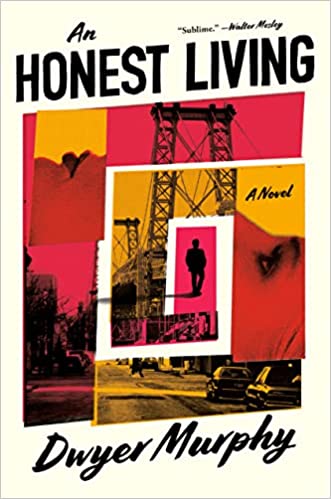
  • An Honest Living

    An Honest Living

    “Noir land is always smoke and mirrors, and for those who like entering that world, be assured that Murphy is already at work on his next book.”

    Anchored in life by little except a few friends, a love of books and cinema, and his nascent law practice—a downward slope from his previous position with a prestigious law firm—we never learn the name of the narrator in An Honest Living, Dwyer Murphy’s first novel. Even his clients seem unsure of who he is, and when one gives him a going away present with his name misspelled, our narrator can only ruefully observe “they were only off by a few letters.”

    A guy like this makes a perfect patsy and that’s what happens when Anna Reddick hires him to determine if her husband is selling off her valuable collection of rare books. It seems easy enough. Staging a meeting with Reddick’s husband at the Poquelin Society which he describes as “a scholarly society dedicated to the art, science and preservation of the book, whatever that meant,” he quickly scores the proof he needs.

    Case solved. Ha! As it could be that easy in a neo-noir novel set in a time and place where everyone seems to have a secret to hide and nothing is as it seems. And that applies also to the people the detective meets. It turns out the woman who hired our detective is not Anna Reddick.

    Now, one of the noir fundamentals dictates that there’s a femme fatale, the kind of dame a hero shouldn’t fall for, but of course, always does. And that dame is the real Anna Reddick, a successful author and heir to old New York money. She hires and beguiles our detective to investigate the disappearance of her husband. Marital strife, a possible suicide or maybe murder, theft, and mystery—why wouldn’t you fall for a woman like that?

    There are layers to this droll, atmospheric novel including the inside jokes the author wants us to get. If you’re wondering about the Poquelin Society, don’t bother trying to join. It doesn’t appear to exist, at least according to a Google search. But there was a French playwright and actor named Jean-Baptiste Poquelin, though he was better known by his stage name, Molière.

    But the biggest of the wink and nods is for movie buffs familiar with the 1974 Jack Nicholson and Faye Dunaway movie Chinatown, directed by Roman Polansky. The plot of An Honest Man is an homage to this great noir classic and the book echoes many of its plot components. The book’s title derives from a conversation Nicholson had in the barbershop scene Chinatown.

    But Chinatown is all Los Angeles in 1937 and the story revolves around water rights, incest, and murder. An Honest Living is New York through and through from the scenes that our detective spies from the G Train and the window of his brownstone or the streets he walks littered with trash and 24-hour diners. It’s Manhattan before the financial meltdown—urban, somewhat gritty, and unhomogenized.

    Murphy has taken that time period and our knowledge of the looming crisis and created a compelling mystery set in a world of jaded hopes and ambiguous relationships. There’s the overwhelming sense that the other shoe will drop and when it does, it will come down heavy on our somewhat hapless narrator.

    Noir land is always smoke and mirrors, and for those who like entering that world, be assured that Murphy is already at work on his next book.

    This review previously appeared in the New York Journal of Books.

    Published by Viking Books, it is also available in audiobook and Kindle formats.

  • Jobs For Girls With Artistic Flair

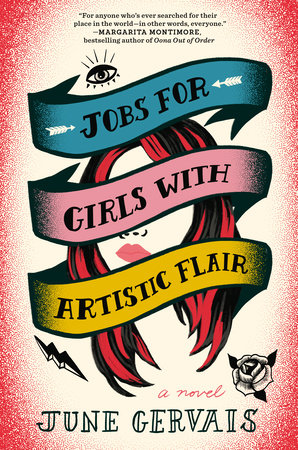
    Jobs For Girls With Artistic Flair

    June Gervais, author of Jobs For Girls With Artistic Flair (Pamela Dorman Books 2022 available in hardcover, Kindle edition and on Audible), talks about her highly praised first novel.

    What inspired you to write about an aspiring tattoo artist? Why did you decide to set it in the 1980s?

     My fascination with tattoos was sparked in childhood, and the tattoo shop setting felt ripe for stories.But when I started the book that became Jobs for Girls with Artistic Flair, I actually didn’t plan to write about an aspiring apprentice in the 1980s. I imagined Gina Mulley as a single mother, an established tattooer in her thirties, circa Y2K, when tattooing really began to catch fire in mainstream culture. I was 19 when I started writing this book, and I thought it would carry more weight if it included a character who was further into adulthood.

     As I dug deeper into the story, however, a mentor encouraged me to write a chapter set in Gina’s youth. The resulting scene had such energy, and was so off-the-wall, that I wanted to see what happened next. The fact that Gina’s teens and early twenties would have lined up with the 1980s turned out to be a stroke of luck, because although I didn’t know it yet, tattooing at that time had a much different vibe. It was riskier, more secretive; in other words, it attracted the kind of misfits who make for good characters.

     What kind of research did you do to learn about the tattoo industry?

    Besides scouring books and documentaries, I interviewed and shadowed ten different tattoo artists, and every one of them taught me something unique and valuable. A few of Gina’s life experiences—like buying her first tattoo machines from an acquaintance who was headed to jail—are drawn from the life of a real-life artist, Lynn TerHaar, the first woman to open a tattoo shop in our county. Many of the fun details about old-school tattooing were furnished by Marvin Moskowitz, a third-generation tattooer whose family had a well-known shop on the Bowery before tattooing was outlawed in New York City. I spent time with Michelle Myles of Daredevil Tattoo, who is not only a veteran artist but a scholar of the art form, and runs a museum within her shop.

    I often met these people through moments of synchronicity that left me feeling awed and grateful. One of the most moving was stumbling on the artist who tattooed my mother in the 1980s. She turned out to be a well-known tattooer named Marguerite, one of the first women ever to tattoo on Long Island. I’d had no idea.

     At times, Gina struggles to adapt when confronted with change—or lack thereof—in both in her professional and personal spheres. Often, it seems like all the odds are stacked against her. Why was it important to you to show Gina faced with such adversity?

     I want stories to be honest about the perils of uphill climbs. If you desperately want to learn a craft, but no one’s paying you to do it—and you’re already weighed down with responsibilities—and you’re short on money, time, or a supportive community—what do you do? Well—you scrape together everything you can and plow ahead; but there’s no guarantee that your labor will ever bear fruit. You can have all the self-discipline and passion in the world, work late into the night or wake before sunrise, but sometimes you’re still thrown back to square one, by events completely out of your control. So you make Plan B and Plan K and Plan Q. You dig deep and find new reasons to keep going, and you find traveling companions, if you can.

     I have felt all of this keenly in my quest to write while still caring for loved ones, paying the bills, and clumsily trying to be a decent citizen of the world. All my urgency and frustration—and all the breakthroughs and moments of growth and beauty—ended up in Gina’s story.

     What’s your connection to, or history with, tattoos?

    I was six years old the first time I walked into a tattoo shop; my mom was getting tattooed, and she took me along. This was in the late 1980s, roughly the same time when my book is set—well before tattoos became mainstream, especially for women—and I was too young to know that the experience I was having was highly unusual. I also had no idea that culture-at-large often viewed tattoos as trashy or dangerous. Mom also studied karate, so I spent a lot of time at her dojo, where many people were tattooed. Because of her, I associated tattoos with love and beauty and strength.

    Throughout my childhood, I used to sit beside my mom tracing the lines of her tattoo with my finger. That butterfly on her wrist is probably the most influential piece of art in my life. When I got my first tattoo on my eighteenth birthday, she came with me.

    The book deals with dual themes of work and finding a vocation. Gina and Rick (a fellow tattoo artist) are both extremely passionate about their work while Gina’s brother Dominic fell into tattooing because he was good at it. And Anna is stuck in a dead-end job but trying to discover her calling. Can you discuss how these themes affect Gina and the other characters?

     Gina has grown up in an insular, go-it-alone family where her mother and brother work to pay the bills, period; she hasn’t been exposed to people who are striving for some common good while also supporting their families. Both Rick and Anna, on the other hand, have been raised in environments where contributing to a larger community is highly valued. Rick mentions at one point that his parents are in helping professions, and even as a tattoo artist, he wants to do whatever good he can. Clues from Anna’s life point to a faith background that emphasized service. These two people really introduce Gina to the idea of vocation. 

     This is eye-opening for Gina, but complicates her relationship with her brother Dominic. At one point, she wanted nothing more than to follow in Dominic’s footsteps. Now she is baffled and angry when he won’t use his position as a business owner to speak out against injustice in their town—which is something I think a lot of Gen Z readers will relate to. What Gina eventually comes to understand is that for Dominic, work holds a sense of purpose, too; that purpose is just confined to his immediate family and friends. But it’s one more rift that makes Gina question whether she still belongs at this tattoo shop she always considered home.

    Tattoo tastes and trends have changed a lot since the 80s. What kind of designs do you think Gina would be creating today?

     Luckily for Gina, the kind of botanical designs she created for Anna have grown in popularity the past few years. So have the dotwork and stippling you see in the book’s illustrations. But in order to make a living, most tattoo artists need to do a good deal of whatever’s popular in addition to what interests them, and demand is sometimes driven by what’s trending on Pinterest or Instagram—I saw a very funny clip on Inked Magazine’s YouTube channel where artists were bemoaning how many lions and pocketwatches they’ve done lately. Gina would also probably be getting a lot of requests for lettering, tiny minimalist tattoos, watercolor tattoos, and mandala-style ornamental work, and I’m sure she’d be getting inquiries about hand-poked tattoos… But I imagine Gina getting most excited about a client who gave her the license to create a large-scale piece just for them, something imaginative and new.

     The book certainly has a feminist bent, and touches on social justice—was this choice intentional or did these elements arise organically as you wrote? How does Gina think through what we owe ourselves and each other?

    I think writers always circle back around to their obsessions, and from the time I was little, I’ve had this built-in obsession—in any given situation—about 1) whether things are being done fairly, 2) whether everybody is okay, and in response to all that, 3) whether I am doing enough. Sometimes I manage to channel this into effective action; sometimes it just manifests as grief and anxiety. And I think the same could be said for Gina in this book. There is no single character in Jobs for Girls who is straightforwardly, autobiographically me; but Gina gets angry about racist real estate practices because I’m angry about racist real estate practices. Anna is haunted by the specter of war because I am, too. Rick’s preoccupation with the question “De qué sirve?”, regarding his work—essentially, “what good does it do?”—is very much my own.

    I love that you also asked about what we owe ourselves. In 1986 Marie Shear wrote, “Feminism is the radical notion that women are people.” And amidst all Gina’s conversations with Rick, in which her eyes are opening to other people’s experiences of injustice, she’s also having another awakening: Maybe my wellbeing and my thoughts matter, too.

     If you went to Gina’s shop, what kind of tattoo would you get?

    I love this question! I think I’d want an oil lamp—or maybe a desk lamp?—tattooed somewhere near my foot.

    The lamp thing alludes to two quotes that were deeply meaningful to me as I persevered with this novel. One is from E.L.  Doctorow: “Writing a novel is like driving a car at night. You can see only as far as your headlights, but you can make the whole trip that way.” The other is an ancient line of sacred poetry: “Your word is a lamp to my feet and a light to my path.” These two quotes meant so much to me that for years, I told myself: If I ever get this published, I’m going to get a tattoo of a lamp somewhere near my foot. Because the thing about the headlights is true, but I don’t really want a headlight tattoo. Although it might have a cool biomechanical steampunk vibe.  

     The concept of identity—whether familial, sexual, or community—plays a significant role in the novel. What do you hope readers will take away from the read?

     Towards the end of the book, Gina thinks through all the specific nicknames she’s been given by every important person in her life, and the identities attached to those names. None of these encompasses the entirety of who she is. By the end of the book, she’s selected another name, and she’s lettered it into a drawing of what she hopes to do with her life.

    Writer Eunice Brown, the founder of Dear Grown-Ass Women, has said, “You don’t have to like me. But I sure as hell do.” By the end of Jobs for Girls with Artistic Flair, I think Gina Mulley has become a person she sure-as-hell likes, and she may not know what’s ahead of her, but she knows for sure that she wants to bring her whole self to it. I hope readers finish the last page feeling a little like that: more alive, a little more awake. I hope they feel electrified by a similar sense that the moment they’re living in is fertile and fleeting, and their wholeness matters. And so does everyone else’s.

    ABOUT THE AUTHOR

    June Gervais grew up on the south shore of Long Island and is a graduate of the Bennington Writing Seminars. Her many jobs have included shelving library books and taking classified ads, grassroots activism and graphic design, art direction, and teaching. Jobs for Girls with Artistic Flair is her debut novel.

  • Girl in Ice

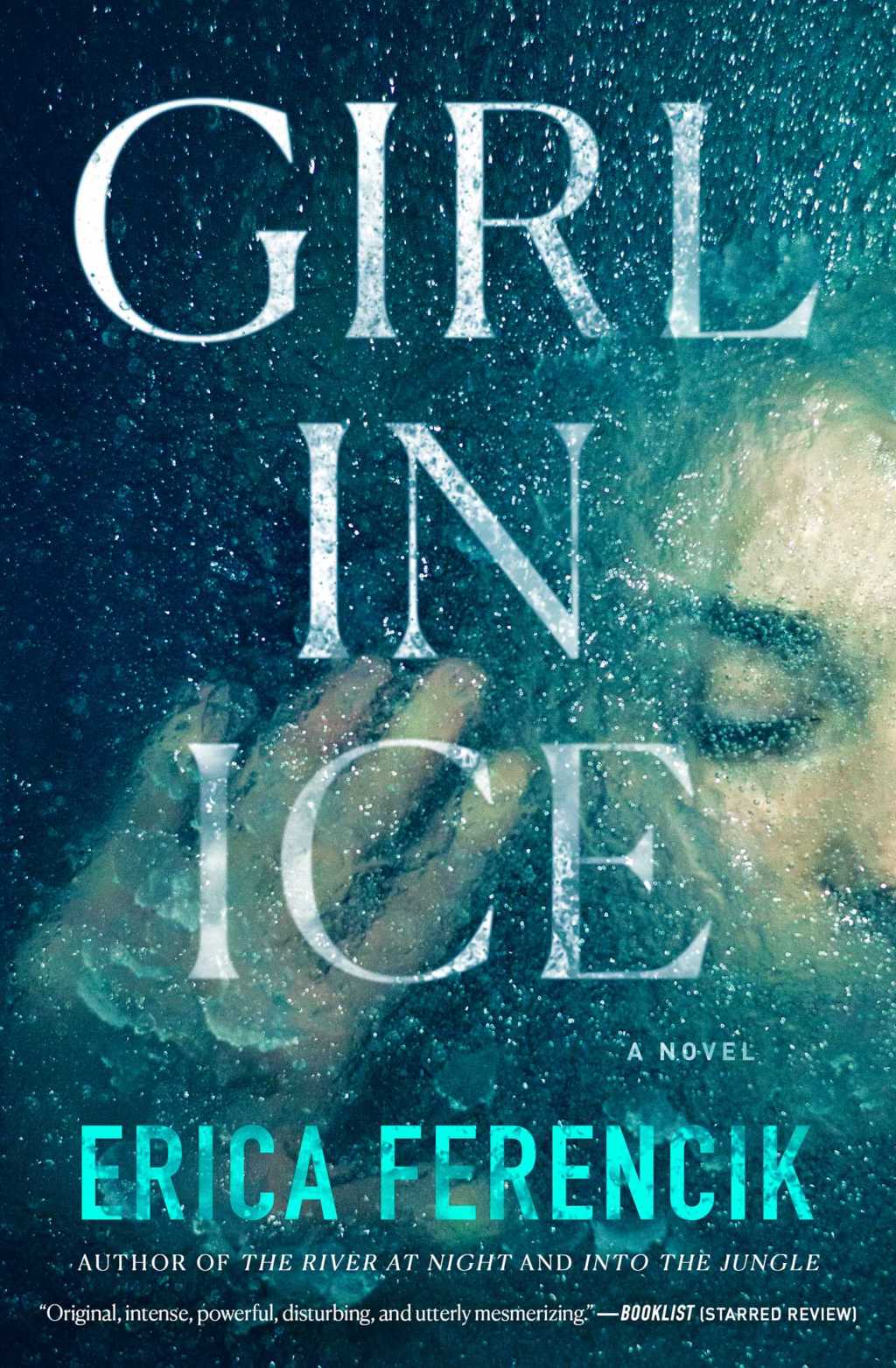
    Girl in Ice

    A gifted linguistic professor who is fascinated by such extinct languages as Old Norse and Old Danish, Val Chesterfield is so frightened of the world that she has immured herself at the university where she teaches and treats her overwhelming anxiety with pills and bottles of Amaretto and merlot.

    Beyond that, she’s mourning the loss of her marriage and the death and possible suicide of Andy, her twin brother who died of exposure on Taaramiut Island off Greenland’s northwest coast.  

    And so, when an email from Wyatt Speeks who is overseeing the scientific lab on Taaramiut, pops up in her inbox, Val’s first thought is to hit delete. But despite her own initial forebodings, she opens it instead.

    So begins Girl in Ice (Simon & Schuster), the a fascinating thriller by Erica Ferencik who also authored Into the Jungle and The River at Night.

    Wyatt is asking her to listen to the attached vocalizations of a girl they extracted from the ice and who has, amazingly and impossibly, thawed out alive. Playing the sounds over and over again, Chesterfield is intrigued. The girl is not speaking any of the Greenlandic dialects spoken in the frigid part of the world where Wyatt is located. Indeed, despite Val’s vast repertoire and knowledge, she cannot recognize the language at all.

    Wyatt wants Val to fly out and study the girl’s language. But that entails she leave her office, her shelves of books, and her everyday routines. When Val visits her elderly father, a noted climate scientist who has always been disdainful of her, he dismisses that the girl could have been thawed out alive and that his daughter has the spunk to travel so far away.

    “You’ve never been out of Massachusetts,” he tells Val. But he also wants her to go, to find out the truth about Andy’s death and delivers an ultimatum. If she doesn’t journey to Greenland, then he doesn’t want to ever see her again.

    The winds blow over 50 miles an hour on Taaramiut across a landscape barren of anything but snow, glaciers, water pocked with ice floes, deep seemingly bottomless crevasses, and herds of caribou.  No native people live this far north so where did the girl come from and how long was she encased in ice?

    Totally isolated, the small community consists only of Wyatt and his assistant Jeanne, Val and a young couple who have won a coveted spot to dive in the frigid waters for specimens. And, of course, the girl who once was frozen and is now strangely alive.

    But it’s not just the isolation, the young girl who speaks a strange language, and being where her brother died outside, alone in the bitter cold, that is unnerving. Wyatt seems to have other hidden agendas and Jeanne may be too good with knives—and she has so many. Even the couple become uneasy, urging Val to just play along until the plane arrives to take them home.

    With the disappearance of her anti-anxiety medication, Val is unable to sleep and maybe unable to reliably process what is happening around her. She takes risky chances and she also has become maternally attached to the young girl as she learns the meaning of her words. What is part of Val’s uneven emotional state and what is real become less defined. She believes Wyatt’s stated quest–to learn how to prevent a cataclysmic climate change, one where sudden outbursts of frozen winds are freezing people to death almost instantaneously around the world–parallel Andy’s own dedicated studies.

    But Val also senses a scary undercurrent and the more she learns, the more she wonders if Andy really committed suicide by wandering off into the cold or whether someone locked him outside. To add to her distress, the young girl is ill and is trying to tell Val in her own language what she needs to survive.

    What can she do to save her? And what can she do to save herself?

    This review originally appeared in The New York Journal of Books.

    Girl in Ice is also available as a Kindle, Audio CD, Audible and in paperback.

    About the Author

    Erica Ferencik is the award-winning author of the acclaimed thrillers The River at NightInto the Jungle, and Girl in Ice, which The New York Times Book Review declared “hauntingly beautiful.” Find out more on her website EricaFerencik.com and follow her on Twitter @EricaFerencik.

  • The Marsh Queen

    The Marsh Queen

    Far from the marshland where her family grew up and that claimed her father’s life, Loni Mae Murrow has found a quiet niche where she creates intricate life-like drawings of birds for the Smithsonian. It’s a rare talent and a job that Murrow, who started drawing at an early age, loves. But there are undercurrents in her job and life starting with a new administrator talking of budget cuts and disdaining Murrow’s need to return home to deal with her aging mother. Making it all more complicated is that she also is confronted with her brother and his controlling, avaricious wife both of whom seem more intent on cashing in on what little money there is in their mother’s portfolio than in helping her. Murrow has just a short time to take care of family business and to sort out messy family entanglements. If she doesn’t return in time, she’ll no longer have a job.

    But the pull of her mother’s needs, a compelling job offer from a good friend, veiled hints at mysteries unsolved along with her realization that her father’s death may be less straightforward than it seemed at the time jarringly jeopardize the peace and tranquility that Murrow has achieved. She finds herself deeper and deeper into the place of her youth and the marshes, both of which she thought—hopefully–she had left behind for good.

    Author Virginia Hartman convincing portrays the beauty of the marshes, creating an atmosphere of serene beauty but also one full of surprises and ultimately danger in The Marsh Queen (Simon & Schuster). She also conveys how easily Murrow falls into the patterns of her father who knew the waterways so well he could navigate the countless channels and inlets without a map. Hartman’s love of this landscape, full of unexpected wonders, is inherent in her writing.

    Individual Portrait

    “Early morning steam rises from the water,” Hartman writes about one of Murrow’s forays into the marshland. “I paddle to a different part of the swamp today, where the Cypress trees grow, as my dad used to say, ‘keepin’ their feet in the water.’ The canopy is high, like a cathedral, and I glide through the landscape of light and shadow. Ferns cascade from the trunks and pink lichen like measle spots and the Cypress knees stick up from beneath the surface like the hats of submerged gnomes.”

    This enchantment of the waterways with all its many unexpected scenes of flora and fauna is something Murrow finds she shares with Adlai, the seemingly gruff proprietor of the canoe shop where she rents her canoe and paddles when she goes in search of such birds to draw as the purple gallinule. Her mother had married down so to speak when she chose Murrow’s father. It is a choice that Murrow ultimately must make as well—to leave a dream job of working at one of the most prestigious museums in the country and life in a bustling cosmopolitan city to return to the backwaters of home.

    But first she must follow, however unwillingly, all the clues that keep presenting themselves regarding the past. It’s a matter of connecting the dots to find out what really did happen to here father all those years ago. And if she doesn’t accomplish that soon enough, then there’s more at risk for Murrow than just losing her job. It may mean losing her life.

    The Marsh Queen is also available in hardcover, on Kindle, Audible and as an Audio CD.

    This review originally appeared in New York Journal of Books.

    About the Author

    Virginia Hartman has an MFA in creative writing from American University and is on the faculty at George Washington University. Her stories have been shortlisted for the New Letters Awards and the Dana Awards. The Marsh Queen is her first novel.

    Virginia Hartman Events

    At the Writer’s Center in Bethesda, Maryland, Virginia teaches Advanced Fiction Workshop (six weeks). For more information, please contact the Writer’s Center at 301-654-8664, www.writer.org.

    • SUNDAY, OCTOBER 23
    • THE BOOK GALLERY 12 noon
    • 7 N. Loudoun Street Winchester, VA 22601
    • FRIDAY, NOVEMBER 4
    • PALM BEACH BOOK STORE 6pm
    • 215 Royal Poinciana Way, Palm Beach, FL 33480
    • WEDNESDAY, NOVEMBER 9
    • BOOKSTORE ONE 2pm
    • 17 S Pineapple Ave, Sarasota, FL 34236
    • THURSDAY, NOVEMBER 10
    • MIDTOWN READER 7pm
    • 1123 Thomasville Rd, Tallahassee, FL, 32303
    • SATURDAY NOVEMBER 12
    • THE BOOKMARK 6pm
    • 220 First St, Neptune Beach, FL 32266
  • The most popular #BookTok books in every state

    The most popular #BookTok books in every state

    TikTok’s book community “#BookTok” was recently referred to by The New York Times as a “best seller machine.” In this community, creators post literary content to the app, ranging from book recommendations to their emotional reactions during pivotal plot points. 

    This content has catapulted sales for a select few books, and major book retailers such as Barnes & Noble are recognizing the community’s power.

    These days, it takes one viral TikTok for a book to become a bestseller. #BookTok reaches readers across the world, and a nation’s most popular books can tell us a lot about its language and culture. So which books are actually selling, and what do they have in common? 

    Using Barnes & Noble, Goodreads, and Google search interest data, we conducted an analysis of the titles rising in popularity due to TikTok. Our report ranks the most popular books and authors, determines which are favored in each state, and even highlights the older books making a comeback due to TikTok. 

    Key findings

    The most popular #BookTok books and authors

    For BookTok community members, reading is all about finding stories that captivate their audience’s emotions – particularly their sense of romance. The top-five best-selling books due to TikTok are nearly all romances, and two of them share the same author.

    The five most popular #BookTok books are:

    • It Ends with Us by Colleen Hoover (romance)
    • The Summer I Turned Pretty by Jenny Han (romance)
    • Ugly Love by Colleen Hoover (romance)
    • The Wedding Date by Jasmine Guillory (romance)
    • The Hunger Games by Suzanne Collins (young adult)

    #BookTok has popularized the romance genre with Gen Z readers. Romance tropes such as “enemies to lovers” and “fake dating” allow readers to enjoy fun, lighthearted stories with satisfying emotional endings across many different books with unique characters. 

    In fact, of the top 55 books analyzed, 24 were in the romance genre, according to Goodreads classifications. Fantasy books took up 12 slots, with young adult (8), thriller (6), and historical fiction (4) genres following.

    With two books in the top three slots, Colleen Hoover is the standout author on #BookTok. Her titles Verity and It Starts With Us are also in the top 25 #BookTok books. A romance author with one thriller title (Verity), Hoover is active on TikTok and Instagram, engaging with the community with her humorous personality. She clearly has a strong sense of what’s popular in online reading communities. 

    Jennifer L. Armentrout also has four titles gaining significant traction on TikTok. A prolific fantasy and romance writer, books from her Blood and Ash, Harbinger and Dark Elements series have each been heavily promoted by the #BookTok community. 

    Other popular #BookTok authors include Alice Oseman, Casey McQuiston, Elle Kennedy and Emily Henry, each with three books on the top #BookTok book list.

    The most popular #BookTok books by state

    A nation’s most popular books can tell us a lot about its culture, and the same is true for individual states. We analyzed the list of over 170 popular #BookTok books using local search data to determine the most popular #BookTok bestseller in every state and created a map to display each state’s favorite title.

    With 41 books represented, there are a wide variety of popular books in the U.S. right now, thanks to TikTok. The books most popular on a state-by-state level include:

    • Ugly Love (4 states)
    • Book of Night (3 states)
    • A Good Girl’s Guide to Murder (2 states)
    • One Last Stop (2 states)
    • The Spanish Love Deception (2 states)
    • The Summer I Turned Pretty (2 states)
    • Written in the Stars (2 states)

    The books making a comeback thanks to #BookTok

    Finally, some books published well over a decade ago are seeing a resurgence in popularity thanks to TikTok. We removed books that have movie adaptations or are part of popular franchises such as Twilight or The Hunger Games

    Here are the lesser-known titles that #BookTok is giving a comeback:

    • I Am Number Four (published 2009)
    • Anna and the French Kiss (published 2010)
    • The Song of Achilles (published 2011)
    • Throne of Glass (published 2012)
    • Aristotle and Dante Discover the Secrets of the Universe (published 2012)

    Conclusion

    Books open up our worlds and minds. Simple stories that follow traditional narrative arcs can also be effective language learning tools. Whether your recommendation comes from #BookTok or The New York Times, discover a new title and learn about a different culture, place, or time. 

    Methodology: Using a list of 170+ popular #BookTok titles compiled by Barnes & Noble, we used Google search data to conduct this analysis. Genre data compiled using Goodreads.

  • The Patron Saint of Second Chances

    The Patron Saint of Second Chances

    is village sadly slipping away, self-appointed mayor and radiator repairman Signor Speranza listens in horror as a water commission official tells him that the water pipes must be replaced or the commission will shut the village’s water supply off — making Prometto uninhabitable.

    The cost to fix it? Seventy thousand euros — an exorbitant sum for a village of 212 residents, most of whom are just barely getting by.

    But Speranza has a plan — not a good plan or even a mediocre one, but at least it’s something. He decides to start a rumor that famed movie star Dante Rinaldi is filming his next mega hit in Prometto. If tourists think that Rinaldi will be readily available, Speranza believes that tourists will descend upon Prometto. After all, when there was a rumor that George Clooney would be filming in a neighboring town, it was a madhouse. And it looks like it will be so once again.

    Soon tourists arrive with plenty of money to spend. But it isn’t just tourists. The locals go crazy with the idea of being in a film, almost any film. The butcher wants Speranza to find roles for all 15 of his overlarge sons, offering Speranza money if he makes it happen. Even Speranza’s daughter gets movie fever.

    “The plan works a little too well, however, and he soon finds that in order to keep up the ruse, he will have to make the movie for real,” said Christine Simon, the author of “The Patron Saint of Second Chances” (Atria 2022; $23.70 on Amazon).

    Simon says her plot was inspired by news articles she ran across that talked about how shrinking Italian villages were offering homes for a dollar.

    “These stories usually have at their core some enterprising mayor trying to drag their village back from the brink of extinction,” she said. “This flash of inspiration was, therefore, triply rewarding for me, because it gave me my setting, my main character, and my main character’s mission, all in one fell swoop. Everyone should be so lucky.”

    It also has origins in the Italian village where Simon’s grandparents grew up.

    “My grandparents came to the United States via Canada in the early 1950s, trading their tiny village of Ferruzzano for Cliffside Park, New Jersey,” she said. “I grew up going to parties in their backyard — sprawling gatherings with dozens of people, many of them also from the village, sitting at long tables in lawn chairs and eating, eating, eating. When I began working on this story, at first I felt intimidated because I’ve never been to Ferruzzano in real life, but as I was researching the setting, and looking at family photos and even Google map images of the village, I was startled to find that the two places — my grandparents’ backyard in Cliffside, and their mountain village of Ferruzzano — looked astonishingly similar. I don’t know how they did it, but they managed to bring their village with them when they came here, and that’s the flavor that I hope I’ve incorporated into the fictional village of Prometto.”

    Simon loved authoring this book, which she did just after the quarantine started.

    “It was wonderful escaping reality each day to see what Signor Speranza and his zany crew would get up to next,” she said.

    Now Simon says she’s devoted to comedy and small-town antics.

    “I guess you can say we know what to expect from my next book,” she said.

  • Printers Row Lit Fest

    FULL PROGRAM SCHEDULE ANNOUNCED FOR PRINTERS ROW LIT FEST, THE MIDWEST’S LARGEST LITERARY CELEBRATION, SEPTEMBER 10 & 11

    Pulitzer Prize winner and Poet Laureate Natasha Trethewey joins over 100 authors including national bestsellers Jamie Ford, Marie Myung-OK Lee, and Danyel Smith in a jam-packed weekend of free programming

    This year’s festival highlights Chicago stories and offers fun for all ages, with a poetry tent organized by The Poetry Foundation; a rare presentation from satire writers at The Onion; interactive programs for youth and families; and more

    The 37th annual Printers Row Lit Fest, presented by the Near South Planning Board, is pleased to announce the full schedule of participating authors and programs. Printers Row Lit Fest is one of the three largest and oldest literary festivals in the U.S. and stretches across five blocks, along South Dearborn Street from Ida B. Wells Drive to Polk Street and on Polk Street from State to Clark, in Chicago’s historic Printers Row neighborhood. The outdoor event is accessible via public transportation and takes place rain or shine from Saturday – Sunday, September 10 – 11, from 10:00 a.m. – 6:00 p.m.

    The festival kicks off with Evanston-based Pulitzer Prize winner and two-term United States Poet Laureate Natasha Trethewey, who will be awarded with this year’s prestigious Harold Washington Literary Award. Chicago authors and stories will be presented during the Printers Row Lit Fest including dozens of new books and anthologies focused on Chicago. From columnist Neil Steinberg’s Every Goddamn Day: A Highly Selective, Definitely Opinionated, and Alternatingly Humorous and Heartbreaking Historical Tour of Chicago and Ray Long’s The House that Madigan Built: The Record Run of Illinois’ Velvet Hammer to fictions set in Chicago neighborhoods such as Toya Wolfe’s Last Summer on State Street, Joe Meno’s Book of Extraordinary Tragediesand One Book One Chicago author Eric Charles May’s Bedrock Faith, Chicago is a leading character in today’s literary zeitgeist.  

    Printers Row Lit Fest’s dynamic lineup offers fun for book lovers of all kinds, from poetry and romance to satire and spoken word. Highlights of this year’s festival include a conversation with Danyel Smith, the first Black editor of Billboard magazine, on her recent book Shine Bright: A Very Personal History of Black Women in PopJamie Ford discussing his current New York Times bestseller The Many Daughters of Afong May; and celebrated author of The Evening Hero, Marie Myung-OK Lee.

    Poetry Tent

    New to this year’s festival is a dedicated poetry tent curated by The Poetry Foundation with a lineup of award-winning and emerging poets. Also new to the festival is the laugh-out-loud Literary Death Match, whichpits four local authors against each other in front of a panel of all-star judges, and the Chicago-based, national satirical news site The Onion will present a rare, behind-the-scenes look at the article production process of “America’s Finest News Source” with a post-apocalyptic twist. Visitors can participate in a spoken word workshop and open mic led by EmceeSkool, and The Moth will showcase recent winners from their popular StorySLAM live storytelling competition.

    The Printers Row Lit Fest will present powerful voices in social and environmental justice and activism with a series of panels hosted by reporters from Chicago Sun-Times and personalities from WBEZ. The fest includes a timely discussion reflecting on two years of the COVID-19 pandemic with a conversation between Dr. David Ansell, author of The Death Gap: How Inequality Kills, and Dr. Thomas Fisher, author of The Emergency: A Year of Healing and Heartbreak in a Chicago E.R. In addition, the Chicago Public Library will host Voices for Justice: Natalie Moore’s “The Billboard” including a staged reading of excerpts from the award-winning play.

    This year marks the return of children and family-focused programming at Printers Row Lit Fest. Programs include Theatre on the Hill’s Choose Your Own Once Upon a Time, an opportunity for children to decide the fates of their favorite fairy tale characters in a live, interactive theatrical event, and Carlos Theatre Productions which will present a Latin American puppet show for children in Spanish and English. Parents can hear Dr. Dana Suskind in conversation with former Chicago Tribune columnist Heidi Stevens about her recent book Parent Nation: Unlocking Every Child’s Potential, Fulfilling Society’s Promise. 

    Programs are organized by Printers Row Lit Fest Program Director Amy Danzer, assistant director of graduate programs at Northwestern University School of Professional Studies and Board President of the Chicago Literary Hall of Fame.

    Including Sandmeyer’s Books and The Book CellarPrinters Row Lit Fest hosts over 100 booksellers in airy outdoor tents, inviting visitors to peacefully peruse everything from the rare to ‘hot off the press,’ newly published works. All programming, includingfeature presentations by myriad authors, spoken word artists, journalists, comedians, and poets,is 100% free of charge.

    Printers Row Lit Fest 2022 Schedule

    SATURDAY, SEPTEMBER 10

    10:00 a.m.

    Center Stage – Children’s Programming – Theatre on the Hill Presents Choose Your Own Once Upon A Time

    Poetry Foundation – Children’s Programming – A bilingual reading of Pablo Neruda’s Book of Questions, Selections/Libro de Preguntas, Selecciones (Enchanted Lion Books, 2022) by translator, Sara Lissa Paulson.

    Main Stage – Welcome by Near South Planning Board Chairman Steven Smutny, Chicago Public Library Commissioner Chris Brown, and First Lady Amy Eshleman. Program to follow featuring Natasha Trethewey, Harold Washington Literary Award Winner in conversation with Donna Seaman, Booklist. Program introduced by Natalie Moore, Harold Washington Literary Award Selection Committee Chair.

    731 S. Plymouth Ct. – The Deep Creativity of Translation: A Reading and Discussion with Izidora Angel, Mary Hawley, and Alta L. Price. Moderated by Irina Ruvinsky. Presented by Another Chicago Magazine and the Third Coast Translators Collective.

    Grace Place (2nd Floor) – Big Shoulders Press Presents Virus City: Chicago 2020-2021. Reading and Discussion featuring Amy Do,  Robin Hoecker, Emily Richards, Oscar Sanchez, and Frank Tempone. Moderated by Rebecca Johns Trissler.

    Grace Place (1st Floor) – Children’s Programming -10:15am – Doors. 10:30am – Miss Friendship Ambassador 2022 Susan Liu to tell the story of the Moon Festival Presented by the Chicago Chinatown Chamber of Commerce. 10:45am – Moon Festival Parade to depart Grace Place.

    11:00 a.m.

    Center Stage – Welcome by Alderman King One Book One Chicago – Thomas Dyja, The Third Coast and Eric Charles May, Bedrock Faith with Judy Rivera-Van Schage

    Poetry Foundation – Children’s Programming – Reading by Julian Randall, Pilar Ramirez and the Escape from Zafa. Emceed by Stefania Gomez. 

    Main Stage – (11:30 a.m.) WBEZ Presents Adriana Herrera, A Caribbean Heiress in Paris, and Sarah MacLean, Heartbreaker: A Hell’s Belles Novel in conversation with WBEZ’s Greta Johnsen, host of Nerdette

    731 S. Plymouth Ct. – Ray Long, The House That Madigan Built: The Record Run of Illinois’ Velvet Hammer in conversation with Joan Esposito

    Grace Place (2nd Floor) – Unlocking Memories and Uncovering Stories: Bindy Bitterman, Skiddly Diddly Skat (children’s book) and Sharon Kramer, Time for Bubbe (children’s book) in conversation with Chicago author Beth Finke 

    Grace Place (1st Floor) – Patricia Carlos Dominguez Presents Yo Luchadora (bilingual children’s book) followed by a workshop

    Saturday Afternoon

    12:00 p.m.

    Center Stage – Erika L. Sanchez, Crying in the Bathroom: A Memoir in conversation with Juan Martinez

    Poetry Foundation – – The Chicago Poetry Center – Readings by Mayda del Valle, Aricka Foreman, Tim Stafford, Natasha Mijares, C. Russell Price, and Viola Lee. Emceed by Marty McConnell.

    Main Stage – (12:30 p.m) WBEZ Presents Danyel Smith, Shine Bright: A Very Personal History of Black Women in Pop in Conversation with WBEZ’s Natalie Moore

    731 S. Plymouth Ct. – Deborah Cohen, Last Call at the Hotel Imperial: The Reporters Who Took On a World at War in conversation with Peter Slevin

    Grace Place (2nd Floor) – Crises: The All Ages Show – Dan Chaon, Sleepwalk and Jean Thompson, The Poet’s House in conversation with Eileen Favorite

    Grace Place (1st Floor) – Writing Overwhelming Realities – Readings by Julia Fine, Dionne Irving, Ananda Lima, Jami Nakamura Lin, and Jeffrey Wolf. Emceed by Ananda Lima.

    1:00 p.m.

    Center Stage – Debut Fiction: Jessamine Chan, The School for Good Mothers and Shelby Van Pelt, Remarkably Bright Creatures in conversation with Rebecca Makkai 

    Main Stage – (1:30 p.m.) Chicago Sun-Times Presents The Environmental Justice Exchange: A tribute to Hazel Johnson, the Mother of Environmental Justice. Host: Brett Chase. Guests: Cheryl Johnson, Hazel’s daughter and executive director of People for Community Recovery; Tarnynon Onumonu, poet and author of “Greetings from the Moon, the Sacrificial Side”; Luis Carranza, poet and author of “Viva la Resistencia”. 

    731 S. Plymouth Ct. – M. Chris Fabricant, Junk Science and the American Criminal Justice System in conversation with Rob Warden

    Grace Place (2nd Floor) – Sourcebooks Presents – How Books Are Made: Authors Discuss the Publishing Process. Julie Clark, The Last Flight and The Lies I Tell; Ann Dávila Cardinal, The Storyteller’s Death; Iman Hariri-Kia, A Hundred Other Girls. Moderated by Kate Roddy, Associate Editor at Sourcebooks.

    2:00 p.m.

    Center Stage – Title IX, 50 years later: Women writers, women’s sports – Corin Adams, Tiny Setbacks, Major Comebacks, Julie DiCaro, Sidelined: Sports, Culture, and Being a Woman in America, and Melissa Isaacson, State: A Team, a Triumph, a Transformation in conversation with Jeanie Chung

    Poetry Foundation – Chicago Literary Hall of Fame, Wherever I’m At: An Anthology of Chicago Poetry – Readings by Daniel Bortzutzky, Ugochi Nwaogwugwu, Elise Paschen, and Sara Salgado. Emceed by Carlo Rotella.

    Main Stage – Chicago Sun-Times Presents Social Justice in Chicago: The Mexican community’s fight to stay in the city. Host: Elvia Malagon. Guest: Mike Amezcua, author of Making Mexican Chicago: From Postwar Settlement to the Age of Gentrification

    731 S. Plymouth Ct. – Dr. David Ansell, The Death Gap: How Inequality Kills and Dr. Thomas Fisher, The Emergency: A Year of Healing and Heartbreak in a Chicago ER with Katherine Davis, Crain’s

    Grace Place (2nd Floor) – Elizabeth Crane, This Story Will Change: After the Happily Ever After with Kim Brooks 

    Grace Place (1st Floor) – The Onion: America’s Finest News Source In The Post-Apocalypse featuring Skyler Higley and Sammi Skolmosk

    3:00 p.m.

    Center Stage – PHENOM & EmceeSkool (Open Mic) 

    Main Stage – (3:30 p.m. ) Joe Meno, Book of Extraordinary Tragedies with Gint Aras

    731 S. Plymouth Ct. – Beth Macy, Raising Lazarus: Hope, Justice, and the Future of America’s Overdose Crisis with Alex McLevy

    Grace Place (2nd Floor) – Leslie Bow, Racist Love: Asian Abstraction and the Pleasures of Fantasy with Michelle Huang.

    Grace Place (1st Floor) – Rebuilding a Life – Ann McGlinn, Ride On, See You; Alex Poppe, Jinwar and Other Stories; Lynn Sloan, Midstream with Rachel Swearingen

    4:00 p.m.

    Center Stage – The Chicago Public Library and16th Street Theatre Present The Billboard by Natalie Moore – Staged Reading featuring Ti Nicole Danridge and Felisha McNeal followed by conversation between Natalie Moore, The BillBoard and Kathy Hey, Third Coast Review

    Poetry Foundation – RHINO Poetry – Readings by April Gibson, Kathleen Rooney, Jessica Walsh, E. Hughes, Faisal Mohyuddin, Kenyatta Rogers, Jacob Saenz, Maja Teref & Steven Teref. Emceed by Naoko Fujimoto and Elizabeth O-Connell Thompson.

    Main Stage – (4:30 p.m.) – Literary Death Match – Presented by StoryStudio Chicago and Near South Planning Board. All-star judges: David Cerda, Julia Morales, and Luis Urrea. Readers: Shannon Cason, Elizabeth Gomez, Mikki Kendall, and Diana Slickman. Emceed by Adrian Todd Zuniga. 

    731 S. Plymouth Ct. – Resistance, Resilience and Surviving the Sex Trade: – Brenda Myers-Powell, Leaving Breezy Street: A Memoir and Hannah Sward, Strip in conversation with Anne Ream, The Voices and Faces Project

    5:00 p.m.

    Center Stage – The Guild Complex Presents Exhibit B – Reading by CM Burroughs, Ruth Margraff, and Nami Mun. Emceed by James Stewart III

    731 S. Plymouth Ct. – Ramzi Fawaz, Queer Forms in conersation with Chicago LGBT Hall of Famer Owen Keehnen 

    SUNDAY, SEPTEMBER 11

    10:00 a.m.

    Center Stage –  Representation in Children’s Books: Reading and Conversation featuring Sam Kirk, The Meaning of Pride; Mrs. Yuka Layme, Co-Producer of Drag Queen Story Hour; Katie Schenkel, Cardboard Kingdom with Barbara Egel 

    Poetry Foundation – A Poetry Reading featuring Jennifer Steele, 826 Chiand Chris Aldana, Luya Poetry

    Main Stage – Pirates, Ghosts, and Loss – Sara Connell, Ghost House and Michael Zapata, The Lost Book of Adana Moreau with Paula Carter

    731 S. Plymouth Ct. – Kori Rumore and Marianne Mather (authors of), and Rick Kogan (prelude to) He Had It Coming: Four Murderous Women and the Reporter Who Immortalized Their Stories with Mary Wisniewski

    11:00 a.m.

    Center Stage – Chicago Graphic Novelists – Markisan Naso, By the Horns and Michael Moreci, Wasted Space in conversation with Terry Gant, Third Coast Comics

    Poetry Foundation – Chris Abani, Smoking the Bible – Reading followed by conversation with Parneshia Jones 

    Main Stage – Jamie Ford, The Many Daughters of Afong Moy in conversation with Carey Cranston, President of the American Writers Museum

    731 S. Plymouth Ct. – Victor Ray, On Critical Race Theory: Why It Matters & Why You Should Care with Cassandra West, Crain’s

    Grace Place (2nd Floor) – – Rev. Amity Carrubba in conversation with Tom Montgomery Fate, The Long Way Home: Detours and Discoveries

    Sunday Afternoon

    12:00 p.m.

    Center Stage – NU Press Reading, Growing Up Chicago – Second to None: Chicago Stories – Readings by Anne Calcagno, Shelley Conner, and Jessie Ann Foley. Emceed by David Schaafsma 

    Poetry Foundation – Roger Reeves, Best Barbarian – Reading followed by conversation with Simone Muench. Musical accompaniment, Mai Sugimoto.

    Main Stage – Girlhood in Chicago – Illinois Poet Laureate Angela Jackson, More Than Meat and Raiment and Debut Novelist Toya Wolfe, Last Summer on State Street in conversation with Amina Gautier

    731 S. Plymouth Ct. – Dana Suskind, Parent Nation: Unlocking Every Child’s Potential, Fulfilling Society’s Promise in conversation with Heidi Stevens

    1:00 p.m.

    Center Stage – City in a Garden of Books: Literary Fellowship Among Independent Publishers and Booksellers – Parneshia Jones, NU Press; Dr. Haki Madhubuti, Third World Press Foundation; Doug Seibold, Agate Publishing with Jeff Deutsch, In Praise of Good Bookstore

    Main Stage – Secrets – Bradeigh Godfrey, Imposter and Marie Myung-Ok Lee, The Evening Hero with Kate Wisel

    731 S. Plymouth Ct. – Kevin Boyle, The Shattering: America in the 1960s in conversation with Elizabeth Taylor

    2:00 p.m.

    Center Stage – Adam Levin, Mount Chicago in conversation with Jarrett Neal

    Poetry Foundation – Young Chicago Authors – Reading featuring The Roots Crew, hosted by E’mon Lauren

    Main Stage – The Moth: 25 Years of Live Storytelling featuring Grace Topinka, Melissa Earley, Archy Jamjun, and Jacoby Cochran

    731 S. Plymouth Ct. – Neil Steinberg, Every Goddamn Day: A Highly Selective, Definitely Opinionated, and Alternatingly Humorous and Heartbreaking Historical Tour of Chicago in conversation with Shermann Dilla Thomas (“6figga_dilla”)

    3:00 p.m.

    Center Stage – Reading and Conversation featuring Ana Castillo, My Book of the Dead: New Poems with Yolanda Nieves

    Main Stage – Romance Panel: Legacy and Love – Ali Brady, The Beach Trap and Natalie Caña, A Proposal They Can’t Refuse with Tanya Lane

    731 S. Plymouth Ct. – The Insidiousness of Hatred – Adam Langer, Cyclorama and Jerry Stahl, Nein, Nein, Nein!: One Man’s Tale of Depression, Psychic Torment, and a Bus Tour of the Holocaust in conversation with Ben Tanzer

    4:00 p.m.

    Center Stage – The Crisis in American Democracy – Dick Simpson, Democracy’s Rebirth: The View from Chicago and Michael Dorf, Clear It with Sid!: Sidney R. Yates and Fifty Years of Presidents, Pragmatism, and Public Service with Gerry Plecki, President of The Society of Midland Authors

    Poetry Foundation – Reading and Conversation featuring Tara Betts, Refuse to Disappear and Keli Stewart, Small Altars. Moderated by Rachel Jamison Webster

    Main Stage – Chloé Cooper Jones, Easy Beauty: A Memoir with Gina Frangello

    731 S. Plymouth Ct. – Sarah Kendzior, They Knew: How a Culture of Conspiracy Keeps America Complacent – with Rick Perlstein, Crain’s

    5:00 p.m.

    Center Stage – Blue Heron Press, Open Heart Chicago: An Anthology of Chicago Writing – Readings by Dorothy Frey, Lorena Ornelas, Joe Peterson, and Sandi Wisenberg. Emceed by Editor Vincent Francone.

    Main Stage – Debut YA Fiction – Giano Cromley, The Prince of Infinite Space and Skyler Schrempp, Three Strike Summer with Michelle Falkof

    731 S. Plymouth Ct. – A Visual Read of the City – Lee Bey, Chicago Sun-Times architecture critic; Blair Kamin, former Chicago Tribune architect critic; Dennis Rodkin, Crain’s with Gerald Butters\

  • First Born by Will Dean

    First Born by Will Dean

    Two identical twins as different as can be. Molly, anxious and reserved, lives a quiet, contained life in London. Katie, gregarious and fun-loving, is now attending school in New York where she has a great apartment, lots of friends and a handsome, athletic boyfriend.

    Molly feels betrayed and jealous — until she gets a call from her parents who are visiting in New York. Katie is dead.

    And so, Molly, forced to leave the safe confines of the cocoon she has enveloped herself in, flies to New York to comfort her parents and to take on the task of discovering her sister’s killer. But this isn’t a simple story of a twin forced to grow beyond the safe confines of her life. In “First Born,” author Will Dean takes us on a twisting path of family secrets, dark deceits and the slow recognition that even those we love aren’t who we think they are.

    Katie, Molly discovers, has earned her admission to the prestigious school program not just because of her academic successes but also because of her relationship with a rich playboy philanthropist who jets around the world with an entourage of pretty young women.

    “Molly soon realizes she never knew her twin as well as she thought she did,” said Dean, who was born in England, studied law at the London School of Economics and now lives in a remote area of Sweden. “Molly grows in confidence in New York. She starts to piece together the puzzle of Katie’s life. She finds those who wronged her. And then she goes about seeking revenge.”

    Remember, we said it wasn’t simple, and as Molly attends Katie’s cremation ceremony with her parents, we learn of her own involvement in Katie’s death. And yet she still seeks vengeance for all those who wronged Katie.

    Dean says the inspiration for his book came to him one night a few years ago.

    “I imagined identical twins who had been treated differently from early childhood,” he said. “I was curious how being labeled ‘the fun one’ and ‘the serious one’ might manifest in later life. I’m also intrigued how we all think we know our partners, siblings, parents, children, etc well. But we never know them quite as well as we think we do.”

    This article originally appeared in the Northwest Indiana Times.

  • The Verifiers by Jane Pek

    The Verifiers by Jane Pek

    Her brother is on the fast track to a successful career in finance and has plans for his sister to follow along. But in Jane Pek’s debut novel, “The Verifiers,” Claudia Lin secretly drops out of the corporate rat race without telling her siblings or mother and takes a job at Veracity, a new start-up that uses algorithms along with good old detective techniques to determine whether online suitors are real or not.

    Claudia, a queer Asian American, really isn’t a computer geek. The reason she was chosen for the job by the company’s founder is her passion for reading, particularly the works about a fictitious crime solver named Detective Yuan.

    Once she is hired, the firm becomes a three-person endeavor, with Claudia spending her time cyberstalking (the modern way to dig up dirt) and real life stalking, like they do in the crime novels Claudia consumes.

    When Iris Lettriste comes in wanting them to investigate the men she’s met online, it at first seems like a simple case. But, of course, they never are. Lettriste is a no-show for her last appointment, and later is found dead of what looks like an accidental overdose of a prescription drug she’s taking.

    Claudia’s bosses want to move on from Iris, but she thinks there’s more, particularly after all the online accounts belonging to Iris disappear and the real Iris shows up, saying that her sister has been impersonating her.

    That’s enough for Claudia to start sleuthing on her own. Soon she’s fired from her job and almost involved in a fatal bicycle accident because someone has rigged her bike. On the home front, her gorgeous older sister is having relationship problems, and Claudia takes it upon herself to do some detecting to see what’s he’s up to.

    Her brother is appalled and disappointed in her when he finds out she has quit the stellar and potentially very lucrative job he arranged for her.

    Pek, who has an undergraduate degree from Yale, a law degree from New York University and an MFA in fiction from Brooklyn College and works as an attorney in New York for an international investment company, says she began the book by asking herself what if there was an online dating detective service, and from there began assembling the story line.

    “I liked that Claudia would actually draw her detective rules from this obviously silly murder mystery series,” said Pek who is working on a sequel, “but that every now and then it would actually work out for her.”

    The article originally appeared in the Northwest Indiana Times.

  • Traveling Through Time and Around the Globe

    Traveling Through Time and Around the Globe

    In 1914, Marian Graves and her twin brother, James, are among the last to be saved when the Josephina Eterna sinks in the North Atlantic. With their father in prison and their mother gone, the two babies are bundled off to live with their Uncle Wallace, an artist in Missoula, Montana. Wallace, preoccupied with his painting, lets the kids run wild, and while James is a sweet-natured child, Marian is a daredevil who revels in the freedom to do what she wants.

    That helps explain her attraction to the lifestyle of barnstorming aviators and her decision at 14 to drop out of school to learn to fly.

    Fast forward a century. Actress Hadley Baxter, whose Hollywood stardom is somewhat diminished, is starring in a movie about the disappearance of Marian Graves in Antarctica.

    The story of these two women takes us back and forth from past to present and around the globe in Maggie Shipstead’s “Great Circle” (Vintage Books 2021; $24).

    The disappearance of a woman aviator is familiar. After all, movies and articles are still being written about Amelia Earhart, whose plane vanished in the Pacific Ocean in 1937. But there are many other female pilots from the early and mid-1900s, though they’re exploits are mostly forgotten now. Writing “Great Circle” required Shipstead to research and travel to give the book its authenticity. She visited the Arctic five times and Antarctica twice.

    Why so many times, I asked Shipstead.

    “I’m drawn to those regions by some weird instinct,” she said. “I think a lot of people are. But I’ve also been lucky to keep getting opportunities to go. Polar travel has become a bit of my specialty, so I’ve been sent on assignment to Alaska, the New Zealand subantarctic, Antarctica, the Canadian high Arctic twice, Greenland twice. I did an artist residency on a ship in Svalbard. In a way, one thing kept leading to another, and I have no complaints.”

    The inspiration for “Great Circle” came to her in New Zealand. She was between books and a story line for her next novel that she had thought looked promising, wasn’t. In the airport, she saw the statue of early aviator Jean Batton, its base inscribed with her quote “I was destined to be a wanderer.”

    She knew she had her book.

    Given how much she has traveled, I wondered if Shipstead was destined to be a wanderer.

    “Destined is probably strong,” she said. “I’ve always been interested in travel, but my life could have taken lots of twists and turns that would have precluded traveling as much as I have. Really, this book turbocharged my traveling because, A, I was motivated to get to more and farther flung places in the name of research, and B, it took so long to write the book that I had the chance to start writing for travel magazines.”

    I next asked if she ever considered becoming a pilot given her interest in the subject.

    “Never,” was her response. “My brother used to fly C-130s in the Air Force and wanted to be a pilot from childhood, so that was always his territory.”

    This article originally appeared in the Northwest Indiana Times.