“I’m destined to disappear,” Rachael Bard tells the listeners of her true crime podcasts.
Eliza Jane Brazier
For Sera Fleece, whose life is tumbling down around her as she dwells upon each of her many perceived failures and seldom leaves her home, her time is totally focused on every episode — each one dedicated to a missing or murdered woman. She thinks in terms of the episodes and absorbs the details Rachel reveals about her personal life. Sera knows she lives on Fountain Creek Ranch in the yellow house somewhat distant from her parents’ home and the barns, stables and quarters for the campers who fill the ranch in the summer.
And then, one day it happens. There are no more podcasts and no more social media posts. Rachel has disappeared.
“I know, the first 48 hours are crucial,” Sera tells herself. (After all, she doesn’t talk to anyone else — not her ex-husband who still cares, or her parents, or even the clerks she interacts with when she finally is able to get herself out of the house to buy tea.) “And every hour you don’t update, I think, ‘Something is wrong.’ I think, ‘The case is going cold.’”
“I will use the things you told me,” she says to Rachel, promising to find her.
But it doesn’t look promising. Somehow she missed the turn for the ranch, and stopping in the little town where Rachel went to school and where her best friend disappeared when they were high school students, she finds that no one will even mention its existence.
Turning back, she finds the ranch’s entrance, noticeable because what is supposed to be a tourist attraction has signs reading “No Trespassing” and “Beware of Dog” posted on the drive.
“The setting came from a job I took in northern California that got weird at an isolated dude ranch. I won’t go into details, but the truth is very nearly stranger than fiction,” Brazier said when I ask about the eerie setting she created. “The emotion came from finding myself single again after my husband died. And the hook came from my love of true crime.”
Like Sera, Brazier says she was looking for answers but in a different way than most.
“After my husband died, I found that the grieving process really replicated true crime podcasts: you are searching for answers,” she said. “I found a lot of comfort in them and still do to this day. For me it’s about facing your fears, making order out of chaos and also about control. In true crime, you know the bad thing is coming. It can be a way to address trauma and feel less alone in it.”
Playing detective, Sera is hired by the Bards to work with the horses, a job that allows her to search for clues to Rachel’s disappearance. Her searching arouses suspicions but startlingly, she realizes that no one seems concerned about Rachel’s disappearance besides Sera. Rachel, she learns, has disappeared before and will do so again. At the ranch, Sera finds meaning not only in her investigation but in working with the horses and her developing romance with the ranch manager.
Yet that doesn’t stop her search for Rachel, or the overwhelming feelings that there are many dangerous unknowns surrounding her. Was Rachel involved with the ranch manager and what happened to his wife? Did she really go back to Texas like he says. Is it possible he’s a murderer?
Brazier, a screenwriter and journalist who lives in Los Angeles, is currently developing “If I Disappear” for television and writing another mystery.
“It’s a brutally funny thriller about very bad rich people,” she said.
Online events
This story previously appeared in the Northwest Indiana Times:
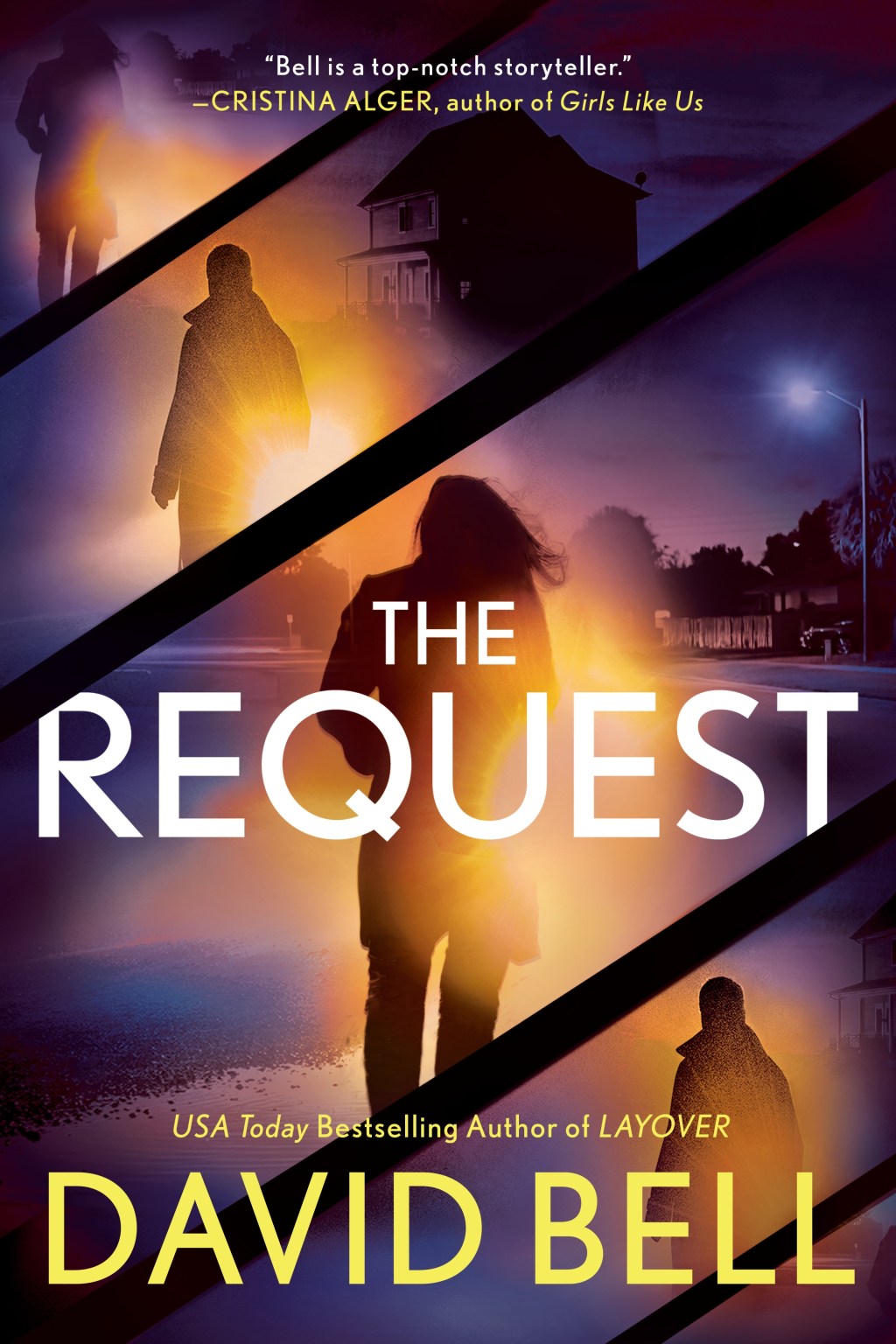
“We all have a friend from our past who is a lot of fun when we’re young but when we get older and get settled that person is someone you want to leave behind,” says David Bell, explaining the idea behind his latest mystery-thriller The Request (Berkley 2020; $11.99—Amazon price). “And I wondered what would happen if that friend showed up and even more if that friend knew something about you that one else knows.”
That’s what happens to Ryan Francis. Years ago, Ryan was involved in a car accident that left a young girl seriously injured. It was his fault his best friend Blake Norton tells Ryan after he wakes up in the hospital, the memory of the accident completely gone.
Since that time, Ryan has rebuilt his life, marrying, starting a successful business and is now the father of a young child. He also carries the guilt of knowing he’s harmed someone and has stealthily left large sums of money in the girl’s mailbox to help with her ongoing medical expenses.
But things are coming undone. The girl’s sister confronts Ryan, demanding a large amount of cash or else she’ll reveal the truth. But she’s not the only one wanting something from Ryan. Blake is back and he needs a big favor—break into his ex-girlfriend’s home and steal letters Blake wrote her that she’s threatening to show his current fiancé. And though Ryan refuses, Blake won’t take no for an answer. If Ryan won’t get those letters then Blake will reveal the truth of what happened all those years ago.
It’ll be easy, Blake assures him. But, of course, it’s not. Letting himself into the house when Blake’s ex is supposed to be at yoga class, Ryan can’t find the letters—they’re not where Blake said they’d be. But much, much worse, the Blake’s ex never left the house to go to yoga. Ryan stumbles across her body—she’s been murdered. And at the same instant, his phone lights up, the woman lying dead at his feet has just asked him to become her Facebook friend.
Blake disappears, stealing Ryan’s laptop, a strange man tries to break into their home while his wife and baby are there by themselves and the police zero in on Ryan—and his wife–as a possible suspects. It seems that others besides Ryan and Blake have their secrets as well.
“Even the person closest to you has a secret they don’t want you to know,” says Bell. “I think we’ve all had the experience of thinking we know someone really well but people can still surprise us, no matter what.”
DAVID BELL is a USA Today bestselling, award-winning author whose work has been translated into multiple foreign languages. He’s currently an associate professor of English at Western Kentucky University in Bowling Green, Kentucky, where he directs the MFA program. He received an MA in creative writing from Miami University in Oxford, Ohio, and a PhD in American literature and creative writing from the University of Cincinnati. His novels include Layover, Somebody’s Daughter, Bring Her Home, Since She Went Away, Somebody I Used to Know, The Forgotten Girl, Never Come Back, The Hiding Place, Cemetery Girl, and The Request.
New York Times bestselling author Karen White’s iconic series about a quirky psychic realtor (yes, you read that right!), set in historic Charleston, continues this winter. A long-anticipated gift to her fans, this holiday season White released her first ever Christmas novel.
Jane Ammeson, who writes the Shelf Life column for The Times of Northwest Indiana and shelflife.blog, interviewed Karen about THE CHRISTMAS SPIRITS ON TRADD STREET, the sixth book in her Tradd Street Series,
With
each new release, Karen’s national platform grows. Her previous installment in
the series, The Guests on South Battery (2017), was a New
York Times hardcover bestseller. Her books have been featured on Southern Living, Reese Witherspoon’s Draper James
blog, Late Night with Seth Meyers, and more. The author of over twenty
books and 12 New York Times bestsellers, she has almost two million books in print in fifteen
different languages.
JA: Since you’re not a realtor
and you’re not seeing ghosts (we don’t think so, anyway!), do you have much in
common with Melanie—like are you super-organized with lots of charts and spread
sheets, etc.?
KW: Let’s just say that people who know me who have also read the
Tradd Street series seem to think that Melanie _is_ me. I’m going to
neither confirm nor deny, but let’s just say that I do love to be organized and
I also adore sweets (although Melanie’s metabolism is simply something I aspire
to). She and I are both ABBA fans and neither of us can text without many
alarming typos.
JA: You grew up all over the world but started off in the south and think of yourself as a Southern girl. Why did you choose historic Charleston for the setting of your series?
KW: My parents (and extended family) are all from the South—mainly
Mississippi—which is where I get my Southern roots. I went to college in
New Orleans (Tulane) and actually planned to set the series there.
However, the year I started writing the first book was 2005, the year
Katrina wreaked so much havoc on the city and her citizens. I knew that
in the series I was planning to write that this sort of natural disaster and
its repercussions wouldn’t fit. I would return to New Orleans and the
storm for The Beach Trees, but for the series I needed to find another
Southern city that had gorgeous architecture, lots of history, and plenty of
ghosts. Charleston was an obvious choice.
JA: Your Tradd Street series novels seem to require a lot of
research into older homes, renovations and history, can you tell us about that?
KW: Since I was a little girl I’ve been obsessed with old houses.
They didn’t need to be grand or even well-maintained to make me beg my
mother to pull the car over to the curb so I could get a better look.
When we moved to London, we were fortunate to live in an Edwardian
building on Regent’s Park. It had leaded glass windows, thick mahogany
doors, and ceiling medallions to make a wedding cake envious. Living in
that flat made me believe that I truly could hold a piece of history in my
hands. My obsession continues with my daughter who holds a master’s
degree in historic preservation from the College of Charleston and currently
works as an architectural historian. She actually appears in the last two
Tradd books (as well as Dreams of Falling) as graduate student Meghan
Black.
JA: Can you give readers who may not have read any of your other
books about Melanie and Jack a description of The Christmas Spirits on Tradd
Street?
KW: In this
penultimate installment (book #6) in the series, we find OCD Realtor (who also
happens to be able to speak with dead people) Melanie Middleton and true crime
mystery writer Jack Trenholm happily married and living with their toddler
twins and teenage daughter, Nola, in their historic home on Tradd Street.
Christmas is approaching and all seems to be going well for them—-except for a
few money problems, Jack’s writing career taking a curveball, and an unpleasant
specter seen haunting Nola’s bedroom that seems to be connected to the ancient
cistern being excavated in their back yard. Unwilling to burden Jack with
one more problem and distract him from his writing despite promises that they
wouldn’t hold secrets from each other, Melanie takes it upon herself to attempt
to solve the mystery behind the ghostly presence—with unsettling results that
Melanie may or may not be able to resolve.
JA: Are your ghosts based upon real life (if you can call it that
when it comes to ghosts) tales of hauntings in Charleston?
When visiting Charleston, I love going on haunted walking tours
(especially the graveyard ones) and always pick up fascinating tidbits to be
used later in my books. I’ve never borrowed a ghost story for my books,
but tend to pick and choose certain parts of favorites and mix them together to
fit into my stories.
JA: Do you live in an older home?
KW: Sadly, no. My husband isn’t a fan of old houses (and in my
first book, the derogatory remarks Melanie makes about old houses came right
from his litany of why he dislikes old houses—mostly having to do with the
expense of heating them). Every house I’ve lived in since the old
Edwardian building in London has been brand new. I’m hoping my daughter
and I can get sway him to our side when it’s time to move again.
Hopefully to Charleston.
JA: Besides a great story and enjoyable read, are there any other
take-aways you’d like for readers to get from The Christmas Spirits on Tradd
Street?
KW: This installment can be read on its own. However, I do
think that readers might enjoy the series more if read in order starting with
the first book. The books each have their own mystery to be solved, but
the growing cast of characters and Melanie’s growth through the series is an
important element and best understood if readers meet her in book #1.
As a journalist, Fiona Barton investigated crimes, attended trials and then wrote and filed her stories. But as the author of the just-released “The Child” and her best-selling novel, “The Widow,” both psychological thrillers, Barton had to switch gears.
“It sounds ridiculous, but I had to stop being a reporter in order to write a novel,” Barton says. “I knew how to write — I’d been doing it for a living for more than 30 years, but what I was writing came from other people. Journalism is listening, probing, testing other people’s words and telling a story concisely and often under 500 words,” she says.
“Writing ‘The Widow’ meant unlearning a lot of things. It was incredibly hard at first and I got to 10,000 words and thought I had nothing left to say, but there was a moment where I gave myself permission to fully invent. It was a real crunching of gears but wonderfully liberating to be free to create my own world in both books.”
Barton’s done it again with “The Child,” which brings back Kate Waters, the newspaper journalist who first appeared in “The Widow.” Wanting to impress her boss, Kate follows up on the discovery of a small skeleton in a recently demolished building. Barton says that the inspiration for the story came from exactly the same place that Kate finds it in the book.“As a journalist, I’m always looking for stories,” she says. “I tore interesting items out of newspapers and magazines — my hairdresser hated me — and shoved them in my handbag for later. They were often just a few lines in a story but it was the unanswered questions that drew me in. One of the scraps of paper lurking in the bottom of my bag many years ago was about the discovery of a baby’s remains. Like Kate, I wanted to know who the infant was? Who had secretly buried it? And who else knew?”