Tag: Women’s fiction

  • “Let’s Call Her Barbie” by Renee Rosen

    “Let’s Call Her Barbie” by Renee Rosen

    In 1956, there were baby dolls for little girls to play with but the idea of an eleven-and-a-half-inch tall grown women with feet permanently arched to wear high heels was a totally alien concept to the men at Mattel when Ruth Handler presented the idea for Barbie.

    Because the times were more “Mad Men” than they are now, there were derogatory comments about the doll’s hourglass figure along with dismayed looks that Handler, a take-no prisoners type when she had an idea, would even suggest Mattel should consider making this doll.

    “She looks like a hooker,” one of the men said.

    Well, we know how this turned out. According to recent statistics, three Barbie dolls are sold every second, totaling about  one billion dolls  having sold since Barbie was introduced in 1959.

    How this all came to be is the delightful tale told by bestselling Chicago author Renee Rosen in her latest novel, titled simply “Let’s Call Her Barbie” (Berkley January 2025), reinforcing Mattel’s estimation that Barbie has 99% worldwide brand reorganization.

    “I’ve never had more fun writing a novel,” Rosen told me recently in a phone interview. “I wanted to do this long before the “Barbie” movie came out.”

    Learning the story behind the creation of Barbie while participating on a panel of feminism in 2019, Rosen knew this was the perfect novel and subject for her. She specializes in writing novels about important figures such as Helen Gurley Brown who changed the magazine world as editor of Cosmopolitan magazine in “Park Avenue Summer,”  the long term love affair of the founder of Marshal Field’s in “What the Lady Wants,” and the feud between two super rich women, Mrs. Astor and Mrs. Vanderbilt, vying for social status supremacy in “The Social Graces.”

    Writing about Barbie would have to wait. Rosen already had two books in the pipeline that she needed to complete. But once she had the time—and the book contract—in her typical way she hit the ground running. A deep dive into the world of Barbie led her to meet Barbie influences (yes, there are Barbie influences including one who has over half-a-million followers) and took her to a Barbie collectors convention in Chicago.

    “I was lucky to get in, admission was almost sold out,” she says.

    There she met 90-year-old Carol Spencer, one of the original Barbie designers.

    “She’s Mattel royalty,” says Rosen who wishes she could have been a fly on the wall when Handler was taking on Mattel in trying to persuade them to spend the big bucks it would take to develop Barbie.

    As for Barbie’s figure, Rosen tells me her shape, which was somewhat scandalous in the late 1950s, was necessary so her clothes would fit.

    “Barbie is a 1/6th scale of a real woman but there’s no such thing as 1/6th scale fabric so in order to make waistbands with zippers, hooks and eyes– all that detail adds bulk,” explains Rosen. “So, if Barbie didn’t have an abnormally slender waist, which is the equivalent of an 18-inch waist on  a woman, her waist would have been bigger than her hips when she was dressed.”

    I told you; she dives deep.

    It got to the point where she unearthed her own collection of Barbies and displayed them in the home she shares with her partner, John, who though he’s a finance guy, was willing to put on a pink shirt for the Barbie convention. It should be pointed out though that John might not be totally cool about the display of Barbies.

    I did a quick check on how in sync Rosen and I are when to comes to Barbies by asking her what her favorite Barbie outfit is. She replies “probably  “Solo in the Spotlight.”  That’s Barbie as a chanteuse dressed in a black skintight floor length gown with a flared ruffled bottom and a microphone.

    “Mine too,” I say. “I wanted that one so badly.”

    And then I mention my sad story of woe. My mother, the librarian, insisted on making outfits for my Barbie so my doll never got to wear that sparkly sleepless dress. I don’t know what they cost at the time, but there’s one for sale on eBay for $500.

    “Barbie is the most collected toy after baseball cards,” Rosen tells me which explains the cost.

    And, of course, there was the movie which so far has earned $1.446 billion globally.

    There was a time when the name Barbie was used as pejorative and dismissed as a shallow and anti-feminist throwback. Poor Ken was frowned upon too when people would dismiss a couple by saying “they look like Barbie and Ken.”

    But really this is a woman’s story. Handler worked in a mostly male world at a time when there were plenty of toys for boys to play with and baby dolls that needed burping and diaper changes for girls. She transformed all that, making it a Barbie world.

    Rosen’s book takes us back to that time and shows us how it happened.

    For more events, visit reneerosen.com.

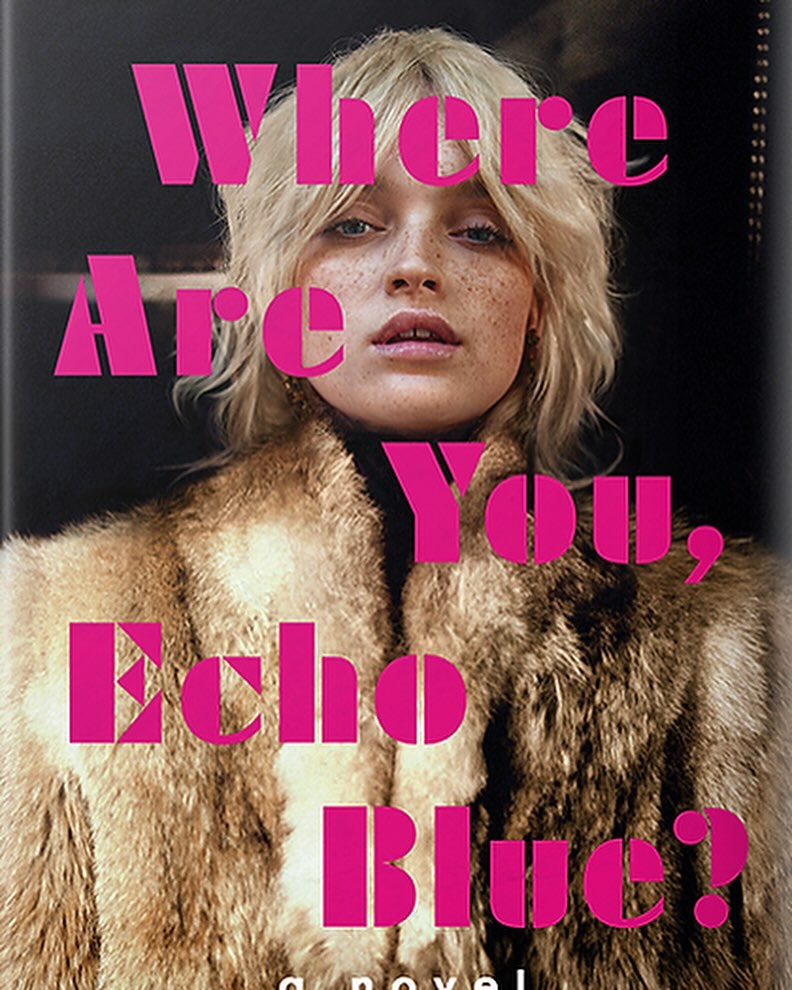
  • Where Are You, Echo Blue?

    Where Are You, Echo Blue?

    “In those years, the hardest of my childhood, Echo felt like a kindred spirit. I memorized her lines in Slugger 8. I practiced her stance on the field in the mirror. I cut out snapshots from Teen Beat magazine. I bought four copies of her cover issue of Sassy, the one where she wore a red cropped T-shirt with big lips smacked across her flat chest. I made a collage, carefully glued images of her together, draped it with a heart garland, and hung it over my bed. My favorite was a photo of Echo and her also-actor dad, Jamie Blue, leaving a restaurant, his arm slung over her shoulders, protecting her, the way I wished my father did.”

    From Where Are You, Echo Blue? by Haley Krischer (Penguin Random House).

    Goldie Klein, a writer for Manhattan Eye, has it bad when it comes to Echo Blue, the famous child actress. The obsession that worried her parents when she was growing up still has a hold on her even now. And when she learns that Echo, who was scheduled to appear on MTV’s New Year’s Eve Y2K special, one that will help her regain her foothold on stardom, hasn’t shown, Goldie knows it has to be more than just a relapse and stint in rehab. Echo has really disappeared.

    Currently, Goldie is writing the kind of stories she hates and that her father, an overly critical professor loves, including her most recent article on boxing. But Goldie’s aspirations are to cover subjects much hipper and more compelling. And she sees Echo’s vanishing as just the ticket. She manages to talk her editor into sending her to Los Angeles to track down the missing star. But it’s going to be difficult. Even those close to Echo have no idea where she is, and they’re upset that Goldie is looking for her.

    But in her adoration of the Echo, Goldie has spun a mythology in her own mind. She saw Echo as the only friend she had during her early teens. The boy-crazy girls in her class intimidated her with their talk about sex while Goldie was still playing with dolls. She tried to connect but it just didn’t happen despite the best efforts of her mother who planned slumber parties to help her make friends. And so, Goldie further immersed herself into Echo’s world—or the world she thought Echo inhabited.

    But Echo’s life was also difficult. Her mother, a washed-up television actress, is a depressive who has locked herself away in their house. To escape that environment, Echo opted to live with her movie star father who was always away on location hoping to become an Academy-award winning actor and never had time to talk on the phone, changed girlfriends monthly and really wasn’t that concerned with his daughter’s well-being. Echo had handlers that raised her and like Goldie she was terribly lonely with just one friend. Stardom couldn’t make up for not having the type of normal life most teenagers have.

    Goldie manipulates herself into the lives of people who know Goldie, including Jamie Blue. Accompanying an actor to his house, she eats a marijuana-laced cookie at the door and becomes completely stoned.

    “Don’t you know not to eat cookies at a stranger’s house without asking what’s in them?” her editor asks incredulously when Goldie calls to tell her as if that’s a basic fact everyone should know. And though Goldie wants to leave, her editor tells her that she’d better get in the hot tub with Jamie, even though he’s likely to be naked.

    Welcome to Hollywood.

    Goldie begins to get the idea of what Echo’s life was like as she continues to hunt for the missing star. The story cuts back and forth between 2000 and the 1990s, capturing the era precisely and what life was like for Echo as she became an Oscar-winning child star. In her pursuit of her story, Goldie realizes that it’s time to chart a new course in her own life.

    This article originally appeared in the New York Journal of Books.

    Book Club Kit.