Tag: recipe

  • Southern Lights: Easier, Lighter, and Better-for-Recipes From the South

    Southern Lights: Easier, Lighter, and Better-for-Recipes From the South

    “Throughout these pages, I’m going to (politely) refute the claim that Southern food is all bad for you and hopefully breathe new life into some tired, worn-out notions,” writes Lauren McDuffie in the first pages of her latest cookbook, Southern Lights: Easier, Lighter, and Better-for-You Recipes From the South (Gibbs Smith). McDuffie, an advocate of Southern cuisine, wants us all to know the entire truth of this regional way of cookery that many of us dismissively think of as fried and fat.

    Once you make your way through the stereotypes, past the overwrought, done-to-death, attention-seeking heavy hitters, the archives of Southern cookery shine with a special sort of brilliance,” continues McDuffie, noting that she is a home cook who has done the majority of her culinary learning in the South ranging from the foothills of central Appalachia to the sandy, abundant low country coastline.

    McDuffie, who lives in Portland, Oregon now, created the award winning food blog: My KItchen Little: Recipes, Ideas, and Inspiration for Busy Home Cooks but her love of Southern cuisine and her ability to bring it to the fore was also apparent in her first cookbook, Smoke, Roots, Mountain, Harvest: Recipes and Stories Inspired by My Appalachian Home. The same passion is conveyed” in this magnificent cookbook with its luscious photos–McDuffie is also a photographer and her luscious color photos are a perfect accompaniment to the recipes that show us how to enjoy the rich heritage of Southern cuisine without the guilt and calories.

    Southern Lights takes us into the world that McDuffie says she loves most– the people, places, things, and flavors that evoke feelings of home.

    To accomplish this, McDuffie, an advocate for fresh and healthy, took a hard look at her kitchen pantry and asked herself a series of questions such as why she was using a particular oil or cut of meat in her cooking and what substitutions would work just as well when using her favorite recipes. From there she re-created favorite dishes incorporating different ingredients but yielding the same delicious results.

    Her recipe for Frico Chicken in a Buttermilk Bath is a great example. Its origins are that perennial Southern classic—fried chicken brined in buttermilk and then deep fried in lard. A definite winner when it comes to taste. Not so in other respects. So what does McDuffie? She produces a healthier and low caloric alternative that really works.

    Calling it a remix and noting that frico translates to fried in Italian, she describes this dish as similar to a simple baked cheese crisp that tops a boneless, skinless, and flattened chicken thighs browned in a minimum of oil. A surprising easy-to-make but sophisticated dish, it offers the crunch and flavor of buttermilk heavily battered chicken with no grease or guilt.

    Like pulled pork sandwiches. McDuffie gives us a very creative take by substituting spaghetti squash (yes, you read that correctly) for the pork in her recipe for “Pulled” BBQ Spaghetti Squash Sandwiches.

    “This has got to be one of the most unusual sandwiches I’ve ever made, but man is it a hit in my house,” writes McDuffie in the introduction to this dish. “Tangled strands of roasted spaghetti squash mimic the fatty pork in a classic meaty version, making for a lighter, more nutritious way to get your fix.”

    The squash mixture is then topped with Halloumi cheese (smoked Gouda or cheddar can be used instead) along with coleslaw and barbecue sauce.

    Voila! A low cal, high flavor profile meal and just one of many in McDuffie’s latest cookbook.

    Honey-Caramelized Tomato Upside-Down Cornbread

    “People get very territorial about their cornbread in the South, a fact that I have always found completely charming,” says McDuffie. “Home cooks are devoted to their recipes and food traditions in a way that serves to sustain them, carrying them across generations. There is so much heart on the table, always. Cooks hold on tight to them, their family recipes, and it’s really the most beautiful thing. This recipe happens to be a favorite version of cornbread in my house. The jammy, juicy-sweet tomatoes suspended on top really do steal this show, and the olive oil makes it pretty special. Feel free to sub a different cooking oil, though, as olive oil ain’t cheap. I highly recommend serving this in thick slices, slathered with lots of Salty Butter–Whipped Honey.”

    Makes 6 to 8 servings

    • Natural nonstick cooking spray
    • 12 ounces cherry or
    • grape tomatoes
    • 6 tablespoons honey, divided
    • 1 1⁄2 teaspoons salt, plus
    • more as needed
    • 1 cup yellow cornmeal
    • 1 cup cake flour
    • 1 1⁄2 teaspoons baking powder
    • 1 teaspoon baking soda
    • 2⁄3 cup olive oil or canola
    • or vegetable oil
    • 2 large eggs, beaten
    • 1 1⁄4 cups buttermilk

    Preheat the oven to 350°F. Adjust the rack to the middle position. Spray an 8- or 9-inch round cake pan with cooking spray and line with parchment paper, allowing some overhang for easy removal (think of them as handles).

    Put the tomatoes, 3 tablespoons of the honey, and a good pinch of salt in a nonstick skillet set over medium heat and cook, stirring occasionally, until the tomatoes just burst and are tender, about 5 minutes. Transfer to the cake pan, juices included, and spread in an even layer.

    In a mixing bowl, whisk together the cornmeal, remaining 1 1⁄2 teaspoons salt, cake flour, baking powder, and baking soda.

    In the bowl of a stand mixer or in a mixing bowl with ahandheld m ixer, combine the oil, the remaining 3 tablespoons of honey, and the eggs. Add half of the dry mixture and mix until combined. Add half of the buttermilk and mix until just combined. Repeat with the remaining halves of each and gently pour the batter into the prepared pan over the tomatoes (it shouldn’t be more than three-fourths full).

    Bake until lightly golden and set, 35 to 45 minutes (use a knife or toothpick to test the doneness—it should come out clean). Cool in the pan for at least 15 minutes before inverting the cornbread onto a serving plate, tomatoes facing up now.

    Salty Butter-Whipped Honey

    Sounds sinful, right? I can assure you that this isn’t nearly as rich as it sounds. This drippy, sticky-sweet thing is my lighter take on a simple honey butter where, instead of infusing a lot of butter with a little honey, we’re going to infuse a lot of honey with a little butter. Just be sure to use a good-quality raw honey.

    Makes about 1 cup

    • 8 ounces honey
    • 2 tablespoons salted butter, at room temperature
    • Salt to taste

    In a blender, combine the honey, butter, and salt and blend until creamy and smooth. Transfer to a lidded storage jar or container. This buttery honey will keep in the refrigerator for up to 1 month.

    Frico Chicken in a Garlicky Buttermilk Bath

    “I’ve taken the things I love most about classic Southern fried chicken and remixed them into something that is just as satisfying, but much lighter—a true win-win,” writes McDuffie about this recipe. “A frico (which means “fried” in Italian) is simply a baked cheese crisp, and here we’ll use them to almost mimic the salty crunch of fried chicken skin. Rather than rich bone-in, skin-on cuts, we’ll use leaner boneless and skinless thighs—my favorite protein of them all. The garlicky buttermilk-fortified bath in which they cook mimics my go-to fried chicken brine, helping the chicken stay tender and juicy. It also happens to be an easy, one-pan, 30-minute meal. So there’s that.”

    Makes 4 to 6 servings

    • 1 1⁄2 cups grated Parmesan cheese
    • 4 teaspoons olive oil, divided
    • 6 boneless, skinless chicken thighs
    • Salt
    • Freshly ground black pepper
    • 1 heaping cup diced sweet onion
    • 10 ounces fresh baby spinach
    • 3 garlic cloves, minced or grated
    • 1⁄2 cup dry white wine (optional)
    • 1 (14.5-ounce) can crushed or diced tomatoes
    • 1⁄2 cup buttermilk

    Preheat the oven to 350°F. Adjust the oven rack to the middle position. Line a large baking sheet with parchment paper or a silicone baking mat.

    Equally space the Parmesan into 6 (1⁄4-cup) mounds on the baking sheet. Use your measuring cup to gently press down on the mounds and work them into round, circular disks (they don’t have to be perfect). Bake until flattened and just beginning to brown lightly around the edges, 3 to 4 minutes. Remove and set aside. They will firm up as they cool.

    Pour 2 teaspoons of the oil into a large pan over medium heat. Season the chicken with salt and pepper to taste. When the oil is hot, add the chicken and brown really well on the first side; this takes 5 to 6 minutes. Flip and cook for another 1 to 2 minutes (they will finish in the sauce). Transfer to a plate and set aside.

    Pour the remaining 2 teaspoons of oil into the pan. When it’s hot, add the onion and spinach and sauté for 3 to 5 minutes, until the spinach is fully wilted and the onion is soft. During the last minute, add the garlic.

    Stir in the wine (if using) and cook for about 1 minute to reduce it. Add the tomatoes and buttermilk and slide the chicken back into the pan. Simmer for about 10 minutes to reduce the sauce and to finish the chicken.

    Lay the Parmesan fricos over the chicken just before serving. They will melt and sort of adhere to the chicken, mimicking salty chicken skin in the best way.

    Recipes excerpted from Southern Lights: Easier, Lighter, and Better-for-You Recipes from the South by Lauren McDuffie. Photographs by Lauren McDuffie. Reprinted by permission of Gibbs Smith Books.

  • Peas Love & Carrots

    Peas Love & Carrots

    Savory Stovetop Turkey. Photo by Moshe Wulliger.

    So, before we start talking about Danielle Renov’s wonderful new cookbook, Peas Love and Carrots (Me’sorah Publications, Ltd. 2020; $28.93 Amazon price) I want to take a few moments to whine. I write a lot about food, I have a food blog, Twitter, Facebook and Instagram accounts where I post about food and travel. I often think it’s lucky I have a large family including cousins who I am able to cajole into following me so I have at least some followers.

    Some don’t seem to need large families to get followers. At least four or five times a year, I interview a cookbook author who started with an Instagram or Facebook or Twitter account and ended up with tens and sometimes hundreds of thousands of followers. I’m not saying I’m anywhere near their level of ability and creativity. Far from it, but still—comparatively my numbers aren’t even close. I’m not writing this to make people feel so sorry for me that they follow me—but hey, if you want to it’s okay. it’s just that with Renov I ran into it again. Four years ago, with her husband out of town and her kids tucked away in bed, she decided to start Instagramming.

    Tuna Salad A` La Moi. Photo by Moshe Wulliger.

    She soon had around 43,000 followers. This year,  the number is over 130,000. She now is considered a kosher and food influencer—someone who has the audience and credibility to persuade others. To give an example of what that means, Kim Kardashian may be the ultimate influencer with 354 million followers across social media channels. Yes, 354 million. That’s about close to the number of people who live in the United States.

    Burnt Cauliflower and Herb Salad. Photo by by Moshe Wulliger.

    Renov, who grew up on Long Island, New York and moved to Israel about 13 years ago, deserves her followers. The 254 plus recipes she created for Peas, Love & Carrots reflect her many life experiences, her family’s heritage, her Sephardic and Ashkenazi roots and her own interest in food in her new homeland including her weekly shopping expeditions to the Machane Yehuda Shuk, a sprawling 19th century
    market in Jerusalem selling among many other items, a variety of foods. In writing the introduction to her recipes, Renov tells a story about it, often displaying a sense of humor.

    “Dinner again?” she writes in the introduction to Crispy Baked Chicken fingers. “I know. it’s crazy. No matter how many times you go through it, it comes back again and again. It’s almost like laundry. Only you can’t eat your laundry, so at least there’s that. This (recipe) is for those days. And since those days happen more than we’d like to admit, I gave you three versions so that you can change things up. You’re welcome.”
    But food is also serious for Renov, who returns frequently to New York where she records cooking videos for kosher.com. She wants her recipes to work, to be easily accessible for both kosher and non-kosher cooks and to offer tastes beyond the everyday.

    Describing her Savory Stovetop Turkey recipe as an ode to her father who doesn’t eat a lot of read met, Renov says she’s always on the hunt for tasty turkey recipes.

    Crispy Baked Chicken Fingers. Photo by Moshe Wulliger.

    “What I never saw was a turkey roast recipe where I felt like the turkey was treated like a proper beef roast,” she says, and I have to agree which is another reason why this recipe looks so intriguing. From the photo, and I’ll soon have my own photos too as I’m making it for company tomorrow, it looks like a richly braised beef roast.

    “That’s what was aiming for here,” she says, “Turkey that was deeply savory, moist, and extremely satisfying.”

    Photo courtesy of Peas Love & Carrots Facebook.

    Go ahead and follow Renov, I won’t mind. Really. She posts her recipes, cooking tutorials, lifestyle tips and inspirational ideas for the kitchen, home, and family on both her blog peaslovencarrots.com and Instagram feed @peaslovencarrots.

    The following were excerpted from Peas Love & Carrots by Danielle Renov. Copyright 2020 by ArtScroll Mesorah Publications, photos by Moshe Wulliger. Reproduced with permission of the copyright holder. All rights reserved.

    Burnt Cauliflower and Herb Salad
    Yield: 2+ quarts
    Cauliflower
    2 (24 oz) bags frozen cauliflower florets
    3 tablespoons olive oil, divided
    4 cloves garlic, minced (about 1 1⁄2 Tablespoons)
    1 1⁄2 teaspoons kosher salt
    1⁄2 teaspoon freshly ground black pepper
    2 teaspoons turmeric
    1 1⁄2 teaspoons sumac
    1⁄2 teaspoons paprika
    1 lemon, halved

    Herb Salad
    1⁄2 cup chopped parsley
    1⁄2 cup chopped cilantro
    1⁄2 cup chopped scallions (from about 4 scallions)
    2 tablespoons chopped mint, optional
    1 small purple onion, finely diced (about 1 cup)
    1-11⁄2 Tablespoons white vinegar kosher salt, to taste
    Freshly ground black pepper, to taste

    Cauliflower
    Preheat oven to 350°F / 180°C. Line a baking sheet with heavy duty foil; coat with 1 tablespoon olive oil.
    Toss frozen cauliflower with 2 tablespoons oil, garlic, salt, pepper, turmeric, sumac, and paprika.
    Spread out on baking sheet in a single layer.

    Roast undisturbed for about 45 minutes (DO NOT OPEN OVEN DOOR DURING THAT TIME!).
    After 45 minutes, cauliflower should begin to get crispy and charred.

    Open oven door remove baking sheet, and squeeze both halves of the lemon over the cauliflower. DO NOT MIX OR STIR. Just squeeze over the top, return to oven and cook for 5-6 minutes.
    Serve and enjoy.

    Herb Salad
    While cauliflower is roasting, combine parsley, cilantro, scallions, mint, and onion in a large bowl.
    When cauliflower is done, add to the herb mixture, tossing to combine. Add vinegar; toss to combine.
    Season to taste with salt and pepper.
    Serve warm or cold.
    Note: If not serving the same day, combine herbs with cauliflower before serving time.

    Tuna Salad A` La Moi
    “This is my favorite lunch salad,” says Renov. “I could eat it, on repeat, every day. I know, mercy. Ok, fine. every other day. It’s filling, the
    flavors are punchy, and it’s my absolute favorite way to eat tuna. Make it today, double the recipe, and store it in an airtight container for tomorrow. it is actually better the second day.”

    2 cups shredded purple cabbage
    1 cup shredded radicchio
    1 cup chopped scallions
    1 cup chopped cucumber
    1 cup finely chopped celery
    1⁄2 cup diced purple onion
    1 cup parsley, chopped
    1 cup chopped preserved lemons
    1⁄2 cup chopped capers 15 ounce canned tuna in water, drained,

    Roughly chopped juice of 1 lemon, 2 teaspoons paprika, 1 teaspoon, cayenne pepper, 1 teaspoon kosher salt and 1⁄2 teaspoon coarsely ground black pepper.

    Place all ingredients into a large bowl. Toss well to combine.

    Let sit for 5 minutes. Toss again.

    Savory Stovetop Turkey
    1 large whole deboned turkey breast
    1 Tablespoon kosher salt
    1 teaspoon coarsely ground black pepper
    1 1⁄2 teaspoons granulated garlic
    1 1⁄2 teaspoons paprika
    1 tablespoon neutral oil
    1 onion, thinly sliced
    4 cloves garlic, minced
    2 Tablespoons tomato paste
    1 1⁄2 cups dry white wine
    2 bay leaves
    1 tablespoon white vinegar
    2 cups chicken broth
    1⁄4 cup duck sauce

    In a small bowl, combine salt, pepper, garlic, and paprika. Season turkey breast with mixture on all sides.
    Heat a pot over medium heat. Add oil; place turkey top side down and sear for 4 minutes on each side.
    Remove turkey from pot; set aside.

    Add onion; cook for 12 minutes.

    Add garlic and tomato paste to the pot. Cook for 2 minutes until fragrant.

    Add wine, bay leaves, and vinegar, stirring to scrape up any bits on the bottom of the pan.

    Cook for 2 minutes; add chicken broth and duck sauce.

    Return turkey to the pot, spooning some of the mixture over the top.

    Bring mixture to a boil, cover pot, and reduce heat to low. Cook for 1 1⁄2 hours, basting every 20 minutes or so. Serve hot and enjoy.
    Tips + Tricks
    If making in advance, slice turkey when it’s cold, return to sauce, and reheat gently.

    Crispy Baked Chicken Fingers:

    Crispy Asian Baked Shnitsel
    1 package chicken tenders (about 18 pieces) OR 12 thin cutlets
    1 cup mayo
    2 tablespoons minced garlic
    2 tablespoons honey
    1-2 teaspoons sriracha (depending how spicy you like it!)
    1 Tablespoon white miso
    1⁄4 cup soy sauce
    3 cups panko breadcrumbs
    Barbecue Crispy Chicken
    1 package chicken tenders (about 18 pieces) OR 12 thin cutlets
    1⁄4 cup mayo
    3⁄4 cup favorite barbecue sauce
    1 teaspoon granulated garlic
    1 teaspoon granulated onion
    3 cups panko breadcrumbs

    Honey Mustard Crispy Chicken
    1 package chicken tenders (about 18 pieces) or 12 thin cutlets
    1⁄4 cup mayo
    1⁄4 cup Dijon mustard
    3 tablespoons honey
    3 cups panko breadcrumbs
    Preheat oven to 350°F

    Coat a baking sheet liberally with nonstick cooking spray.
    In a large bowl, combine flavoring ingredients (aside from chicken and breadcrumbs) in selected recipe.
    Add chicken to wet mixture; mix to coat.
    Dip coated chicken into breadcrumbs, then place flat on prepared baking sheet. Spray the top of the chicken pieces with a little more nonstick spray.
    Bake for 30-40 minutes, until chicken is cooked through.

  • Japan: The Vegetarian Cookbook

    Japan: The Vegetarian Cookbook

    Nancy Singleton Hachisu dives deep into the Japanese food scene, having married a Japanese farmer and learning the intricacies of cooking various vegetables and other ingredients that most of us aren’t familiar with.

    The author of several cookbooks including Japanese Farm Food, winner of the Gourmand World Cookbook Awards 2012: USA Winner for the Best Japanese Cuisine Book, Preserving the Japanese Way: Traditions of Salting, Fermenting, and Pickling for the Modern Kitchen, and Food Artisans of Japan, Hachisu is meticulous in her receipt development and helping us understand the intricacies of Japanese gastronomy. Her latest is Japan: The Vegetarian Cookbook (Phaidon 2023).

    For those who want to learn, Hachisu’s recipes require attention to detail and buying foods we may have trouble sourcing. But the results, for those who like a kitchen challenge, are well worth it and as someone who has been following Hachisu and using her cookbooks for years, I can assure you it gets much easier.

    It’s a fascinating take on Japanese cuisine from Hachisu, a native Californian who moved to Japan to stay there just for a year and immersed herself in Japanese food culture. Love intervened and after meeting an organic farmer, she married and moved to the rural Saitama Prefecture.

    That was more than 30 years ago, time enough for Hachisu to raise a family in an 85-year-old traditional Japanese farmhouse and become proficient in both culture and cooking.

    The book is so very niche that it’s almost like being in her kitchen and on her farm, giving us an amazing insight into a tiny slice of Japanese farm culture.

    CHILLED UME-TOFU SQUARES IN DASHI

    • Preparation time: 30 minutes, plus 2-3 hours pressing and chilling
    • Cooking times: 10-15 minutes
    • Serves: 4 squares
    • Vegan, Dairy-free, Nut-free

    Junsai, harvested from ponds from May to September, are baby water lily buds called “water shield” in English. They have a natural gelatinous covering so add a cool, slippery element to summer dishes. They might be available at Japanese markets, otherwise, just omit or substitute with blanched julienned green beans or cooked edamame. Salted sour “plums” have been prepared in Japan for a millennium, since the Heian period (794–1185), and are purported to have many health-improving qualities, including aiding digestion and combatting summer fatigue during the rainy season. The combination here makes a subtle, but lovely little bite.

    INGREDIENTS

    • 101⁄2 oz (300 g) cotton tofu or Japanese-style soft block tofu • 1 tablespoon hon kuzu
    • 2 medium umeboshi
    • Canola (rapeseed) oil, for greasing the pan
    • Generous 3/4 cup (63/4 fl oz/200 ml) Konbu Dashi
    • 1⁄2 tablespoon shoyu
    • A pinch of flaky sea salt
    • Scant 1⁄2 cup (31⁄2 fl oz/100 ml) baby water lily buds
    • Boiling water

    DIRECTIONS

    Place the tofu on a dinner plate and weight with a small cutting board for 1 hour.

    Smash the kuzu to a fine powder in a Japanese grinding bowl (suribachi, see page 354). Squeeze the tofu by handfuls to express excess moisture  and drop into the suribachi. Mash into the kuzu until well incorporated.

    Cut out the umeboshi pits (stones) and discard. Finely chop the umeboshi and fold into the smashed tofu.

    Dampen a folded-up piece of paper towel with the oil and grease the bottom and sides of
    a 5 1⁄2 × 4 1⁄2 × 2-inch (14 × 11 × 4.5 cm) nagashikan mold (see page 353) or a 4 3⁄8 × 8 1⁄2-inch (11.5 × 21 cm) loaf pan (bottom lined with parchment paper). Scrape the ume-tofu mixture into the pan and rap smartly on the counter to eliminate air pockets and make sure the tofu is evenly distributed into the pan.

    Set a bamboo steamer over a large wok filled one-third of the way with water and bring to a boil. Place the pan in the steamer, cover, and steam over high heat for about 10 minutes until set. Remove from the steamer, blot off accumulated moisture, and lay a piece of plastic wrap (cling film) on the surface. Refrigerate for at least 2 hours to chill.

    In a small saucepan, stir the dashi, shoyu, and salt together over medium heat to dissolve the salt. Transfer to a small bowl and refrigerate for 1 hour to chill.

    Place the junsai in a wire-mesh sieve and pour boiling water over for 10 seconds. Refresh
    by running the sieve under cold water. Shake off excess water and set the sieve over a bowl to drain. Store in the fridge for 1 hour to chill.

    Unmold the umedofu, cut into 4 squares, and place each on a small shallow individual dish. Stir the junsai into the cold dashi and spoon around the umedofu. Serve immediately as a light, palate-cleansing bite.

    Extracted from JAPAN: The Vegetarian Cookbook © 2023 by Nancy Singleton Hachisu. Photography © 2023 by Aya Brackett. Reproduced by permission of Phaidon. All rights reserved.

  • Islas: A Celebration of Tropical Cooking
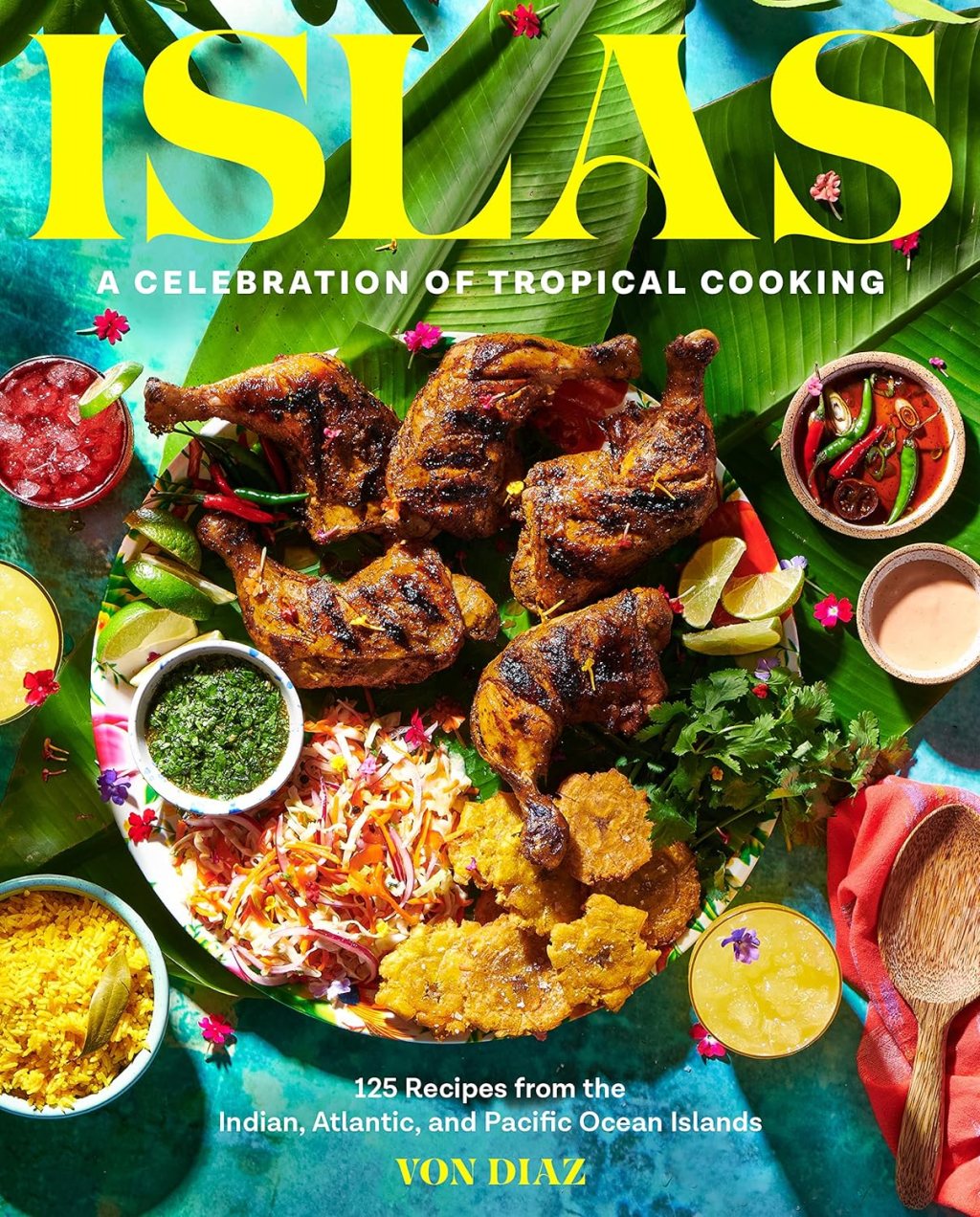
    Islas: A Celebration of Tropical Cooking

    “Whatever you cook or don’t cook, this book is a trip to the islands or islas of the world.”

    A beauty of a book, all lively colors, and wonderful photos, Islas: A Celebration of Tropical Cooking (Chronicle Books) takes us from island to island through the Indian, Atlantic, and Pacific Oceans.

    “The people who live on tropical islands are among the toughest, scrappiest, most resilient people of the planet,” writes author Von Diaz, an Emmy Award-winning documentarian, food historian, and author of Coconuts to Collards: Recipes and Stories from Puerto Rico to the Deep South (University Press of Florida) . “Storms have always been unpredictable, and generations of islanders have cultivated ancestral knowledge around how to survive and, importantly, how to feed themselves despite it all. With limited ingredients, they cook in ways that are soul-nourishing and emphasize flavor. Making magic out of what’s available.”

    Her cookbook is about preserving the wisdom and values of island people who live in what Diaz describes as the most volatile and vulnerable places on the planet. She follows their histories and how the grapple with their new realities, combining legacy, adaptability, culture, and fortitude.

    She tells and shows us cooking techniques and recipes from faraway places such as Santo, Vanuatu’s largest island. Here we meet Primrose Siri who shares such recipes as Laplap, the national dish with its alternative layers of starch such as cassava or yam, seafood or chicken, herbs, spices, and fresh coconut milk cooked oven an earth oven heated with hot rock. Closer to home, there’s Pasteles de Masa, a Puerto Rican Christmas traditional dessert.

    Even those who may never cook Arroz Negro Con Pulpo y Calamares (Black Rice with Octopus and Squid) with its rice blackened with squid ink, will be intrigued by this Puerto Rican dish that is definitely eye-catching.

    Keshi Yena’s history dates back to the first Dutch colonial period in Curaçao, a bustling island some 30 miles off the coast of Venezuela. It is the food of enslaved people, as Curaçao was a slave port, who out of necessity took the rinds of cheeses such as Gouda that were discarded by their masters and stuffing it with meat scraps and other scavenged ingredients.

    Some recipes are simple and easy to make at home without a lot of extra ingredients such as Ensalada Talong (Grilled Eggplant and Vegetable Salad) from the Philippines. Others, such as Monfongo Con Guiso, a common dish of green plantains and chicharron or fried pork skins in Puerto Rico are more time consuming but within reach of any cook who wants to give it a try.

    The book is arranged by the chapters including the island’s cooking techniques: Marinating, Pickling + Fermentation, Braising + Stewing, Steaming + In-Ground Cooking, Frying, Grilling, Roasting + Smoking, as well as pantry staples, and sauces, spice blends, and condiments that can easily be made.

    Whatever you cook or don’t cook, this book is a trip to the islands or islas of the world.

    This review originally appeared in the New York Journal of Books.

  • Persian Feasts: Recipes & Stories from a Family Table

    Persian Feasts: Recipes & Stories from a Family Table

    The cuisine of Iran, with origins dating back centuries, is arguably one of the most sophisticated in the world, offering an incredible array of dishes. This cuisine hails from the lands of ancient Persia and has evolved through the ages to what comprises the myriad and distinct regional cuisines in present-day Iran. Also shaping this cuisine is the variety of climates in Iran, the country’s terrain, and geography, with rich soil and plentiful sunshine, as well as the ethnocultural diversity of the country. From Persian Feasts (Phaidon 2024 by Leila Heller).

    A beauty of a cookbook with its lush food photos set on backgrounds of Middle Eastern designs, Persian Feasts celebrates centuries of culinary and cultural history of a land that during the first Persian Empire stretched from the Balkans in Eastern Europe in the west to the Indus valley in the east. Now known as Iran, the cuisine is complex with each region having a distinct imprint upon the ingredients and how it is prepared.

    Drilling down even further, according to author Leila Heller, each Iranian household holds itself to a high standard and has strong beliefs when it comes to Persian food. That said, anyone first attempting to cook these dishes at home should be assured by Heller’s statement that there is no wrong way or right way of making Persian food,

    “The personal preferences do impact Persian recipes,” she writes. “For instance, some prefer sweetness over tartness, buttery over dry, and many will adjust seasoning spices and herbs accordingly.”

    Making it even more accessible, most of the recipes in her book can be recreated at home from ingredients readily available in both neighborhood supermarkets and gourmet food stores. The more unique items—sumac, dried barberries dried, Persian limes, and prunes—are available at Middle Eastern or Indian food stores as well as online.

    Heller, president of the Leila Heller Gallery, a contemporary art gallery in New York and Dubai. She holds a bachelor of art degree from Brown University, a master’s degree in art from Sotheby’s Institute in London, and a second master’s degree in art history and museum management from George Washington University. She lives in both New York and Dubai, bridging the gap between East and West through art, culture, and food. This book is another way for her to share her knowledge in these areas. Besides recipes, we learn about celebrations, festivities, and events and the foods involved in each.

    For those just beginning to experiment with Persian cuisine, several recipes stand out as a straightforward way to get acquainted with techniques and ingredients. For example, all the ingredients needed to make Chicken Saffron Frittata are familiar and the dish can be completed in seven steps. In her description of the dish, Heller helps acquaint us with the background of the frittata locally known as chegehertmeh and hails from the lush province of Gilan in northern Iran that borders on the Caspian Sea.

    Smoked Eggplant with Tomato is another dish originating from the Caspian Sea region. Again, the ingredients are readily available, and many are already probably in a home chef’s pantry. The dish has seven short steps but is slightly different in that the eggplant is smoked over an open flame to give it the distinct flavor that makes this dish a winner. A refreshing summer dessert that’s both easy to make and gluten-free, Cardamom & Rose Water Pudding takes only four steps to create a pretty presentation. Yogurt Drink with Mint is even easier—five ingredients mixed in a blender.

    Once a home chef has mastered these simple recipes, more complex dishes like Herb & Noodle Potage, Shirazi Rice with Cabbage and Meatballs, and Persian Noodle Rice will seem less daunting, making Persian cooking an easy undertaking.

    Lentil & Quinoa Salad with Herbs

    By Leila Heller, “Persian Feasts: Recipes & Stories from a Family Table

    2 tablespoons butter
    2 cups (8 oz/225 g) dried barberries, rinsed
    1 tablespoon sugar
    2 cups (1 lb/450 g) dried Puy lentils
    1 cup (8 fl oz/250 ml) and 2 tablespoons extra-virgin olive oil
    1 cup (6 1/2 oz/185 g) quinoa
    1 cup (3 1/2 oz/300 g) finely chopped scallions (spring onions)
    1/2 cup (1 oz/30 g) finely chopped cilantro (coriander), plus extra for garnish
    1/2 cup (2 oz/55 g) finely chopped chives
    1/2 cup (1 oz/30 g) finely chopped parsley
    4 tablespoons finely chopped dill
    3/4 cup (6 fl oz/175 ml) red wine vinegar or pomegranate molasses
    2 tablespoons cumin seeds
    1 tablespoon salt
    2 teaspoons black pepper
    1/2 teaspoon cayenne pepper
    1 1/2 cups (9 3/4 oz/275 g) pomegranate seeds, for garnish (optional)

    Melt the butter in a large skillet over medium heat. Reduce the heat to low, then add the barberries and sugar. Mix for 2-3 minutes, until the sugar has melted.Pick over the Puy lentils to remove any debris.

    Rinse the lentils under cold running water. In a medium saucepan, combine the lentils, 4 cups (32 fl oz/950 ml) of water, and 2 tablespoons of oil. Bring the water to a boil, then reduce the heat to a simmer and cook for 20-35 minutes, until the lentils are cooked through. Drain, then set aside.

    Rinse the quinoa under cold running water, then drain. In a medium saucepan, combine the quinoa and 1 1/2 cups (12 fl oz/350 ml) of water. Bring to a boil, then reduce the heat to medium-low. Cover and simmer for 15-20 minutes, until tender. Set aside to cool.

    In a large bowl, combine the quinoa, lentils, scallions (spring onions), herbs, and barberries.

    In a medium bowl, whisk 1 cup (8 fl oz/250 ml) of oil, vinegar, cumin, salt, pepper, and cayenne pepper. Pour over the salad and toss well. Season to taste, then garnish with pomegranate seeds, if using.

    This article originally appeared in the New York Journal of Books.