Tag: Politics

  • The Rulebreaker: The Life and Times of Barbara Walters
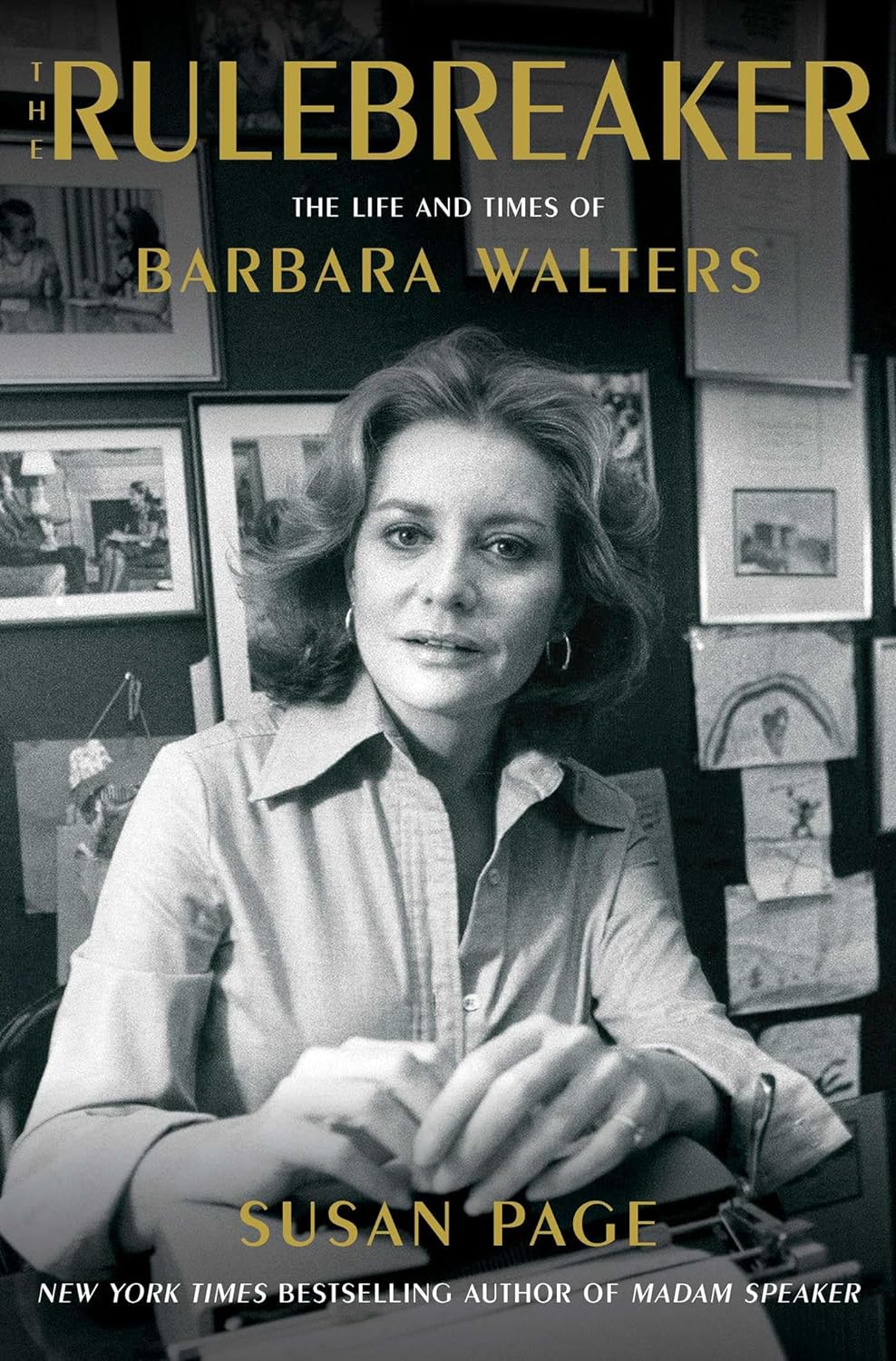
    The Rulebreaker: The Life and Times of Barbara Walters

    “a compelling look at a dynamic trailblazer who broke into a field that was male dominated and leading the way for other women . . .”

    “When Dana Walters found her husband ashen-faced and unconscious in their hotel bed, his bottle of sleeping pills emptied, she didn’t call an ambulance,” writes author Susan Page in The Rulebreaker, her biography of Barbara Walters. “She called their daughter.

    “‘I can’t wake your father up,’ her mother said, her voice frantic. ‘He just won’t wake up!!’

    “Barbara ran to the street and hailed a cab for the Hotel Navarro on Central Park South, a mile away where her parents were staying. When she got there, she tried to shake her unconscious father awake—Daddy, Daddy—she shouted—as her mother and sister watched. Jackie, who as always was living with her parents, didn’t fully understand what was happening, but she knew it was a crisis. Lou didn’t respond. Barbara was the one who called the ambulance.”

    Walters was the daughter of a nightclub owner who at times was extremely successful and at other times was broke, his family caught up in a cycle of living high and barely scraping throughout Barbara Walters’s childhood. And though she was a journalist, her father’s showmanship was also part of her genetic make-up; and so when Lou Walters, after having his stomach pumped, was out of danger, she went into public relations mode.

    “No one had to warn the daughter of Lou Waters about the perils of bad press. At the hospital once her father’s stomach had been pumped, she recognized the risk to his reputation in his future prospects if word got out he had tried to take his own life. . . . Sometimes bad news required a shiny finish.”

    This brief description of a major family emergency succinctly highlights the aspects of Walters ‘s personality, a summation of all the components of what led her to be such an outstanding success. She was the one people turned to in crisis. And even though she was devastated and fearful of losing her father, she kept her cool, she evaluated, and then made her decisions about what was the course of action. But underneath it all, her formative years had instilled a sense of impending doom, an understanding that life could change in a nanosecond. But that anxiety didn’t stop her from breaking through the barriers that had kept women out of the coterie of male reporters who were seen as the only ones capable of relaying news with the gravity and seriousness required.

    She was a “rulebreaker,” a woman who managed a somewhat complicated private life (divorces, affairs, and the like) while working toward her goals. Walters is famous for many things and among them are the number of big “gets,” interviews with famous people such as Henry Kissinger, Richard Nixon, John Wayne, Egyptian President Anwar Sadat, Israeli Prime Minister Menachem Begin, Fidel Castro, the Shah of Iran, Monica Lewinsky, Ted Turner, and Betty White.

    Not only a rule breaker but a groundbreaker, when Walters was 67—retirement age for many—she created a new television show with The View, the first in what is now known as talk TV.

    Page, the author of the New York Times bestselling Madame Chair and the award-winning Washington bureau chief of USA Today, interviewed more than 150 people for her book and did a deep dive in archival research. The result is a compelling look at a dynamic trailblazer who broke into a field that was male dominated and leading the way for other women including Oprah, who announced when she was seventeen that she wanted to be Barbara Walters.

    This article previously appeared in the New York Journal of Books.

  • C-SPAN’s Book TV is again partnering with the Library of Congress to bring the 2023 National Book Festival to a national television audience, live and on-site.

    C-SPAN’s Book TV is again partnering with the Library of Congress to bring the 2023 National Book Festival to a national television audience, live and on-site.


    As an original supporter of the National Book Festival, C-SPAN’s Book TV is contributing the following for this year’s event – held on Saturday, August 12, at the Walter E. Washington Convention Center:

    • live coverage of author interviews and panel discussions.
    • lengthy live call-in interviews with nonfiction authors on location from the grand lobby.
    • 20,000 totes promoting both the Library of Congress and C-SPAN’s Book TV available to Festivalgoers.
    • public access to its video coverage via C-SPAN’s online archives at C-SPAN.org.


    C-SPAN’s Book TV has been providing live, in-depth, uninterrupted coverage of the National Book Festival – and partnering with the Library of Coverage on promotion – since the event began on September 8, 2001.

    Book TV’s LIVE coverage has taken C-SPAN’s audience to the Festival’s various venues – U.S. Capitol grounds (2001), a vast tent city on the National Mall (2002-2013), an expo-style event in the Washington Convention Center (2014-2019), a virtual event during the pandemic (2020-2021), and back to the Walter E. Washington Convention Center (2022).

    Book TV’s extensive coverage of nonfiction authors appearing at the National Book Festival kicks off the network’s coverage of book fairs held throughout the country in the fall. And the celebration of C-SPAN’s 25 years of Book TV will launch from this year’s festival.


    About Book TV:
    Book TV – Sundays on C-SPAN2 – is the only television service dedicated to nonfiction books. Book TV features programming on a rich variety of topics, such as history, biography, politics, current events, the media and more. Watch author interviews, book readings and coverage of the nation’s largest book fairs. Every Sunday on C-SPAN2 starting 8 am ET or online anytime at booktv.org. Use that website as well to connect with Book TV via social media and the email newsletter.

    About C-SPAN:
    C-SPAN, the public affairs network providing Americans with unfiltered access to congressional proceedings, was created in 1979 as a public service by the cable television industry and is now funded through fees paid by cable and satellite companies that provide C-SPAN programming. C-SPAN connects with millions of Americans through its three commercial-free TV networks, C-SPAN Radio, C-SPAN Podcasts, the C-SPAN Now app, C-SPAN.org and various social media platforms.

    The network’s video-rich website contains over 270,000 hours of searchable and shareable content. Engage with C-SPAN on Twitter, Facebook, Instagram and YouTube, and stay connected through weekly and daily newsletters. 


    Full 2023 National Book Festival Book TV
    Coverage Schedule, Saturday Aug. 12

    9amET Interview Librarian of Congress Carla Hayden

    9:30am Authors Panel: Accidental Spies
    Authors: John Lisle “The Dirty Tricks Department”;
    Janet Wallach “Flirting with Danger”
    Moderator: CBS’s Jeff Pegues

    10:30am Interview Author R.K. Russell, “The Yards Between Us”

    10:45am Authors Panel: Environmental Awakening vs. Climate Change
    Authors: Douglas Brinkley “Silent Spring Revolution”;
    David Lipsky “The Parrot and the Igloo”
    Moderator: Jenn White of NPR

    11:45 Interview: Charles “Cully” Stimson, senior legal fellow at The Heritage Foundation
    “Rogue Prosecutors: How Radical Soros Lawyers Are Destroying America’s Communities.”

    12pm Author Talk: Sports and Culture
    Author: R.K. Russell, “Yards Between Us”
    Moderator: LZ Granderson of the LA Times

    12:45pm Interview, David Rubenstein

    1pm Author Panel: Escaping Genocide and Human Trafficking
    Authors: Tahir Hamut Izgil, “Waiting to Be Arrested at Night”;
    Saket Soni, “The Great Escape”
    Moderator: Washington Post’s Jason Rezaian

    2:20pm Interview Librarian of Congress Carla Hayden

    3:15pm Interview with Chasten Buttigieg, “I Have Something to Tell You”

    3:30pm Author Panel – Behind the Scenes with Black Writers
    Authors Camille Dungy and Tiphanie Yanique
    Moderator: Author Jericho Brown

    4:30pm Joan Biskupic, “Nine Black Robes”

    4:45pm Author Panel – Dig In: What Food Says About Us
    Authors Cheuk Kwan and Anya von Bremzen
    Moderator: Wash. Post Food Writer Daniela Galarza

    For more information c-span.org/booktv

  • Corruptible: Who Gets Power and How It Changes Us
    Corruptible: Who Gets Power and How It Changes Us

                  Does the current state of the world seem overwhelming? Do our leaders often seem to be all about themselves and not about us? Is it easier to turn on a sitcom rerun than to sit through the news because we feel so helpless to change what’s going on?

                You’re not alone. Brian Klaas, a columnist for the Washington Post Assistant Professor of Global Politics at University College London, and author of the new book “Corruptible: Who Gets Power and How It Changes Us” (Scribner 2021; $28), has taken on the task of interviewing more than 500 world leaders from the best to the worst– to answer questions like the following. Does power corrupt or is it that corrupt people are drawn to power? What personality types are drawn to power? Why are so many dictators sociopaths and narcissists? And why do even good people, once in a position of power, become authoritarian?

                Here is a brutal fact that will make you reach for remote and flip to an episode of “Green Acres” where the biggest problem of the day is whether Arnold the Talking Pig can take that trip to Hawaii he won.

                Democracies are dying with more and more countries sliding towards authoritarian rule says Klaas who writes that there are no countervailing forces.

                Indeed, Klaas who created and hosts the award-winning Power Corrupts podcast, says “There’s nothing that rewards being a sober moderate who believes in democracy and tries to govern by consensus.”

                Describing democracy as being like a sandcastle, one that can be easily wiped out by a big wave or successive small hits, Klaas gives Turkey as an example.

                “Initial coverage of Erdogan’s 2002 election was positive, showing him to be someone was a populist who would shake things up, go up against the elite and status quo, and bring democracy to Turkey,” says Klaas who looked back through New York Times archives to highlight how that country has changed for the worse. “For 19 years now, he’s chipped away at democracy instead.”

                Though the book’s subject matter might seem dull, it’s not. Klaas is a strong writer with a sense of humor and he is very capable of delivering telling anecdotes that reflect the changes a democracy can encounter and how quickly that can happen in a compelling way.

                “If you lose the battle for democracy, you don’t get to battle for taxes, infrastructure, healthcare, or any of the policies that change lives,” says Klaas, who earned a MPhil in Politics from the University of Oxford (New College) and an MPhil in Comparative Government from the University of Oxford (St. Anthony’s). “In the places that I’ve studied where democracy has died, it’s still dead pretty much everywhere.”

                How to fix it?

                Klaas suggests becoming active. Call your congressperson or senator, run for local office, become politically active, and in general, participate in making changes to bring about change.

                “That’s the type of activity that ultimately can transform the political system at the national level,” he says.

                But there’s no time to delay.     

                “If we don’t fix it in the next two to four years,” he says, “it probably won’t get fixed.”

    Follow Brian Klaas’s podcast Power Corrupts.

  • President Obama’s Annual List of Favorites

    “As 2020 comes to a close, I wanted to share my annual lists of favorites,” Barack Obama, the 42nd President of the United States, tweeted to his 127.5 million followers. “I’ll start by sharing my favorite books this year, deliberately omitting what I think is a pretty good book – A Promised Land – by a certain 44th president. I hope you enjoy reading these as much as I did.”

    Somehow, the President forgot to include adding one of my books to his list again. Well, there’s always next year.

    Jack by Marilynne Robinson

    Caste by Isabel Wilkerson

    Luster by Raven Leilani

    Sharks in the time of Saviors by Kawai Strong Washburn
    Twilight of Democracy by Anne Applebaum

    Homeland Elegies by Ayad Akhtar
    The Undocumented Americans by Karla Cornejo Villavicencio
    Long Bright River by Liz Moore
    Memorial Drive Natasha Trethewey
    Deacon King Kong by James McBride
    Missionaries by Phil Klay
    The Vanishing Half by Britt Bennett
    The Ministry for the Future by Kim Stanley Robinson
    The Glass House by Emily St. John Mandel
  • The Poisoned City by Anna Clark

    The Poisoned City by Anna Clark

    Like an accident in slow motion, Anna Clark, a Detroit-based journalist followed the crisis of toxic drinking water in Flint, Michigan.
    “I had my head in it for years and it’s still there, I talk about it and I can’t get my head about how it happened,” says Clark, who has written for The New York Times, the Washington Post and Politico.
    This obsession with the government’s failure to provide clean water in a once thriving manufacturing city whose population of about 99,000 is largely African American compelled Clark, who was a Fulbright fellow in Nairobi, Kenya and edited A Detroit Anthology, a Michigan Notable Book, compelled her to research and write The Poisoned City: Flint’s Water and the American Urban Tragedy (Metropolitan Books 2018; $30) which was an Amazon Best Book of 2018 . But she didn’t do so as a faraway observer. Clark, who graduated from the University of Michigan’s Residential College with highest honors, double majoring in History of Art and Creative Writing & Literature, and minoring in Crime and Justice and received an MFA from Warren Wilson College, has always been a doer.
    For almost two years, citizens of Flint complained about the water, showing up at meetings with jars of the putrid looking liquid that came out of the faucets and talked about how people were getting ill from drinking it. The GM plant in Flint actually changed their water system because the city water was corroding the auto parts they manufactured.
    “It wasn’t good enough for the machines, but it was good enough for the people?” Clark asks rhetorically. “I wanted to really dig deep. I loved the research and the long conversations with a lot of people. I traveled to Flint a lot, to attend events, meet people and just hang out. I audited classes at the University of Michigan on metropolitan structures, legal issues and water rights. There was so much information to connect. I really couldn’t stop until my publisher said I had to turn in my manuscript.”
    Clark says most of the credit for the crisis being covered by major media sources is due to the city’s residents.
    “They would go to Lansing to meet with legislators and attend meetings, the mapped where the symptoms were occurring,” she says, noting their work propelled the story to a national level which is when the state finally started took action. “I really think many people in positions of power didn’t think the people in the city mattered very much. The clear message is we don’t actually care to do anything sizable about it.”
    But what happened in Flint could happen anywhere. Clark also sees this as an urgent public health care issue and one that is even more important as the national conversation is about dismantling safety regulations.
    “Even people in less disadvantaged cities have lead in their popes,” she says. “At the base level of what a city should do for its citizens, I think safe drinking water is pretty basic.”


    Ifyougo:
    What: Anna Clark discusses The Poisoned City and then will be joined in conversation with Rick Perlstein, the author of several books. A Q&A will follow the discussion.
    When: Thursday, January 24 at 6 pm
    Where: The Seminary Co-op Bookstore, 5751 S. Woodlawn Ave., Chicago, IL
    Cost: Free
    FYI: 773-752-4381; 57th.semcoop.com

  • Good and Mad: The Revolutionary Power of Women’s Anger
    Good and Mad: The Revolutionary Power of Women’s Anger

    Women’s anger is complicated, dating back to the days before they were allowed to vote and when all but a few careers were available to them. Even in the last generation or so, women have fought against discrimination in pay, employment—consider that former Supreme Court Justice Sandra Day O’Connor could at first only get a job as a deputy county attorney even though she graduated from the prestigious Stanford University and what they wore (up until the 1970s even pantsuits were considered inappropriate in the workplace) among many other things. On a personal level, when my father returned from serving overseas during World War II, at least one of the men on the East Chicago Public Library board demanded that my mother resign because she was taking a job away from a man. Fortunately, other board members disagreed and she worked there until she was in her 70s, retiring after 50 years. Other women weren’t as lucky—many were asked to leave or fired so that men could be re-employed.Rebecca Traister_credit_Victoria Stevens

    For New York Times bestselling author Rebecca Traister, a National Magazine Award winner for her coverage of the Harvey Weinstein scandals, writer at large for New York Magazine and contributing writer for Elle, the long-simmering anger women have felt is now brimming over. This is shown by the ever growing #MeToo movement and also what she sees as women’s reaction to Donald Trump and his policies that hurt women. In her newest book, Good and Mad: The Revolutionary Power of Women’s Anger (Simon & Schuster 2018; $27) Traister wants to let women know their anger is potent.

    “It’s consequential, it’s meaningful, valid and rational,” says Traister who discusses how women’s anger is often held against them and used to invalidate their feelings. “I think those are things that women are told are not true about their anger all the time. This book sort of serves as a guide and a reminder–to let women know that their anger is powerful, that it has historical precedence.”

    Indeed, Traister argues that anger, when used to make changes, is a potent force.

    “It’s the bottling up of anger, rather than the anger itself, that raises our blood pressure and makes us grind our teeth,” she says.

    Though her book was written before the recent confirmation of Supreme Court Justice Brett Kavanaugh, Traister says the  reaction to how the women who came forward were treated will also reverberate into the future—just as they did 26 years ago after the Anita Hill and Clarence Thomas confirmation hearings.

    “#MeToo was an examination of how often sexualized harm was actually a tool of inequality within workplaces and within power structures where women faced all kinds of economic, professional, public forms of discrimination,” she says noting the harm being done wasn’t just sexual—it was also economic and professional. “What was being exposed were fundamental inequalities.

    Ifyougo:

    What: Chicago Humanities Festival, in conversation with Dr. Brittney Cooper

    When: Sunday, October 28 at 3:30 p.m.

    Where: Pick-Staiger Concert Hall, Northwestern University, 50 Arts Circle Dr., Evanston, IL

    FYI: (847) 467-4000; chicagohumanities.org/events/207-rebecca-traister-good-and-mad