Tag: New York Journal of Books

  • The Couple in the Photo by Helen Cooper
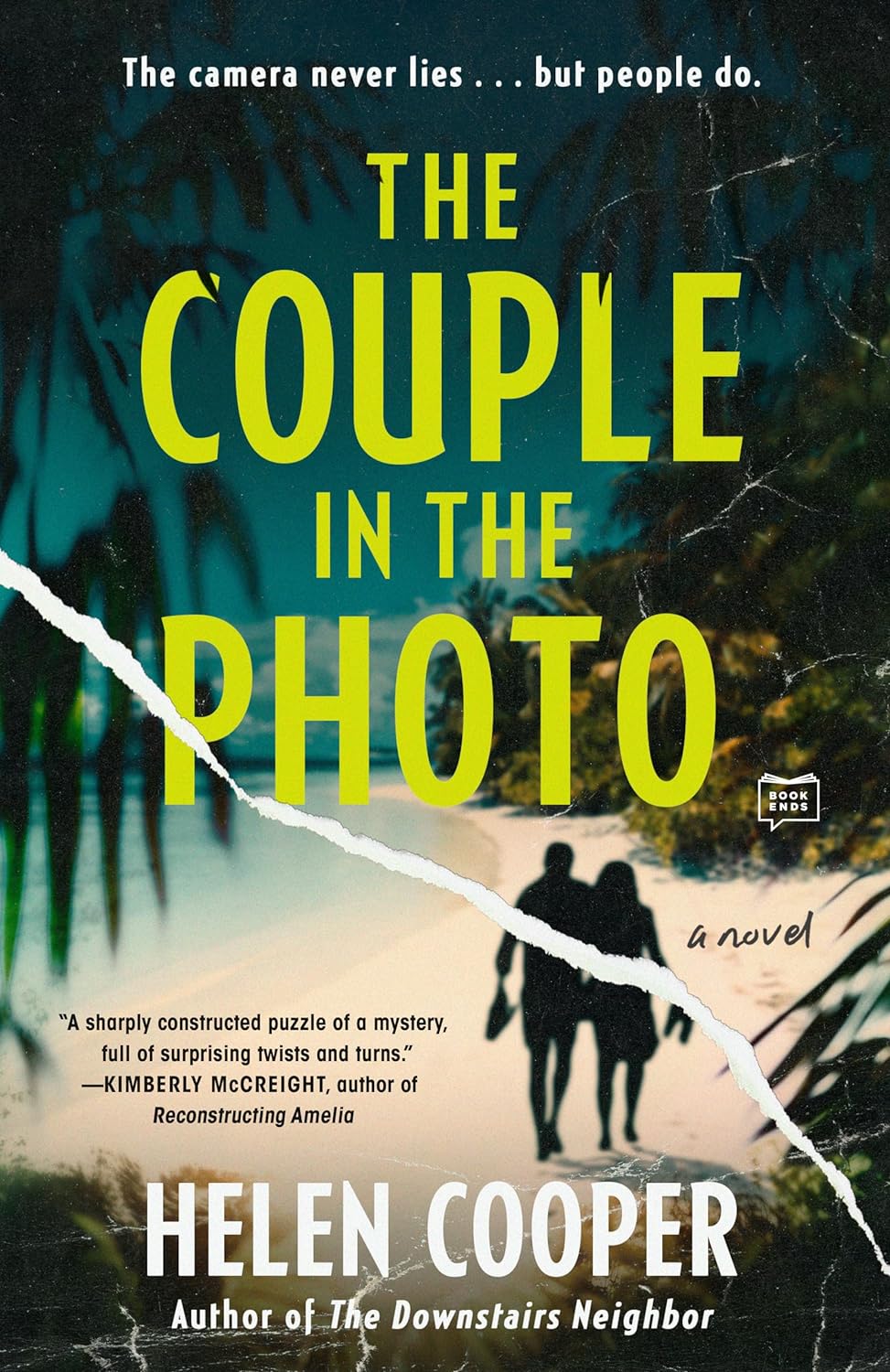
    The Couple in the Photo by Helen Cooper

    Always fascinated by photos, Lucy is eager to see her colleague’s snapshots from her honeymoon in the Maldives. But as Lucy slides through Ruth’s pictures, she pauses, surprised to see a familiar auburn-haired man. It’s Scott, her best friend’s husband but the woman with him isn’t his wife Cora nor is she someone that Lucy recognizes.

    “’How…” Lucy’s head felt thick. “What were their names?”

    “’Jason and Anna,” Ruth reeled off with pride writes Helen Cooper in her mystery novel The Couple in the Photo (G. P. Putnam’s Sons). “An interesting pair! Pretty drunk that night but then so were we!’ She laughed to herself as if at some remembered in-joke, then swiped onward, reeling through more palm trees and lapping waves while Lucy sat back in her chair with bile rising in her throat.”

    Unwilling or unable to believe she’s misidentified the man, Lucy begins prying to the consternation of Scott as well as her own husband, Adam, who has been best friends with Scott and Cora since college. When Adam married Lucy she became part of the tightly knit group that is so intertwined that their kids are best friends, and they restoring a weekend cottage they bought together. But Lucy has always felt that there were things she didn’t know from that time, a feeling she tried to dismiss because she had attended the same university as them.

    Her feelings of misapprehension darken into a much deeper concern than just whether Scott, who was supposedly in Japan on a business trip, was having an affair. She tries to get a copy of the photo from Ruth but finds she’s absent from work. Ruth is avoiding her but when finally pins her down says the photo was erased.

    Watching television, Lucy learns that a woman named Juliet Noor failed to return from a trip to the Maldives. Juliet, whose bludgeoned body turns up on the island, is the woman with Scott in the photo. Scott denies knowing her, but Lucy discovers that Juliet, a journalist, interviewed Scott for an article not long before. And there’s a connection between Juliet and Cora, Scott, and Adam. They all went to university together along with a man named Guy who mysteriously died back then.

    It all gets murkier when Ruth says she’s found the photo after all but when she sends it to Lucy, it’s a different couple. And when Lucy arrives at Ruth’s house to confront her, she learns that Ruth has been attacked and it’s not sure if she’ll survive.

    Sick with worry and fear, Lucy realizes that her relationship with her husband and best friends is based on lies, deceit, and possibly more than one murder. The truth is she doesn’t really know them at all. What she does know is that one or more of them may be willing to harm her to prevent the truth from coming out.

    ABOUT THE AUTHOR

    Helen Cooper is the author of The Other Guest and The Downstairs Neighbor. She is from Derby and has a MA in Creative Writing and a background in teaching English and Academic Writing. Her creative writing has been published in Mslexia and Writers’ Forum; she was shortlisted in the Bath Short Story Prize in 2014, and came third in the Leicester Writes Short Story Prize 2018.

    This review originally appeared in the New York Journal of Books.

  • Night Shift by Robin Cook

    Night Shift by Robin Cook

    His mother-in-law has moved in with him, his young daughter has been diagnosed as being on the autism spectrum, his son’s school wants an ADD diagnosis, and his wife’s promotion to Chief Medical Examiner has turned her into a nemesis in some ways as she now expects her husband to no longer go rogue when investigating a potential homicide.

    What’s a seasoned medical examiner to do?

    For Jack Stapleton, whose irreverent style and sarcastic humor often get him into trouble, the answer is to find a very compelling case to dive into. And fate intervenes when the body of Dr. Sue Passero, his wife’s best friend, lands on Jack’s autopsy table. But even after the autopsy is completed, Jack is still at a loss as to how the seemingly healthy doctor died. Was it a drug overdose? A heart attack? None of the toxicology tests show that’s the answer. So Jack, trying to avoid the tension at home, starts investigating. He talks to Cherine Gardener, a colleague of Passero’s, who tells him that Sue believed there was serial killer roaming Manhattan Memorial Hospital, where the two worked together.

    Gardener promises to meet Jack the next day to tell him more. And she does, but not in the way expected. Just as Sue showed up unexpectedly on his autopsy table the day before, now it’s Cherlne who is dead. Did she really die of a drug overdose? What about the witness who heard her scream, the sounds of fight, and a stranger fleeing down the stairs and out the door? Could she have been murdered to keep from revealing more about the death rate at the hospital? Jack’s good buddy, police detective Lou Saldano, suspects it was a homicide and warns Jack to leave the investigation to the police.

    But Jack’s not good at following rules. And now the killer wants him dead, too.

    Author Robin Cook, a medical doctor whose second book Coma, released in 1977, was a bestseller and made into a blockbuster movie, is considered to have created the medical mystery genre.

    In Coma and his other novels, Cook adds another layer to his plots as he has his protagonists grapple with modern medical issues and the role of private equity ownership putting profits over patients in the hospitals they run. Because of that, the killer in Night Shift easily gets away with his crimes and adds to the obstacles Jack encounters when trying to determine not only how the two women died and why but to stop future deaths including his own.

    In Night Shift, Cook’s 37th novel, he shows that he hasn’t lost his touch.

    This review originally ran in the New York Journal of Books.

  • Henry VIII’s Children: Legitimate & Illegitimate Sons & Daughters of the Tudor King

    Henry VIII’s Children: Legitimate & Illegitimate Sons & Daughters of the Tudor King

    “This book is a compelling read as Angus is a clear, concise, and talented writer who makes even small facets of long ago lives fascinating.”

    The irony of Henry VIII is acute. The once dashing heroic young man who succumbed to gluttony, cruelty, and, though it was done in a state-sanctioned manner, the murder of unwanted wives in hopes he could finally sire an heir, had at least one and most likely more illegitimate sons. But Edward, born of his third wife, Jane Seymour, who gained the throne with the beheading of his second wife, Anne Boleyn, was sickly and would die after a short stint as king.

    And thus, first Henry’s legitimate daughter Mary, to be soon known as Bloody Mary because of her religious fanaticism, and then Elizabeth would come to rule. There is more irony here as well. Mary was the daughter of Henry and his first wife, Katharine of Aragon, who was cast aside so that he could marry Anne. Elizabeth 1 was born of that short-lived union. Both Mary and Elizabeth’s early childhoods were filled with rejections and loss of status. Things grew more precarious after her mother’s death. Her father was off with his next wife—there would be six all together and Mary, after Edward’s death, saw her half-sister, a Protestant to boot, as a rival for the throne. It was as dysfunctional of a family as any on a Jerry Springer show.

    But what went on between these two siblings isn’t the only story regarding Henry’s children. And Caroline Angus, author of Henry VIII’s Children has written an immensely readable history of Henry’s other children, their mothers, and how they fit into Tudor society.

    “The tales of King Henry VIII’s illegitimate children are stories made form precious few recorded clues, plus memory, slander, gossip, and conjecture,” writes Angus. “But within the dramatic lives of the Tudor dynasty, almost anything is possible.”

    It was while Henry was married to his first wife, Katharine of Aragon, the widow of his brother Arthur, who was pregnant with his child, that he impregnated Bessie Blount. Still in her teens, Blount was in the third tier of Katharine’s ladies-in-waiting, not noble or wealthy enough to be in the first or second ranks but better than the fourth tier. Her job was to fetch and hold items for the queen and deliver messages. For that, she received her own room and servant and was granted permission to keep pets in the royal household.

    Bessie wouldn’t be the first of the Queen’s ladies that Henry bedded. He had already had an affair with at least one and would embark relations with several others. Katharine’s lost her child, much to the chagrin of the kin who was tired of his wife’s inability to give him a son. Bessie did much better and Henry was delighted with their son who was called Henry Fitzroy. The term Fitzroy is French word meaning “son of a king” and was used by the English to denote an illegitimate child. Henry bestowed upon titles and lands upon little Henry while Katherine just had to smile and bear it. That’s what women had to put up with in those days.

    Angus’ research is so extensive that readers even learn what Fitzroy ate for his afternoon meal. The first course was pottage, boiled beef, mutton, geese, capons, veal, and custard. If that sounds like a lot consider the second course consisted of lamb or kid, rabbits, pigeons, wildfowl, a tart or baked meat, fruits, and four gallons of ale and two pitchers of wine. Now, of course, some of that was probably for those who were dining with him. Fitzroy’s dinner meal was equally heavy and included 12 sweet desserts.

    In another touch of irony, after Henry divorced Katharine, he could have made Fitzroy legitimate by marrying Bessie Blount whose husband had just died. But he was so entranced by Anne Boleyn that he married her instead, believing she would give him a son. She didn’t and lost her head.

    There were other illegitimate children scattered around, probably more than history reveals. Anne’s sister Mary oldest son and daughter, Catherine and Henry Carey, were said to be Henry’s children. So was Ethelreda Malte, whose mother was a laundress. John Perrot claimed he was the son of Henry. And there were rumors Henry was the father of Thomas Stuckley, Richard Edwardes, and Henry Lee.

    This book is a compelling read as Angus is a clear, concise, and talented writer who makes even small facets of long ago lives fascinating.

    This article orignally appeared in the New York Journal of Books.

  • Salamati: Hamed’s Persian Kitchen: Recipes and Stories from Iran to the Other Side of the World

    for the adventuresome home chef, Allahyari offers a world of flavors.”

    In mortal danger for his beliefs, Hamed Allahyari and his pregnant girlfriend fled their homeland of Iran, first spending two months in Indonesia and then, after grueling hours long by truck over badly paved back roads and then days crammed aboard a boat another five months on Christmas Island before being granted asylum by the Australian government. Once there, life remained extremely difficult for the young couple who were now parents of two young children, and though Allahyari had been a chef and restauranteur in Iran, no one was interested—or so it seemed—in Persian cuisine.

    Unable to find work Allahyari began volunteering at the Resource Center, an organization that provides support, legal advice, and other assistance including meals to refugees and people seeking asylum.

    “Every day they feed 250 people a free lunch,” Allahyari writes in the introduction to his cookbook Salamati: Hamed’s Persian Kitchen: Recipes and Stories from Iran to the Other Side of the World. “I started cooking there two days a week, making Persian food for people from all over the world: Sri Lanka, Afghanistan, Miramar, Sierra Leone, all kinds of places, and most of them had never tried Persian food before. But when they tried it, they liked it. They talked to me about it, asked me about it, and it made me happy.”

    Culinary Connections

    At the recommendation of others, Allahyari also began teaching cooking classes, demonstrating how to make such dishes as Zeytoon Parvadrah (Olive and Walnuts Chunky Dip), Yogurt and Cucumber soup, Sabzi Pofow Ba Mahi (Fish with Herb Pilaf) Sabzi Pofow Ba Mahi (Fish with Herb Pilaf), and Persian Love Cake. Over the years, Allahyari taught more than 2500 people how to make Persian food. Now, he caters and is chef/owner of SalamiTea, a restaurant located in Sunshine, an ethnically diverse neighborhood in Melbourne. The name is a play on “salamati,” the Persian word meaning both “health” and “cheers.”

    Salamati is more than just a cookbook, it’s also a memoir and homage to the country he had to flee. The introduction to the featured recipes in his book might offer a personal connection to the dish, a description of a unique ingredient that helps define it and bring out its best flavors—though he also offers a substitute for such items as Persian dried limes, which might be difficult to locate outside of a major city, and/or puts the food in context with the scenes to Iran.

    This dish is traditionally served in Iranian shisha shops, the cafes where older men gather to smoke water pipes, drink tea and solve the problems of the world,” he writes about Ghahve Khunee Omelette (Street-Food Tomato Omelette). “Shisha shops don’t really serve food but inevitably people get hungry while they’re hanging around, so it’s become traditional for staff to whip up a quick tomato omelette for customers and serve it with bread, raw red onion, herbs and lemon. If you want one, all you ask for is ‘omelette.’ There’s no menu as such.”

    Not all the recipes are easy but for those who don’t want to spend a lot of time in the kitchen, there are enough simple ones to get started. Full-color photos of each recipe show what the finished product will look like. And for the adventuresome home chef, Allahyari offers a world of flavors.

    This review originally appeared in the New York Journal of Books.