Tag: Murder
-

Disturbing the Bones
It’s an archaeological dig so finding human remains shouldn’t be a surprise, but Dr. Molly Moore immediately recognizes that the skeleton they’ve unearthed is much more recent than what you’d find on a site dating back 12,000 years. Indeed, the body is that of a young Black reporter who disappeared just decades ago when covering the racial unrest in Cairo, Illinois.
The loss of his mother has left a large void in the life of Chicago Police Detective Randal Jenkins, and he travels back to Cairo, where he lived as a young boy, to learn more about the case. But it soon becomes clear that this is more than just the murder of an investigative reporter during a tumultuous time. Moore finds herself pressured by her long-time mentor and supporter, retired military general and contractor William Alexander to complete the dig and minimize her discovery. As Moore and Jenkins, each with their own family issues to deal with, work at discovering answers they realize that the General is trying to disrupt the process of a disarmament agreement being developed at a global peace summit taking place in Chicago. The stakes are so high that not only are their lives in jeopardy, but the world may be hurling towards a nuclear disaster.
Disturbing the Bones (Melville House 2024) is the first joint effort by director and screenwriter Andrew Davis, a native of Chicago’s southside and Jeff Biggers, an American Book Award-winning historian, journalist, playwright, and monologist.
In writing the book, Biggers, whose work has appeared in American and foreign newspapers and magazines as well as numerous anthologies, relied upon his knowledge of archaeology, the environment, culture, and history as well as his abilities as a researcher. He is the author of such books as Reckoning at Eagle Creek: The Secret Legacy of Coal in the Heartland and The United States of Appalachia: How Southern Mountaineers Brought Independence, Culture, and Enlightenment to America.
“I’ve been around a lot of archaeological digs,” he said in a joint conversation with Davis and this writer.
It’s also a timely story in that there’s a presidential election going on as Jenkins and Moore race to solve the mystery.
“It’s the only novel with a woman running for the presidency but in the book she’s from Chicago,” says Davis, noting that, as in the book, he sees this election as a turning point in our history. “The story is a blending of art and action, and it asks provocative questions which I think any good book should do.”
Any enjoyable book should, as it tells a story, also open another world for us. The authors do that here as we learn about archaeology, what happens on a dig, and the social upheaval the country went through during the Civil Rights movement. It also explores the psychology of Jenkins and Moore whose personal lives affect their profession and the decisions they make.
This was the first collaboration between Biggers and Davis, but it won’t be their last. The two are also working on a screenplay for the book. Davis has an extensive background in this area, having worked on a myriad of films such as “Holes”, “Under Siege”, “Code of Silence”, “A Perfect Murder”, and “The Guardian.” Known for directing intellectual thrillers, his film “The Fugitive,” was nominated for seven Academy Awards including Best Picture.
Biggers, who served as the Climate Narrative Playwright-in-Residence at Indiana University Northwest several times and lived in Miller Beach during his time there, enjoyed the collaborative process.
“I’ve written a lot of books on my own,” he says, “but this was, in ways, the best of both worlds as we went back and forth and exchanged ideas and shared thoughts.”
-

Women Who Murder by Mitzi Szereto
“For the female of the species is more deadly than the male.”
—Rudyard Kipling, from the poem “The Female of the Species.”
“Why is that we’re always so shocked when women commit violent crimes, in particular, the crime of murder? Perhaps we’re more accustomed to seeing men as the aggressors when it comes to murder, not women. Yet some of history’s most notorious killers have been women. From Countess Erzsebet Bathory, Delphine LaLaurie, Amelia Dyer, Lizzie Borden, and Belle Gunness . . . it often seems impossible to keep up.”
True crime writer Mitzi Szereto is the editor of Women Who Murder: An International Collection of Deadly True Tales (Mango Publishing), a compendium of murderous women written by internationally famous writers such as horror writer Anthony Ferguson, who lives in Australia; Tom Larson, an American mystery writer; and Cathy Pickens, an attorney who writes both true crime and the Blue Ridge Mountain Cozy Mysteries.
The tales they tell, some well-known such as “Ruth Snyder: The Original Femme Fatale” by Claran Conliffe and “On the Courtroom Steps: The Trial of Susan Smith” by Picken and others much more obscure but no less fascinating like “Mona Fandey: The Malaysian Murderer” by Chang Shih Yen and “Anno Biesto, Anno Funesto” by Alish Holland about the brutal slaying of John Charles on Leap Year Day in 2000 in New South Wales, give lie to the saying that women are the gentler sex. Indeed, these women can kill just as violently and wantonly as any man.
In her introduction, Szereto points out that men and women do kill differently and often for different reasons. Poison, at least in the past, often was the murder weapon of choice of women—easier to administer than creeping up and stabbing someone and so much tidier—no blood to clean up. They also kill less frequently and are typically not in it for the thrill of the kill like many male serial killers. Szereto says that many women, particularly those labeled as Black Widows, do so for the money, though that’s not the only reason. Sometimes it’s the only way to get rid of a threatening boyfriend or spouse or because of jealousy, love, and hate.
But kill they do. And in this fascinating read, we learn about 14 women who did.
This review originally appeared in the New York Journal of Books.
.
-

Deliberate Cruelty: Truman Capote, The Millionaire’s Wife, and the Murder of the Century
With the grit and determination to overcome very similar hardscrabble backgrounds, Truman Capote and Ann Woodward both rose to pinnacles in New York’s glittering mid-century high society. But overcoming such comparable odds didn’t make them fast friends. Instead, Ann’s coarse description of Capote’s sexual orientation turned him into a virulent foe. Eventually, each would plummet, losing friends and their reputations.
Their paralleled rise and fall is chronicled in Roseanne Montillo’s Deliberate Cruelty: Truman Capote, The Millionaire’s Wife, and the Murder of the Century, a juicy true crime tome that takes us into the lives of headliners of the time such as the Duke and Duchess of Windsor, Lee Radziwill, Claus von Bulow (who would later be accused of attempting to murder his wife), and Babe Paley.

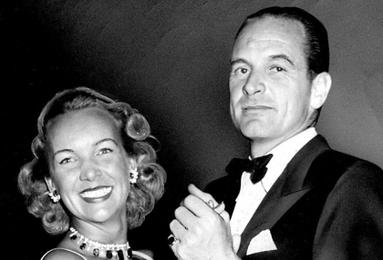
Ann and Billie. Photo source Wikipedia.
For Ann Eden, her romance with Billie started so well. She worked the midnight to 3:00 a.m. shift at Felipe’s, a popular Manhattan night club, performing in a white bathing suit, black fishnet stockings, and high heels. Admirers would invite the dancers to their tables for a cocktail and, possibly, negotiations. There were rumors that Ann was available for more than just drinks and Billie, the handsome heir to a banking fortune, was an attentive beau, who showered her with gifts. There was one drawback: He was married, and she was just a showgirl with a bad pedigree for those who keep score of such things.
But Ann’s beauty and moxie was such that she negotiated for more and ultimately landed one of the biggest matrimony catches when she and Billie wed. But this was no Cinderella marriage despite the expensive homes, extensive wardrobe of designer duds and fur coats, and invitations to soirees packed with a who’s who of upper crust New Yorkers. Ann often felt an overwhelming sadness which she treated with the use of tranquilizers. It wasn’t a good mix with the cocktails she and Billie also overly imbibed. The couple was known for their stupendous, alcohol-fueled rages.
The night Ann shot Billie had proceeded along those lines. Returning from an exquisite party where the candles were soaked in Chanel Number 5 and the table set with silver and the finest China, the two returned to their 43-acre estate and retreated into separate bedrooms. Waking up an hour or so later to the sound of a crash, Ann reached for the shotgun she kept nearby. A burglar had been breaking into houses in their rich neighborhood and Ann, as she would tell police, thought they were being robbed. She fired twice—and only then realized she had killed her husband.

Truman Capote in 1959
Was it a deadly mistake? Or had Ann purposefully fired, knowing it was Billie? After all, if he divorced her, she might lose everything. As his widow, she could maintain the wealthy lifestyle she had struggled so hard to achieve. Billie’s family and friends thought they knew.
As for Capote, he was still riding high on the success of In Cold Blood, which ironically is credited as being the first in the now burgeoning true crime genre. Ann was cleared of her husband’s murder, but Capote was on her trail now. It wasn’t going to be pretty.
“Both were vulnerable and mean,” writes Montillo in the prologue to her book. “Both were familiar with violence and the violence that caused the death of Billy Woodward would, as recounted by Truman Capote 1975, incite fresh violence that would ultimately destroy them both. What began with insults in Saint Moritz would end in death for one and ignominy for the other.”
-
CrimeReads: 10 New Books Coming Out This Week ‹ CrimeReads
CrimeReads: 10 New Books Coming Out This Week ‹ CrimeReads. https://crimereads.com/10-new-books-coming-out-this-week-february-14-2022/