Once called Coatlan after the earthenware vessels that were coiled like a serpent and used for storing pulque, a white wine made from the Mexcal tree and used as an offering to a stone idol, Cuiseon was a small village on The Nine Rivers which flowed into Lake Chapala.
This and other food traditions, according to The Geographic Account of Poncitlán and Cuiseo del Río dated March 9, 1586, showed their typical fare as venison, fish, and rabbit, a thin kind of porridge to drink hot with powdered chile that was broken up and sprinkled on top, and Izquitl—corn toasted on a comal and seasoned with salt. The villagers harvested chia, huauhtli, and cocotl, the latter a mustard-like seed that is ground up and mixed with corn and water to drink both before and after eating.
As it relates to the foods we eat today, we still consume corn and fish and season with salt and powdered chiles. We’re less likely to dine on venison or rabbit while cocotl is so obscure that even a Google search doesn’t come up with a hit. But both chia and huauhtli, a species of amaranth, an ancient grain, are recognized as beneficial to our health. And so, the foods of this village still play a part in our lives.
This is an obscure slice of everyday life, a glimpse into the past that would be lost to time, confined to dusty archives, and/or shelved away to be forgotten in libraries or museums, if not for the work of Tony Burton, an award-winning writer whose books include “Lake Chapala: A Postcard History” (2022), “Foreign Footprints in Ajijic: Decades of Change in Mexican Village” (2022), “If Walls Could Talk: Chapala’s historic buildings and their former occupants” (2020), “Mexican Kaleidoscope: myths, mysteries and mystique” (2016), and “Western Mexico, A Traveler’s Treasury” (4th edition, 2013).
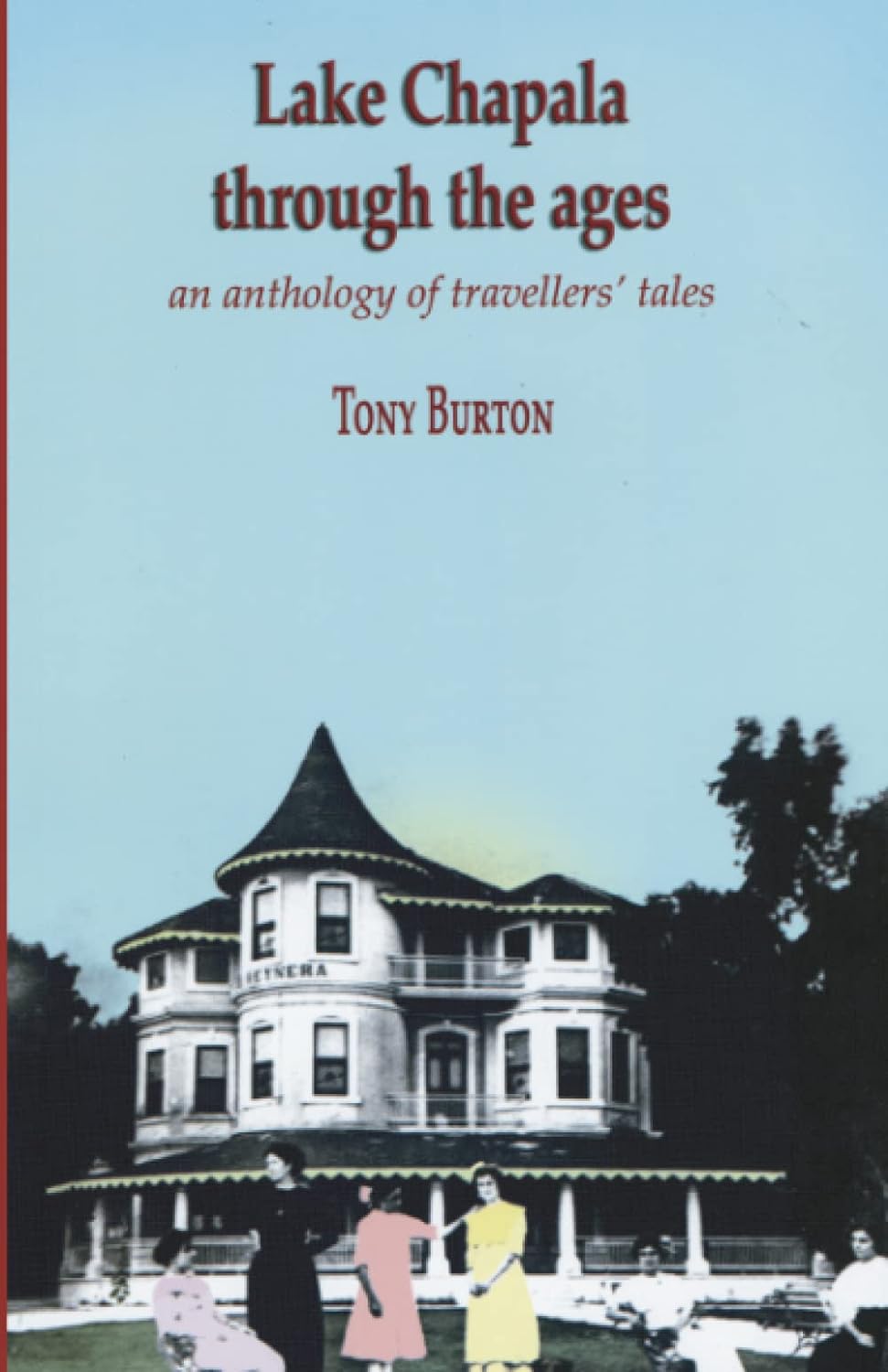
Reading through a unique collection of extracts from more than fifty original sources, many never previously available in English, Burton’s book, “Lake Chapala Through the Ages; an anthology of travelers’ tales,” is a fascinating look at the region's formative years from the arrival of conquistadors in the early 1500s to the start of the Mexican Revolution in 1910, as told through the eyes of an assortment of travelers-- poets, friars, exiles, government officials, geographers, historians, explorers, and scientists.
What they saw in their journeys is fascinating, as are the people who traveled and then shared their observations.
"My inspiration was really curiosity about the documentary basis for things I’d heard about the history of the area, some of which struck me as highly imaginative," says Burton. "I began working on the book way before the development of online search engines or digitized books, so it took me almost a decade to track down originals of the 50+ published works, excerpts from which appear in the final book. It would have been impossible without the support of an excellent inter-library loan system, personal visits to libraries in the USA and England, and the generous contributions of a small army of people I thank in the book’s acknowledgments.
"I still remember the shivers that ran down my spine when I first handled the leather-bound Belgian journal from the 1830s containing an article about Lake Chapala by Henri Galeotti. I knew that article existed because some parts had been translated into Spanish and published in Mexico. The challenge of finding the original proved to be well worth the effort—in my opinion, Galeotti’s masterful, illustrated, systematic, scientific coverage of the area's geology and natural history has no equal."
Barrister and seasoned traveler William Henry Bullock Hall (1837–1904), who was born in Essex, England, and educated at Balliol College, Oxford visited Mexico taking a route that began in Veracruz and took in Mexico City, Tepic, San Blas, Guadalajara, Querétaro and Tampico."
Looking for boiling water while staying at the hacienda of Buena Vista, he made the following observation:
“In one of the recesses of the building, I discovered, over her earthenware pots, the old woman, upon whom you are sure to stumble, sooner or later, in Mexican houses, if you only persevere. As good luck would have it, this old crone was in the act of trying to blow into a sufficient glow to boil a jug of water, the bits of charcoal which, laid in a square receptacle sunk in the face of a solid brick counter, do the duty of a fire all over Mexico. From this old lady I obtained not only boiling water, but a couple of poached eggs, so that I fared sumptuously.”
English women often were intrepid travelers, journeying to places remote and probably most uncomfortable. How joyous to meet Rose Georgina Kingsley (1845–1925), the oldest child of the Rev. Charles Kingsley, a celebrated English clergyman and novelist, who contributed the prologue to her book” South by west or winter in the Rocky Mountains and spring in Mexico,” published in 1874 and digitized by Harvard University in 2006.
Rose crossed the Atlantic to Colorado Springs in November 1871 to join her brother, Maurice, who was assistant treasurer of the company developing Colorado Springs writes Burton, noting that, even by 1872, there were fewer than 800 residents, so both Kingsleys were pioneer settlers. Her writings and sketches were published by General William Jackson Palmer, the founder of Colorado Springs, a railway entrepreneur and owner of the newspaper Out West.
When Palmer decided that same year to examine possible routes for a railway linking Texas to Manzanillo, Rose accepted the invitation to join him along with his wife, Queen, and General William Rosencrans on a trip that took them first to Manzanillo and then inland to Colima, Guadalajara, Guanajuato, Querétaro, and Mexico City. Her descriptions of the sights and interactions along the way are fascinating.
“At San Pedro [Tlaquepaque] we stopped and got three men as escort, and at 9.30 came to San Antonio, a hacienda where we changed mules, and had breakfast in a hut by the roadside,” she writes. “The women in the hut, which was only made of sticks and thatch, gave us eggs, frijoles, tortillas, and carne seca, in chilli Colorado sauce, which for hotness almost beat the mole de guajalote at Atenquique. But besides these native viands we got capital chocolate, made from some cakes we had brought with us. So, on the whole, we fared well.”
They arrived at La Barca, on the Rio Lerma, on market day and ate a very good meal in a dirty fonda (restaurant) where the walls were covered with broken bits of pottery in decorative patterns. There they learned they had barely missed being robbed the night before—all of which Rose, in her writings at least, takes in stride.
Burton, the editor-in-chief of MexConnect, Mexico’s top English-language online magazine, spans time and place to take us into one of his favorite regions of Mexico where he lived for over a decade, bringing the past alive and introducing us to an interesting cast of characters.
Tag: Mexican cuisine
-

Western Mexico, A Traveler’s Treasury: Notes from the Road from the 16th Century On
-
Plant Powered Mexican: Fasy, Fresh Recipes from a Mexican-American Kitchen
Unless you’re deeply committed to a life of vegetables, words like plant-based can be a turnoff when it comes to menus and cookbooks. Sure, many of us, myself included, want to expand our vegetable repertoire but still need to indulge their inner carnivore—particularly when we think of a bleak future with nothing but quinoa and steamed broccoli. But Kate Ramos, who created the blog ¡Hola! Jalapeño! with the goal of merging authentic ingredients and flavors with modern preparations, has our back. Taking that philosophy, Ramos has written her Plant Powered Mexican: Fast, Fresh Recipes from a Mexican-American Kitchen , published by Harvard Common Press, it’s a lushly photographer book with recipes that are so wonderful it’s easy to forget there’s nary an animal protein anywhere in her book.

Instead, Ramos offers us such dishes as Chileatole (a thick soup) with Masa Dumplings and Lime Crema, Potato and Collard Greens, Crispy Tacos with Ancho Chile Crema, and my personal favorite–One-Pan Cheesy Rice Chile Relleno Casserole.
In her first chapter, Ramos tells us what’s in her pantry, providing us with an entrée into the world of chiles, peppers, oils, spices, herbs, and Mexican cheeses as well as the equipment she relies upon. The latter are simple enough. Just a comal (but she notes you can use a cast iron skillet instead) and a molcajete and tejolote, a volcanic stone mortar and pestle for grinding spices and making chunky salsas. As for the ingredients she commonly uses, I’d be willing to bet that many of us have such items as black pepper, smoked paprika, garlic powder, kosher salt, and coriander in our spice drawer already. That just leaves a variety of dried chile powders—ancho, guajillo, arbol, and habanero as well as a few other ingredients that can be bought as needed. Unlike many entrees into a new cuisine, Ramos keeps it simple and inexpensive.

Six of the remaining chapters are divided into cooking methods—slow cookers, stovetop, grills, and oven. Instant Pot aficionados will be very happy to hear that there’s an entire chapter devoted to recipes using the beyond popular small kitchen appliance. Ramos cooks out of a small kitchen and says she’s never been enamored of kitchen equipment until, that is, she fell in love with her Instant Pot. Besides, its ability to cook beans—a common ingredient in Mexican cookery–quickly, Ramos offers a selection of recipes she’s developed for quick dinners for busy home cooks like Black Bean Enchilada Casserole, Smoky Tomato Tortilla Soup, and her Loaded Sweet Potatoes with Lime Crema, Sofrito Beans, Roasted Kale, and Chives.
The recipes I made all worked without me having to make tweaks to salvage them. That’s a plus because I have encountered recipes that haven’t been tested or at least not well evaluated before being included in a cookbook. If I have one complaint about Plant Powered Mexican it’s that the font is small so instead of just glancing at the recipe while cooking, I often had to pick up the book to be able to read the directions. It’s a small complaint and shouldn’t stop anyone who is interested in plant-based cooking from purchasing this well-written cookbook.

Vegan Picadillo Tostadas with Rice and Peas
For the tostadas
12 6-inch corn tortillas
For the picadillo
- 2 tablespoons avocado or sunflower oil
- 1 medium white onion chopped
- 2 medium carrots chopped
- 3 cloves garlic chopped
- 3 small Yukon gold potatoes peeled and diced
- 1 pound plant-based beef
- 1 recipe Magic Spice Mix see below
- 1 ¼ cups Gluten-free beer or vegetable broth
- ½ cup frozen peas no need to thaw
- ¼ cup chopped fresh Italian parsley
For serving
- 3 cups steamed rice
- Lime wedges
- 1 large avocado diced
- 1-2 medium jalapeños thinly sliced
- Green salsa
To make the tostadas: Heat the oven to 350°F. Once the oven is ready, lay the tortillas directly on the oven racks with plenty of room around them for air to circulate. (I put six on the top rack and six on the bottom in my oven.)
Bake for about 15 minutes, turning the tortillas halfway through, until they are very crisp and crack if you break them. Look for a light brown color, no darker than the shade of a roasted peanut. Remove the tortillas to a serving platter.
To make the picadillo: Heat the oil in a large frying pan over medium-high heat. Add the onion, carrots, garlic, and potatoes. Cook until the garlic and onions start to brown, about 5 minutes.
Add the plant-based beef and spice mix, breaking up the meat with the back of a wooden spoon. Continue cooking until the beef is browned, about 3 minutes. Add the beer or broth, reduce the heat to medium-low, and cover. Simmer the picadillo for about 10 minutes or until the veggies are tender. Stir in the peas and parsley, and cook for about 1 minute.
To Serve: Spread ¼ cup of rice on a tostada, and top with ¼ cup picadillo. Pass the garnishes at the table.
Magic Spice Mix:
Mix 1 tablespoon guajillo chile powder, 1 teaspoon kosher salt, ½ teaspoon ground black pepper, ½ teaspoon smoked paprika, ½ teaspoon garlic powder, ½ teaspoon ground coriander, ½ teaspoon dried epazote or oregano (preferably Mexican) together in a small bowl until evenly combined. Use immediately or keep in a container for up to 1 month.
Chilled Avocado Soup
FOR THE SOUP:
- 1 large ripe avocado, peeled and pitted
- 2 cups cold water
- 2 small Persian cucumbers
- 2 scallions, trimmed and chopped
- 1/4 cup fresh lime juice (from 2 limes)
- 1/4 cup chopped fresh cilantro
- 1/4 cup extra virgin olive oil
- 1 teaspoon kosher salt
FOR THE FAIRY DUST
- 1/4 cup roasted, salted sunflower seeds
- 1/4 cup white sesame seeds
- 1/4 cup popped amaranth
- 1/4 cup edible flower petals, such as nasturtium, pansies, marigolds, or cornflowers
- 1 teaspoon toasted cumin seeds
To make the soup:
Blend soup ingredients. Add avocado, water, cucumbers, scallions, chile, lime juice, cilantro, oil, and salt to a blender. Blend until smooth.
Chill. Cover and chill in the refrigerator until completely cold, at least 2 hours.
To make the fairy dust:
Combine. Add the sunflower seeds, sesame seeds, amaranth, flowers, and cumin seeds to a small bowl. Mix gently.
Serve. Ladle the cold soup into bowls and sprinkle fairy dust over the top.
This review originally appeared in The New York Journal of Books.
