Tag: James Beard

  • Introducing the James Beard 2024 Book Award Nominees

    Introducing the James Beard 2024 Book Award Nominees


    Baking and Desserts:

    This award recognizes books with recipes focused on the art and craft of baking, pastries, and desserts, both sweet and savory items, including ingredients, techniques, equipment, and traditions.

    This year, submissions to the Bread category were included for consideration within the Baking and Desserts category.


    Dark Rye and Honey Cake: Festival Baking from Belgium, the Heart of the Low Countries

    Regula Ysewijn
    (Weldon Owen)

    Mayumu: Filipino American Desserts Remixed

    Abi Balingit
    (HarperCollins)

    More Than Cake: 100 Baking Recipes Built for Pleasure and Community

    Natasha Pickowicz
    (Artisan Books)

    Beverage with Recipes:

    This award recognizes books with recipes focused on beverages, such as
    cocktails, beer, wine, spirits, coffee, tea, or juices.

    Juke Joints, Jazz Clubs, and Juice: Cocktails from Two Centuries of African American Cookbooks

    Toni Tipton-Martin
    (Clarkson Potter)

    The Maison Premiere Almanac: Cocktails, Oysters, Absinthe, and Other Essential Nutrients for the Sensualist, Aesthete, and Flaneur

    Joshua Boissy, Jordan Mackay, and Krystof Zizka
    (Clarkson Potter)

    Slow Drinks: A Field Guide to Foraging and Fermenting Seasonal Sodas, Botanical Cocktails, Homemade Wines, and More

    Danny Childs
    (Hardie Grant North America)

    Beverage without Recipes:

    This award recognizes books without recipes that focus on beverages, such
    as cocktails, beer, wine, spirits, coffee, tea, or juices; or books that cover these subject areas where recipes are not the focus of cooking, not just a single topic, technique, or region.

    Agave Spirits: The Past, Present, and Future of Mezcals

    Gary Paul Nabhan and David Suro Piñera
    (W. W. Norton & Company)
    The New French Wine

    Jon Bonné
    (Ten Speed Press)

    Vines in a Cold Climate: The People Behind the English Wine Revolution

    Henry Jeffreys
    (Atlantic)
    Food Issues and Advocacy:

    This award recognizes books that focus on investigative journalism, food
    policy, food advocacy, deep dives, and critical analysis of the changing social landscape around food.

    At the Table: The Chef’s Guide to Advocacy

    Katherine Miller
    (Island Press)

    Avocado Anxiety: and Other Stories About Where Your Food Comes From

    Louise Gray
    (Bloomsbury Wildlife)

    Resilient Kitchens: American Immigrant Cooking in a Time of Crisis: Essays and Recipes

    Philip Gleissner and Harry Eli Kashdan
    (Rutgers University Press)

    General:

    This award recognizes books with recipes that address a broad scope of cooking, not just a single topic, technique, or region.

    A Cook’s Book

    Nigel Slater
    (Ten Speed)

    The Everlasting Meal Cookbook: Leftovers A-Z

    Tamar Adler
    (Scribner)

    Start Here: Instructions for Becoming a Better Cook

    Sohla El-Waylly
    (Alfred A. Knopf)

    International:

    This award recognizes books with recipes focused on food or cooking traditions of countries, regions, or communities outside of the United States.

    Made in Taiwan: Recipes and Stories from the Island Nation

    Clarissa Wei with Ivy Chen
    (Simon & Schuster/Simon Element)

    My Everyday Lagos: Nigerian Cooking at Home and in the Diaspora

    Yewande Komolafe
    (Ten Speed Press)

    The World Central Kitchen Cookbook

    José Andrés and Sam Chapple-Sokol
    (Clarkson Potter)

    Literary Writing:

    This award recognizes narrative nonfiction books, including memoirs, culinary travel, culinary tourism, biography, reflections on food in a cultural context, and personal essays.

    Food Stories: Writing That Stirs the Pot

    The Bitter Southerner

    (The Bitter Southerner)

    For The Culture: Phenomenal Black Women and Femmes in Food: Interviews, Inspiration, and Recipes

    Klancy Miller
    (HarperCollins)

    The Migrant Chef: The Life and Times of Lalo García

    Laura Tillman
    (W. W. Norton & Company)

    Reference, History, and Scholarship:

    This award recognizes manuals, guides, encyclopedias, or books
    that present research related to food or foodways.

    The Ark of Taste: Delicious and Distinctive Foods That Define the United States

    David S. Shields and Giselle K. Lord
    (Hachette Book Group)

    Food Power Politics: The Food Story of the Mississippi Civil Rights Movement

    Bobby J. Smith II
    (University of North Carolina Press)

    White Burgers, Black Cash: Fast Food from Black Exclusion to Exploitation

    Naa Oyo A. Kwate
    (University of Minnesota Press)

    Restaurant and Professional:

    This award recognizes books written by a culinary professional or
    restaurant chef with recipes that may include advanced cooking techniques, the use of specialty ingredients and professional equipment, including culinary arts textbooks.

    Ester: Australian Cooking

    Mat Lindsay with Pat Nourse
    (Murdoch Books)

    Fish Butchery: Mastering The Catch, Cut, and Craft

    Josh Niland
    Hardie Grant Books)

    Rintaro: Japanese Food from an Izakaya in California

    Jessica Battilana and Sylvan Mishima Brackett
    (Hardie Grant North America)

    Single Subject:

    This award recognizes books with recipes focused on a single ingredient, dish, or method of cooking. Examples include seafood, grains, pasta, burgers, or canning. Exceptions are baking and desserts books, vegetable-focused books, restaurant and professional books, and beverage books—
    which would be entered in their respective categories.

    The Hog Island Book of Fish and Seafood: Culinary Treasures from Our Waters

    John Ash
    (Cameron Books)

    Pasta Every Day: Make It, Shape It, Sauce It, Eat It

    Meryl Feinstein
    (Hachette Book Group

    Yogurt & Whey: Recipes of an Iranian Immigrant Life

    Homa Dashtaki
    (W. W. Norton & Company)

    U.S. Foodways:

    This award recognizes books with recipes focused on the cooking or foodways of regions or communities located within the United States.

    Ed Mitchell’s Barbeque

    Ed Mitchell, Ryan Mitchell, and Zella Palmer
    (Ecco)

    Love Japan: Recipes from Our Japanese American Kitchen


    Aaron Israel and Sawako Okochi with Gabriella Gershenson
    (Ten Speed Press)

    Made Here Recipes & Reflections From NYC’s Asian Communities

    Send Chinatown Love
    (Self-Published)

    Vegetable-Focused Cooking:

    This award recognizes books on vegetable cookery with recipes that are meatless, vegetarian, or vegan.

    Ever-Green Vietnamese: Super-Fresh Recipes, Starring Plants from Land and Sea

    Andrea Nguyen
    (Ten Speed Press)
    Japan: The Vegetarian Cookbook

    Nancy Singleton Hachisu
    Phaidon Press)

    Tenderheart: A Cookbook About Vegetables and Unbreakable Family Bonds

    Hetty Lui McKinnon
    (Alfred A. Knopf)

    Visuals:

    This award recognizes books on food or beverage with exceptional graphic design, art, or photography.

    The Book of Sichuan Chili Crisp

    Yudi Echevarria
    (Ten Speed Press)
    For The Culture: Phenomenal Black Women and Femmes in Food: Interviews, Inspiration, and Recipes

    Kelly Marshall and Sarah Madden
    (HarperCollins)
    Thank You Please Come Again: How Gas Stations Feed & Fuel the American South

    Kate Medley with Dave Whitling
    (BS Publishing)

    Cookbook Hall of Fame:

    This award is given to either a cookbook that has significantly influenced the way we think about food, honoring authors who possess an exceptional ability to communicate their gastronomic vision via the printed page, or an author whose cookbooks and other culinary books and work, taken together, make a difference in the world of food and cooking.

    The Book Awards Subcommittee selects the winner for this category. The Cookbook Hall of Fame winner will be announced at the Media Awards ceremony on June 8.

  • Bill Kim “Korean BBQ: Master Your Grill inSeven Sauces”
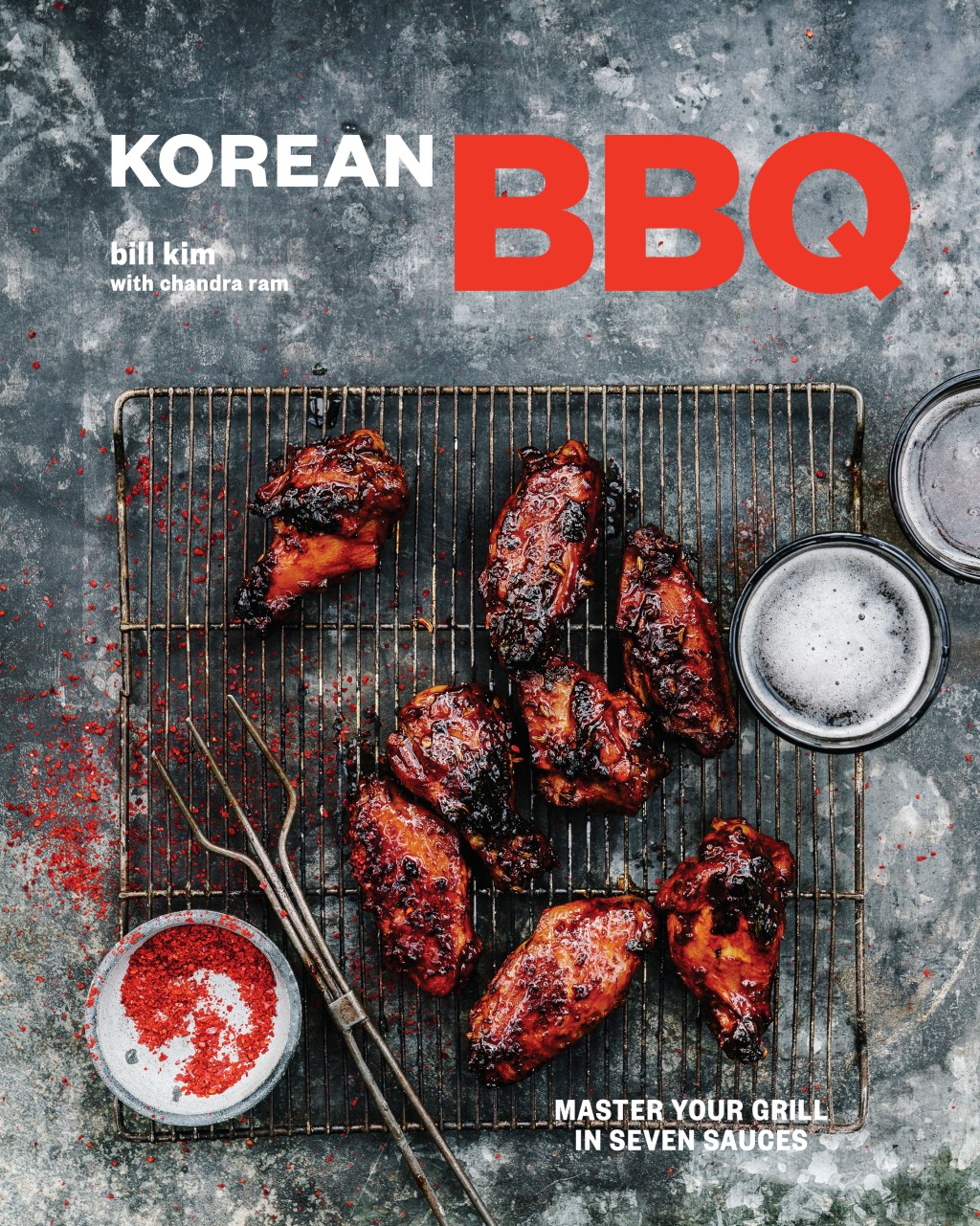
    Bill Kim “Korean BBQ: Master Your Grill inSeven Sauces”

    Seoul Buffalo Shrimp

                My friend  Kimiyo Naka asked if I’d like to interview Bill Kim, a Chicago chef/ restaurateur and James Beard Award nominee who had a new cookbook out on grilling Korean-style who would be doing a demonstration at the Japan Pavilion at this year’s National Restaurant Association. I’ve wanted to learn more about Korean cooking and because I was writing about grilling, the whole thing seemed like a perfect fit. To make it even more interesting, Kim is a fun interview,humorous, friendly and knowledgeable plus he makes Korean cooking sound easy.         

                It turns out that Kim’s first cooking experience was making instant ramen over seogtan(burning coals) at age six a year before his family moved from Seoul, Korea to Chicago. Fast forward four decades and Kim, who owns several restaurants in Chicago including urbanbelly, a communal-seating restaurant featuring creative noodle, dumpling and rice dishes, Belly Shack featuring menu items blending Asian and Latin flavors and bellyQ, a modern Asian barbecue concept, recently authored Korean BBQ: Master Your Grill in Seven Sauces (Ten Speed Press 2018; $28).

                His career path to culinary heights and James Beard Award nominations began with experiences feeding siblings and cousins while his parents worked and worries about not being able to make it in a traditional college atmosphere when attending a college recruitment event at his high school. That all changed when he saw a giant wedding cake. It was a lure and when he approached the table, a representative from a culinary school asked if was interested in a cooking career. 

                Attending Kendall College where he studied classic French and worked at several prestigious French restaurants and was also the chef de cuisine at Charlie Trotter’s but when it came time to open his own restaurants, he decided to focus on his own heritage as well as that of his wife who is from Puerto Rico in a style he calls Kori-Can. There were, of course, many remnants from his French culinary background and world travels in the mix as well and his American upbringing. For the latter, check out his recipe for Kimchi Potato Salad. He also wanted to get away from the rarified world of cuisine and open up his food to everyone.

                “My parents were very humble people who owned their own dry cleaning business for 35 years,” says Kim. “I wanted them to see their sacrifice pay off by taking all the things that I learned and being able to use it. My parents had only eaten at one restaurant I worked and that made me sad, I saw  because I knew how hard they worked. As I got further in my career, I was cooking for fewer people—only those people who had  he means to eat in the restaurants I worked in. But those weren’t the people I grew up and I wanted them to have restaurants to eat at.”

                “BBQ itself is engrained in the Korean culture says Kim.”

                “We didn’t have a lot of things when I was growing up in Chicago, we didn’t have a grill,” he says. “So when we wanted to barbecue, we had to go to park where there were free grills. I remember how the aroma of the foods we were cooking always attracted by people who weren’t part of our family. that someone from a different country could come up to you and ask what it was we were cooking.  My mom would give even strangers food. It was pretty powerful watching them when they tried it, the way their eyes opened and they smiled.  That’s when I learned food doesn’t speak a certain language.”

    Chef Bill Kim and Jane Ammeson at the Japan Pavilion at the 2018 National Restaurant Association

                Making Korean barbecue accessible was one of the inspirations behind Kim’s decision to write his cookbook.

                “I think I had a lot to say,” he says. “I really didn’t think there was a cookbook out there written by a chef, sharing the experience of being born in Korean and growing up here and adapting to a culture that was a very foreign to me.”   

                He also sees it as a way of giving back and to make Korean food accessible.

                “I think we take for granted that food is an entry level to a different culture,” says Kim. “I want people to look at the book and know the history behind it. And I wanted people to be able to cook Korean barbecue at home.”

                Indeed, with a wonderful, heartfelt introduction and seven master sauces and three spice rubs that make his dishes easy and simple to recreate at home, Kim takes away the mysteries of Korean food.

                “The thing that I want people to understand is that you can cook without borders now more than ever because the borders have crumbled,” he says.  “Even though the food is not 100% Korean it’s these flavors that can come out.”

    Seoul to Buffalo Shrimp

    1½ cups Lemongrass Chili Sauce (see below)

    ⅓ cup unsalted butter, melted

    2 tablespoons white sesame seeds, toasted

    2 tablespoons sambal oelek

    3 pounds extra-large peeled and deveined shrimp (16/20 count)

    ¼ cup Blackening Seasoning (see below)

    FEEDS 6 people

    Heat the grill for direct heat cooking to medium (350°F to 375°F).

    Combine the Lemongrass Chili Sauce, butter, sesame seeds, and sambal oelek in a large bowl and whisk until well mixed. Set aside.

    When the grill is ready, season the shrimp with the Blackening Seasoning, coating them evenly. Place the shrimp on the grill grate, close the lid, and cook for 2 minutes. Flip the shrimp over, close the lid, and cook them for another 2 minutes, until they turn an opaque pink color.

    Remove the shrimp from the grill, add to the sauce, toss well, and serve.

    Lemongrass Chili Sauce

    1 teaspoon minced garlic

    1 teaspoon minced, peeled fresh ginger

    ¼ cup minced lemongrass

    1 cup sweet chili sauce

    ¼ cup fish sauce

    ¼ cup sambal oelek

    2 tablespoons toasted sesame oil

    PREP TIME 10 minutes

    MAKES 2¼ cups

    Combine the garlic, ginger, lemongrass, chili sauce, fish sauce, sambal oelek, and oil in a bowl and whisk until blended. Transfer to an airtight container and refrigerate for up to 2 weeks or freeze for up to 2 months (see note).

    Blackening Seasoning

    ¼ cup sweet paprika

    ¼ cups granulated garlic or garlic powder

    ¼ cup chili powder

    2 teaspoons kosher salt

    Makes ¾ cup

    Combine all the ingredients in a small bowl and stir to mix. Store in airtight container in a cool, dark cupboard for up to six months

    NOTE This sauce won’t fully harden when frozen, so you can spoon out as much as you need whenever you want to use it.

    Sesame Hoisin Chicken Wings

    ½ cup Soy Balsamic Sauce (see below)

    ¼ cup Magic Paste (see below)

    ¼ cup hoisin sauce

    ½ cup thinly sliced green onions, white and green parts

    3 pounds chicken wings and drumettes

    Korean chili flakes (optional)

    FEEDS 6 people

    In a large bowl, combine the Soy Balsamic Sauce, Magic Paste, hoisin sauce, and green onions and mix well. Measure out ½ cup of the marinade and reserve for basting the wings on the grill. Place the chicken wings and drumettes in a large, shallow dish, pour the remaining marinade on top, and turn the wings and drumettes to coat evenly. Cover and marinate in the refrigerator for 1 hour.

    Heat the grill for indirect heat cooking to medium (350°F to 375°F). (If using a charcoal grill, rake the coals to one side of the charcoal grate; if using a gas grill, turn off half of the burners.)

    Place the wings and drumettes on the grill grate away from the heat, close the lid, and cook for 5 minutes. Flip the wings and drumettes over, baste them with some of the reserved marinade, close the lid, and cook for another 5 minutes. Flip the wings and drumettes over two more times, moving them directly over the fire, basting, and cooking for 5 minutes on each side. Sprinkle on some Korean chili flakes, if you like things a little spicier.

    Transfer the wings and drumettes to a platter and serve.

    Soy Balsamic Sauce 

    1 teaspoon cornstarch, or as needed

    2 tablespoons water

    ¼ cup dark brown sugar, firmly packed

    ½ cup balsamic vinegar

    ½ cup soy sauce

    MAKES 1 cup

    In a small bowl, stir together the cornstarch and water until the cornstarch dissolves and the mixture is the consistency of heavy cream, adding more cornstarch if the mixture is too thin.

    Combine the brown sugar, vinegar, and soy sauce in a small saucepan and bring to a boil over medium heat, stirring to dissolve the sugar. Stir the cornstarch mixture briefly to recombine, then stir it into the soy-vinegar mixture and simmer over low heat for about 3 minutes, until the sauce thickens enough to coat the back of a spoon.

    Remove from the heat, let cool completely, then refrigerate in an airtight container. This sauce will last for months without going bad.

    MAGIC PASTE

    1 (1-inch) piece fresh ginger, peeled and sliced

    5 cloves garlic, peeled

    2 tablespoons fennel seeds

    ½ cup fish sauce

    ¼ cup toasted sesame oil

    ¼ cup Korean chili flakes

    MAKES 1 cup

    Combine the ginger, garlic, and fennel seeds in a food processor and process until minced, periodically scraping down the sides of the bowl to make sure all of the ginger gets chopped. Add the fish sauce, oil, and chili flakes and process for 30 seconds.

    Transfer to an airtight container and refrigerate for up to 2 weeks or freeze for up to 2 months. Or freeze in standard ice-cube trays, then transfer the cubes (about 2 tablespoons each) to plastic freezer bags and freeze for up to 2 months.

    Reprinted with permission from Korean BBQ: Master Your Grill in Seven Sauces, copyright © 2018 by Bill Kim with Chandra Ram. Published by Ten Speed Press, an imprint of Penguin Random House LLC.Photographs copyright © 2018 by Johnny Autry.

    Jane Ammesoncan be contacted via email at janeammeson@gmail.com