Tag: Italian

  • A Blissful Feast: Celebrations of Family, Food, and History
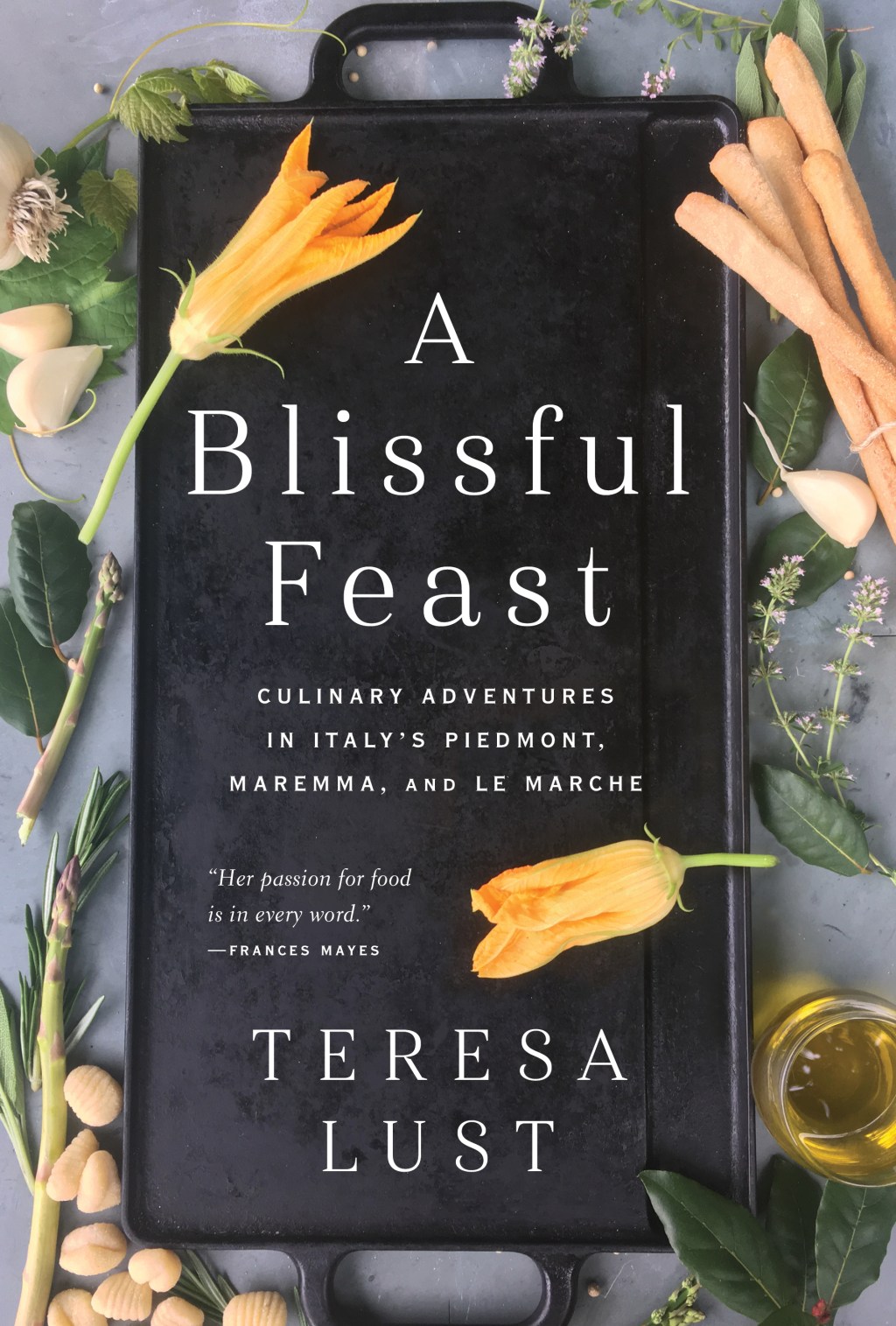
    A Blissful Feast: Celebrations of Family, Food, and History

    “In our culture we have lost our connection to cooking,” says Teresa Lust, author of  A Blissful Feast, Culinary Adventures in Italy’s Piedmont, Maremma, and Le Marche ( Pegasus Books 2020; $19.19 Amazon hardcover price), The Readable Feast’s 2020 winner for Best Food Memoir.

    Teresa Lust

    Lust, who teaches Italian at Dartmouth University in New Hampshire and also cooking classes, grew up in an Italian-American family, learning to cook from her mother and grandmother whose recipes were written by hand on little notecards. Wanting to discover and delve into Italian cuisine because of its meaning to her, she learned to speak Italian and traveled through the country of her ancestors.

    “I wanted to see and feel the connections to the traditions and geography of the regions,” says Lust, whose previous book,  Pass the Polenta: and Other Writings from the Kitchen, was praised by Frances Mayes, author of Under the Tuscan Sun and Julia Child.

    Going deep, she visits relatives and meets the people of the regions’ small towns, going into their kitchens to watch as they prepare food. It’s a constant learning process about the intricacies not only of the broad regional cookery of Italy that many of us are familiar with—that of Florence, Naples, or Sicily but of such places as Maremma, an area in western central Italy bordering the Tyrrhenian Sea and Le Marche, a region sandwiched between the Adriatic Sea and the Apennine Mountains.

    “Italian food is very regional, and even in the regions its broken down by cities, and then gets smaller and smaller until each dish is an expression of oneself and it can be an affront and violation if others add ingredients or make changes,” she says. “There’s an integrity to the dish.”

    It’s not the way we think of food here. Indeed, to me a recipe is to be altered by ingredients I have on hand so the idea of not changing is a thoughtful concept, one that I will think about. But then again, I’m not making family recipes dating back centuries and besides, old habits die hard. 

    In Camerano, a town in Le Marche, an 80-year-old woman shows Lust how to hand-roll pasta with a three-foot rolling pin. In Manciano, she masters making Schiacciata  All’Uva, a grape flatbread with honey and rosemary that back home in New Hampshire takes her two days to complete.

    But, Lust says, you only spend a few minutes in active work as if it were as easy as popping a frozen dinner into a microwave.

    Intrigued by the food philosophy of the people she cooks with, she goes beyond recipe and its ingredients to their history and what they represent.

    Acquacotta—such a beautiful word and beautiful dish–but then you find  out what it really means–cooked water and that it was born out of poverty made by people who had nothing,” Lust tells me when we chat on the phone.

    In her description, acquacotta is a rustic soup that nourished generations of the area’s shepherds and cowhands. It’s her way of adding poetry to food and to people who take such pride in what they cook.

    Lust includes recipes in her book, but this is not a glossy cookbook, but rather a lovely and thoughtful journey of rediscovering roots and meaning.

    The two of us discuss growing up with ethnic relatives and how important the culture of the table was for us when young.  It does seem to be something that is missing from our daily lives and Lust is hoping to reconnect people to food and help them see the importance of  taking the time to bring friends and family to the table to enjoy a meal.

    In the cooking classes she teaches she demonstrates how to make Italian food  and encourages participants to talk to her in Italian. She feels that she is helping forge an important connection that way.

    “I have people contact me through the website who said they tried the gnocchi and though they never thought they could make it, they found it was easy for them,” she says with a touch of pride.

    For more, visit www.teresalust.com

  • Fabio Viviani: Fabio’s 30-Minute Italian

    “Good cooking and a lot of flavor don’t have to take a lot of time,” says Fabio Viviani, chef, restauranteur and TV personality, explaining why he wrote Fabio’s 30-Minute Italian (St. Martin’s 2017; $27.99), his beautifully photographed cookbook filled with wonderfully accessible recipes. “The whole premise is easy.”

    Viviani, who grew up in Florence, Italy, started working in a bakery when he was 11 not so much from a love of food but because he needed to work to help out his family. But labor developed into a passion. Now 28 years later, he’s amassed a food empire with two California vineyards, several cookbooks, stints on several Top Chef show (he won Fan Favorite on Season Five), restaurants including two in Chicago—Siena Tavern and Prime & Provisions and his Mercado concept, described as a “rustic-yet refined eatery destination by celebrity chef Fabio Viviani” with locations that include Chicago, Tempe, Arizona and Benton Harbor, Michigan.

    He also currently has a weekly web series, “Fabio’s Kitchen” and is doing “Dinner is Served,” an online video series

    With such a busy schedule, I wonder if he ever gets tired of cooking.

    “I like it,” he says, “sometimes I don’t. It’s like a marriage, you yell at each other and then you go back to it.”

    Asked what recipes he might recommend for those who haven’t cooked Italian before, Viviani recommends the chapters on pasta and salads because they have, for the most part particularly if you don’t make your pasta from scratch, “have less ingredients and take less time.”

    Noting that his Italian heritage taught him less is more, Viviani says “you don’t have to overdo it to put really good food on the table.”

    Ifyougo:

    What: Fabio will be doing a presentation, cooking demo, Q&A, & cookbook signing.

    When: Tuesday, May 16 at

    Where: Snaidero Showroom, 222 W Merchandise Mart Plaza, Chicago, IL