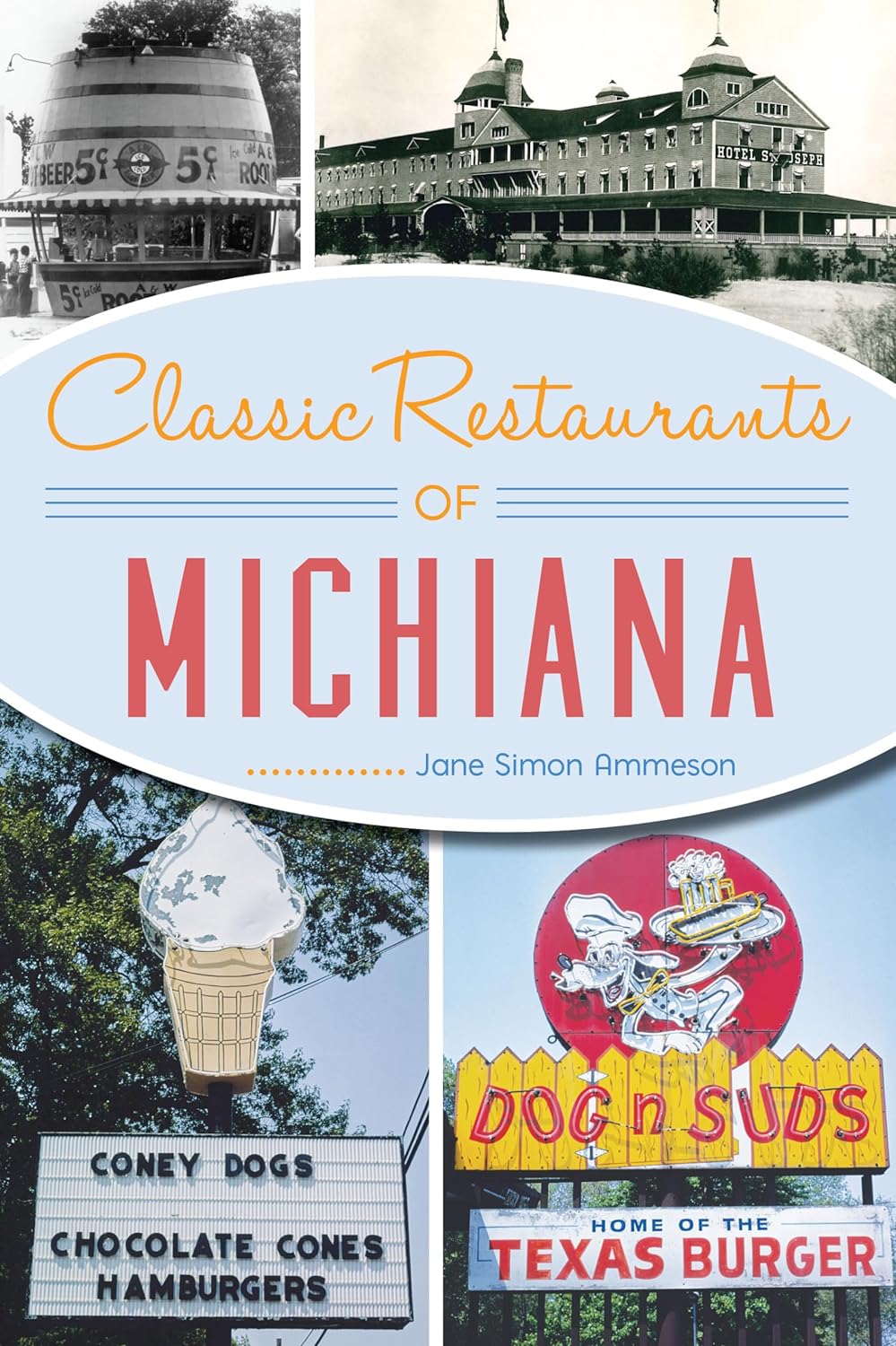
The members of the Sacred Heart of Mary Catholic ChurchBook/Movie Discussion Group have invited me to speak this Wednesday, June 11th at 6:30 p.m. If you have the time and are interested in the history of restaurants in Michiana, please come. The church is lovely, located in a beautiful country setting at 51841 Leach Rd, Dowagiac, Michigan. The event itself is next door in the Parish Hall.
Mary’s City of David Vegetarian Cafe in Benton Harbor, which opened in 1931 and closed in 1975, specialized in farm-to-table meals.
Here is the flyer that Terri Moore sent out:
Over the centuries, residents of Michiana have never wanted for superb dining choices. Award-winning author Jane Simon Ammeson will lead us on a culinary road trip through Northern Indiana and Southwestern Michigan.
A cigarette girl at the posh House of David motor lodge and restaurant/nightclub called the Vista Grande
Once a stagecoach stop, The Old Tavern Inn has been open since the time of President Andrew Jackson. Tosi’s is known for its gorgeous starlit garden and gastronomic traditions stretching back almost a century, and The Volcano was amongst the first pizzerias in the country.
One of the earliest hotels in St. Joseph, the Perkins house, built in 1840, stood on the corner of State and Ship Streets. Note the side entrance for the saloon which was, of course, given the times, for men only.
These restaurants and other classic eateries remain part of the thriving local food scene. But the doors of others have long been closed. Some like Mead’s Chicken Nook and Robertson’s Tea Room linger in memories while The Owl Saloon, O. A. Clark’s Lunch Rooms, and Lobster Lounge are long lost to time.
The restaurant is still open at the Barbee, it was a fav of Al Capone. However, when he arrived, all the other guests had to leave.
Jane Simon Ammeson is a food and travel columnist who has authored seventeen books, including Classic Restaurants of Northwest Indiana. Always willing to travel for food, she blogs about her experiences at janeammeson.com.
At one time, the lakeside towns of southwesterern Berrien County had a large Swedish population. The Swedish Coffee Pot was just one of several. Only the Swedish Bakery remains.
In 1832, at the height of the Georgia gold rush, gold had been discovered on the banks of the Etowah River on land owned by Alfred Minette. As men flocked to work in the mine and others to supply their needs, a small town arose and Minette named it after his firstborn, a beautiful but frail girl named Juliana who had died years ago in South Carolina.
But now the Civil War was waging and while the men and boys of Juliana were off fighting, Minette forced their wives and children to work in the mines.
Union General Philip Sheridan and his troops were laying waste to all he passed through on his march to the sea and Juliana lay in his path. Destroying the town meant destroying the wealth that helped fuel the Confederate war effort and so three of the town elders, including Minette, formed a plan to save it.
And it worked. Sheridan did stop in Juliana and he and his men decimated the town’s food and livestock supplies but they didn’t discover the mine, nor the women and children trapped in the bottom of the mine when the town’s elders had the entrance dynamited with explosives. Sheridan and his troops tarried and by the time the mine was unsealed, all those insides were dead. When the surviving men returned home from the war, they were told their families had been sent away and they could now work in the lumber mill Minette was building, accept it as God’s will that their families were gone, and start anew.
It was a small sacrifice for the good of all, Minette argued, and that his daughter, Julianna, was pleased with their offering.
More than 160 years later, Billie Hope receives an offer. A former restaurateur, Billie lives in a cramped apartment with her husband and daughter in New York City when she receives an offer to purchase a dream home in historic Juliana for just $100. The offer describes the town as idyllic, and the accompanying photo shows a quaint town square straight out of a storybook as does the link to the professionally done town website. Billie sees it as part of a trend to lure people to help grow stagnant towns with new citizens. Feeling at a dead end in her life and lured by the thought of a pretty house in a lovely small town, she replies.
It’s an offer too good to be true, but desperation often clouds people’s judgment, so it is with Billie and her family who make the move to Juliana.
“A small town,” she thinks. “Our own house. A perfect childhood for Mere and…another restaurant for me.”
Of course, it doesn’t work out that way.
Bestselling author Emily Carpenter, whose other suspense novels include Burying the Honeysuckle Girls and The Weight of Lies, weaves a frightening and compelling tale as we follow Billie and her family move from elation at what they see as a chance for a new and better life and the dawning realization that they may have embarked upon a dangerous and frightening adventure.
It’s an archaeological dig so finding human remains shouldn’t be a surprise, but Dr. Molly Moore immediately recognizes that the skeleton they’ve unearthed is much more recent than what you’d find on a site dating back 12,000 years. Indeed, the body is that of a young Black reporter who disappeared just decades ago when covering the racial unrest in Cairo, Illinois.
The loss of his mother has left a large void in the life of Chicago Police Detective Randal Jenkins, and he travels back to Cairo, where he lived as a young boy, to learn more about the case. But it soon becomes clear that this is more than just the murder of an investigative reporter during a tumultuous time. Moore finds herself pressured by her long-time mentor and supporter, retired military general and contractor William Alexander to complete the dig and minimize her discovery. As Moore and Jenkins, each with their own family issues to deal with, work at discovering answers they realize that the General is trying to disrupt the process of a disarmament agreement being developed at a global peace summit taking place in Chicago. The stakes are so high that not only are their lives in jeopardy, but the world may be hurling towards a nuclear disaster.
Disturbing the Bones (Melville House 2024) is the first joint effort by director and screenwriter Andrew Davis, a native of Chicago’s southside and Jeff Biggers, an American Book Award-winning historian, journalist, playwright, and monologist.
In writing the book, Biggers, whose work has appeared in American and foreign newspapers and magazines as well as numerous anthologies, relied upon his knowledge of archaeology, the environment, culture, and history as well as his abilities as a researcher. He is the author of such books as Reckoning at Eagle Creek: The Secret Legacy of Coal in the Heartlandand The United States of Appalachia: How Southern Mountaineers Brought Independence, Culture, and Enlightenment to America.
“I’ve been around a lot of archaeological digs,” he said in a joint conversation with Davis and this writer.
It’s also a timely story in that there’s a presidential election going on as Jenkins and Moore race to solve the mystery.
“It’s the only novel with a woman running for the presidency but in the book she’s from Chicago,” says Davis, noting that, as in the book, he sees this election as a turning point in our history. “The story is a blending of art and action, and it asks provocative questions which I think any good book should do.”
Any enjoyable book should, as it tells a story, also open another world for us. The authors do that here as we learn about archaeology, what happens on a dig, and the social upheaval the country went through during the Civil Rights movement. It also explores the psychology of Jenkins and Moore whose personal lives affect their profession and the decisions they make.
This was the first collaboration between Biggers and Davis, but it won’t be their last. The two are also working on a screenplay for the book. Davis has an extensive background in this area, having worked on a myriad of films such as “Holes”, “Under Siege”, “Code of Silence”, “A Perfect Murder”, and “The Guardian.” Known for directing intellectual thrillers, his film “The Fugitive,” was nominated for seven Academy Awards including Best Picture.
Biggers, who served as the Climate Narrative Playwright-in-Residence at Indiana University Northwest several times and lived in Miller Beach during his time there, enjoyed the collaborative process.
“I’ve written a lot of books on my own,” he says, “but this was, in ways, the best of both worlds as we went back and forth and exchanged ideas and shared thoughts.”
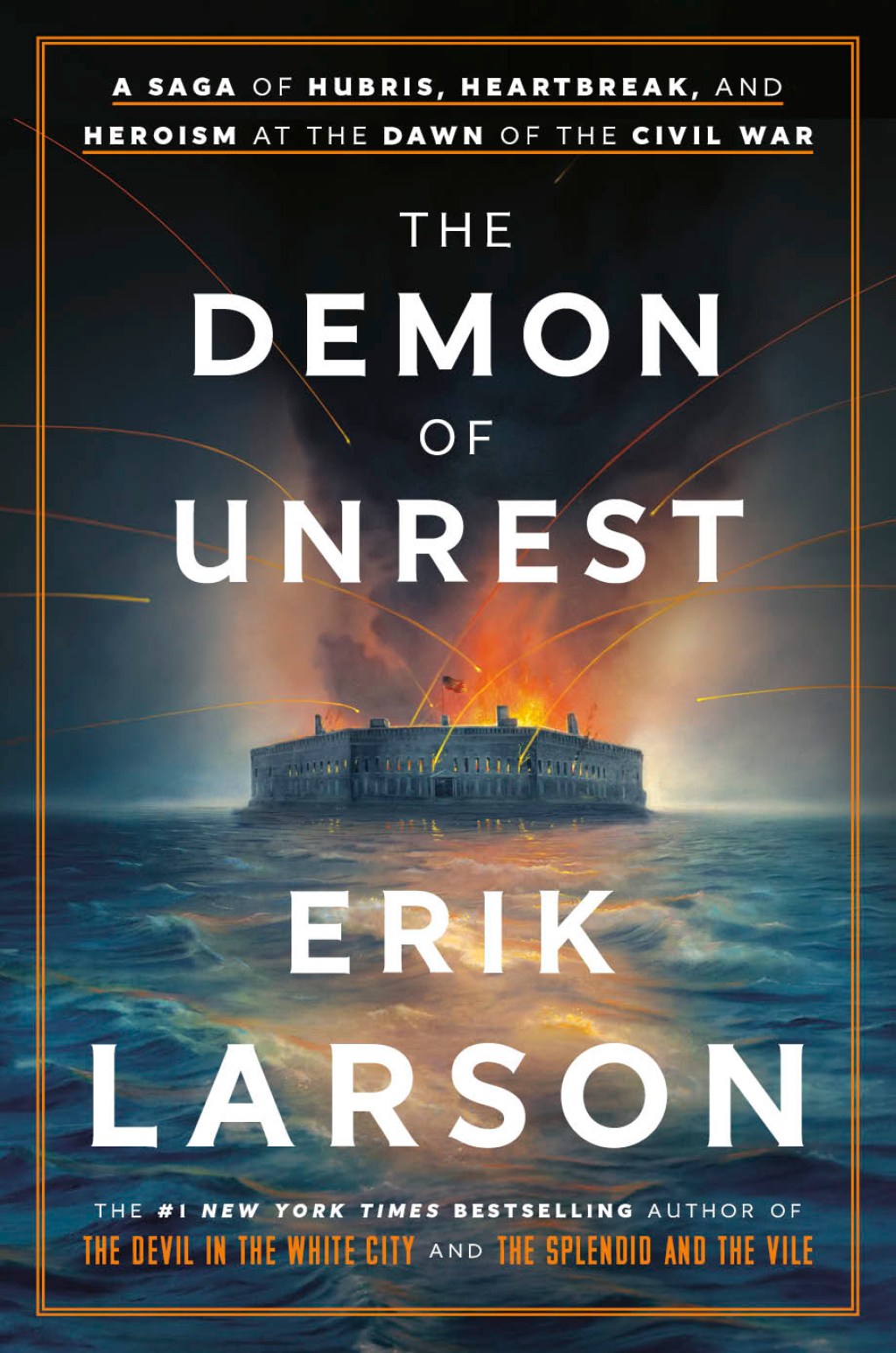
Only a master storyteller like Erik Larson could turn the five tumultuous months leading up to the Civil War into “The Demon of Unrest: A Saga of Hubris, Heartbreak, and Heroes at the Dawn of the Civil War” (Crown), a compelling, page-turning read, chock full of anecdotes, psychological profiles and obscure but compelling tidbits of history all set against a relentless march towards a conflict that would kill over 620,000 soldiers and devastate a nation.
Larson, the author of six New York Times bestsellers whose previous works include “The Devil in the White City: Murder, Magic, and Madness at the Fair That Changed America,” about a mass murderer and the 1893 Chicago’s World Fair, writes in a novelistic style that makes history come alive. He does so through his ability to weave together the familiar facts of history with information that can only be gleaned through relentless and extensive research.
Yes, most of us know that the Civil War began with the firing on Fort Sumter, which was located in Charleston Harbor and under the command of U.S. Army Major Robert Anderson. But did you know that Anderson had owned enslaved people and was a defender of slavery? That Lincoln often misspelled Sumter as Sumpter? Or, more importantly, South Carolina did not have to succeed because of Lincoln’s election, as he had no intention of outlawing slavery in the Southern states?
“When I started out doing this, one concern I had was that the Civil War has not exactly been underwritten,” Larson told me during a phone conversation earlier this week, noting that a quick Google indicated around 65,000. “I had vowed over the years never ever to write about the Civil War.”
That changed when, as he was looking for the topic of his next book and watching the events of the Jan. 6, 2021 assault on the U.S. Capitol, he began to consider the deep divide and unrest of our own times.
Faced with what he describes as an intimidating world of previous scholarship, Larson says “What I really wanted to do was to provide a rich sense, on an intimate level, of what the forces were and the motivations for the start of the Civil War.”
The magic of his writing is that he accomplishes this by immersing the reader in details, descriptions, and personalities mostly unknown to many of us, including “eight typical characters” such as Charleston society doyenne Mary Boykin Chestnut, who kept a detailed diary, and James Henry Hammond, a Charleston planter who was a leader of the secessionist movement and who later became a U.S. senator despite public knowledge of his sexual relationships with four nieces ages 13 to 19.
The Southern mindset among the owners of enslaved people of the time is best summed up in a letter written to President James Buchanan, president before Lincoln, by Arthur Peronneau Hayne, a U.S. senator from Charleston. In it, he writes that without slavery “our every comfort would be taken from us. Our wives, our children, made unhappy — education, the light of knowledge — all lost and our people ruined forever. “
“White southerners had persuaded themselves that slavery was a good thing for all concerned, especially for the enslaved blacks,” said Larson. He also notes that many of these same men were devoted readers of writers like Sir Walter Scott, author of “Ivanhoe,” and believed fervently in honor and the code of chivalry.
As outrageous and hypocritical as that seems today, Larson says when writing about a different era it’s important to consider the point of view of those times to accurately reflect how events unfolded.
“It gives a better sense of what the forces were that did lead to states like South Carolina succeeding from the Union and the Civil War,” he said, noting that understanding is not condoning, but historic context provides a lesson for the present and future as we struggle with political division today.
Oenophiles might be surprised to learn that the oldest winery anywhere in the Americas is Casa Madero, formally established as long ago as 1597, located in Parras de la Fuente, a small town in the northern state of Coahuila.
“In 1549 the Spanish priests and soldiers who explored this region discovered native vines growing wild in a valley and chose the spot to found the Mission of Santa María de Las Parras (“Holy Mary of the Vines”),”writes Tony Burton, the editor of MexConnect, Mexico’s top English-language online magazine, in his book Mexico Kaleidoscope: Myths, Mysteries and Mystique.“The early Mission of Santa María soon began to make wine from the local grapes, and a few years later the wines and brandies of the Valley of Parras were being shipped to the rest of the Americas.”
But Mexico’s sophisticated approach to agriculture goes even further back than that.
“The Mexica/Aztecs solved the dilemma of how to supply food to their island capital by developing a sophisticated wetland farming system involving raised beds, or chinampas, built in the lake,” writes Burton about when the city of Tenochtitlan was built, fortress-like, on an island. Though good for defense, it made providing a food source more difficult but there was a solution to that. “Originally these chinampas were free-floating, but over time they became rooted to the lake floor. The chinampas were separated by narrow canals, barely wide enough for small boats or canoes. From an ecological perspective, chinampas represented an extraordinary achievement: a food production system which proved to be one of the most environmentally sustainable and high-yielding farming systems anywhere on the planet! Constructing and maintaining chinampas required a significant input of labor, but the yields per unit area could be very high indeed, especially since up to four harvests a year were possible.”
Burton covers 10,000 years of Mexican culture and history. It’s a compilation of “Did You Know?” columns for MexConnect, which ranks in the top 3% of all Internet sites in the world, registering over half a million sessions a year.
It was his way of presenting and preserving relatively little-known but fascinating information about Mexico to a large number of readers.
“One of my main motivations was that—to the best of my knowledge—no similar book for the general reader had been published in the past forty years,” says Burton. “An incredible amount of interesting academic research had been done on Mexico over that time, leading to reevaluations and reinterpretations of many former ideas and beliefs. I wanted to make readers aware of some of these extraordinary developments, which continually refuel my passionate interest in Mexico.”
This very readable and fascinating book can be read cover to cover, says Burton, noting that it is also designed to allow readers to ‘dip into’ and read in whatever order appeals to them.
“When writing the book, I was trying to engage readers by expanding on, or challenging, some commonly held or overly simplistic ideas, in the hope of offering some ‘food for thought’ about many things Mexican,” he says.“Each chapter has a list of sources and suggestions for those readers who want to explore more.”
The title Mexican Kaleidoscope is a nod to Norman Pelham Wright, a British writer whose own collection of essays, with the same title, was published in 1948.
“That book was an eye-opener for me when I first began to get intimately acquainted with Mexico more than forty years ago,” says Burton. “The subtitle Myths, Mysteries and Mystique came from a suggestion by one of my regular golfing partners—who had read an early draft of the book—as we played the 11th hole at Cottonwood Golf Course on Vancouver Island.”
The book is illustrated by Mexican artist Enrique Velázquez, a long-time friend of Burton’s.
“Enrique has a keen interest in the subject matter and an uncanny ability to portray ideas in just a few lines,” says Burton. “I originally envisioned using small, inline drawings to break up the text, much in the manner of old-time illustrators, but his final drawings were far too good for that, so we changed track and gave them the prominence and space they merit.”
“Every chapter has come to mean far more to me than is expressed by mere words on a page,” says Burton about the 30 chapters. “I really hope some of my enthusiasm comes through to readers. At the very least I’d like the book to cause readers to stop and think, to be occasionally surprised, and perhaps question things that they may have previously thought or heard about Mexico. As I’ve written elsewhere, Mexico is not always an easy country to understand but any effort to do so always seems to bring rich reward!”
About the Author
Burton, a Fellow of the Royal Geographical Society who was born and educated in the United Kingdom, first visited Mexico in 1977. Returning, he lived for almost two decades in the country where he worked as a writer, educator, and ecotourism specialist. An award-winning author, his other books include If Walls Could Talk:Chapala’s Historic Buildings and Their Former Occupants; Foreign Footprints in Ajijic: Decades of Change in a Mexican Village; Western Mexico: A Traveler’s Treasury; and Lake Chapala Through The Ages: An Anthology of Travelers’ Tales.
Mexico Kaleidoscope can be found in print and on Kindle through Amazon.
Born in the United Kingdom, Tony Burton, a Cambridge University-educated geographer with a teaching certificate from University of London, first traveled to Mexico after spending three years as a VSO [Voluntary Service Overseas] volunteer teaching geography, and writing a local geography text, on the Caribbean island of St. Kitts. From there his travels took him to Mérida in summer 1977, where he spent several weeks backpacking around southern and central Mexico, returning two years later to teach at Greengates School in Mexico City.
Over the next seven years, Tony traveled extensively throughout Mexico, visiting every state at least once, and organizing numerous four-day earth science fieldwork courses for his students. He co-led the school’s extensive aid efforts following the massive 1985 earthquake.
From Mexico City, he moved to Guadalajara, where he continued to organize short, residential fieldwork courses for a number of different schools and colleges and began organizing and leading specialist eco-tours for adult groups to destinations such as Paricutín Volcano, the monarch butterfly sanctuaries, and Copper Canyon.
An award winning author, he’s written numerous books about Mexico including his latest Lake Chapala: A Postcard History(Sombrero Publishing). It’s part of a series he’s written on this region which is located about an hour south of Guadalajara. The 417-square-mile lake, Mexico’s largest, located in the states of Jalisco and Michoacán is situated at an elevation of 5,000ft in the middle of the Volcanic Axis of Mexico and is known for its wonderful climate, laid-back ambience, and is a popular destination for both travelers and ex-pats looking for a charming, low-key place to relocate. The three main towns along the lake are Chapala,Ajijic and Jocotepec. In an intriguing aside, Tony met his wife Gwen Chan Burton when she was working as at the director of the pioneering Lakeside School for the Deaf in Jocotepec. Gwen writes about the school and all that it has accomplished in her book, New Worlds for the Deaf, also published by Sombrero Books.
Because I’m always interested in foodways, Tony was kind enough to share a copy of an undated Spanish language project put together by students from the Instituto Politécnico Nacional School of Tourism titled “Gastronomy of Jalisco.” It includes numerous recipes from the region including one for the famous Caldo Michi of Chapala (the recipe is below).
I had the chance to ask Tony, who currently is the editor of MexConnect, Mexico’s leading independent on-line magazine, aboutLake Chapala: A Postcard History as well as the time he spent in this beautiful region of Mexico.
How did you first become familiar with Lake Chapala?
I first visited Lake Chapala in early 1980, on my way back to Mexico City from the Copper Canyon and Baja California Sur. Little did I imagine then that it would be where I would later fall in love, get married, and have two children!
What inspired you to write Lake Chapala: A Postcard History?
There is no single overwhelming inspiration. I realized, while living at Lake Chapala and writing my first books about Mexico, that a lot of what had been previously written was superficial and left many unanswered questions. In the hopes of finding answers, I decided to trawl through all the published works (any language) I could find, which resulted in Lake Chapala Through the Ages (2008), my attempt to document and provide context to the accounts of the area written between 1530 and 1910.
My next two books about Lake Chapala—If Walls Could Talk: Chapala’s Historic Buildings and Their Former Occupants, and Foreign Footprints in Ajijic: Decades of a Change in a Mexican Village—focused on the twentieth century history of the two main centers for the very numerous foreign community now living on ‘Lakeside.’ Part of my motivation was to dispel some of the myths that endlessly recirculate about the local history, as well as to bring back to life some of the many extraordinary pioneering individuals indirectly responsible for the area becoming such an important destination for visitors.
Lake Chapala: APostcard History is my attempt to widen the discussion and summarize the twentieth century history of the entire lake area. Its reliance on vintage postcards makes this a very visual story, one which I hope will appeal to a wide readership, including armchair travelers.
What were some of the challenges you encountered in writing this book? Was it difficulty finding the numerous postcards you included? And doing the extensive research that went into the book? Are there any intriguing stories about hunting down certain postcards and any “aha” moments of discovery when writing your book?
The main challenge was in deciding how best to structure the material. Because of the originality of what I’m doing, it is impractical to follow the advice that writers should start with a detailed plan and then write to that plan! In my case, after collecting the information and ideas that exist, the challenge is to select what can be teased and massaged into a coherent and interesting narrative.
Because the postcard book is the product of decades of research, I had ample time to build my personal collection of vintage postcards, through gifts, auctions and online purchases.
There were many significant “aha” moments in the process: some concerned the photographers and publishers responsible for the postcards and some the precise buildings or events depicted. While I’m saving some of these “aha” moments–because they are central to a future book–one was when it suddenly dawned on me that wealthy businessman Dwight Furness was the photographer of an entire series of cards (Figs 6.3, 6.4, 6.5, etc.) that relate to my next response.
If you could go back in time to visit one of the resorts that is no longer there that you featured in your book, is there one that stands out and why is that?
Ooohhh; I’d love to go back to about 1908 and stay at the Ribera Castellanos resort (Chapter 6) during its heyday. While staying there, perhaps I could interview owner Dwight Furness, his wife and a few guests? Apart from a few ruined walls, Furness’ postcards of the resort are pretty much the only remaining evidence of the hotel. And perhaps one night I could invite local resident and prolific professional photographer Winfield Scott and his wife to dinner to hear their stories?
How long did it take to write Lake Chapala?
The writing took less than a year; but only because of the many prior years of research.
Since I often talk about food and travel, are there any culinary specialties in the Lake Chapala region?
Long standing culinary specialties of the area include (a) Lake Chapala whitefish (b) charales (c) caldo michi. And, when it comes to drinks, there is a very specific link to postcards. The wife of photographer José Edmundo Sánchez, who sold postcards ( Figs 7.5, 7.6 and 7.7) in the 1920s from his lakefront bar in Chapala, is credited with inventing sangrita, still marketed today as a very popular chaser or co-sip for tequila. (Chapter 7, page 74).
Is there anything else you’d like readers to know about your book?
I hope readers find the book as fun and interesting to read as it was to write!
MICHI BROTH
Ingredients:
2 tablespoons corn oil
¾ kg of tomato seeded and in pieces
¼ onion in pieces
½ kg carrot, peeled and cut into diagonal slices
½ kg of sliced zucchini
4 or 6 chiles güeros
100 gr. chopped coriander
2 sprigs of fresh oregano
Salt to taste
2 ½ liters of water
1kg well washed catfish, yellow carp or red snapper
PREPARATION: Heat the oil and stew the vegetables in it, add water and salt to taste, let it simmer over low heat until the vegetables are well cooked, then add the fish and leave it for a few minutes more until it is soft.
Sangrita
I had the opportunity to stay at Tres Rios Nature Park, a 326-acre eco-resort north of Playa del Carmen and was first introduced to sangrita during my stay. I took several cooking lessons and learned to make a dish with crickets, but that is a different story. Chef Oscar also talked to us about the history of sangrita. The Spanish name is the less-than-appetizing “little blood” but hey, when you’re learning to grill crickets, you can deal with a name like that. The drink, as Tony writes in his postcards book, originated in Chapala in the 1920s.
Here is the excerpt:
”In the same year the Railroad Station opened, Guillermo de Alba had become a partner in Pavilion Monterrey, a lakefront bar in a prime location, only meters from the beach, between the Hotel Arzapalo and Casa Braniff,” he writes. “The co-owner of the bar was José Edmundo Sánchez. Regulars at the bar included American poet Witter Bynner, who first visited Chapala in 1923 in the company of D H Lawrence and his wife, Frieda. Bynner subsequently bought a house near the church. When de Alba left Chapala for Mexico City in 1926, Sánchez and his wife—María Guadalupe Nuño, credited with inventing sangrita as a chaser for tequila—ran the bar on their own. After her husband died in 1933, María continued to manage the bar, which then became known as the Cantina de la Viuda Sánchez (Widow Sánchez’s bar).”
Sangrita is typically used as accompaniment to tequila, highlighting its crisp acidity and helping to cleanse the palate between each peppery sip. According to Chef Oscar, the red-colored drink serves to compliment the flavor of 100% agave tequila. The two drinks, each poured into separate shot glasses, are alternately sipped, never chased and never mixed together.
Here is Chef Oscar’s recipe and below is one from Cholula hot sauce which originated in Chapala. Tony has a great story about that as well. More in my next post on his books.
For one liter of Sangrita:
400 ml. orange juice
400 ml. tomato juice
50 ml. lemon juice
30 ml. Grenadine syrup
20 ml. Worcestershire sauce
Maggi and Tabasco hot sauce (mixed up) to taste
Salt and pepper to taste
Mix together all the ingredients and serve cold. Suggested duration of chilling : 3 to 4 days.
Cholula’s Sangrita
1/4 cup (2 ounces) fresh orange juice
1/4 cup (2 ounces) fresh grapefruit juice
2 tablespoons fresh lime juice
20 pomegranate seeds
3 fresh sprigs of cilantro or to taste
1/2 stalk celery
3 teaspoons smoked coarse sea salt or sal de gusano, divided
1 tablespoon Cholula® Original Hot Sauce
Place all ingredients except salt in blender container, with about 1 cup ice cubes. Puree until smooth.Strain twice though a fine mesh sieve, discarding any solids.
Rim shot glasses with sea salt. Serve sangrita cold in rimmed shot glasses alongside your favorite tequila.
Now one of the most popular retirement area for Americans and Canadians, the Lake Chapala Region, nestled in a valley almost a mile high in Mexico’s Volcanic Axis, has long been a draw for ex-pats and vacationers, lured by its almost perfect climate and beauty.
In his book If Walls Could Talk: Chapala’s historic buildings and their former occupants about Mexico‘s earliest international tourist destination (also available in Spanish), award-winning author Tony Burton shares his knowledge and interest in a region where he has spent more than two decades. Burton, a Fellow of the Royal Geographical Society who was born and educated in the United Kingdom, first visited Mexico in 1977. That visit was obviously a big success as he returned and for almost 18 years lived and worked full-time in Mexico as a writer, educator and ecotourism specialist.
He met his wife, Gwen Chan Burton who was a teacher of the deaf and then director at the Lakeside School for the Deaf in Jocotepec, one of the three main towns lining the shores of Lake Chapala. Though they now reside on Vancouver Island, British Columbia, the Burtons continue to revisit Mexico regularly and he is currently editor-in-chief of MexConnect, Mexico’s top English-language online magazine.
The other two towns, each with its own distinctive vibe, are Ajijic and Chapala, native villages resettled by the Spanish Conquistadors in the 1500s. “This book looks at how Chapala, a small nondescript fishing village in Jalisco, suddenly shot to international prominence at the end of the nineteenth century as one of North America’s earliest tourist resorts,” writes Burton. “Within twenty years, Chapala, tucked up against the hills embracing the northern shore of Mexico’s largest natural lake, was attracting the cream of Mexican and foreign society. Thus began Lake Chapala’s astonishing transformation into the vibrant international community it is now, so beloved of authors, artists and retirees.”
The book, organized as a walking tour, covers not only existing buildings but also pinpoints the spots where significant early buildings no longer stand but their histories still weave a story of the town. It’s only a partial guide, explains Burton, noting that an inventory prepared by the National Institute of Anthropology and History identified more than eighty such buildings in Chapala including many not easily visible from the road but hidden behind high walls and better viewed from the lake.
Among the famous people who lived in Chapala at some point in their careers was author D.H. Lawrence, probably best remembered for his risqué (at the time) novel, Lady Chatterley’s Lover.
In 1923, Lawrence and his wife, Frieda, rented Casa de las Cuentas (House of Rosary Beads), a house that dates back to the 1800s. At the time, a one-story abode with a half-moon entrance and heavy wooden gates, it was located at 307 Calle Zaragoza, a street formerly known as Calle de la Pesquería (“Fishing street”) so named as it was where the local fishermen repaired their nets and hung them out to dry. It was while living on Calle Zaragoza that Lawrence wrote the first draft of The Plumed Serpent, published in 1926. The novel is described as “the story of a European woman’s self-annihilating plunge into the intrigues, passions, and pagan rituals of Mexico.”
Over the decades, after the Lawrences moved out, subsequent changes were made to Casa de las Cuentas including the addition of a swimming pool in the mid-1950s when artist Roy MacNicol and his wife, Mary, owned the home.
While Lawrence’s writings were considered by some as scandalous, MacNicol’s life had its scandals as well. Burton describes him as “colorful” in that he was married multiple times and was involved in many escapades as well as lawsuits.
It wasn’t the work of a dilettante as reviews of her book such as this one on Amazon shows.
“Flower Cookery is recipes, but far more than recipes,” writes one reviewer. “The book is organized by the popular name of the flower in question. Each section is introduced with quotations from literature, philosophy, and poetry that feature the blossom. This is followed by the recipes, interwoven with mythology, stories, and aphorisms about the flower, the plant from which it grows, its symbolism, and the culture or society in which humans discovered the value of the plant or blossom. The recipes include original favorites as well as recipes collected from historical sources and contemporary sources around the world. Here is just the tiniest sampling of the riches in the book.”
Burton shares her Christmas Cheer recipe from when she lived at Casa de las Cuentas.
Christmas Cheer
10-12 squash blossoms with stems removed
2 eggs, beaten
2 to 3 tablespoons water
Flour, enough to thicken mixture about one tablespoon
Salt and pepper
1 cup neutral oil such as grapeseed, canola, or safflower
Wash and dry squash blossoms on paper towels, making sure to remove all the water. Mix remaining ingredients except oil to make a smooth batter. Place oil in a large, heavy skillet to 350-375°F. Dip blossoms in batter and fry in oil until golden brown. Drain on paper towels. Serve hot.
As for the house, it was renovated again in the early 1980s and is now Quinta Quetzalcoatl, a lovely boutique hotel.
The above maps, both copyrighted, show Chapala 1915 [lower map] and 1951 [upper map].
In all, he’s planning on adding several more to what he currently calls the Lake Chapala Quartet, these focusing on the writers and artists associated with the area. I asked him to describe the region so readers who have never been there can get an idea of what it is like, but it turns out the Burton is NOT a traveler who meticulously plots every moment of a trip before he arrives. Instead, he tells me that part of the fun when traveling is to not know in advance what places are like and instead to see and experience them for yourself.
“That said,” he continues, “the various villages and towns on the shores of Lake Chapala are all quite different in character. The town of Chapala, specifically, is a pretty large and bustling town. It is growing quite rapidly and has added several small high end boutique hotels in recent years, as well as some fine dining options to complement the more traditional shoreline ‘fish’ restaurants. The many old–100 years plus–buildings in Chapala give the town a historic ‘air’ where it is relatively easy to conjure up images of what it was like decades ago. By comparison, Ajijic, now the center of the foreign community on Lake Chapala, has virtually no old buildings and more of a village and artsy feel to it, though it also has very high quality accommodations and more fine restaurants than you can count.”
Other structures still standing include the Villa Tlalocan, completed in 1896 and described by a contemporary journalist as “the largest, costliest and most complete in Chapala… a happy minglement of the Swiss chalet, the Southern verandahed house of a prosperous planter and withal having an Italian suggestion. It is tastefully planned and is set amid grounds cultivated and adorned with flowers so easily grown in this paradisiacal climate where Frost touches not with his withering finger…”
Also still part of the landscape is Villa Niza. One of many buildings designed by Guillermo de Alba, the house, according to Burton, was built in 1919 and looks more American than European in style. Located at Hidalgo 250, it takes advantage of its setting on Lake Chapala and has a mirador (look out) atop the central tower of the structure, which affords sweeping panoramic views over the gardens and lake. De Alba’s strong geometric design boasts only minimal exterior ornamentation.
Burton, who specializes in non-fiction about Mexico, related to geography, history, travel, economics, ecology and natural history, has written several fascinating books about the history of the Lake Chapala region.
In If Walls Could Talk, Burton invites you to walk with him through time as you explore the city.
On Saturday, December 3, 2022, at 1:00 pm Central time, guests are invited to gather in the historic Santa Claus Church where the spell-binding Susan Fowler will return to the site to give us her entertaining and interactive rendition of the classic tale Twas the Night Before Christmas. A Merry Memory Sketch souvenir illustration of the afternoon’s story will be available for each family. There is no charge to attend, however donations to help restore the historic church are happily accepted.
Immediately following the storytelling, Mrs. Patricia Koch, w will hold a book signing for her recently published book entitledSanta’s Daughter. Mrs. Koch’s nostalgic book shares stories about her hometown of Mariah Hill, her experiences at Santa Claus Land and memories of her dad, Santa Jim Yellig. Her goal, at age 91, is to preserve the history of the town of Santa Claus and the surrounding area. Mrs. Koch will be in the historic church to sign books, answer questions and chat with visitors. Mrs. Koch is being honored this year by Indiana Governor Eric Holcomb with the 2022 Sachem Award, the state’s highest honor. She also has been inducted into the International Santa Claus Hall of Fame.
Also at no charge, families are invited to visit the museum, check in with Santa in his Museum Office, browse the gift shop, write letters to Santa in the historic Post Office, view the 12-foot Santa Claus Mural and the 22 foot Santa Claus Statue.
The Santa Claus Museum & Village is a not-for-profit organization which not only seeks to preserve the history of the town of Santa Claus but also to perpetuate the tradition of answering thousands of children’s letters to Santa. The Museum & Village are open daily Monday through Thursday from 10 am – 2 pm and Friday through Sunday 9 am to 4 pm, closed Christmas Day. The Santa Claus Museum & Village is located just south of Holiday World at 69 State Road 245 in Santa Claus, Indiana. For questions or further information, please call the Santa Claus Museum at 812-544-2434. And for more holiday ideas in the town of Santa Claus, click here.
In 1914, Marian Graves and her twin brother, James, are among the last to be saved when the Josephina Eterna sinks in the North Atlantic. With their father in prison and their mother gone, the two babies are bundled off to live with their Uncle Wallace, an artist in Missoula, Montana. Wallace, preoccupied with his painting, lets the kids run wild, and while James is a sweet-natured child, Marian is a daredevil who revels in the freedom to do what she wants.
That helps explain her attraction to the lifestyle of barnstorming aviators and her decision at 14 to drop out of school to learn to fly.
Fast forward a century. Actress Hadley Baxter, whose Hollywood stardom is somewhat diminished, is starring in a movie about the disappearance of Marian Graves in Antarctica.
The disappearance of a woman aviator is familiar. After all, movies and articles are still being written about Amelia Earhart, whose plane vanished in the Pacific Ocean in 1937. But there are many other female pilots from the early and mid-1900s, though they’re exploits are mostly forgotten now. Writing “Great Circle” required Shipstead to research and travel to give the book its authenticity. She visited the Arctic five times and Antarctica twice.
Why so many times, I asked Shipstead.
“I’m drawn to those regions by some weird instinct,” she said. “I think a lot of people are. But I’ve also been lucky to keep getting opportunities to go. Polar travel has become a bit of my specialty, so I’ve been sent on assignment to Alaska, the New Zealand subantarctic, Antarctica, the Canadian high Arctic twice, Greenland twice. I did an artist residency on a ship in Svalbard. In a way, one thing kept leading to another, and I have no complaints.”
The inspiration for “Great Circle” came to her in New Zealand. She was between books and a story line for her next novel that she had thought looked promising, wasn’t. In the airport, she saw the statue of early aviator Jean Batton, its base inscribed with her quote “I was destined to be a wanderer.”
She knew she had her book.
Given how much she has traveled, I wondered if Shipstead was destined to be a wanderer.
“Destined is probably strong,” she said. “I’ve always been interested in travel, but my life could have taken lots of twists and turns that would have precluded traveling as much as I have. Really, this book turbocharged my traveling because, A, I was motivated to get to more and farther flung places in the name of research, and B, it took so long to write the book that I had the chance to start writing for travel magazines.”
I next asked if she ever considered becoming a pilot given her interest in the subject.
“Never,” was her response. “My brother used to fly C-130s in the Air Force and wanted to be a pilot from childhood, so that was always his territory.”
A mordant, linguistically deft historical novel about the ambiguities of the Jewish-American experience, presenting ideas and disputes as volatile as its tightly-wound plot.
A funny, poignant play that deftly transposes “Hamlet” to a family barbecue in the American South to grapple with questions of identity, kinship, responsibility, and honesty.
A gripping account of Indigenous justice in early America, and how the aftermath of a settler’s murder of a Native American man led to the oldest continuously recognized treaty in the United States.
An original and compelling history, spanning five centuries, of the island that became an obsession for many presidents and policy makers, transforming how we think about the U.S. in Latin America, and Cuba in American society.
A searing first-person illustrated account of an artist’s life during the 1950s and 1960s in an unreconstructed corner of the deep South–an account of abuse, endurance, imagination, and aesthetic transformation.
A virtuosic collection that inventively expands the sonnet form to confront the messy contradictions of contemporary America, including the beauty and the difficulty of working-class life in the Rust Belt.
An affecting, deeply reported account of a girl who comes of age during New York City’s homeless crisis–a portrait of resilience amid institutional failure that successfully merges literary narrative with policy analysis.