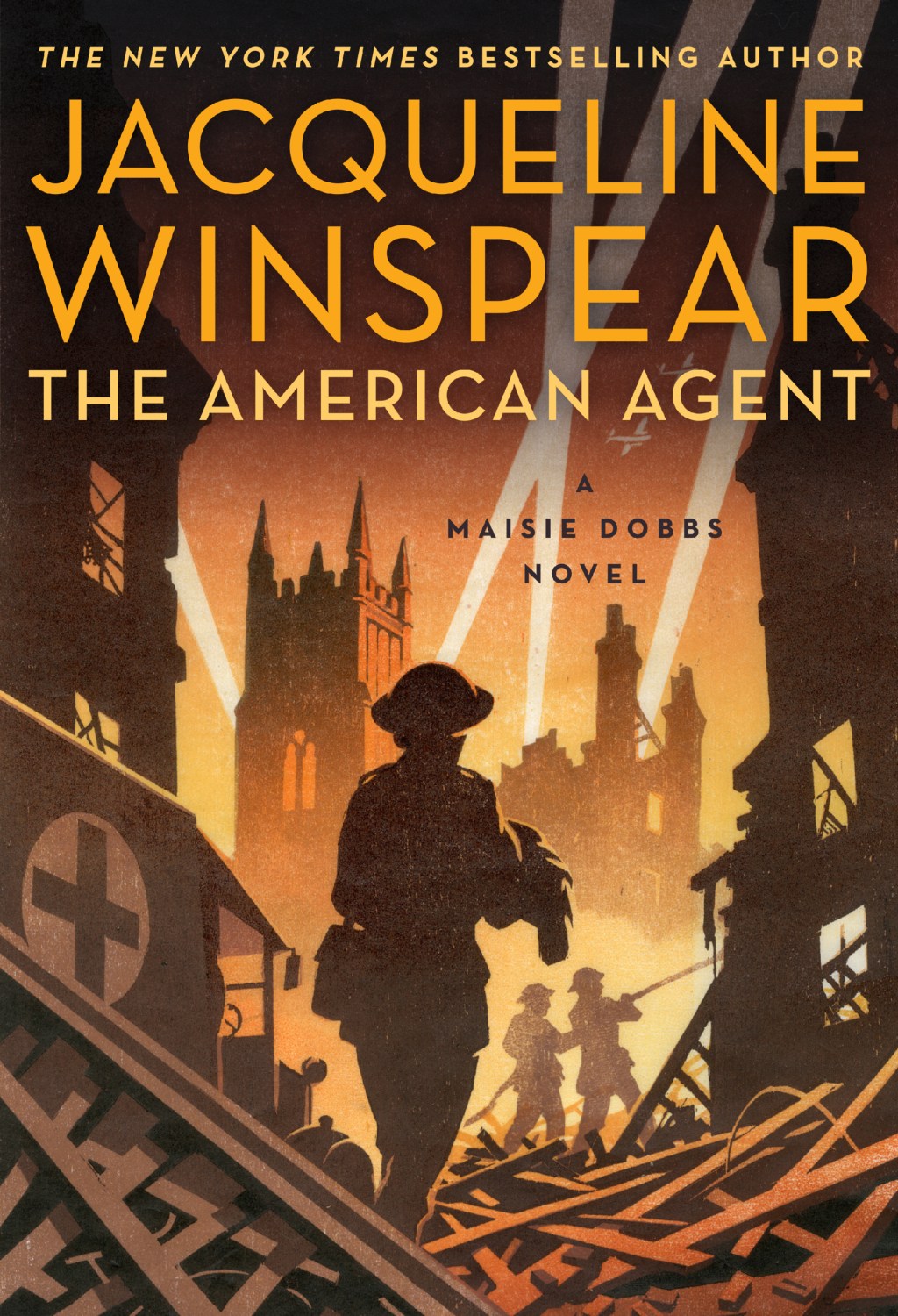
Jacqueline Winspear, author of The American Agent, the 15th book in her Maisie Dobbs’ series, transports us to early September 1940, as Adolf Hitler unleashed his Blitzkrieg or lighting attack on London and other United Kingdom cities, an intensive attack already used successfully in Spain, the Netherlands, Poland, Belgium and France to enable an invasion to take place. Day after day, night after night for months on end, hundreds of German bombers would fly across the Channel to wreak havoc. Maisie and her friend, Priscilla are volunteer ambulance drivers, and on one run they are accompanied by an American war correspondent, Catherine Saxon.
Following her late-night broadcast to the US, where she describes
her experience of seeing the death and destruction that the bombings have
wrought on the city, Saxon is found dead in her rooms. Maisie Dobbs is brought
in to conduct an undercover investigation – her presence requested by a man
from the US Department of Justice, Mark Scott, who had previously saved her life
in Munich, in 1938. The story is
peppered with excerpts from real broadcasts and reporting at the time.
On a multi-city tour, Winspear will be in Chicago for a book signing on April 4. Speaking to Jane Ammeson, she talks about An American Agent and how her own past was an impetus for her series.
For
readers who have never met Maisie, can you give us a brief summary?
Readers first met Maisie Dobbs in the first
novel in the series – entitled Maisie
Dobbs. From a working class
background, Maisie is a young woman of intellect and a keen intuitive ability,
which is recognized by a friend of her employer. Dr. Maurice Blanche – a
psychologist and Doctor of Forensic Medicine who consults with the police –oversees
her education and entry to university, which is sponsored by her employer – but
WW1 intervenes, and Maisie volunteers for nursing service, and is later wounded
at a Casualty Clearing Station in France – an experience that defines her. Later, having recovered, she becomes Blanche’s
assistant, and in the first novel in the series we see her striking out on her
own upon his retirement – she is a “psychologist and investigator.” Maisie is
very much a woman of her day – so many young women had to be incredibly
self-sufficient as the men they might have married had been lost to war. I have
written extensively on this subject as it’s always interested me.
I am
impressed by your vast knowledge and ability to bring us into this time period.
I know your grandfather was severely injured in the Battle of the Somme and
your family talked about the war. How did those experiences translate into you
writing books and immersing yourself in this time period?
Family stories always have an immediacy that
reading books and immersing oneself in research sometimes lacks. My grandfather
was very much of his generation of men who saw the most terrible death in the
trenches of WW1 France and Belgium – he never talked about it, with the
exception of a couple of stories shared with my father. But I could see the
wounds – his poor shrapnel-filled legs (he was still removing shrapnel
splinters when he died at age77), and I could hear the wheezing of his
gas-damaged lungs. And I knew he had suffered shell-shock. Added to this were my mother’s stories of the
Second World War – her experiences of being evacuated, of having to return to
London, then of being bombed out time and again. And yes, of seeing death on
the streets following a bombing. The
experience of listening to family stories – even from a very young age –
inspired my curiosity, which later became an adult inquiry, so you could say
I’ve been researching my subject since childhood.
This
is your 15th book in the series. How do you go about developing your stories?
Are they mapped out or do you take an incident and place Maisie in there and
let it all happen?
I think creating a story is like lighting fire.
First of all, you lay down the paper and kindling, then you need a match for
the flame, and you follow that with your fuel.
Often the kindling for a story is laid down years before I begin to
write – because I have been waiting for the spark to light the fire and then
the fuel to build the flame. For
example, I had known the true story that inspired “Elegy for Eddie” since I was
a teen – of a young girl not 16 years old, a cleaner in the local brewery
stables who had given birth to a baby boy while at work, and while stopping him
from crying had starved his brain of oxygen. That young boy – thereafter
considered “slow” – was born and grew up around horses and had a gift. As he grew up, he could settle the most
uppity horse, simply by laying a hand upon the animal – that’s how he earned a
living at a time when horses were vital for commerce and transportation. As a boy, my father knew this young man, and
he told me of his later “suspicious” demise.
After I began writing the series, I knew “Eddie” would form the basis of
a story – the kindling, if you will. Then
I learned more about the pre-war machinations of various powerful men close to
Churchill, and the secrecy surrounding their work, whether it was in creating
soft propaganda or developing fighter aircraft.
That’s when I asked the question – what if an innocent, a young man of
limited intellectual ability but deep empathy stumbled across crucial
classified information? Then what might happen? The flame caught and I had a
fire. But when I begin writing any
story, I only know the main landing points along the way, I do not know all the
details – they come as the story is written. I like to have the basic map, but
I also like to “dance with the moment” and be able to respond to new ideas or
information as they emerge.
Are
there times you’re back in the England between the wars versus 2019?
To some extent I have to be in the years I’m writing about – I cannot be distracted by today while I’m writing. When I’m at work, I am completely with my characters – I walk their streets, I can see what they are wearing, what they buy, what they eat, and I can hear their use of language, which is different from today.