Tag: Charleston

  • Author Erik Larson offers compelling acount of the start of the Civil War
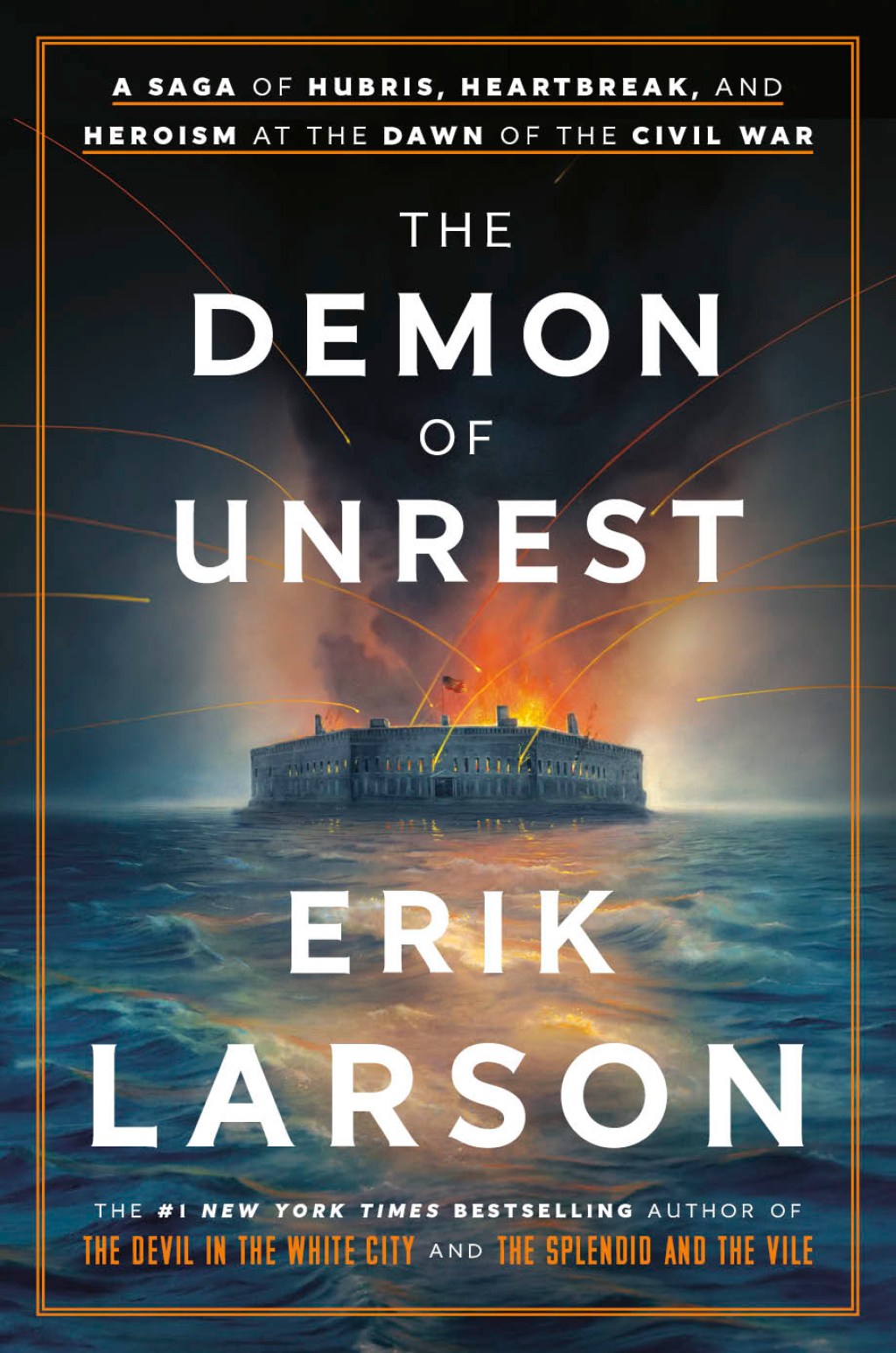
    Author Erik Larson offers compelling acount of the start of the Civil War

    Only a master storyteller like Erik Larson could turn the five tumultuous months leading up to the Civil War into “The Demon of Unrest: A Saga of Hubris, Heartbreak, and Heroes at the Dawn of the Civil War” (Crown), a compelling, page-turning read, chock full of anecdotes, psychological profiles and obscure but compelling tidbits of history all set against a relentless march towards a conflict that would kill over 620,000 soldiers and devastate a nation.

    Larson, the author of six New York Times bestsellers whose previous works include “The Devil in the White City: Murder, Magic, and Madness at the Fair That Changed America,” about a mass murderer and the 1893 Chicago’s World Fair, writes in a novelistic style that makes history come alive. He does so through his ability to weave together the familiar facts of history with information that can only be gleaned through relentless and extensive research.

    Yes, most of us know that the Civil War began with the firing on Fort Sumter, which was located in Charleston Harbor and under the command of U.S. Army Major Robert Anderson. But did you know that Anderson had owned enslaved people and was a defender of slavery? That Lincoln often misspelled Sumter as Sumpter? Or, more importantly, South Carolina did not have to succeed because of Lincoln’s election, as he had no intention of outlawing slavery in the Southern states?

    “When I started out doing this, one concern I had was that the Civil War has not exactly been underwritten,” Larson told me during a phone conversation earlier this week, noting that a quick Google indicated around 65,000. “I had vowed over the years never ever to write about the Civil War.”

    That changed when, as he was looking for the topic of his next book and watching the events of the Jan. 6, 2021 assault on the U.S. Capitol, he began to consider the deep divide and unrest of our own times.

    Faced with what he describes as an intimidating world of previous scholarship, Larson says “What I really wanted to do was to provide a rich sense, on an intimate level, of what the forces were and the motivations for the start of the Civil War.”

    The magic of his writing is that he accomplishes this by immersing the reader in details, descriptions, and personalities mostly unknown to many of us, including “eight typical characters” such as Charleston society doyenne Mary Boykin Chestnut, who kept a detailed diary, and James Henry Hammond, a Charleston planter who was a leader of the secessionist movement and who later became a U.S. senator despite public knowledge of his sexual relationships with four nieces ages 13 to 19.

    He also includes information about resolving issues regarding dueling, from “The Code of Honor or Rules for the Government Principals and Seconds in Dueling” and instructions for the “proper” way of whipping slaves as well as the going prices for selling human beings.

    The Southern mindset among the owners of enslaved people of the time is best summed up in a letter written to President James Buchanan, president before Lincoln, by Arthur Peronneau Hayne, a U.S. senator from Charleston. In it, he writes that without slavery “our every comfort would be taken from us. Our wives, our children, made unhappy — education, the light of knowledge — all lost and our people ruined forever. “

    “White southerners had persuaded themselves that slavery was a good thing for all concerned, especially for the enslaved blacks,” said Larson. He also notes that many of these same men were devoted readers of writers like Sir Walter Scott, author of “Ivanhoe,” and believed fervently in honor and the code of chivalry.

    As outrageous and hypocritical as that seems today, Larson says when writing about a different era it’s important to consider the point of view of those times to accurately reflect how events unfolded.

    “It gives a better sense of what the forces were that did lead to states like South Carolina succeeding from the Union and the Civil War,” he said, noting that understanding is not condoning, but historic context provides a lesson for the present and future as we struggle with political division today.

    This article previously appeared in the Northwest Indiana Times.

  • The Attic on Queen Street by Karen White

    The Attic on Queen Street by Karen White

    Karen White and I are talking about ghosts, particularly the ghosts haunting Melanie Middleton Trenholm in White’s latest novel, The Attic on Queen Street, the last in the series set in haunted Charleston, South Carolina.

    “Do you believe in ghosts?” she asks.

    Not really, I reply, but I also don’t like staying in places that are supposedly haunted when I’m by myself.

    White feels the same way because, as we both agree, you just never know.

    It’s then that her phone goes dead.

    “I don’t what happened,” says White when she calls back. “My phone was charged and everything.”

    Coincidence? Most likely. But still, it makes you wonder.

    But phones going dead are the least of the problems for Melanie, a Charleston real estate agent with young twins, a husband who is deciding whether he wants to stay in the marriage, and a teenaged stepdaughter whose room is haunted. Indeed, the entire house on Tradd Street is haunted. Some of the ghosts are helpful, some are evil, and one is the ghost of a dog—which is fine as it gives Melanie’s dog a companion to play with. And to make matters worse, Melanie’s young daughter is already showing signs of being able to see ghosts.

    Ghosts are such a problem that Melanie learned early on to sing ABBA songs loudly to drown out the sounds of the dead people trying to talk to her. But that only works sometimes and in this novel there’s plenty of evil for Melanie to deal with both living and dead. For starters there’s Marc Longo, who stole her husband’s manuscript and turned himself into a bestselling author. Longo is now heading a film crew in Melanie’s house while underhandedly trying to discover the diamonds he believes are hidden there. Melanie is also trying to aid a good friend in discovering who murdered her sister years ago—with the help of the cryptic messages the deceased sister keeps sending her way. And then there’s Jack, her handsome husband. They’re still in love but Jack is darned tired of Melanie always getting herself into deadly situations.

    White first introduced us to Melanie in The House on Tradd Street in what was to be a two book series.

    “But when it came out and was so popular, my publisher said let’s make it four,” says White. “This is the seventh and I’m really going to miss them.”

    Well, kind of, as White is continuing the theme of a haunted city and the Trenholm family, only with Melanie’s stepdaughter in the key role who has to deal with her only supernatural beings when she move  to New Orleans in a book due out this coming March called The Shop on Royal Street.

    Interestingly, the Tradd Street series was originally going to be set in New Orleans. White went to Tulane University and in 2005 she was all set to go with her family back to New Orleans to do research for the first book when Hurricane Katrina hit.

    “I knew that there was no way with all the catastrophic flooding, and deaths that I could write this story without having Katrina in it and this wasn’t that kind of book,” says White, who has authored 23 books,

    Choosing Charleston made sense as White had ancestors who lived in Charleston in the late 1700s and family who had lived on Tradd Street. In ways, she says that when she visited, she felt the pull of genetic memory—a sensation of a past shared life.

    “I smelled what they call pluff—which is rotted vegetation,” recalls White, “and I said oh doesn’t that smell so wonderful.”

    Coincidence? Doubtful.

    The Attic on Tradd Street is also available as an audiobook and electronically.

  • THE CHRISTMAS SPIRITS ON TRADD STREET

    THE CHRISTMAS SPIRITS ON TRADD STREET

    New York Times bestselling author Karen White’s iconic series about a quirky psychic realtor (yes, you read that right!), set in historic Charleston, continues this winter. A long-anticipated gift to her fans, this holiday season White released her first ever Christmas novel.

    Jane Ammeson, who writes the Shelf Life column for The Times of Northwest Indiana and shelflife.blog, interviewed Karen about THE CHRISTMAS SPIRITS ON TRADD STREET, the sixth book in her Tradd Street Series,

    With each new release, Karen’s national platform grows. Her previous installment in the series, The Guests on South Battery (2017), was a New York Times hardcover bestseller. Her books have been featured on Southern LivingReese Witherspoon’s Draper James blogLate Night with Seth Meyers, and more. The author of over twenty books and 12 New York Times bestsellers, she has almost two million books in print in fifteen different languages.

     JA: Since you’re not a realtor and you’re not seeing ghosts (we don’t think so, anyway!), do you have much in common with Melanie—like are you super-organized with lots of charts and spread sheets, etc.?

    KW: Let’s just say that people who know me who have also read the Tradd Street series seem to think that Melanie _is_ me.  I’m going to neither confirm nor deny, but let’s just say that I do love to be organized and I also adore sweets (although Melanie’s metabolism is simply something I aspire to).  She and I are both ABBA fans and neither of us can text without many alarming typos.

    JA: You grew up all over the world but started off in the south and think of yourself as a Southern girl. Why did you choose historic Charleston for the setting of your series?

    KW: My parents (and extended family) are all from the South—mainly Mississippi—which is where I get my Southern roots.  I went to college in New Orleans (Tulane) and actually planned to set the series there.  However, the year I started writing the first book was 2005, the year Katrina wreaked so much havoc on the city and her citizens.  I knew that in the series I was planning to write that this sort of natural disaster and its repercussions wouldn’t fit.  I would return to New Orleans and the storm for The Beach Trees, but for the series I needed to find another Southern city that had gorgeous architecture, lots of history, and plenty of ghosts.  Charleston was an obvious choice.

    JA: Your Tradd Street series novels seem to require a lot of research into older homes, renovations and history, can you tell us about that?

    KW: Since I was a little girl I’ve been obsessed with old houses.  They didn’t need to be grand or even well-maintained to make me beg my mother to pull the car over to the curb so I could get a better look.  When we moved to London, we were fortunate to live in an Edwardian building on Regent’s Park.  It had leaded glass windows, thick mahogany doors, and ceiling medallions to make a wedding cake envious.  Living in that flat made me believe that I truly could hold a piece of history in my hands.  My obsession continues with my daughter who holds a master’s degree in historic preservation from the College of Charleston and currently works as an architectural historian.  She actually appears in the last two Tradd books (as well as Dreams of Falling) as graduate student Meghan Black.

    JA: Can you give readers who may not have read any of your other books about Melanie and Jack a description of The Christmas Spirits on Tradd Street?

    KW: In this penultimate installment (book #6) in the series, we find OCD Realtor (who also happens to be able to speak with dead people) Melanie Middleton and true crime mystery writer Jack Trenholm happily married and living with their toddler twins and teenage daughter, Nola, in their historic home on Tradd Street. Christmas is approaching and all seems to be going well for them—-except for a few money problems, Jack’s writing career taking a curveball, and an unpleasant specter seen haunting Nola’s bedroom that seems to be connected to the ancient cistern being excavated in their back yard.  Unwilling to burden Jack with one more problem and distract him from his writing despite promises that they wouldn’t hold secrets from each other, Melanie takes it upon herself to attempt to solve the mystery behind the ghostly presence—with unsettling results that Melanie may or may not be able to resolve.

    JA: Are your ghosts based upon real life (if you can call it that when it comes to ghosts) tales of hauntings in Charleston?

    KW: Growing up, my father loved to read true ghost stories to my brothers and me—usually right before bedtime.  I also had a grandmother who always spoke about conversations she’d had with dead relatives.  I suppose that’s the reason why I thought ghosts were like doilies on the backs of chairs—some people had them, some people didn’t.  I continue to enjoy ghost stories (I listen to several podcasts on the subject) and, even though I have never had an experience, my son has three times.  

    When visiting Charleston, I love going on haunted walking tours (especially the graveyard ones) and always pick up fascinating tidbits to be used later in my books.  I’ve never borrowed a ghost story for my books, but tend to pick and choose certain parts of favorites and mix them together to fit into my stories.

    JA: Do you live in an older home?

    KW: Sadly, no.  My husband isn’t a fan of old houses (and in my first book, the derogatory remarks Melanie makes about old houses came right from his litany of why he dislikes old houses—mostly having to do with the expense of heating them).  Every house I’ve lived in since the old Edwardian building in London has been brand new.  I’m hoping my daughter and I can get sway him to our side when it’s time to move again.  Hopefully to Charleston.

    JA: Besides a great story and enjoyable read, are there any other take-aways you’d like for readers to get from The Christmas Spirits on Tradd Street?

    KW: This installment can be read on its own.  However, I do think that readers might enjoy the series more if read in order starting with the first book.  The books each have their own mystery to be solved, but the growing cast of characters and Melanie’s growth through the series is an important element and best understood if readers meet her in book .

    JA: Anything else you’d like our readers to know?

    KW:  Yes, there are ghosts and some spooky scenes in all of the books.  But these are not paranormal or thriller type books.  These are character-driven stories centered around Melanie Middleton and her relationships with family and friends and set in the gorgeous and historical city of Charleston, South Carolina.  This is Southern Women’s Fiction—with the added bonus of a few spirits who need Melanie’s help to solve a mystery.