Tag: #books

  • Southern Lights: Easier, Lighter, and Better-for-Recipes From the South

    Southern Lights: Easier, Lighter, and Better-for-Recipes From the South

    “Throughout these pages, I’m going to (politely) refute the claim that Southern food is all bad for you and hopefully breathe new life into some tired, worn-out notions,” writes Lauren McDuffie in the first pages of her latest cookbook, Southern Lights: Easier, Lighter, and Better-for-You Recipes From the South (Gibbs Smith). McDuffie, an advocate of Southern cuisine, wants us all to know the entire truth of this regional way of cookery that many of us dismissively think of as fried and fat.

    Once you make your way through the stereotypes, past the overwrought, done-to-death, attention-seeking heavy hitters, the archives of Southern cookery shine with a special sort of brilliance,” continues McDuffie, noting that she is a home cook who has done the majority of her culinary learning in the South ranging from the foothills of central Appalachia to the sandy, abundant low country coastline.

    McDuffie, who lives in Portland, Oregon now, created the award winning food blog: My KItchen Little: Recipes, Ideas, and Inspiration for Busy Home Cooks but her love of Southern cuisine and her ability to bring it to the fore was also apparent in her first cookbook, Smoke, Roots, Mountain, Harvest: Recipes and Stories Inspired by My Appalachian Home. The same passion is conveyed” in this magnificent cookbook with its luscious photos–McDuffie is also a photographer and her luscious color photos are a perfect accompaniment to the recipes that show us how to enjoy the rich heritage of Southern cuisine without the guilt and calories.

    Southern Lights takes us into the world that McDuffie says she loves most– the people, places, things, and flavors that evoke feelings of home.

    To accomplish this, McDuffie, an advocate for fresh and healthy, took a hard look at her kitchen pantry and asked herself a series of questions such as why she was using a particular oil or cut of meat in her cooking and what substitutions would work just as well when using her favorite recipes. From there she re-created favorite dishes incorporating different ingredients but yielding the same delicious results.

    Her recipe for Frico Chicken in a Buttermilk Bath is a great example. Its origins are that perennial Southern classic—fried chicken brined in buttermilk and then deep fried in lard. A definite winner when it comes to taste. Not so in other respects. So what does McDuffie? She produces a healthier and low caloric alternative that really works.

    Calling it a remix and noting that frico translates to fried in Italian, she describes this dish as similar to a simple baked cheese crisp that tops a boneless, skinless, and flattened chicken thighs browned in a minimum of oil. A surprising easy-to-make but sophisticated dish, it offers the crunch and flavor of buttermilk heavily battered chicken with no grease or guilt.

    Like pulled pork sandwiches. McDuffie gives us a very creative take by substituting spaghetti squash (yes, you read that correctly) for the pork in her recipe for “Pulled” BBQ Spaghetti Squash Sandwiches.

    “This has got to be one of the most unusual sandwiches I’ve ever made, but man is it a hit in my house,” writes McDuffie in the introduction to this dish. “Tangled strands of roasted spaghetti squash mimic the fatty pork in a classic meaty version, making for a lighter, more nutritious way to get your fix.”

    The squash mixture is then topped with Halloumi cheese (smoked Gouda or cheddar can be used instead) along with coleslaw and barbecue sauce.

    Voila! A low cal, high flavor profile meal and just one of many in McDuffie’s latest cookbook.

    Honey-Caramelized Tomato Upside-Down Cornbread

    “People get very territorial about their cornbread in the South, a fact that I have always found completely charming,” says McDuffie. “Home cooks are devoted to their recipes and food traditions in a way that serves to sustain them, carrying them across generations. There is so much heart on the table, always. Cooks hold on tight to them, their family recipes, and it’s really the most beautiful thing. This recipe happens to be a favorite version of cornbread in my house. The jammy, juicy-sweet tomatoes suspended on top really do steal this show, and the olive oil makes it pretty special. Feel free to sub a different cooking oil, though, as olive oil ain’t cheap. I highly recommend serving this in thick slices, slathered with lots of Salty Butter–Whipped Honey.”

    Makes 6 to 8 servings

    • Natural nonstick cooking spray
    • 12 ounces cherry or
    • grape tomatoes
    • 6 tablespoons honey, divided
    • 1 1⁄2 teaspoons salt, plus
    • more as needed
    • 1 cup yellow cornmeal
    • 1 cup cake flour
    • 1 1⁄2 teaspoons baking powder
    • 1 teaspoon baking soda
    • 2⁄3 cup olive oil or canola
    • or vegetable oil
    • 2 large eggs, beaten
    • 1 1⁄4 cups buttermilk

    Preheat the oven to 350°F. Adjust the rack to the middle position. Spray an 8- or 9-inch round cake pan with cooking spray and line with parchment paper, allowing some overhang for easy removal (think of them as handles).

    Put the tomatoes, 3 tablespoons of the honey, and a good pinch of salt in a nonstick skillet set over medium heat and cook, stirring occasionally, until the tomatoes just burst and are tender, about 5 minutes. Transfer to the cake pan, juices included, and spread in an even layer.

    In a mixing bowl, whisk together the cornmeal, remaining 1 1⁄2 teaspoons salt, cake flour, baking powder, and baking soda.

    In the bowl of a stand mixer or in a mixing bowl with ahandheld m ixer, combine the oil, the remaining 3 tablespoons of honey, and the eggs. Add half of the dry mixture and mix until combined. Add half of the buttermilk and mix until just combined. Repeat with the remaining halves of each and gently pour the batter into the prepared pan over the tomatoes (it shouldn’t be more than three-fourths full).

    Bake until lightly golden and set, 35 to 45 minutes (use a knife or toothpick to test the doneness—it should come out clean). Cool in the pan for at least 15 minutes before inverting the cornbread onto a serving plate, tomatoes facing up now.

    Salty Butter-Whipped Honey

    Sounds sinful, right? I can assure you that this isn’t nearly as rich as it sounds. This drippy, sticky-sweet thing is my lighter take on a simple honey butter where, instead of infusing a lot of butter with a little honey, we’re going to infuse a lot of honey with a little butter. Just be sure to use a good-quality raw honey.

    Makes about 1 cup

    • 8 ounces honey
    • 2 tablespoons salted butter, at room temperature
    • Salt to taste

    In a blender, combine the honey, butter, and salt and blend until creamy and smooth. Transfer to a lidded storage jar or container. This buttery honey will keep in the refrigerator for up to 1 month.

    Frico Chicken in a Garlicky Buttermilk Bath

    “I’ve taken the things I love most about classic Southern fried chicken and remixed them into something that is just as satisfying, but much lighter—a true win-win,” writes McDuffie about this recipe. “A frico (which means “fried” in Italian) is simply a baked cheese crisp, and here we’ll use them to almost mimic the salty crunch of fried chicken skin. Rather than rich bone-in, skin-on cuts, we’ll use leaner boneless and skinless thighs—my favorite protein of them all. The garlicky buttermilk-fortified bath in which they cook mimics my go-to fried chicken brine, helping the chicken stay tender and juicy. It also happens to be an easy, one-pan, 30-minute meal. So there’s that.”

    Makes 4 to 6 servings

    • 1 1⁄2 cups grated Parmesan cheese
    • 4 teaspoons olive oil, divided
    • 6 boneless, skinless chicken thighs
    • Salt
    • Freshly ground black pepper
    • 1 heaping cup diced sweet onion
    • 10 ounces fresh baby spinach
    • 3 garlic cloves, minced or grated
    • 1⁄2 cup dry white wine (optional)
    • 1 (14.5-ounce) can crushed or diced tomatoes
    • 1⁄2 cup buttermilk

    Preheat the oven to 350°F. Adjust the oven rack to the middle position. Line a large baking sheet with parchment paper or a silicone baking mat.

    Equally space the Parmesan into 6 (1⁄4-cup) mounds on the baking sheet. Use your measuring cup to gently press down on the mounds and work them into round, circular disks (they don’t have to be perfect). Bake until flattened and just beginning to brown lightly around the edges, 3 to 4 minutes. Remove and set aside. They will firm up as they cool.

    Pour 2 teaspoons of the oil into a large pan over medium heat. Season the chicken with salt and pepper to taste. When the oil is hot, add the chicken and brown really well on the first side; this takes 5 to 6 minutes. Flip and cook for another 1 to 2 minutes (they will finish in the sauce). Transfer to a plate and set aside.

    Pour the remaining 2 teaspoons of oil into the pan. When it’s hot, add the onion and spinach and sauté for 3 to 5 minutes, until the spinach is fully wilted and the onion is soft. During the last minute, add the garlic.

    Stir in the wine (if using) and cook for about 1 minute to reduce it. Add the tomatoes and buttermilk and slide the chicken back into the pan. Simmer for about 10 minutes to reduce the sauce and to finish the chicken.

    Lay the Parmesan fricos over the chicken just before serving. They will melt and sort of adhere to the chicken, mimicking salty chicken skin in the best way.

    Recipes excerpted from Southern Lights: Easier, Lighter, and Better-for-You Recipes from the South by Lauren McDuffie. Photographs by Lauren McDuffie. Reprinted by permission of Gibbs Smith Books.

  • Peas Love & Carrots

    Peas Love & Carrots

    Savory Stovetop Turkey. Photo by Moshe Wulliger.

    So, before we start talking about Danielle Renov’s wonderful new cookbook, Peas Love and Carrots (Me’sorah Publications, Ltd. 2020; $28.93 Amazon price) I want to take a few moments to whine. I write a lot about food, I have a food blog, Twitter, Facebook and Instagram accounts where I post about food and travel. I often think it’s lucky I have a large family including cousins who I am able to cajole into following me so I have at least some followers.

    Some don’t seem to need large families to get followers. At least four or five times a year, I interview a cookbook author who started with an Instagram or Facebook or Twitter account and ended up with tens and sometimes hundreds of thousands of followers. I’m not saying I’m anywhere near their level of ability and creativity. Far from it, but still—comparatively my numbers aren’t even close. I’m not writing this to make people feel so sorry for me that they follow me—but hey, if you want to it’s okay. it’s just that with Renov I ran into it again. Four years ago, with her husband out of town and her kids tucked away in bed, she decided to start Instagramming.

    Tuna Salad A` La Moi. Photo by Moshe Wulliger.

    She soon had around 43,000 followers. This year,  the number is over 130,000. She now is considered a kosher and food influencer—someone who has the audience and credibility to persuade others. To give an example of what that means, Kim Kardashian may be the ultimate influencer with 354 million followers across social media channels. Yes, 354 million. That’s about close to the number of people who live in the United States.

    Burnt Cauliflower and Herb Salad. Photo by by Moshe Wulliger.

    Renov, who grew up on Long Island, New York and moved to Israel about 13 years ago, deserves her followers. The 254 plus recipes she created for Peas, Love & Carrots reflect her many life experiences, her family’s heritage, her Sephardic and Ashkenazi roots and her own interest in food in her new homeland including her weekly shopping expeditions to the Machane Yehuda Shuk, a sprawling 19th century
    market in Jerusalem selling among many other items, a variety of foods. In writing the introduction to her recipes, Renov tells a story about it, often displaying a sense of humor.

    “Dinner again?” she writes in the introduction to Crispy Baked Chicken fingers. “I know. it’s crazy. No matter how many times you go through it, it comes back again and again. It’s almost like laundry. Only you can’t eat your laundry, so at least there’s that. This (recipe) is for those days. And since those days happen more than we’d like to admit, I gave you three versions so that you can change things up. You’re welcome.”
    But food is also serious for Renov, who returns frequently to New York where she records cooking videos for kosher.com. She wants her recipes to work, to be easily accessible for both kosher and non-kosher cooks and to offer tastes beyond the everyday.

    Describing her Savory Stovetop Turkey recipe as an ode to her father who doesn’t eat a lot of read met, Renov says she’s always on the hunt for tasty turkey recipes.

    Crispy Baked Chicken Fingers. Photo by Moshe Wulliger.

    “What I never saw was a turkey roast recipe where I felt like the turkey was treated like a proper beef roast,” she says, and I have to agree which is another reason why this recipe looks so intriguing. From the photo, and I’ll soon have my own photos too as I’m making it for company tomorrow, it looks like a richly braised beef roast.

    “That’s what was aiming for here,” she says, “Turkey that was deeply savory, moist, and extremely satisfying.”

    Photo courtesy of Peas Love & Carrots Facebook.

    Go ahead and follow Renov, I won’t mind. Really. She posts her recipes, cooking tutorials, lifestyle tips and inspirational ideas for the kitchen, home, and family on both her blog peaslovencarrots.com and Instagram feed @peaslovencarrots.

    The following were excerpted from Peas Love & Carrots by Danielle Renov. Copyright 2020 by ArtScroll Mesorah Publications, photos by Moshe Wulliger. Reproduced with permission of the copyright holder. All rights reserved.

    Burnt Cauliflower and Herb Salad
    Yield: 2+ quarts
    Cauliflower
    2 (24 oz) bags frozen cauliflower florets
    3 tablespoons olive oil, divided
    4 cloves garlic, minced (about 1 1⁄2 Tablespoons)
    1 1⁄2 teaspoons kosher salt
    1⁄2 teaspoon freshly ground black pepper
    2 teaspoons turmeric
    1 1⁄2 teaspoons sumac
    1⁄2 teaspoons paprika
    1 lemon, halved

    Herb Salad
    1⁄2 cup chopped parsley
    1⁄2 cup chopped cilantro
    1⁄2 cup chopped scallions (from about 4 scallions)
    2 tablespoons chopped mint, optional
    1 small purple onion, finely diced (about 1 cup)
    1-11⁄2 Tablespoons white vinegar kosher salt, to taste
    Freshly ground black pepper, to taste

    Cauliflower
    Preheat oven to 350°F / 180°C. Line a baking sheet with heavy duty foil; coat with 1 tablespoon olive oil.
    Toss frozen cauliflower with 2 tablespoons oil, garlic, salt, pepper, turmeric, sumac, and paprika.
    Spread out on baking sheet in a single layer.

    Roast undisturbed for about 45 minutes (DO NOT OPEN OVEN DOOR DURING THAT TIME!).
    After 45 minutes, cauliflower should begin to get crispy and charred.

    Open oven door remove baking sheet, and squeeze both halves of the lemon over the cauliflower. DO NOT MIX OR STIR. Just squeeze over the top, return to oven and cook for 5-6 minutes.
    Serve and enjoy.

    Herb Salad
    While cauliflower is roasting, combine parsley, cilantro, scallions, mint, and onion in a large bowl.
    When cauliflower is done, add to the herb mixture, tossing to combine. Add vinegar; toss to combine.
    Season to taste with salt and pepper.
    Serve warm or cold.
    Note: If not serving the same day, combine herbs with cauliflower before serving time.

    Tuna Salad A` La Moi
    “This is my favorite lunch salad,” says Renov. “I could eat it, on repeat, every day. I know, mercy. Ok, fine. every other day. It’s filling, the
    flavors are punchy, and it’s my absolute favorite way to eat tuna. Make it today, double the recipe, and store it in an airtight container for tomorrow. it is actually better the second day.”

    2 cups shredded purple cabbage
    1 cup shredded radicchio
    1 cup chopped scallions
    1 cup chopped cucumber
    1 cup finely chopped celery
    1⁄2 cup diced purple onion
    1 cup parsley, chopped
    1 cup chopped preserved lemons
    1⁄2 cup chopped capers 15 ounce canned tuna in water, drained,

    Roughly chopped juice of 1 lemon, 2 teaspoons paprika, 1 teaspoon, cayenne pepper, 1 teaspoon kosher salt and 1⁄2 teaspoon coarsely ground black pepper.

    Place all ingredients into a large bowl. Toss well to combine.

    Let sit for 5 minutes. Toss again.

    Savory Stovetop Turkey
    1 large whole deboned turkey breast
    1 Tablespoon kosher salt
    1 teaspoon coarsely ground black pepper
    1 1⁄2 teaspoons granulated garlic
    1 1⁄2 teaspoons paprika
    1 tablespoon neutral oil
    1 onion, thinly sliced
    4 cloves garlic, minced
    2 Tablespoons tomato paste
    1 1⁄2 cups dry white wine
    2 bay leaves
    1 tablespoon white vinegar
    2 cups chicken broth
    1⁄4 cup duck sauce

    In a small bowl, combine salt, pepper, garlic, and paprika. Season turkey breast with mixture on all sides.
    Heat a pot over medium heat. Add oil; place turkey top side down and sear for 4 minutes on each side.
    Remove turkey from pot; set aside.

    Add onion; cook for 12 minutes.

    Add garlic and tomato paste to the pot. Cook for 2 minutes until fragrant.

    Add wine, bay leaves, and vinegar, stirring to scrape up any bits on the bottom of the pan.

    Cook for 2 minutes; add chicken broth and duck sauce.

    Return turkey to the pot, spooning some of the mixture over the top.

    Bring mixture to a boil, cover pot, and reduce heat to low. Cook for 1 1⁄2 hours, basting every 20 minutes or so. Serve hot and enjoy.
    Tips + Tricks
    If making in advance, slice turkey when it’s cold, return to sauce, and reheat gently.

    Crispy Baked Chicken Fingers:

    Crispy Asian Baked Shnitsel
    1 package chicken tenders (about 18 pieces) OR 12 thin cutlets
    1 cup mayo
    2 tablespoons minced garlic
    2 tablespoons honey
    1-2 teaspoons sriracha (depending how spicy you like it!)
    1 Tablespoon white miso
    1⁄4 cup soy sauce
    3 cups panko breadcrumbs
    Barbecue Crispy Chicken
    1 package chicken tenders (about 18 pieces) OR 12 thin cutlets
    1⁄4 cup mayo
    3⁄4 cup favorite barbecue sauce
    1 teaspoon granulated garlic
    1 teaspoon granulated onion
    3 cups panko breadcrumbs

    Honey Mustard Crispy Chicken
    1 package chicken tenders (about 18 pieces) or 12 thin cutlets
    1⁄4 cup mayo
    1⁄4 cup Dijon mustard
    3 tablespoons honey
    3 cups panko breadcrumbs
    Preheat oven to 350°F

    Coat a baking sheet liberally with nonstick cooking spray.
    In a large bowl, combine flavoring ingredients (aside from chicken and breadcrumbs) in selected recipe.
    Add chicken to wet mixture; mix to coat.
    Dip coated chicken into breadcrumbs, then place flat on prepared baking sheet. Spray the top of the chicken pieces with a little more nonstick spray.
    Bake for 30-40 minutes, until chicken is cooked through.

  • Princess of Blood

    Princess of Blood

    I devoured Sarah Hawley’s Servant of Earth, the first in her Shards of Magic triology, a romantasy that centers around Kenna, a young woodland girl, held in contempt in her village, who, trying to save her only friend, finds herself a slave in the opulent world of the Fae. These beautiful and magical creatures over-indulge in the pleasures and sins of life–sumptuous food and drink, complicated love affairs, glamorous surroundings, and evil machinations.

    The world of the Fae is one of danger, false friendships, and death. To survive, Kenna must outwit and out manuever the most powerful of the Fae. You can read my review here.

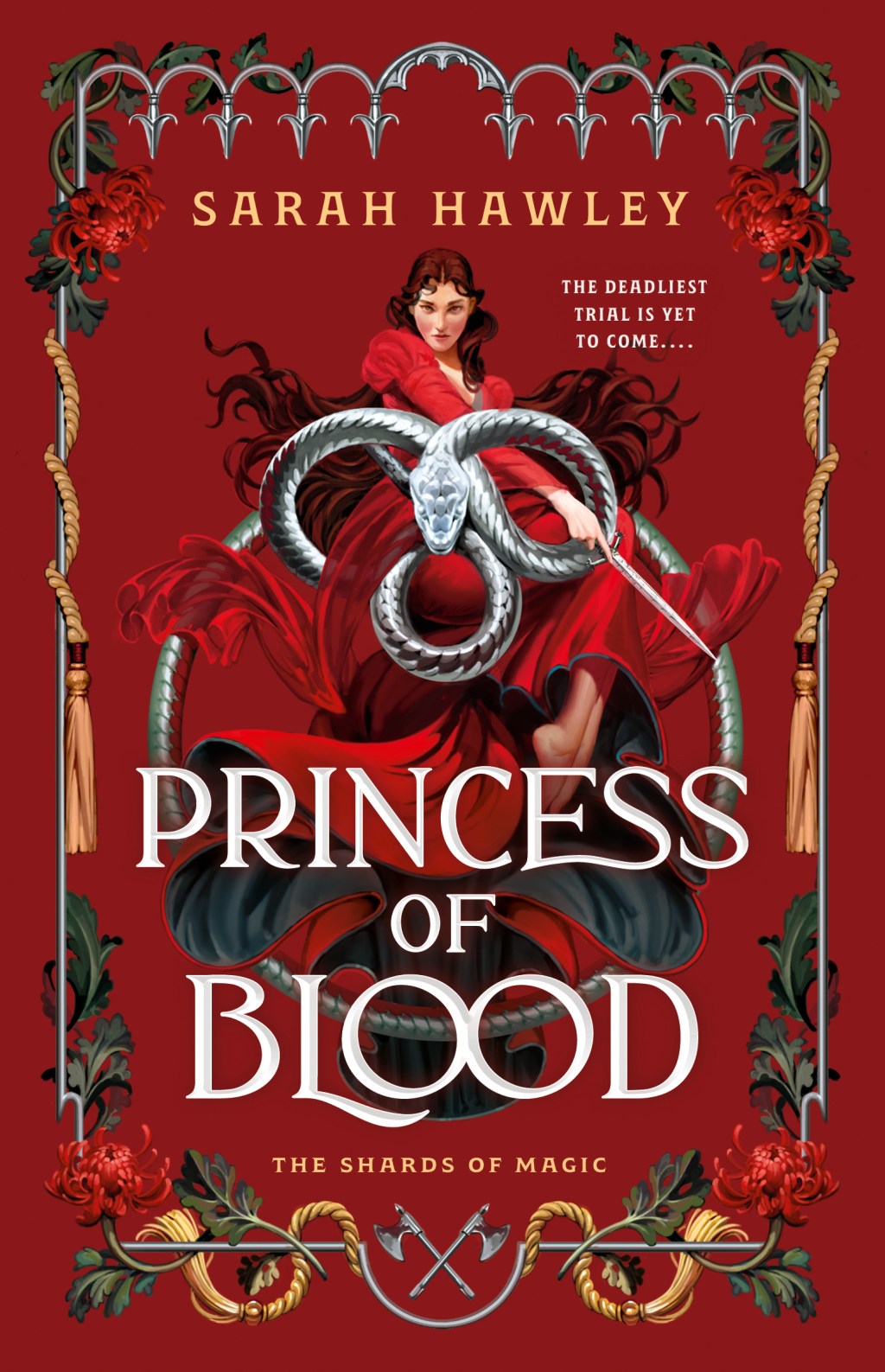
    I eagerly awaited Hawley’s second book, Princess of Blood, and was not disappointed when it came out earlier this fall. It’s darker as Kenna becomes enmeshed in a power struggle over who will rule the Fae, a battle that imperils her life and those of her friends and followers. Now, I’m hoping that Hawley is working hard on the third and final book in the trilogy as I’m eager to see how it all turns out.

    I again had the chance to interview Hawley and thought I’d include the Q & A here.

    Were there specific myths, legends, your previous work as an archaeologist or personal experiences that influenced the book’s political intrigue, power struggles, or Fae society?

    I’ve always loved reading about the Fae in folklore and fantasy novels! They’re a fascinating combination of whimsical, deadly, beautiful, mercurial, and mysterious, and there are so many ways a writer can pay homage to that lore and take it in new directions.

    Many Fae stories include underground elements because the folklore is tied to burial mounds and the remains of ancient structures. Those archaeological sites developed a reputation for being gateways to a mysterious Fae underworld, which served as the inspiration for the subterranean kingdom of Mistei. Combining that dramatic setting and the tricky nature of the Fae in fairy tales led to the complicated politics and power struggles explored in SERVANT OF EARTH and PRINCESS OF BLOOD.

    Princess of the Blood explores such heavy themes as trauma, healing, betrayal, murder, and forging new alliances. How did you approach exploring such difficult and emotionally compelling but difficult subjects in your writing? And how did you react emotionally when writing about such things?

    Fantasy novels are a great way to explore dark themes that are relevant to our lives. The fantastical setting adds an element of distance while also allowing for very high stakes. It can be difficult to write such heavy content (I feel bad for my characters sometimes!) and I definitely cried while writing certain passages, but I also think it’s a wonderful way to explore themes of healing and growth. I spend a lot of time thinking about how my characters’ emotions and traumas would impact their actions and how they might change over the course of the story.

    How did your background in archaeology shape the historical textures and power dynamics in your fantasy world? After all there were a lot of complex, traumatic and emotional plot lines in ancient times as well as diverse architecture.

    My background in archaeology definitely impacts my worldbuilding. I’m always thinking about how a society is laid out, from its geography to its social hierarchy, as well as how the characters move through that space. How do they dress and act to signify their status as an insider or outsider? What are the rituals of everyday life? I also like to consider how my characters relate to their own world’s past—their history and myths and the combination of fact, fiction, and propaganda that impacts their beliefs. Their politics and actions are shaped by the stories they tell themselves, just as ours are. I always want the reader to have a sense of an expansive world where countless stories are happening just off the page.

    Is there a particular scene or line in “Princess of the Blood” that holds special meaning for you either personally or as an author?

    There are a lot of scenes and lines that hold meaning for me, but one passage sums up the central theme of this book and series, which is the cyclical nature of history and the importance of trying to break destructive cycles even if the fight seems hopeless:

    History ate itself like a snake swallowing its own tail as the Fae continued their unending battle for power . . . but that didn’t mean we should give up. Even if our victories had a steep price. Even if we lost.

    Is there anything else you’d like readers to know?

    I’m so excited that readers are discovering SERVANT OF EARTH and PRINCESS OF BLOOD! It’s been thrilling and fulfilling to see Kenna’s story resonating with so many people. Thank you to everyone who has picked these books up.

    When can we expect the third and final book?

    I don’t have an exact publication date yet, but it will be coming in 2026!

    My article about Princess of the Blood appeared in the Northwest Indiana Times.

  • Becoming Caitlin Clarke

    Becoming Caitlin Clarke

    “There is no Caitlin Clark without Iowa,” writes Howard Megdal in his recently released biography “Becoming Caitlin Clarke: The Unknown Origin Story of a Modern Basketball Superstar” (Triumph Books 2025).

    And while that may be somewhat puzzling, it isn’t when Megdal explains the history of the sport. The game of basketball was invented in 1891 and within a year young women were being taught to play the game at Smith College in Northampton, Massachusetts. The love of the game quickly spread and soon women were shooting hoops at the YWCA in Dubuque, Iowa as well as throughout the country.

    But as with so many steps forward, a countermovement began to spread, and schools began banning women’s sports in both high school and college, the premise being that it might be bad for their physical health as well as their reproductive capabilities. And besides, people posited, shouldn’t the monies, time, and effort of sports be more wisely direct towards men instead of women? Do I need to say more about that? I don’t think so.

    And so, in the second decade of the 20th century, there was a drive to ban women’s sports in Iowa. Fortunately, it didn’t happen and, as Megdal digs deep into the history of the game he shows the connections between women playing 6-on-6 basketball in Iowa in the 1920s and Clark becoming a star in the 2020s.

    “Caitlin’s playing college ball are direct consequence of an effort and interest in Iowa in women’s basketball that Vivian Stringer made as University of Iowa’s head coach,” he says about Stringer who during her 40 plus year career at Iowa and other schools amassed 1,055 wins, four NCAA Final Four appearances, 28 berths in the NCAA Tournament, and was inducted into the Women’s Basketball Hall of Fame in 2001. He also notes that Lisa Bluder, a three-year starter at the University of Northern Iowa who coached Clark at Iowa, is part of the state’s legacy.

    Other women weren’t as lucky as other states ended their programs a century ago and didn’t restart them again until the 1960s and 1970s with the advent of Title IX and the founding of the Women’s National Basketball Association.

    “That movement unfortunately was very successful,” says Megdal. “I mourn on a regular basis how many stories were stopped before they even started.”

    It was Clark, says Megdal in a phone interview that broke basketball women’s basketball in the best way possible. She was a phenomenal success and a phenomenal player who captured the attention of the country. Indeed, she was so popular that the singing phenom Taylor Swift invited her to attend a Kansas City Chiefs game to watch her boyfriend, tight end Travis Kelce, play.

    Megdal, founder and editor in chief of The IX newsletter, a daily newsletter covering 5 different women’s sports, and the nest, a 24/7 woman’s basketball outlet, has written several other books including “Rare Gems,” “The Baseball Talmud” and “The Cardinals Way.” During his 20 years writing about sports, he has pushed to ensure that women’s sports get as much attention as men’s.

    “When you’re in this space you quickly become aware of the fact that there’s a yawning chasm between how men’s sports are covered and how women’s sports are covered and so I’ve gone about trying to change that over the course of my career,” he says, noting he has had the opportunity do so at such publications as The New York Times, Washington Post and Sports Illustrated.”

    And Clark seems like the person to up the score for women in sports.

    “There are a lot one dimensional narratives around Caitlin Clark and that just reinforced for me how important it would be to tell this story in a way for people to understand where this comes from,” says Megdal who wanted to counter such narratives as Clark just happened to be in the lucky one. “The reality is that this is a century in the making.”

    Of course, it is also important to note, says Megdal, that Clark has blown away any and everything you could have ever expected of her on the court and off the court. It’s the perfect melding of the right person converging with the right moment in history.

    “Caitlin Clark went out and became this transcendent player,” he says, “one who is changing the fundamentals of everything from the audience for women’s basketball to the economics around it.”

  • All the Other Mothers Hate Me

    All the Other Mothers Hate Me

    Florence Grimes is a mess. Once part of a popular girl rock band, after a brief interlude with the manager who is really in love with another of the women in the group, she’s cast out and left with a baby to raise courtesy of the man who fired her. Sure, he pays for their son to go to a posh private school, and she adores her child, but her royalty checks are dwindling and let’s face it—she shouldn’t be spending what little money she has left on fancy nail art and other unnecessary items.

    But then Flo isn’t someone who knows how to manage her life, She just doesn’t fit in with the other mothers, but then she doesn’t try that hard—her clothing and attitude impairing her ability to be accepted.

    Finally, there’s hope. She gets a call about meeting an old colleague and she dreams of returning to the stage, but, as always with Flo, bad stuff happens and this time it’s really bad. Her son’s class bully mysteriously vanishes on a field trip, and Florence’s quirky, misunderstood 10-year-old son becomes a suspect.

    “To save her son, Florence has to figure out what actually happened to the missing boy,” says Sarah Harman, author of All the Other Mother’s Hate Me (G. P. Putnam’ & Sons 2025). “But the more she uncovers, the more she realizes her son might not be as innocent as she’d like to believe,”

    Books about missing children and women on the rocks aren’t typically funny but Harman, who describes the subject as a “fine line to walk” uses humor in recounting Flo and her attempts not only to resuscitate her career—and her life—but find out what really happened. And Flo, despite all her faults and mishaps, is someone to root for.

    “Personally, as a parent, I have zero interest in fiction about bad things happening to children,” says Harman. “There’s enough of that in the real world; I do not want to consume that darkness in my limited free time. So, it was important to me to telegraph to the reader from the outset, that while this is a twisty mystery about a missing boy, this is not a book where children are going to suffer.”

    Harman was never in a girl band (that’s what they called them back then) but she was inspired to write the novel by thinking back to the early aughts and the way that female celebrities were treated by the media and society in general. She references Britney Spears as one example.

    “Or remember how the paparazzi took a horrible upskirt photo of Anne Hathaway and then Matt Lauer asked her on national television ‘what lesson she learned from the experience?’” she says. “That was in 2012. It really wasn’t very long ago. When I was writing Florence, I was thinking about how coming of age creatively in that sort of environment might shape a person’s worldview —and the rest of her life.”

    The book, which came out in March of this year, is so compelling that even before publication, foreign rights to it were sold at auction in 14 markets  and the TV rights bought by FX and The Bear creator Chris Storer, Not bad at all for any novel, but this is Harman’s first which makes it even more impressive.

    Like Flo, Harman is an American living in the West End of London, and she notes that navigating the class system is much different than here. But there are some things that are common worldwide and one of them, she says, the redemptive power of female friendship.

    “When we meet Florence, all the other mothers hate her—and for a good reason,” she says. “She’s kind of awful. Over the course of the novel, as Florence forges an unlikely alliance with another mom, Jenny, she discovers that she actually is capable of caring about something other than herself. It’s only by learning to be a friend that Florence is able to move on from her past and forgive herself for her failures. Ultimately, my hope is that this book makes readers feel it’s never too late for a comeback.”

    This article originally appeared in the Northwest Indiana Times.

  • Letters from the Dead: A Q & A with Isabella Valeri

    Letters from the Dead: A Q & A with Isabella Valeri

    Mesmerizing, atmospheric, Gothic, and lyrical, Isabella Valeri’s first novel in a trilogy, took me into an opaque and lawless world of ancestral and deadly family dynasties beholden to no nation and no one but themselves. Valeri, who writes and lives under an assumed name and in an undisclosed Alpine location, is described as an avid markswoman, skier, equestrian, and pilot. I had the chance to interview her as she was writing the upcoming sequel, The Prodigal Daughter due out July 7, 2026.

    Q.  What inspired you to write Letters from the Dead (Atria/Emily Bestler Books/Simon & Schuster)and explore the world of old European dynasties and how much impact they have on the world?

    A. I had rather an unusual childhood and when I was quite young I read The Fate of Empires and Search for Survival a work written by the British military officer Sir John Glubb. Glubb describes a set of phases that empires go through during their rise and decline.

    A dramatic painting depicting chaos and destruction, with a massive statue of a figure holding an object amidst stormy skies and tumultuous waters, symbolizing the fall of an empire.

    I was also fascinated by the “Course of Empire” series of paintings by Thomas Cole, and I remember being saddened by the fifth and last in the series “Desolation” that Cole himself describes thus: “The gorgeous pageant has passed – the roar of battle has ceased – the multitude has sunk in the dust – the empire is extinct.”

    A serene landscape featuring a ruined column in the foreground, with remnants of classical architecture and a body of water reflecting the sky, evoking themes of desolation and the passage of time.

    But dynasties, particularly the hereditary variety, I realised, can outlast empires. The Yamato Imperial House of Japan endured for more than 2,500 years. This made me wonder what sort of properties permitted dynasties to endure for so long.

    When I began to write Letters from the Dead, it seemed the perfect theme for my young anti-heroine to explore: the way that dynasties subsume their members, and inevitably corrupt them so that the dynasty itself can survive. How does one fight such an entity, particularly as the youngest and the only girl of a generation?

    I won’t spoil it, but I hope that the Letters from the Dead series answers that question.

    A faded, aged piece of paper with text that appears to be an excerpt from a fictional story. The content describes a scene where the narrator feels alone on a jet, has a fleeting interaction with a figure named Karl, and expresses distress over a separation from their grandfather. The text captures a tense, emotional moment.

    Q.  Did any real-life families or historical events influence the creation of the protagonist’s family and their legacy? Or is some or all of it based upon your own experiences?

    A. Certainly the House of Hapsburg and its fate after the First World War provided some inspiration. Their influence was of such concern that the “Hapsburg Law” of 1919 stripped the family of power, seized all its property, and banished its memebers from Austria unless they renounced all their titles and claims.

    Some refused and went into exile. In fact, the Imperial family was later deported from Switzerland when the authorities discovered that Charles I was, for the second time, trying to mount a coup, restore the monarchy to power, and install himself on the Hungarian throne.

    A historic family portrait featuring a father in military uniform, a mother in dark Victorian clothing, and three children, all dressed in white garments. The family is posed in a studio setting with floral decorations in the background.
    The Russian Imperial Romanov family in early years. Wikimedia Commons.

    The fate of the House of Habsburg-Lorraine (and the murder of the Russian Imperial Romanov family at the hands of the Bolsheviks a year earlier) certainly provided an incentive for dynastic families to adopt rather a lower profile. Concepts like exile and secret power structures and the clandestine machinations they wield are certainly rich ground for an author to mine, and so themes like secret societies, banking secrecy, and the goings on in shadowy halls of power play central roles in Letters from the Dead and the rest of the series.

    Q. The Alpine estate feels almost like a character itself. How did you create such a vivid and atmospheric setting? And did the remote estate mpact the people who live there?

    A. I worked very hard to imbue my prose with that feeling I’m very glad to know that this comes through in the book. In a way, the dynasty that my anti-heroine is born into is a living, breathing thing. It has wants, needs, and desires. What are the dynasty’s ancestral lands and the “family seat,” the centre of the family’s power, but the physical manifestations of the dynasty itself?

    A woman stands in a lush, grassy field, her hair gently blowing in the wind, capturing a serene moment in nature.
    Photo courtesy of Isabella Valeri.

    Certainly my anti-heroine, who knows nothing of the outside world for the first twelve years of her life, finds herself born as part of that ecosystem. There’s always a hint of the supernatural in my books and the suggestion that the family’s ancestors do their best to wield their influence from beyond the grave.

    This concept was a fairly central tenant of belief in Ancient Rome and the title Letters from the Dead certainly alludes to the influence of “those who have gone before.” The estate is their only connection with the living so it does take on life of its own now and again, and for good or for ill, has a seductive influence over everyone who walks on those lands.

    A serene Alpine landscape featuring green pastures, rolling hills, and majestic snow-capped mountains, with two cows grazing peacefully in the foreground.
    Photo courtesy of Switzerland Tourism

    Of course, it helps that the Alpine foothills and the High Alps, where large portions of my books are set, are breathtakingly beautiful. My writing retreat is far up in the mountains and the descriptions of the hills, valleys, fogs, mists, and clouds on the estate were some of the first passages I wrote while looking down from there.

    Q. I loved how you meshed the intellectual with a high-paced thriller.Was that difficult to do?

    A. It was, in fact, very, very difficult. Early on I was repeatedly warned that it was nearly impossible to publish longer books. I am beyond grateful that Emily Bestler, my publisher, proved that untrue.

    I think and hope that longer form fiction is making a comeback and that even younger readers have tired of the quick dopamine fix of social media. I set out to write the books I wanted to read and almost all my favourites are longer works shot through with texture and detail and with very intellectual themes. Donna Tartt’s The Secret History, perhaps my very favourite novel and a huge inspiration for me, is nearly 200,000 words.

    Hilary Mantel’s Wolf Hall, an absolutely beautiful book, is longer than that. A.S. Byatt’s wonderful Possession is also nearly 200,000 words.

    Ancient Greek pottery depicting a mythological scene with several figures, including women and men in elaborate clothing, engaged in dialogue and holding various objects.
    Wikimedia Commons

    I think it’s hard to fully appreciate The Secret History unless you understand quite a bit about Dionysus and the Eleusinian Mysteries. But Tartt gives that to her readers in rather a clever way by bringing them along for her main character’s lessons where those concepts are discussed.

    There are so many deeper themes in Letters from the Dead that I also felt as if I needed to show my readers how my anti-heroine uncovers them, and how, at a young age, she develops the skills and tools she needs to embrace her destiny.

    Moreover, I cannot abide the tendency of female characters to devolve into “Mary Sue”s, young women who apparently sprung from the womb as already accomplished international jewel thieves with incredible gymnastic abilities and an innate immunity to cyanide (that conveniently saves their life in the middle of Act II).

    To me it was very important to let my readers learn how my anti-heroine acquires what she needs to follow her character arc, and maybe even to learn along with her.

    You can’t fight an old world dynasty, after all, unless you understand something about trusts and estates law. I’m still not sure that I struck the right balance between the intellectual concepts in the book and the pace of the story, but I’m told that all authors fret about such things even well after publication.

    Q. Without spoilers, what was the most difficult plot twist or revelation to write?

    A. The dynasty my anti-heroine is born into obviously uses violence, even murder, to its own ends. But, such a structure would not survive long if such acts were perpetrated in the open.

    So, much of the violence in Letters from the Dead occurs “off-camera” so to speak, hidden in the shadows, hinted at in ways that cause my anti-heroine to speculate, even if she cannot be sure what is and isn’t true. There is one plot twist, however, that sparks a terrible act of violence that has horrible and long-lasting consequences and one that I knew that, as an author, I could not shy away from.

    That was a very difficult scene to write because elements of it were deeply personal to me. I also knew that this scene would be critical not just to Letters from the Dead, but the whole series and therefore it had to hit a certain tone perfectly.

    I revisited and revised the scene maybe a dozen times which was deeply traumatic and prose quickly became so visceral that even to this day the scene upsets me. But, I really felt that I had to inflict that pain on myself and to really pour that agony into the passage or I would always feel like I had cheated my readers somehow.

    Q. Did you always know how the story would end, or did it evolve as you wrote?

    A. I started off as a “pantser,” a writer who writes by the seat of her pants, but a very unusual thing happened to me that turned me into a devoted “plotter,” committed to mapping out the entire work in advance.

    Movie poster for the film 'Alien,' featuring a large alien egg emitting a green light with the tagline 'In space, no one can hear you scream.'

    I was amazingly lucky to be hosted by director David Leitch and his wife and producer Kelly McCormick at the famous Shepperton Studios in Surrey, England. One of my favourite movies of all time, Alien, was filmed there.

    A group of eight characters dressed in tactical gear, standing together against a plain white backdrop, posing with various weapons and equipment.

    They were astoundingly gracious with me even though they were busy filming Hobbs & Shaw at the time and I got a complete tour of the shoot. What really stuck with me was the “war room” where they had just taken over a whole conference room and laid out the entire film on every surface with photos, magazine cutouts for costume concepts, and detailed dioramas of sets.

    Poster for the movie 'Hobbs & Shaw', featuring the main characters portrayed by Dwayne Johnson and Jason Statham, with action elements and a dramatic design.

    You could sit in a swivel chair in the middle and spin around and see the entire concept of film unfold. I was so taken by that idea that the moment I got home I turned one of the conference rooms in my own offices into the “war room” for Letters from the Dead.

    Before I was done I had covered the walls with detailed scene-level timelines of every book in the series complete with full-colour pictures of the characters, settings, key events. Some of the timelines four feet tall and twenty feet long. So, yes. All the way at the end of the timeline for the last book the last scenes in the series are depicted (and readers will finally learn her name).

    Q. Your life sounds almost as mysterious-and maybe as fraught with danger– as the lives of those in the book. Do you have any comments about that?

    A. I have a friend who likes to speculate that I’m a “retired Bond girl” and that my writing retreat in the Alps is a “Bond villian’s lair” obviously references to the old James Bond movies. I always jest back with her and say: “Who’s retired?” Certainly, I’ve had an unusual life, but I don’t want that to distract from my books and I think there is something at least mildly distasteful about the post-modern urge to make “the messenger,” so to speak, so much of the “story.”

    Jack Carr has a wonderful discussion about such things in the preface of his debut novel The Terminal List. Of the book’s main character he writes: “I am not James Reece. He is more skilled, witty and intelligent than I could ever hope to be. Though I am not James Reece, I understand him.”

    Similarly, I am not my anti-heroine. But I certainly understand her. Of course, Jack Carr has a good reason to write that disclaimer: he was a Navy SEAL and many of his missions were classified. There is an element of “write what you know” in my novels, as there must be. Thankfully, however, my life is quite a bit less exciting than Jack Carr’s.

    Q. Letters from the Dead is the first in a series. Can you give us any hints about what’s to come in The Prodigal Daughter?

    A. Gillian Flynn, the author of Gone Girl, wrote some comments about female main characters that always resonated with me to the effect that many of them are boring. Of course, her own female characters can be downright evil and I think that’s a refreshing change from books with those happy endings where the female protagonist ends up with the man of her dreams just as he inherits the winery in France and they live together happily ever after (and in such cases the author has clearly not realised how much work a vineyard is).

    It is one reason that I write anti-heroines instead of female protagonists. One of the major themes in the Letters from the Dead series is the conflict between freedom and duty or loyalty.

    The Prodigal Daughter is about a return from exile, discovering the dark plans the dynasty she was born into has in store for my anti-heroine, and the trials she must, at the greatest personal cost, go through first to understand what her destiny is, and eventually realise it. In Letters from the Dead her grandfather tells her: “My dear, sometimes the patriarch must embrace total amorality, even immorality, in order to grant to his family the luxury of morality.”

    In The Prodigal Daughter she must come to terms with the true implications of that advice, and what it will take to either accept or reject it.

    Q. Besides a great read, what else would you like readers to take away from your book?

    A. Another major theme in Letters from the Dead is secrecy and hidden worlds. I hope that my readers will be inspired by the book to look into the shadows they are normally discouraged from investigating. Letters from the Dead is also a coming of age story focused on the youngest sibling and the only girl of her generation and the non-traditional things she becomes interested in that shape her destiny in unexpected ways.

    I would love someday to hear that the novel inspired a young woman to investigate forbidden mysteries and undertake strange and unusual pursuits that opened up new worlds for her (though hopefully not by angering a powerful and potentially murderous dynasty along the way).

  • Sidney Karger: Best Men

    Sidney Karger: Best Men

    The youngest of five children with a father who was jokester and a mother who did impressions, Sidney Karger learned early that being funny garnered attention from his parents.

    It also instilled in him a sense of comedic timing coupled with an obsession with both “Comedy Central” and “Saturday Night Live” as well as director John Hughes who directed several movies in Karger’s hometown of Highland Park, Illinois including “Ferris Bueller’s Day Off,” “Risky Business” and “Sixteen Candles.”

    “He was my god,” says Karger, who knowing that Hughes had been a copywriter for an advertising firm studied advertising at Michigan State University. He was successful as a copywriter but didn’t find the work fulfilling.

    “It didn’t fill my comedy writing needs,” says Karger, who around that time was offered a job writing for “Comedy Central ” and was unsure of what to do. “I remember standing on a street corner, talking to family, asking do I want to go with an advertising job or “Comedy Central.” It’s pretty amazing when you think of it.”

    Karger chose “Comedy Central” and also was a contributing writer to “Saturday Night Live.

    Working for “Comedy Central” was amazing, says Karger, describing the job as “great fun and like working with family.”

    With his success,Karger, an award-winning screenwriter for film and television, has now branched out with a romantic comedy (or rom-com as they’re known) titled “Best Men” (Penguin-Random House). The story is about Max, a gay guy struggling with his failing romance, and Paige, his best friend since childhood. Now engaged, Paige is having her usual second and third thoughts and Max, who is Paige’s man of honor and her soon-to-be husband’s younger brother and best man work together to keep the marriage on track. And, of course, fall in love.

    The novel, a New York-centric look at love, friendships, finding yourself and realizing your potential, is full of witty conversations and observations. It’s warm, inviting and laugh-out loud funny at times as well. It’s received lot of glowing reviews and was featured as “most anticipated” and made suggested reading lists from Goodreads, BuzzFeedBookRiot, and LGBTQ Reads.

    “Max and Paige’s friendship is ultimately the star of the show, and readers will find their banter reminiscent of fan favorites like Amy Poehler and Tina Fey or Dan Levy and Annie Murphy. A charming debut filled with cocktails, chocolate and comedy,” wrote Kirkus Review, while Anderson Cooper, New York Times bestselling author and journalist, describes the book as “Bursting with laughs and so much love, Sidney Karger’s debut novel delivers a truly refreshing spin on the romantic comedy. It’s full of funny, flawed and poignant characters, set in the dreamy, sharply-observed New York City that we love. ‘Best Men’ is a big-hearted, feel-good summer escape.”

    And though Karger recenlty released his second novel, “The Bump, ” he still is writing screenplays as well as doing rewrites of scripts. It’s a good balance.

    “I always wanted to be a screenwriter and comedian when I was in college,” says Karger about his career path. “So I decided to write smaller like about Highland Park.”

    His script made the coveted Black List, Hollywood’s shortlist of the most liked screenplays, and he started getting numerous writing assignments.

    Now, he’s able to write across several mediums and have fun doing it.

    This article originally appeared in the Northwest Indiana Times.

  • “Let’s Call Her Barbie” by Renee Rosen

    “Let’s Call Her Barbie” by Renee Rosen

    In 1956, there were baby dolls for little girls to play with but the idea of an eleven-and-a-half-inch tall grown women with feet permanently arched to wear high heels was a totally alien concept to the men at Mattel when Ruth Handler presented the idea for Barbie.

    Because the times were more “Mad Men” than they are now, there were derogatory comments about the doll’s hourglass figure along with dismayed looks that Handler, a take-no prisoners type when she had an idea, would even suggest Mattel should consider making this doll.

    “She looks like a hooker,” one of the men said.

    Well, we know how this turned out. According to recent statistics, three Barbie dolls are sold every second, totaling about  one billion dolls  having sold since Barbie was introduced in 1959.

    How this all came to be is the delightful tale told by bestselling Chicago author Renee Rosen in her latest novel, titled simply “Let’s Call Her Barbie” (Berkley January 2025), reinforcing Mattel’s estimation that Barbie has 99% worldwide brand reorganization.

    “I’ve never had more fun writing a novel,” Rosen told me recently in a phone interview. “I wanted to do this long before the “Barbie” movie came out.”

    Learning the story behind the creation of Barbie while participating on a panel of feminism in 2019, Rosen knew this was the perfect novel and subject for her. She specializes in writing novels about important figures such as Helen Gurley Brown who changed the magazine world as editor of Cosmopolitan magazine in “Park Avenue Summer,”  the long term love affair of the founder of Marshal Field’s in “What the Lady Wants,” and the feud between two super rich women, Mrs. Astor and Mrs. Vanderbilt, vying for social status supremacy in “The Social Graces.”

    Writing about Barbie would have to wait. Rosen already had two books in the pipeline that she needed to complete. But once she had the time—and the book contract—in her typical way she hit the ground running. A deep dive into the world of Barbie led her to meet Barbie influences (yes, there are Barbie influences including one who has over half-a-million followers) and took her to a Barbie collectors convention in Chicago.

    “I was lucky to get in, admission was almost sold out,” she says.

    There she met 90-year-old Carol Spencer, one of the original Barbie designers.

    “She’s Mattel royalty,” says Rosen who wishes she could have been a fly on the wall when Handler was taking on Mattel in trying to persuade them to spend the big bucks it would take to develop Barbie.

    As for Barbie’s figure, Rosen tells me her shape, which was somewhat scandalous in the late 1950s, was necessary so her clothes would fit.

    “Barbie is a 1/6th scale of a real woman but there’s no such thing as 1/6th scale fabric so in order to make waistbands with zippers, hooks and eyes– all that detail adds bulk,” explains Rosen. “So, if Barbie didn’t have an abnormally slender waist, which is the equivalent of an 18-inch waist on  a woman, her waist would have been bigger than her hips when she was dressed.”

    I told you; she dives deep.

    It got to the point where she unearthed her own collection of Barbies and displayed them in the home she shares with her partner, John, who though he’s a finance guy, was willing to put on a pink shirt for the Barbie convention. It should be pointed out though that John might not be totally cool about the display of Barbies.

    I did a quick check on how in sync Rosen and I are when to comes to Barbies by asking her what her favorite Barbie outfit is. She replies “probably  “Solo in the Spotlight.”  That’s Barbie as a chanteuse dressed in a black skintight floor length gown with a flared ruffled bottom and a microphone.

    “Mine too,” I say. “I wanted that one so badly.”

    And then I mention my sad story of woe. My mother, the librarian, insisted on making outfits for my Barbie so my doll never got to wear that sparkly sleepless dress. I don’t know what they cost at the time, but there’s one for sale on eBay for $500.

    “Barbie is the most collected toy after baseball cards,” Rosen tells me which explains the cost.

    And, of course, there was the movie which so far has earned $1.446 billion globally.

    There was a time when the name Barbie was used as pejorative and dismissed as a shallow and anti-feminist throwback. Poor Ken was frowned upon too when people would dismiss a couple by saying “they look like Barbie and Ken.”

    But really this is a woman’s story. Handler worked in a mostly male world at a time when there were plenty of toys for boys to play with and baby dolls that needed burping and diaper changes for girls. She transformed all that, making it a Barbie world.

    Rosen’s book takes us back to that time and shows us how it happened.

    For more events, visit reneerosen.com.

  • Bearer of Bad News

    Bearer of Bad News

    Lucy Rey is having a very bad week. Besides finding out Julian, her fiancé—the one who convinced her to move to Las Vegas and rent, in her name, an expensive apartment and then decamped to Hollywood in order to find work as an actor—is cheating on her, her hairdressing business is in a slump, and she hates Vegas. Oh, and the diamond engagement ring Julian gave her is really cubic zirconia.

    And so when she sees an advertisement for an expense paid job with a $25,000 success fee just to find a missing sister and deliver unspecified bad news, what does she have to lose? Her flight to Europe is all paid, there’s a generous per diem, and Ortisei, the village in the Italian Dolomites where she is sent, is totally charming.

    But being a Bearer of Bad News (Gallery Books), which is the title of Lucy’s new job and this first novel by Elisabeth Dini, is not a slam dunk. First of all, Taffy, the woman who hired her, is totally flaky, the assignment murky, and, Lucy soon discovers, the village, though quaint and pretty has an unsavory past including Nazis and stolen jewels.

    Soon, the assignment gets even stranger as it becomes apparent that Taffy (real name Countess Tabitha Georgiana Wellington Ernst) crafted the ad to attract and hire Lucy, who is the estranged granddaughter of a once very famous movie actress.

    Taffy isn’t the only one searching for stolen jewels. There’s the Department of Lost Things, a quasi-government agency working to return valuables people lost during the war.

    “The Department of Lost Things was inspired by stories about the numerous ongoing lawsuits over art and other valuables that were stolen or sold during World War II,” says Dini. “I was shocked by how long the legal process takes–many cases are still ongoing even decades later, with some of those suing for the return of family heirlooms dying before the case could reach a resolution.”

    Dini always found stories about clandestine secret organizations fascinating and so inventing the Department of Lost Things, an organization working to return the diamonds to their rightful owner, was a natural solution.

     “As for the idea of a Bearer of Bad News, I was reading an article about a man who had outsourced various life tasks to a virtual personal assistant, from writing an apology email to his wife to calling companies to complain on his behalf, and I thought that if people would pay for that, then why not outsource delivering bad news?” she says.

    But being a bad news bearer doesn’t go smoothly for Lucy. Chased by an influencer whose photo shoot she accidentally interrupted, Lucy is hidden by a charming hotel clerk in rooms above the oldest tavern in town, which is also where much of the action happened in the past. For being hidden away, Lucy’s lodgings get a lot of action—including a handsome man she met on the tram and Coco, the missing sister, a human rights attorney who might have been fired under suspicious circumstances. In other words, who do you trust?

    Dini drew upon her work as a trial lawyer at the International Criminal Court when writing the book.

    “I knew from working with legal case files what types of things might end up there after years of investigating, and my background interviewing witnesses informed the interview files as well,” she says, noting that no matter how different the conflict or the country where it happens, certain things are always true: among the ugliness, there are always acts of extraordinary kindness and bravery. “As heavy as it felt at times, my time prosecuting war crimes left me hopeful about the ultimate nature of human beings, and I wanted to leave readers with this same feeling of hope, especially in a time when world events can feel very heavy.”

  • Where to start? This week’s new releases are an all-you-can-read buffet https://flip.it/22f_6h