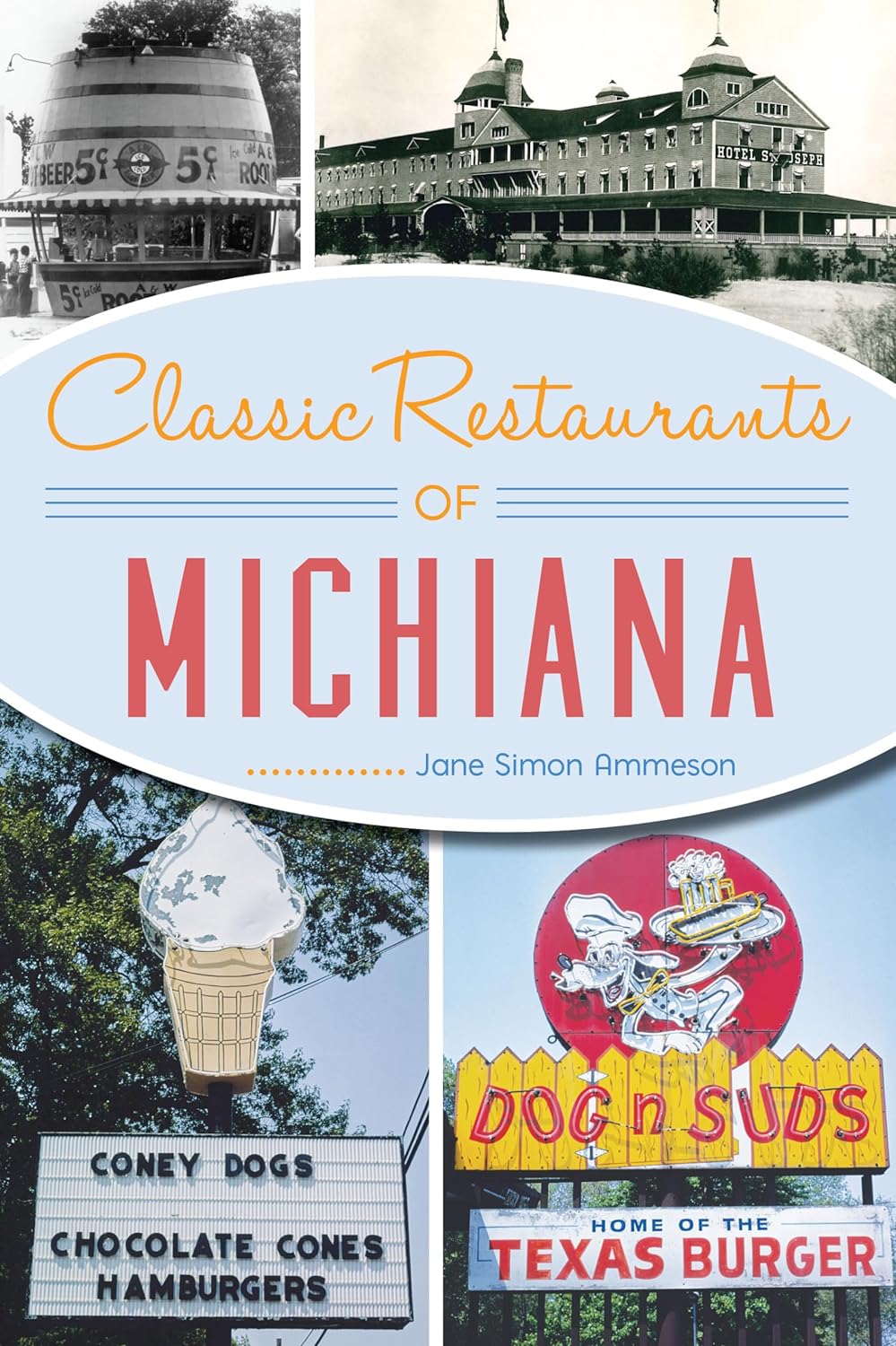
The members of the Sacred Heart of Mary Catholic ChurchBook/Movie Discussion Group have invited me to speak this Wednesday, June 11th at 6:30 p.m. If you have the time and are interested in the history of restaurants in Michiana, please come. The church is lovely, located in a beautiful country setting at 51841 Leach Rd, Dowagiac, Michigan. The event itself is next door in the Parish Hall.
Mary’s City of David Vegetarian Cafe in Benton Harbor, which opened in 1931 and closed in 1975, specialized in farm-to-table meals.
Here is the flyer that Terri Moore sent out:
Over the centuries, residents of Michiana have never wanted for superb dining choices. Award-winning author Jane Simon Ammeson will lead us on a culinary road trip through Northern Indiana and Southwestern Michigan.
A cigarette girl at the posh House of David motor lodge and restaurant/nightclub called the Vista Grande
Once a stagecoach stop, The Old Tavern Inn has been open since the time of President Andrew Jackson. Tosi’s is known for its gorgeous starlit garden and gastronomic traditions stretching back almost a century, and The Volcano was amongst the first pizzerias in the country.
One of the earliest hotels in St. Joseph, the Perkins house, built in 1840, stood on the corner of State and Ship Streets. Note the side entrance for the saloon which was, of course, given the times, for men only.
These restaurants and other classic eateries remain part of the thriving local food scene. But the doors of others have long been closed. Some like Mead’s Chicken Nook and Robertson’s Tea Room linger in memories while The Owl Saloon, O. A. Clark’s Lunch Rooms, and Lobster Lounge are long lost to time.
The restaurant is still open at the Barbee, it was a fav of Al Capone. However, when he arrived, all the other guests had to leave.
Jane Simon Ammeson is a food and travel columnist who has authored seventeen books, including Classic Restaurants of Northwest Indiana. Always willing to travel for food, she blogs about her experiences at janeammeson.com.
At one time, the lakeside towns of southwesterern Berrien County had a large Swedish population. The Swedish Coffee Pot was just one of several. Only the Swedish Bakery remains.
The Book Stall (811 Elm Street in Winnetka) will be welcoming authors Nancy Chadwick, Michelle Cox and Patti Eddington on Thursday, July 11that 6:30 PM. In a discussion moderated by Michelle Cox, each author will talk about her writing process, and the origins of her book. Our guest authors work with similar themes, and they will be exploring these connections in their new works of historical fiction, connections with the natural world, and memoir. Whether you are a fan of writing by and about women or a writer looking for guidance on completing and publishing a book, this is the program for you! We’ll leave plenty of time for audience Q&A.
This event is free with registration! Visit their website or CLICK HERE.
Nancy Chadwickis the author of Under the Birch Tree: A Memoir of Discovering Connections and Finding Home. Her essays have appeared in The Magic of Memoir: Inspiration for the Writing Journey, Adelaide Literary Magazine, and Turning Points – The Art of Friction, as well as in blogs by Off Campus Writers’ Workshop, the Chicago Writers Association Write City, and Brevity. Her debut novel, The Wisdom of The Willow, has been included in the “Most Anticipated Books of 2024” by the Chicago Review of Books. She finds writing inspiration from her many meanderings through any forest.
Michelle Coxis the award-winning author of the Henrietta and Inspector Howard series, a mystery/romance saga set in 1930s Chicago. She also pens the wildly popular, “Novel Notes of Local Lore,” a weekly blog chronicling the lives of Chicago’s forgotten residents. Her debut novel, The Fallen Woman’s Daughter, is her first foray into women’s historical fiction and is based on a story she heard working in a nursing home. She has spent years crafting it into a novel and is delighted to finally share it with the world.
Patti Eddingtonis a newspaper and magazine journalist whose favorite job ever was interviewing the famous authors who came through town on book tours. She never dreamed of writing about her life because she was too busy helping build her husband’s veterinary practice, caring for her animal obsessed daughter—whose favorite childhood toy was an inflatable tick—and learning to tap dance. Then fate, (and a DNA test) led her to a story she felt compelled to tell. Today, the mid-century modern design enthusiast and former dance teacher enjoys being dragged on walks by her ridiculous three-legged dog, David, and watching egrets and bald eagles from her deck on a beautiful bayou in Spring Lake, Michigan.
The Book Stall is an independent bookstore and cultural institution on Chicago’s North Shore. We are known for our great selection of books, cards, and gifts, as well as our long-running author event series. Learn more at www.thebookstall.com.
For those of
us who grew up in and around Chicago, there are names of long gone restaurants
that still tug at our heart, evoking memories of foods no longer served,
surroundings replaced and aromas we many never smell again.
Hoe Sai Gai
For me, that’s the allure of Greg Borzo’s latest book, Lost Restaurants of Chicago with foreword by Dough Sohn, the owner of the now closed Hot Doug’s.
Borzo, a Chicagoan historian who has
written several books about the city’s bicycling, transportation and history
including its fountains frequently gives tours and talks for organizations such
as Forgotten Chicago, the Chicago History Museum and Chicago Cycling Club. The
idea for his latest came about when he and his friends were chatting about the
good times they’d had at restaurants over the years and how many were gone. His
book goes further back though, starting over a century-and-a-half ago.
Jacques
“My list of restaurants to research from
at least a hundred people,” he says, noting that he still gets some complaints
about places he left out but then with seven out of eight restaurants closing
within a few years of opening, the number of those gone are overwhelming.
I ask Borzo what some of his favorite
are “lost” restaurants. Some he had dined at, like The Great Gritzbe’s Flying
Food Show, a Richard Melman restaurant that opened in 1974.
Maxim’s
“It had a dessert bar and you could
get as many desserts as you wanted, like a salad bar,” he recalls about the
restaurant that closed in 1883. “There’s also Trader Vic’s which was in the Palmer
House. Its décor was completely over the top.”
When Trader Vic’s, a Tiki bar
extraordinaire first opened in 1957, bringing it up to its Polynesian zenith
cost $500,000 which included a décor boasting huge Eastern Island carved wooden
heads, totem poles, canoes and massive Maori beams. It was part of the Tiki
rage that swept the U.S. and Trader Vic’s had its competitors include Don the
Beachcomber which featured 85 types of run and 65 different cocktails.
There are also places he wishes he ate
at but didn’t such as Maxim’s de Paris, which was opened from 1963 to 1982.
“It was a replica of the Maxim’s in
Paris,” says Borzo. “I went to it when it later when the building was an event
space.”
Which is another phenomena of Chicago
restaurants.
“Many single locations have been many
different restaurants,” says Borzo.
Indeed, Bistro 110 at 110 East Pearson used to be the Blackhawk,
then became Bar Toma Restaurant which is now closed.
“This book is a history book too,” says Borzo. “It reflects
the character of the city through the food and showing the different income
levels. Some people were going to diners, others to the Pump Room.”
The girl on the trapeze at Flo’s Restaurant and Cocktail Parlous
Borzo and I both share a laugh about the now closed Flo’s
Restaurant and Cocktail Parlor which was located at 17 West Randolph, near what
is now Macy’s flagship store. I used to see it as a kid when my parents took me
shopping in the Loop. It was notable because a woman in a form fitting
Playboy-bunny like costume and spiked heels climbed out on a swing on the
second floor balcony to advertise the place.
Greg Borzo
“I’ve eaten at a lot of the places I
write about,” says Borzo. “And those that were already closed I tried to find
people who had eaten there, researched old newspaper stories and searched through
vintage photos.”
Ifyougo:
What: Greg
Borzo talk and book signing
When, Where
and Contact Information:
Thursday,
January 24 at 5 p.m.
Cindy
Pritzker Auditorium, Harold Washington Library, 400 S. State St., 6-7 p.m. A
free raffle will give away more than $1,000 of gifts: trips, tours, food, books
and more.