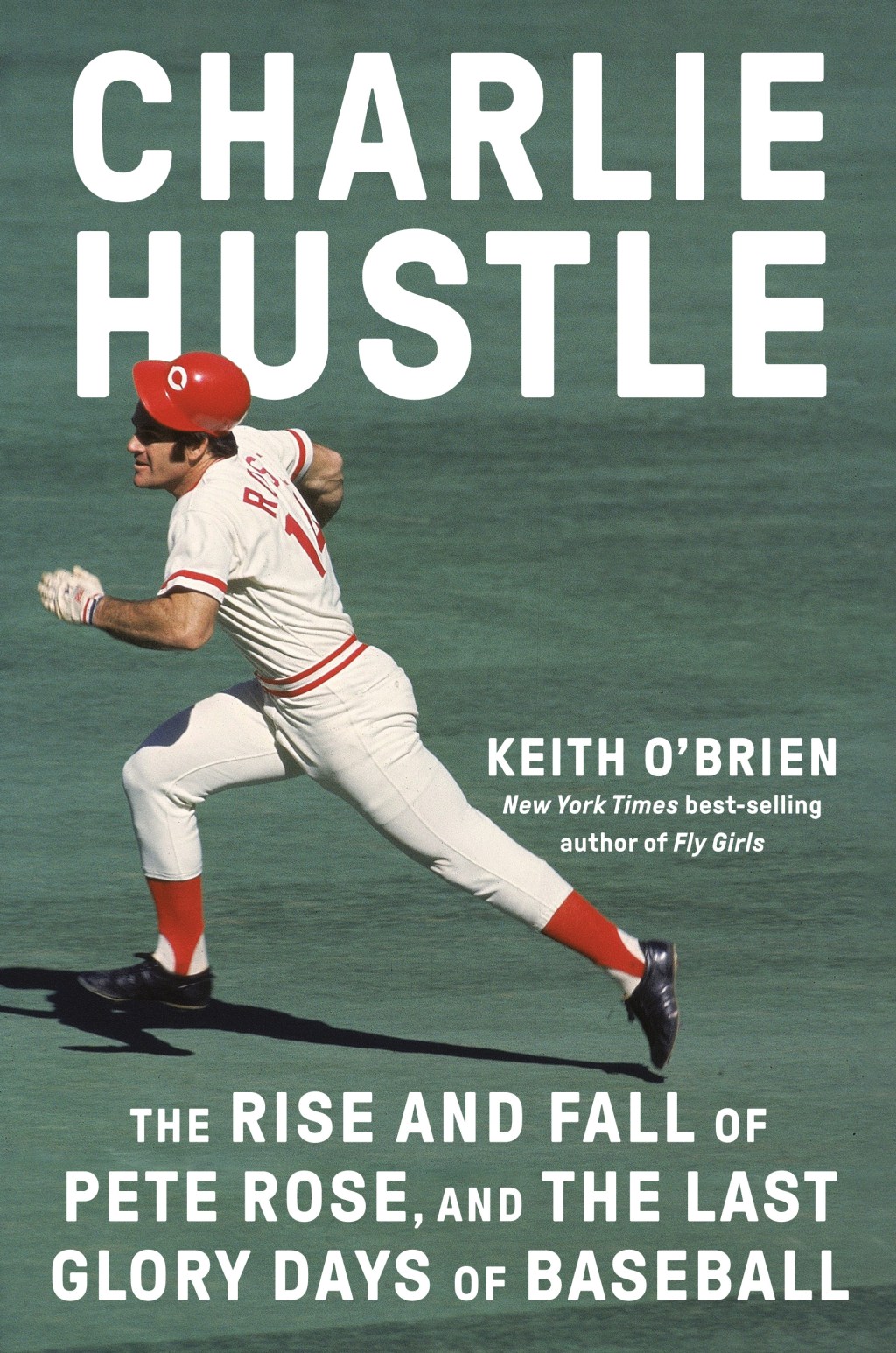
It’s an epic story. A young man with talent, maybe not as much as some but what he lacks in physical and athletic prowess he makes up with moxie and determination. And like most epics, there’s a rise to the heights and then a fall from grace.
It could be a movie. Maybe it will be. But Keith O’Brien, an award-winning journalist has done a deep dive into the life of Pete Rose, winner of three World Series rings, including 27 hours of in-person and phone interviews with the baseball legend, has written “Charlie Hustle: The Rise and Fall of Pete Rose, and the Last Glory Days of Baseball.” It’s the type of story that even those who aren’t baseball fanatics (that would include me) would find as compelling as any work of fiction.
Rose played Major League Baseball from 1963 to 1984 and then managed the Cincinnati Reds where he’d spent the majority of his career from 1984 to 1989. And what a career it was. His records still holding to this day include most career hits (4,256), most career games played (3,562), and most career at-bats (14,053). But it all came crashing down when it was discovered that Rose was betting on games including his own team.
I caught up with author O’Brien during a book signing in Carmel, Indiana to another in Louisville. Closer to home he’ll be at The Book Stall in Winnetka on April 10.

Like Rose, O’Brien grew up on the west side of Cincinnati, played ball as a kid, and had a love of baseball growing up.
“My grandfather lived in Merrillville, and we’d visit him in the summer,” he says, noting that he considered the White Sox as his second team because they’d go to the games at Comiskey Field.”
O’Brien thinks that might have helped get the interviews—Rose had never before agreed to talk to an author for a book unless he had editorial control over what was written.
But it wasn’t their common roots weren’t what compelled O’Brien to write about Charlie Hustle, Rose’s nickname.
“I felt that in the last 35 years that he’s been banned from baseball, making mistake after mistake off the field we have forgotten why we ever cared about him in the first place and so I wanted to go back and tell that whole story,” he says. “I told Pete back in 2021 when I originally reached out to him this felt to me like the time for reckoning with his past. To use the old sports cliche we’re all day-to-day but when you’re in your 80s like Pete Rose that notion is decidedly more present.”
Ultimately Rose ghosted O’Brien.
“It’s a guess as to why he stopped calling, my only thought is I was pushing it.” says O’Brien. “I wanted to talk about everything, the good times and the bad times—baseball, the off-field decisions, and the gambling. I think maybe in the end I might have just pushed Pete too far or as far as he was willing to go.”
During his career, there had been rumors about Rose’s gambling though it hadn’t leaked out to the general public.
O’Brien’s research and conversations with people who were on the scene when Rose was first called into the offices of Major League Baseball for a secret meeting in February 1989 indicate it could have gone a lot differently.
“If Pete had been honest and told them the truth that yes he had bet on baseball and that yes he bet on the Reds and that yes he had a gambling problem, baseball would have done everything it could to save him,” says O’Brien. “I’m not suggesting he would have gotten off or wouldn’t have been punished. He would have but I don’t believe that it would have been the sort of punishment that he is still wrestling with 35 years later.”