Category: Yale University Press

  • Ben Hecht: Fighting Words, Moving Pictures

    Ben Hecht: Fighting Words, Moving Pictures

                  When we think of Ben Hecht—and really, how many of us do? it’s because the college drop-out, turned Chicago Daily News reporter and then screenwriter personifies the early part of the 19th century. He was a war and crime journalist who went beyond writing and instead helped solve murder cases, along with the help of fellow newsman, Charlie MacArthur of the Chicago Examiner.  

    Adina Hoffman

                  Indeed many people, including author Adina Hoffman know and love Hecht’s movies including such classics as Scarface, Twentieth Century, The Front Page and Notorious without even knowing his name.

                  “I worked as a film critic throughout the 90s, and it was only when I started to really involve myself in film history that I read Hecht’s memoir, A Child of the Century,” says Hoffman, author of the just released Ben Hecht: Fighting Words, Moving Pictures (Yale University Press 2018; Amazon price $17.61), noting there is so much of Hecht’s DNA in the movies made during the Golden Age of Hollywood.

                  But as Hoffman read more and more about Hecht, she realized there was more to him than a Jazz Age writer who overindulged in a variety of vices.

    “I realized that his screenwriting was in some ways just the start of it,” says Hoffman, whose biography of Taha Muhammad Ali, My Happiness was named one of the best twenty books of 2009 by the Barnes & Noble Review and won the UK’s 2010 Jewish Quarterly-Wingate Prize.  “Maybe for him, it was the least of it. Hecht had multiple occupations—really preoccupations—and threw himself with gusto into being a journalist, novelist, playwright, a film director, producer, a memoirist, and Jewish activist, someone passionately engaged with the future of Palestine/Israel. I was fascinated by that multiplicity of his, by all the hats he managed to wear at once and with such incredible panache—even genius.”

                  Hoffman also deeply identified with Hecht’s desire to be involved in a serious if playful way with several realms at once and his having multiple job descriptions much as she does.

    “At the same time, there are certain things that set Hecht apart from me in a very basic way: his political positions in terms of Israel/Palestine are approximately the opposite of my own, and I thought it would be an interesting challenge to write about someone with whom I strongly disagree on this front,” she says.

                  Though she’s spent much of her adult life living in Jerusalem, Hoffman did the majority of her research at The Newberry in Chicago which holds Hecht’s papers.

                  “He seems to have been friend or colleague or rhetorical sparring partner to or with almost anybody who was anybody in twentieth century culture,” says Hoffman.  “I’d find myself in the course of a day reading these incredibly lively, funny letters and telegrams to and from everyone from David O. Selznick to Carl Sandburg, Menachem Begin, Katharine Hepburn, George Grosz, Sherwood Anderson, the gangster Mickey Cohen, Groucho Marx, and on and on. There are also marvelous photographs, drafts of his work, scrapbooks, objects—passports, pipes, letter openers, and even his first Oscar.”

                  Hoffman says one of the purposes of her book is for Hecht to be much better remembered than he is today.

    “He was someone who played a central role in creating American popular culture as we know it, but he’s been almost completely forgotten,” she says. “I think people around Chicago and in the Midwest know more about him than most others. I got an awful lot of blank or confused looks when people would ask me what I was working on and I’d say a book about Ben Hecht. The full range of his accomplishment or accomplishments is something I’d like people to realize—and also the complex way that his Jewishness figured into the rest of it. Hecht claimed he ‘became a Jew in 1939’—which is to say, he became a Jew because of the Holocaust—but I totally disagree. Being Jewish was always a part of him, as was being American. And there was absolutely no contradiction in his being both things at once and in the most vital way.”

    Ifyougo:

    What: Author talk and book signing

    When: Tuesday, February 19 at 6 pm

    Where: Ruggles Hall, The Newberry, 60 West Walton St., Chicago, IL

    Cost: Free and open to the public. Registration required.

    FYI: (312) 943-9090; newberry.org

  • Art Deco Chicago: Designing Modern America
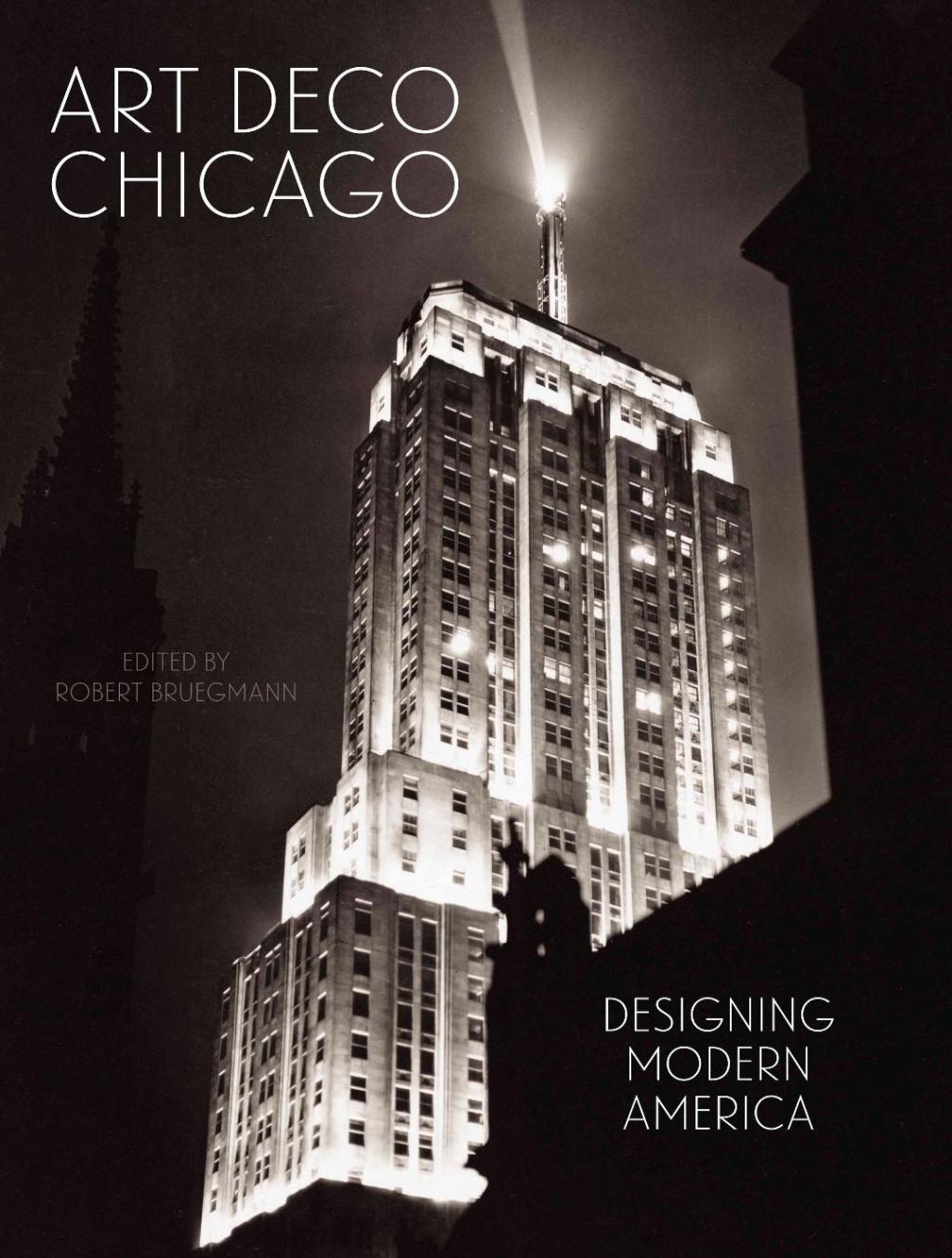
    Art Deco Chicago: Designing Modern America


    sleek and glorious as any Art Deco masterpiece whether it be the grand Palmolive Building built in 1922 or the much lowlier but still spectacular Bell telephone Model 302 designed not by a noted artist or architect but instead by George Lum, a Bell Labs engineer in 1937,  Art Deco Chicago: Designing Modern America (Yale Press 2018; $47.75 on Amazon) showcases 101 key works coupled with more than 300 photos as well as critical essays and extensive research. Altogether, they comprise a wonderful, extensively curated and chronologically organized tome about the many facets–architecture, advertising, household objects, clothing, and food design–of a style that has fascinated so many of us for more than a century.

    Robert Bruegmann, a distinguished professor emeritus of architecture, art history, and urban planning at the University of Illinois at Chicago, was first asked to write the introduction to the book

    thought I’d knock it out in a week,” says Bruegmann, a historian of architecture, landscape and the built environment.

    That was back in 2011 and Bruegmann, author of several other books including The Architects and the City: Holabird & Roche of Chicago, 1880-1918 (Chicago Architecture and Urbanism), quickly realized that it would take much more than that. He ended up editing and shaping this complex book, a task which included overseeing 40 writers and researchers, helping to find and collect photos and defining Art Deco and its impact on the city through design. He would spend the next five years, working 50 to 60 hours a week to do so.

    One of the first questions we asked is how do we define Art Deco recalls Bruegmann.

    “Should it be narrowly like the French-inspired luxury goods, which is the narrowest to the big tent which we ended up doing,” he says noting that many products (think as blasé as refrigerators, bicycles, radios and mixmasters) created in Chicago by companies like Motorola, Sunbeam and Schwinn, changed the world in a way that other forms of Art Deco didn’t.

    It many come as a surprise that the term Art Deco wasn’t invented until the 1960s and came about because of its association with the Decorative Arts Fair Exposition of 1925 in Paris. But in Chicago, Art Deco, even before it was so named, was often about both beauty and usefulness.

    “If I had to pick a single object to suggest what we tried to do in Art Deco Chicago, I would probably choose the Craftsman brand portable air compressor sold by Sears starting in 1939,” says Bruegmann about the cast iron aluminum machine which used, as described in the book, “a series of cooling fins that functioned as a heat sink while adding a streamlined visual flair to the product…This product alluded to themes of speed, transportation, and movement while remaining stationary.”

    “It was related to the avant garde work of the Bauhaus who thought they were going to save the world through their designs,” says Bruegmann. “But they were too expensive. But Sears on the other hand made things affordable.”

    Indeed, Bruegmann says that companies like Sears and Montgomery Ward did change the world.

    “Up until the Sears catalogue, a lot of clothes outside of big cities, were handmade,” says Bruegmann. “Because Sears sold so many outfits through their catalogue, they could afford to send their designers to Paris to study the latest design and then come back and change them so they were less expensive, creating one of the most important social and political movements by making  designs for the masses. For a $1.99 a woman working in a packing plant or a farmer’s wife could wear a knockoff of a Paris dress.

    Art Deco Chicago serves as the companion publication to the exhibition “Modern by Design: Chicago Streamlines America” organized by the Chicago History Museum, which runs October 27, 2018–December 2, 2019. Proceeds from sales of and donations to Art Deco Chicago, which explores and celebrates Chicago’s pivotal role in the development of modern American design, will be used to support ongoing public education, research, and preservation advocacy of this critical period of modern American design.

    Ifyougo:

    What: Newberry Library presents Meet the Author: Robert Bruegmann, Art Deco Chicago

    When: Thursday, November 29 from  to 7:30 p.m.

    Where: Newberry Library, 60 West Walton Street, Chicago, IL

    Cost: Free and open to the public

    FYI: 312-943-9090; newberry.org

    8/18/06 University Scholar- Robert Bruegmann