Category: Travel

  • Western Mexico, A Traveler’s Treasury: Notes from the Road from the 16th Century On
    Western Mexico, A Traveler’s Treasury: Notes from the Road from the 16th Century On

    Once called Coatlan after the earthenware vessels that were coiled like a serpent and used for storing pulque, a white wine made from the Mexcal tree and used as an offering to a stone idol, Cuiseon was a small village on The Nine Rivers which flowed into Lake Chapala. 

    This and other food traditions, according to The Geographic Account of Poncitlán and Cuiseo del Río dated March 9, 1586, showed their typical fare as venison, fish, and rabbit, a thin kind of porridge to drink hot with powdered chile that was broken up and sprinkled on top, and Izquitl—corn toasted on a comal and seasoned with salt. The villagers harvested chia, huauhtli, and cocotl, the latter a mustard-like seed that is ground up and mixed with corn and water to drink both before and after eating.

    As it relates to the foods we eat today, we still consume corn and fish and season with salt and powdered chiles. We’re less likely to dine on venison or rabbit while cocotl is so obscure that even a Google search doesn’t come up with a hit. But both chia and huauhtli, a species of amaranth, an ancient grain, are recognized as beneficial to our health. And so, the foods of this village still play a part in our lives.

    This is an obscure slice of everyday life, a glimpse into the past that would be lost to time, confined to dusty archives, and/or shelved away to be forgotten in libraries or museums, if not for the work of Tony Burton, an award-winning writer whose books include “Lake Chapala: A Postcard History” (2022), “Foreign Footprints in Ajijic: Decades of Change in Mexican Village” (2022), “If Walls Could Talk: Chapala’s historic buildings and their former occupants” (2020), “Mexican Kaleidoscope: myths, mysteries and mystique” (2016), and “Western Mexico, A Traveler’s Treasury” (4th edition, 2013).

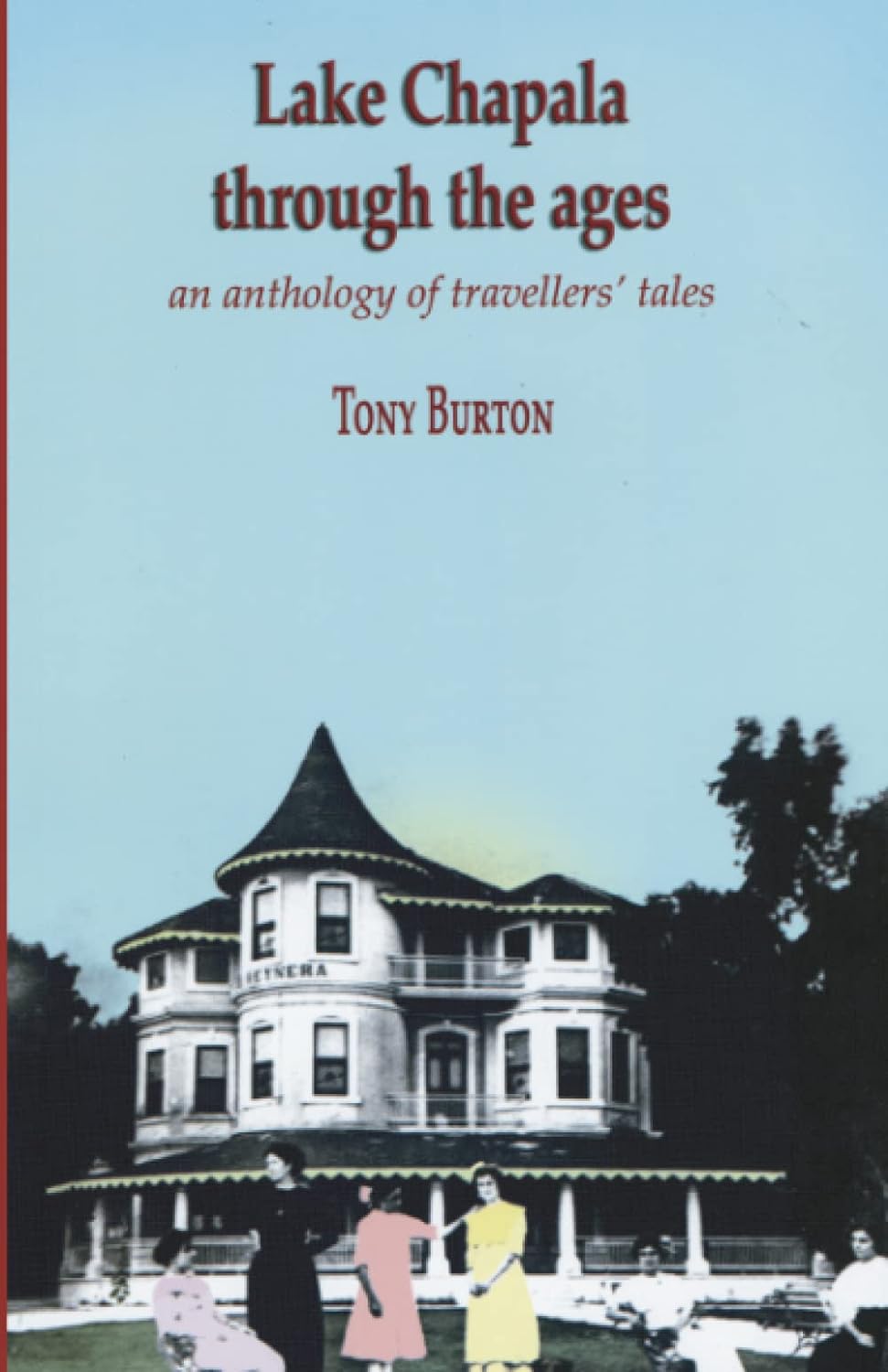
    Reading through a unique collection of extracts from more than fifty original sources, many never previously available in English, Burton’s book, “Lake Chapala Through the Ages; an anthology of travelers’ tales,” is a fascinating look at the region's formative years from the arrival of conquistadors in the early 1500s to the start of the Mexican Revolution in 1910, as told through the eyes of an assortment of travelers-- poets, friars, exiles, government officials, geographers, historians, explorers, and scientists.

    What they saw in their journeys is fascinating, as are the people who traveled and then shared their observations.

    "My inspiration was really curiosity about the documentary basis for things I’d heard about the history of the area, some of which struck me as highly imaginative," says Burton. "I began working on the book way before the development of online search engines or digitized books, so it took me almost a decade to track down originals of the 50+ published works, excerpts from which appear in the final book. It would have been impossible without the support of an excellent inter-library loan system, personal visits to libraries in the USA and England, and the generous contributions of a small army of people I thank in the book’s acknowledgments.

    "I still remember the shivers that ran down my spine when I first handled the leather-bound Belgian journal from the 1830s containing an article about Lake Chapala by Henri Galeotti. I knew that article existed because some parts had been translated into Spanish and published in Mexico. The challenge of finding the original proved to be well worth the effort—in my opinion, Galeotti’s masterful, illustrated, systematic, scientific coverage of the area's geology and natural history has no equal."

    Barrister and seasoned traveler William Henry Bullock Hall (1837–1904), who was born in Essex, England, and educated at Balliol College, Oxford visited Mexico taking a route that began in Veracruz and took in Mexico City, Tepic, San Blas, Guadalajara, Querétaro and Tampico."

    Looking for boiling water while staying at the hacienda of Buena Vista, he made the following observation:

    “In one of the recesses of the building, I discovered, over her earthenware pots, the old woman, upon whom you are sure to stumble, sooner or later, in Mexican houses, if you only persevere. As good luck would have it, this old crone was in the act of trying to blow into a sufficient glow to boil a jug of water, the bits of charcoal which, laid in a square receptacle sunk in the face of a solid brick counter, do the duty of a fire all over Mexico. From this old lady I obtained not only boiling water, but a couple of poached eggs, so that I fared sumptuously.”

    English women often were intrepid travelers, journeying to places remote and probably most uncomfortable. How joyous to meet Rose Georgina Kingsley (1845–1925), the oldest child of the Rev. Charles Kingsley, a celebrated English clergyman and novelist, who contributed the prologue to her book” South by west or winter in the Rocky Mountains and spring in Mexico,” published in 1874 and digitized by Harvard University in 2006.

    Rose crossed the Atlantic to Colorado Springs in November 1871 to join her brother, Maurice, who was assistant treasurer of the company developing Colorado Springs writes Burton, noting that, even by 1872, there were fewer than 800 residents, so both Kingsleys were pioneer settlers. Her writings and sketches were published by General William Jackson Palmer, the founder of Colorado Springs, a railway entrepreneur and owner of the newspaper Out West.

    When Palmer decided that same year to examine possible routes for a railway linking Texas to Manzanillo, Rose accepted the invitation to join him along with his wife, Queen, and General William Rosencrans on a trip that took them first to Manzanillo and then inland to Colima, Guadalajara, Guanajuato, Querétaro, and Mexico City. Her descriptions of the sights and interactions along the way are fascinating.

    “At San Pedro [Tlaquepaque] we stopped and got three men as escort, and at 9.30 came to San Antonio, a hacienda where we changed mules, and had breakfast in a hut by the roadside,” she writes. “The women in the hut, which was only made of sticks and thatch, gave us eggs, frijoles, tortillas, and carne seca, in chilli Colorado sauce, which for hotness almost beat the mole de guajalote at Atenquique. But besides these native viands we got capital chocolate, made from some cakes we had brought with us. So, on the whole, we fared well.”

    They arrived at La Barca, on the Rio Lerma, on market day and ate a very good meal in a dirty fonda (restaurant) where the walls were covered with broken bits of pottery in decorative patterns. There they learned they had barely missed being robbed the night before—all of which Rose, in her writings at least, takes in stride.

    Burton, the editor-in-chief of MexConnect, Mexico’s top English-language online magazine, spans time and place to take us into one of his favorite regions of Mexico where he lived for over a decade, bringing the past alive and introducing us to an interesting cast of characters.


  • Mexico Kaleidoscope: Myths, Mysteries and Mystique

    Oenophiles might be surprised to learn that the oldest winery anywhere in the Americas is Casa Madero, formally established as long ago as 1597, located in Parras de la Fuente, a small town in the northern state of Coahuila.

    “In 1549 the Spanish priests and soldiers who explored this region discovered native vines growing wild in a valley and chose the spot to found the Mission of Santa María de Las Parras (“Holy Mary of the Vines”),”writes Tony Burton, the editor of MexConnect, Mexico’s top English-language online magazine, in his book Mexico Kaleidoscope: Myths, Mysteries and Mystique. “The early Mission of Santa María soon began to make wine from the local grapes, and a few years later the wines and brandies of the Valley of Parras were being shipped to the rest of the Americas.”

    But Mexico’s sophisticated approach to agriculture goes even further back than that.

    “The Mexica/Aztecs solved the dilemma of how to supply food to their island capital by developing a sophisticated wetland farming system involving raised beds, or chinampas, built in the lake,” writes Burton about when the city of Tenochtitlan was built, fortress-like, on an island. Though good for defense, it made providing a food source more difficult but there was a solution to that. “Originally these chinampas were free-floating, but over time they became rooted to the lake floor. The chinampas were separated by narrow canals, barely wide enough for small boats or canoes. From an ecological perspective, chinampas represented an extraordinary achievement: a food production system which proved to be one of the most environmentally sustainable and high-yielding farming systems anywhere on the planet! Constructing and maintaining chinampas required a significant input of labor, but the yields per unit area could be very high indeed, especially since up to four harvests a year were possible.”

    Burton covers 10,000 years of Mexican culture and history. It’s a compilation of “Did You Know?” columns for MexConnect, which ranks in the top 3% of all Internet sites in the world, registering over half a million sessions a year.

    It was his way of presenting and preserving relatively little-known but fascinating information about Mexico to a large number of readers.

    “One of my main motivations was that—to the best of my knowledge—no similar book for the general reader had been published in the past forty years,” says Burton. “An incredible amount of interesting academic research had been done on Mexico over that time, leading to reevaluations and reinterpretations of many former ideas and beliefs. I wanted to make readers aware of some of these extraordinary developments, which continually refuel my passionate interest in Mexico.”

    This very readable and fascinating book can be read cover to cover, says Burton, noting that it is also designed to allow readers to ‘dip into’ and read in whatever order appeals to them. 

    “When writing the book, I was trying to engage readers by expanding on, or challenging, some commonly held or overly simplistic ideas, in the hope of offering some ‘food for thought’ about many things Mexican,” he says.“Each chapter has a list of sources and suggestions for those readers who want to explore more.”

    The title Mexican Kaleidoscope is a nod to Norman Pelham Wright, a British writer whose own collection of essays, with the same title, was published in 1948.

    “That book was an eye-opener for me when I first began to get intimately acquainted with Mexico more than forty years ago,” says Burton. “The subtitle Myths, Mysteries and Mystique came from a suggestion by one of my regular golfing partners—who had read an early draft of the book—as we played the 11th hole at Cottonwood Golf Course on Vancouver Island.”

    The book is illustrated by Mexican artist Enrique Velázquez, a long-time friend of Burton’s.

    “Enrique has a keen interest in the subject matter and an uncanny ability to portray ideas in just a few lines,” says Burton. “I originally envisioned using small, inline drawings to break up the text, much in the manner of old-time illustrators, but his final drawings were far too good for that, so we changed track and gave them the prominence and space they merit.”

    “Every chapter has come to mean far more to me than is expressed by mere words on a page,” says Burton about the 30 chapters. “I really hope some of my enthusiasm comes through to readers. At the very least I’d like the book to cause readers to stop and think, to be occasionally surprised, and perhaps question things that they may have previously thought or heard about Mexico. As I’ve written elsewhere, Mexico is not always an easy country to understand but any effort to do so always seems to bring rich reward!”

    About the Author

    Burton, a Fellow of the Royal Geographical Society who was born and educated in the United Kingdom, first visited Mexico in 1977. Returning, he lived for almost two decades in the country where he worked as a writer, educator, and ecotourism specialist. An award-winning author, his other books include If Walls Could Talk: Chapala’s Historic Buildings and Their Former Occupants; Foreign Footprints in Ajijic: Decades of Change in a Mexican Village; Western Mexico: A Traveler’s Treasury; and Lake Chapala Through The Ages: An Anthology of Travelers’ Tales.

     Mexico Kaleidoscope can be found in print and on Kindle through Amazon.


  • Western Mexico: A Traveler’s Treasury

    Western Mexico: A Traveler’s Treasury

    A travel guide for the intellectually curious, Tony Burton’s Western Mexico: A Traveler’s Treasury provides an insider’s entry to this extraordinary region of Mexico. The book, published by Sombrero Press and now in its fourth edition is less about logistics and instead focuses on the myriad of reasons–historical, ecological, cultural, and/or scenic–that make each place featured in this well-written and well-researched book both special and worth visiting.

    Burton, an award-winning travel writer, educator, and ecotourism specialist, who was born in the United Kingdom and has an M.A. in geography from the University of Cambridge and a teaching qualification from the University of London, moved to Mexico in 1979 and subsequently was granted Mexican citizenship, looks for the road less traveled.

    And in this book, he encourages us to explore the smaller, lesser known community with their many local customs, seasonal celebrations, sites, and events, places that, in his words, “offer a glimpse of the Mexico behind the mask; they are places where Mexico has retained her ancient culture and her ancient traditions.”

    Providing a mix of interests, Burton opens the doors, so to speak, to such historical sites as Zacatecas, Lagos de Moreno and San Blas; artistic colonies like Ajijic; and lakeside communities including Chapala and Pátzcuaro.

    Besides that there are ecological wonders, such as Manantlán, the monarch butterflies, the old mining towns of Angangueo and Bolaños, coastal communities like Barra de Navidad and Puerto Vallarta, Angahuan and other Indian villages, and a host of others. He delves into Pueblos Mágicos, designated as Magic Towns by the federal government in recognition of their cultural, historical, and/or ecological significance, their nearness to major cities, and the facilities they offer visitors.

    This is a travel guide but of the most intimate kind. We drive with Burton along the lovely road to Tamazula, settled from pre-Columbian times, conquered by the Spanish in 1524, and a vital silver mining town and hacienda center until the mines were worked out by the end of the 18th century. As for its name, well, interestingly enough, it translates to “place of frogs.”

    Where to stay when there? Burton recommends Hotel Real de la Loma with its spacious and comfortable rooms and pool and two person tubs in the room filled from a hot-water spring at the foot of a hill. The views from the hotel are of the Tamazula River and its valley made green with sugar-cane. A good time to go for many is during the two-week Our Lady of Sagrario festival.

    We learn that Mazamitla is “one of the prettiest towns in all Jalisco. It is a graceful, charming town of cobblestone streets, adobe walls, wooden balconies, old doorways and red-tile roofs, one of Mexico’s Magic Towns. Among its many attractions are the fresh air and scenic beauty of the surrounding countryside, some fine restaurants specializing in Mexican food, and the chance to shop for fresh cream, cheese, and home-made preserves. As befits a mountain town, its inhabitants also make lovely woolen sweaters and ponchos, for sale in the local shops.”

    Burton, who has lived in Mexico City, Guadalajara, and Jocotepec, has traveled widely, leading educational excursions and specialist ecological tourism groups to both well-known areas such as the Yucatán and Copper Canyon as well as little-known ones like Manantlán and Tingambato. At the former, at the Manantlán Biosphere Reserve visitors can experience the astonishing diversity of plant and animal life found in a cloud forest, one of the rarest types of vegetation anywhere in the world. In the latter, located near the major archaeological site of Tinganio, is one of the few sites in Western Mexico where there are genuine pyramids.

    Larger than the previous editions there are dozens of new destinations and each chapter contains new material, updated travel directions, and redrawn maps.

    Divided into parts, one and two are within three hours of driving time from either Guadalajara (Mexico’s second city) or nearby Lake Chapala, a popular retirement center for Americans and Canadians making them perfect for day trippers.

    Parts 4 to 9 are longer journeys such as the trip to Jungapeo, where director John Huston filmed scenes from The Treasure of the Sierra Madre starring Humphrey Bogart. Here, in this small village, you can stay at Agua Blanca Canyon Resort which dates back to the 1940s. According to Burton, it is a charming spa-hotel with just 20 rooms arranged in the Purépecha Indian style around three sides of the greenest lawn in Mexico. Its pools and lawns overlook the deeply carved valley of the River Tuxpan.

    “Many butterfly visitors, after the cool and dusty atmosphere in the fir forests want nothing more than a long soak in a warm tub and this is the ideal place,” he writes.

    And, of course, there are the Monarch butterflies. Every winter, some one hundred million monarch butterflies fly into Mexico from the U.S. and Canada. On arrival they congregate in a dozen localities high in the temperate pine and fir forests of the state of Michoacán.

    For me, a definite-not-to-be-missed is Zitácuaro, where my culinary hero Diana Kennedy lived. Famous for her cookbooks on Mexican cuisine, she made her home outside of Zitácuaro. And here again, is how deep Burton drills down into his destinations. Kennedy lived near the Rancho San Cayetano, a small, exclusive hotel on the road towards Huetamo and the Del Bosque reservoir.

    “The San Cayetano’s charm lies not only in its comfortable rooms but also in its first rate cuisine,” he writes, asking if there could be a better recommendation for the food served there than the fact that Diana Kennedy regularly brought friends to dine in the hotel?

    For aficionados of Mexican food, there are several outstanding restaurants to put on the list of where to go.

    “Neither of my two favorites is well known to tourists, hence their inclusion here,” writes Burton. “Next to the gas station in Pátzcuaro, where the highway from Morelia and Quiroga enters the town, is the Camino Real restaurant where the Tarascan soup, a local specialty which is a bean-based version of tortilla soup, has to be tasted to be believed. Whatever you choose in this unpretentious restaurant, you will not be disappointed,” he writes. “The Camino Real has a sister restaurant, the Real del Cobre, in Santa Clara del Cobre.

    My other favorite is an hour’s drive away, in the unpretentious town of Tacámbaro. Near the entrance to the town is the Hotel-Restaurant El Molino (The Mill), housed in a museum-piece nineteenth century flour mill, complete with grinding wheels. Simply and artistically decorated and furnished, this hotel-restaurant’s fixed-price comida features slightly finer cuisine than that of the Camino Real, with more subtle sauces and a more varied menu.”

    Whether your interests are in art, architecture and/or archaeology; fiestas and folklore; unusual sights and natural wonders, or in Indian villages and indigenous handicrafts, Burton’s book is your guide to Western Mexico’s many hidden treasures.

    Burton, author of many books about Mexico including If Walls Could Talk: Chapala’s historic buildings and their former occupants; Lake Chapala: A Postcard History; and Mexican Kaleidoscope: Myths, mysteries and mystique, is currently editor-in-chief of MexConnect, Mexico’s top English-language online magazine. He says the inspiration for writing this book came about with the “realization that it was impossible for me to personally introduce readers to many of the places and things I consider most rewarding to find and appreciate. Of the truly spectacular, I have yet to find anyone who ever forgets the magic of visiting the Monarch Butterflies in one of their overwintering sites. By sheer good fortune, I happened upon them the first time in 1980, several years before their locations became widely known or any organized tourist excursions to them had begun.”

    Burton encourages opening up to new places and experiences.

    “With an open mind ‘gems’ can be found everywhere in Western Mexico,” says Burton. “My greatest hope is that my book encourages readers to explore and find their own hidden gems.”

  • Three Charming Villages on the shores of Lake Chapala

    Three Charming Villages on the shores of Lake Chapala

    Born in the United Kingdom, Tony Burton, a Cambridge University-educated geographer with a teaching certificate from University of London, first traveled to Mexico after spending three years as a VSO [Voluntary Service Overseas] volunteer teaching geography, and writing a local geography text, on the Caribbean island of St. Kitts. From there his travels took him to Mérida in summer 1977, where he spent several weeks backpacking around southern and central Mexico, returning two years later to teach at Greengates School in Mexico City.

    Over the next seven years, Tony traveled extensively throughout Mexico, visiting every state at least once, and organizing numerous four-day earth science fieldwork courses for his students. He co-led the school’s extensive aid efforts following the massive 1985 earthquake.

    From Mexico City, he moved to Guadalajara, where he continued to organize short, residential fieldwork courses for a number of different schools and colleges and began organizing and leading specialist eco-tours for adult groups to destinations such as Paricutín Volcano, the monarch butterfly sanctuaries, and Copper Canyon.

    An award winning author, he’s written numerous books about Mexico including his latest Lake Chapala: A Postcard History (Sombrero Publishing). It’s part of a series he’s written on this region which is located about an hour south of Guadalajara. The 417-square-mile lake, Mexico’s largest, located in the states of Jalisco and Michoacán is situated at an elevation of  5,000ft in the middle of the Volcanic Axis of Mexico and is known for its wonderful climate, laid-back ambience, and is a popular destination for both travelers and ex-pats looking for a charming, low-key place to relocate. The three main towns along the lake are Chapala, Ajijic and Jocotepec. In an intriguing aside, Tony met his wife Gwen Chan Burton when she was working as at the director of the pioneering Lakeside School for the Deaf in Jocotepec. Gwen writes about the school and all that it has accomplished in her book, New Worlds for the Deaf, also published by Sombrero Books.

    Tony’s other books about this region include Western Mexico A Traveler’s Treasury, illustrated by Mark Eager, now in its fourth edition; Mexican Kaleidoscope: Myths, Mysteries and Mystique, illustrated by Enrique Veláquez, and Foreign Footprints in Ajijic: Decades of Change in a Mexican Village. I’ll be covering them in upcoming posts.

    Because I’m always interested in foodways, Tony was kind enough to share a copy of an undated Spanish language project put together by students from the Instituto Politécnico Nacional School of Tourism titled “Gastronomy of Jalisco.”  It includes numerous recipes from the region including one for the famous Caldo Michi of Chapala (the recipe is below).

    I had the chance to ask Tony, who currently is the editor of MexConnect, Mexico’s leading independent on-line magazine, about Lake Chapala: A Postcard History as well as the time he spent in this beautiful region of Mexico.


    How did you first become familiar with Lake Chapala?

    I first visited Lake Chapala in early 1980, on my way back to Mexico City from the Copper Canyon and Baja California Sur. Little did I imagine then that it would be where I would later fall in love, get married, and have two children!

    What inspired you to write Lake Chapala: A Postcard History?

    There is no single overwhelming inspiration. I realized, while living at Lake Chapala and writing my first books about Mexico, that a lot of what had been previously written was superficial and left many unanswered questions. In the hopes of finding answers, I decided to trawl through all the published works (any language) I could find, which resulted in Lake Chapala Through the Ages (2008), my attempt to document and provide context to the accounts of the area written between 1530 and 1910.

    My next two books about Lake Chapala—If Walls Could Talk: Chapala’s Historic Buildings and Their Former Occupants, and Foreign Footprints in Ajijic: Decades of a Change in a Mexican Village—focused on the twentieth century history of the two main centers for the very numerous foreign community now living on ‘Lakeside.’ Part of my motivation was to dispel some of the myths that endlessly recirculate about the local history, as well as to bring back to life some of the many extraordinary pioneering individuals indirectly responsible for the area becoming such an important destination for visitors.

    Lake Chapala: APostcard History is my attempt to widen the discussion and summarize the twentieth century history of the entire lake area. Its reliance on vintage postcards makes this a very visual story, one which I hope will appeal to a wide readership, including armchair travelers.


    What were some of the challenges you encountered in writing this book? Was it difficulty finding the numerous postcards you included? And doing the extensive research that went into the book? Are there any intriguing stories about hunting down certain postcards and any “aha” moments of discovery when writing your book?

    The main challenge was in deciding how best to structure the material. Because of the originality of what I’m doing, it is impractical to follow the advice that writers should start with a detailed plan and then write to that plan! In my case, after collecting the information and ideas that exist, the challenge is to select what can be teased and massaged into a coherent and interesting narrative.

    Because the postcard book is the product of decades of research, I had ample time to build my personal collection of vintage postcards, through gifts, auctions and online purchases.

    There were many significant “aha” moments in the process: some concerned the photographers and publishers responsible for the postcards and some the precise buildings or events depicted. While I’m saving some of these “aha” moments–because they are central to a future book–one was when it suddenly dawned on me that wealthy businessman Dwight Furness was the photographer of an entire series of cards (Figs 6.3, 6.4, 6.5, etc.) that relate to my next response.


    If you could go back in time to visit one of the resorts that is no longer there that you featured in your book, is there one that stands out and why is that?

    Ooohhh; I’d love to go back to about 1908 and stay at the Ribera Castellanos resort (Chapter 6) during its heyday. While staying there, perhaps I could interview owner Dwight Furness, his wife and a few guests? Apart from a few ruined walls, Furness’ postcards of the resort are pretty much the only remaining evidence of the hotel. And perhaps one night I could invite local resident and prolific professional photographer Winfield Scott and his wife to dinner to hear their stories?

    How long did it take to write Lake Chapala?

    The writing took less than a year; but only because of the many prior years of research.

    Since I often talk about food and travel, are there any culinary specialties in the Lake Chapala region?

    Long standing culinary specialties of the area include (a) Lake Chapala whitefish (b) charales (c) caldo michi. And, when it comes to drinks, there is a very specific link to postcards. The wife of photographer José Edmundo Sánchez, who sold postcards ( Figs 7.5, 7.6 and 7.7) in the 1920s from his lakefront bar in Chapala, is credited with inventing sangrita, still marketed today as a very popular chaser or co-sip for tequila. (Chapter 7, page 74).

    Is there anything else you’d like readers to know about your book?

    I hope readers find the book as fun and interesting to read as it was to write!

    MICHI BROTH

    Ingredients:

    • 2 tablespoons corn oil
    • ¾ kg of tomato seeded and in pieces
    • ¼ onion in pieces
    • ½ kg carrot, peeled and cut into diagonal slices
    • ½ kg of sliced ​​zucchini
    • 4 or 6 chiles güeros
    • 100 gr. chopped coriander
    • 2 sprigs of fresh oregano
    • Salt to taste
    • 2 ½ liters of water
    • 1kg well washed catfish, yellow carp or red snapper

    PREPARATION: Heat the oil and stew the vegetables in it, add water and salt to taste, let it simmer over low heat until the vegetables are well cooked, then add the fish and leave it for a few minutes more until it is soft.

    Sangrita

    I had the opportunity to stay at Tres Rios Nature Park, a 326-acre eco-resort north of Playa del Carmen and was first introduced to sangrita during my stay. I took several cooking lessons and learned to make a dish with crickets, but that is a different story. Chef Oscar also talked to us about the history of sangrita. The Spanish name is the less-than-appetizing “little blood” but hey, when you’re learning to grill crickets, you can deal with a name like that. The drink, as Tony writes in his postcards book, originated in Chapala in the 1920s.

    Here is the excerpt:

    ”In the same year the Railroad Station opened, Guillermo de Alba had become a partner in Pavilion Monterrey, a lakefront bar in a prime location, only meters from the beach, between the Hotel Arzapalo and Casa Braniff,” he writes. “The co-owner of the bar was José Edmundo Sánchez. Regulars at the bar included American poet Witter Bynner, who first visited Chapala in 1923 in the company of D H Lawrence and his wife, Frieda. Bynner subsequently bought a house near the church. When de Alba left Chapala for Mexico City in 1926, Sánchez and his wife—María Guadalupe Nuño, credited with inventing sangrita as a chaser for tequila—ran the bar on their own. After her husband died in 1933, María continued to manage the bar, which then became known as the Cantina de la Viuda Sánchez (Widow Sánchez’s bar).”

    Sangrita is typically used as accompaniment to tequila, highlighting its crisp acidity and helping to cleanse the palate between each peppery sip. According to Chef Oscar, the red-colored drink serves to compliment the flavor of 100% agave tequila. The two drinks, each poured into separate shot glasses, are alternately sipped, never chased and never mixed together.

    Here is Chef Oscar’s recipe and below is one from Cholula hot sauce which originated in Chapala. Tony has a great story about that as well. More in my next post on his books.

    For one liter of Sangrita:

    • 400 ml. orange juice
    • 400 ml. tomato juice
    • 50 ml. lemon juice
    • 30 ml. Grenadine syrup
    • 20 ml. Worcestershire sauce
    • Maggi and Tabasco hot sauce (mixed up) to taste
    • Salt and pepper to taste

    Mix together all the ingredients and serve cold. Suggested duration of chilling : 3 to 4 days.

    Cholula’s Sangrita

    • 1/4 cup (2 ounces) fresh orange juice
    • 1/4 cup (2 ounces) fresh grapefruit juice
    • 2 tablespoons fresh lime juice
    • 20 pomegranate seeds
    • 3 fresh sprigs of cilantro or to taste
    • 1/2 stalk celery
    • 3 teaspoons smoked coarse sea salt or sal de gusano, divided
    • 1 tablespoon Cholula® Original Hot Sauce

    Place all ingredients except salt in blender container, with about 1 cup ice cubes. Puree until smooth.Strain twice though a fine mesh sieve, discarding any solids.

    Rim shot glasses with sea salt. Serve sangrita cold in rimmed shot glasses alongside your favorite tequila.

  • Driving the Green Book: A Road Trip Through the Living History of Black Resistance 

    Driving the Green Book: A Road Trip Through the Living History of Black Resistance 

    Buy on Amazon

    “The Green Book was more than just a road trip guide but a way of survival. Hall hopes that its history will live on.”

    The road, a symbol of freedom, was fraught with dangers for Black travelers in the time when Jim Crow laws still existed. Not much is known about Victor Hugo Green, the author of the “Green Book,” a series of tomes released annually listing places in cities and states that willingly accommodated Black travelers.

    What we do know is that Green at one point had worked as a postal worker and had an entrepreneurial spirit according to Alvin Hall, the author of Driving the Green Book: A Road Trip Through the Living History of Black Resistance who hypothesizes that Green authored the book in response to his own travels with his wife, Alma.

    “Back at the time the Green Book first appeared in the late 1930s, the automobile had seemed a likely safe haven for Black travelers—or at least safer,” writes Alvin Hall. “In a bus or on a train, a Black person ran the risks and humiliations of the laws and strictures around the use of public transportation due to segregation. That’s why a car road trip was particularly important: travelers needed more protection en route to their destinations—whether that was going home to Birmingham, Alabama; to visit Uncle Jerome in New York; or to gather with Alma Greens relatives in Richmond, Virginia.”

    Hall determined that he would revisit the places mentioned in Green’s books, accompanied by his friend Janée Woods Weber. Their journey took them from New York to New Orleans by way of Detroit. As they drove, they gathered in as much of the past as they could by visiting the clubs, restaurants, shops, and motels still in existence that Green said were safe. When possible, at each stop they tried to trace who were alive back then and capture their reminiscences.

    In Memphis, they visit the Lorraine Motel where Dr. Martin Luther King was assassinated. Besides the horrors of the murder of the Civil Rights leader, the monetary impact on the family that owned the hotel was profound as well as travelers shied away from staying there. But this is a story that has a sense of triumph as well. It is now a state-owned museum and on the National Register of Historic Places.

    The Green Book was more than just a road trip guide but a way of survival. Hall hopes that it’s history will live on.

    Jane Simon Ammeson’s most recent book is Lincoln Road Trip: The Back-Roads Guide to America’s Favorite President, a Bronze winner in the Travel Book category for the 2019–20 Lowell Thomas Travel Journalism Competition. Lincoln Roadtrip was also a finalist for a 2019 Foreword Indie Award for Travel. Her travel writing appears in various newspapers and magazines.

    Follow Jane Simon Ammeson at Travel/Food.

    This review previously was published by New York Journal of Books.

  • Tapas: Classic Small Dishes from Spain

    Tapas: Classic Small Dishes from Spain

    Tapas—delicious tidbits served on tiny dishes that originally served as lids for glasses of wine or sherry—are meant to be just two mouthfuls and were until recently free for those ordering spirits. All that has changed with the increasing popularity of tapas, writes Elisabeth Luard, an award-winning food writer who spent 15 years living in Spain who brings this expertise and experience to her latest cookbook, Tapas: Classic Small Dishes from Spain (Grub Street). But that doesn’t change the enchantment of getting to try many bites of an assortment of delicious foods.

    Courtyards of Córdoba

    Describing tapas as embodying a way of life, Luard tells about her experiences of moving with her novelist husband and their four children to a remote Andalucian valley and learning to appreciate the pleasures of this thoroughly Spanish way of eating.

    “Long before the fashion for open kitchens in Michelin-starred restaurants, the humble provider of tapas cooked to order and set everything out on display,” she writes in the introduction of her book.

    There was a lack of entertainment at the time—they moved there in the 1960s—but there were tapas and wine to be found in the small towns of Andalucía with their Moorish influences and names like Pelayo, Valdepenas, and Puerto de Santa Maria, or the bigger cities such as Algeciras, a bustling seaport. Here, they could enjoy dishes of tapas, drink the local wine, and socialize.

    “Since we did not live in a village, we would make our way to our chosen locale and do the rounds,” she continues. “If we turned east down the road towards the Atlantic, we could have spider-crabs and sea snails in a bar set into the Moorish battlements of Tarifa, and the go on further, to the chozo down by the beach at Punta Paloma, for deep-fried quail and the fattest crispiest chips in Spain.”

    Flowers flowerpot on the walls on streets (Calle Velazquez Bosco). Cordoba, Andalusia, Spain

    Saturday night was typically when Luard and her husband and their four children would plan where to go for tapas. Once they arrived it was typical for bartenders to be ready to recite the list of tapas when asked “Que hay para tapar?” or “What is there to pick on?” And the answer to that depended upon not only local ingredients but also the kitchen equipment as well. That might include a plancha—the flat metal griddle used to grill sardines, prawns, thin slices of tuna, swordfish, and pork fillets marinated with garlic and paprika, a cazuela—a shallow earthenware casserole, or a metal tin filled with white-hot charcoal that dates back to the days of Moors.

    Luard provides a plethora of recipes that she hopes will encourage us to get the tapas habit and once that happens, she suggests we raise our glasses together in the traditional Spanish toast, “Salud, amor y pesetas!” Here’s to health, love and wealth!”

    Flowers flowerpot on the walls on streets (Calle Velazquez Bosco). Cordoba, Andalusia, Spain

    And with her recipes, all simple to make including such small plates as croquettas de atun (tuna croquettes), pinchitos morunos (Moorish kebabs), filetes con cabrales (steaks with blue cheese), and a variety of omelettes, the salutation will be a joy to make.

    The following recipes are from Tapas by Elisabeth Luard.

     Fried Baby Artichokes

    (Alcachofitas fritas)

    • 6 baby artichokes
    • Olive oil for shallow frying
    • Sea salt
    • 1 lemon, quartered, to serve

    Wipe the artichokes and trim the stalks off level with the base. With a sharp knife, peel off the rough outside of the stalks and cute them in half lengthwise. Halve the artichokes and nice out the hairy little choke.

    In a frying pan heat enough oil to half-submerge the artichokes when placed cut-side down in the pan. When a faint blue haze rises from the surface of the oil, put in as many artichoke halves as the pan with accommodate in a single layer.

    Fry until the leaves are prettily bronzed and the choke tender, turning them once. Continue until all are ready, leaving the stalks until the end.

    Drain on kitchen paper, sprinkle with salt and serve with the quartered lemon.

    Eat them with your fingers, from the choke towards the leaves as far as is tender.

    Grilled (broiled) Mushrooms with Garlic and Rosemary

    Champinones a la parrilla

    • 8 ounces mushrooms
    • 1 to 2 fat garlic cloves
    • 2 tablespoons olive oil, finely chopped
    • Salt and pepper
    • Bread squares, to serve

    Wipe the mushrooms and trim the stalks level with the caps. Discard the trimmings. Arrange the mushrooms stalk upwards on a grill or broiling pan or griddle.

    Sprinkle the mushrooms caps with the chopped garlic, rosemary, olive oil, salt and pepper.

    Grill (broil) the mushrooms fiercely until the juices run and the caps are spitting hot. Serve on squares of fresh bread, each speared with a cocktail stick.

    This review previously ran in the New York Journal of Books.

  • “Ladies of the Lights” Showcases Female Lighthouse Keepers

    “Ladies of the Lights” Showcases Female Lighthouse Keepers

    “Ladies of the Lights” Presentation by Michigan Maritime Expert Dianna Stampfler Showcases Female Keepers of Michigan’s Historic Beacons

    “Ladies of the Lights” Presentation Showcases Female Keepers of Michigan’s Historic Beacons

    Michigan lighthouse historian and author Dianna Stampfler has announced a series of presentations of her popular “Ladies of the Lights” in honor of Women’s History Month. This program, which includes readings from newspapers and autobiographies, as well as countless historic photos, sheds light on the dedicated women who served at lights around the state dating back as early as the 1830s.

    These were women before their time, taking on the romantic yet dangerous and physically demanding job of tending to the lighthouses that protected the Great Lakes shoreline. Given this was also a government job, their involvement was even more unique. In all, nearly 50 women have been identified who excelled in this profession over the years.

    One of the most notable was Elizabeth (Whitney) VanRiper Williams who took over the St. James Harbor Light on Beaver Island after her husband, Clement, died while attempting to rescue the crew of a ship sinking in the harbor. She later became the first keeper of the Little Traverse Lighthouse in Harbor Springs, retiring after a combined 44 years of service.

    There is also Julia (Tobey) Braun Way who outlived two husband keepers at the Saginaw River Rear Range Lighthouse in Bay City, and some say who still haunts the place today. Anastasia Truckey served as the interim keeper at the Marquette Harbor Lighthouse in the 1860s while her husband, Nelson, was off serving in the Civil War. Mary Terry served 18 years before she died in a fire at the Sand Point Lighthouse in Escanaba in 1886 – her death still shrouded in mystery 137 years later.

    Stampfler has been researching Great Lakes lighthouses for more than 25 years and is the author of Michigan’s Haunted Lighthouses (2019) and Death and Lighthouses on the Great Lakes (2022) both from The History Press. She has penned countless articles and been interviewed extensively about the lighthouses and their keepers. She is also the president of Promote Michigan.

    The March 2023 program schedule includes:

    • Tuesday, March 14 (6-7:30pm)

    Chesterfield Township Library

    www.chelibrary.org

    • Wednesday, March 15 (10am-Noon)

    Saginaw Valley State University, University Center

    OLLI Class (Registration required: $20 members/$40 non-members)

    www.enrole.com/svsu/jsp/session.jsp?sessionId=275W23&courseId=275LADIES&categoryId=D488D638

    • Wednesday, March 15 (5-6:30pm)

    Harbor Beach District Library

    www.hbadl.org

    • Tuesday, March 21 (6-7:30pm)

    Livonia Public Library ZOOM

    https://us02web.zoom.us/j/88565136420

    • Wednesday, March 22 (6-7:30pm)

    St. Clair County Library, Port Huron

    • Thursday, March 23 (7-8:30pm)

    Novi Public Library Zoom

    www.novilibrary.org 

    Stampfler will be selling/signing copies of her books following each presentation.

  • Destination Heartland: A Guide to Discovering the Midwest’s Remarkable Past

    Destination Heartland: A Guide to Discovering the Midwest’s Remarkable Past

              “I wanted to dispel the myth that the Midwest is boring,” Cynthia Clampitt tells me when I ask about the inspiration for writing Destination Heartland: A Guide to Discovering the Midwest’s Remarkable Past (University of Illinois Press), her book about the many fascinating places to visit in the stretch of our country from the Dakotas to Ohio.


    I’m happy to report that Clampitt’s goal was a success. Her book takes us to both well-known and out-of-the-way destinations that offer a historic perspective and—in some cases—a culinary delight. Think of it as an in-depth historical travel guide and choose from a plethora of places to read about and/or visit covered in her book. I certainly have a few I now want to explore. These include the Amana Colonies in Iowa which started off as a religious society that escaped religious persecution in Germany. But though it’s rooted in the past with many places to visit such as the High Amana General Store and Zuber’s Homestead Hotel which was built in 1862) it’s also one that embraced technology producing, writes Clampitt, “many high-end electronic products, including everything from microwave ovens to washing machines.”


    Strictly old-fashioned though is the recipe Clampitt shares for pickled ham that was given to her the Ronneberg Restaurant which opened more than 70 years ago in Amana. Pickled ham, one of the specialties of the area, can also be purchased in jars at the Amana Meat Shop & Smokehouse that dates back to 1855.

              Clampitt, a Chicago-based food historian and travel writer who has also authored other books including Midwest Maize: How Corn Shaped the U.S. Heartland, who says she also wants to keep these icons of the past from disappearing by creating an interest to visit them, learned to appreciate iconic Midwestern destinations when young and visiting places with her family. That developed a long-time fascination that endures to this day.

              This love of exploration isn’t confined to just the Midwest. Clampitt has visited thirty-seven countries on six continents.

              “When I’m not traveling, I’m thinking of traveling,” she says, adding that she does a lot of research in preparation as well.

              Indeed, since the publication of her book, she has racked up more destinations so here’s hope for  a sequel to her book. No matter what, Clampitt will keep traveling and she invites others to do so as well.

              “There are so many places in the Midwest to visit that are remarkable, I don’t want them to vanish,” says Clampitt. “I hope people get in their cars and go visit.”

  • If Walls Could Talk: Lake Chapala’s historic buildings and their former occupants

    If Walls Could Talk: Lake Chapala’s historic buildings and their former occupants

    Now one of the most popular retirement area for Americans and Canadians, the Lake Chapala Region, nestled in a valley almost a mile high in Mexico’s Volcanic Axis,  has long been a draw for ex-pats and vacationers, lured by its almost perfect climate and beauty.

    In his book If Walls Could Talk: Chapala’s historic buildings and their former occupants about Mexico‘s earliest international tourist destination (also available in Spanish), award-winning author Tony Burton shares his knowledge and interest in a region where he has spent more than two decades. Burton, a Fellow of the Royal Geographical Society who was born and educated in the United Kingdom, first visited Mexico in 1977. That visit was obviously a big success as he returned and for almost 18 years lived and worked full-time in Mexico as a writer, educator and ecotourism specialist.

    He met his wife, Gwen Chan Burton who was a teacher of the deaf and then director at the Lakeside School for the Deaf in Jocotepec, one of the three main towns lining the shores of Lake Chapala. Though they now reside on Vancouver Island, British Columbia, the Burtons continue to revisit Mexico regularly and he is currently editor-in-chief of MexConnect, Mexico’s top English-language online magazine.

    The other two towns, each with its own distinctive vibe, are Ajijic and Chapala, native villages resettled by the Spanish Conquistadors in the 1500s. “This book looks at how Chapala, a small nondescript fishing village in Jalisco, suddenly shot to international prominence at the end of the nineteenth century as one of North America’s earliest tourist resorts,” writes Burton. “Within twenty years, Chapala, tucked up against the hills embracing the northern shore of Mexico’s largest natural lake, was attracting the cream of Mexican and foreign society. Thus began Lake Chapala’s astonishing transformation into the vibrant international community it is now, so beloved of authors, artists and retirees.”

    The book, organized as a walking tour, covers not only existing buildings but also pinpoints the spots where significant early buildings no longer stand but their histories still weave a story of the town. It’s only a partial guide, explains Burton, noting that an inventory prepared by the National Institute of Anthropology and History identified more than eighty such buildings in Chapala including many not easily visible from the road but hidden behind high walls and better viewed from the lake.

    Among the famous people who lived in Chapala at some point in their careers was author D.H. Lawrence, probably best remembered for his risqué (at the time) novel, Lady Chatterley’s Lover.

    In 1923, Lawrence and his wife, Frieda, rented Casa de las Cuentas (House of Rosary Beads), a house that dates back to the 1800s. At the time, a one-story abode with a half-moon entrance and heavy wooden gates, it was located at 307 Calle Zaragoza, a street formerly known as Calle de la Pesquería (“Fishing street”) so named as it was where the local fishermen repaired their nets and hung them out to dry. It was while living on Calle Zaragoza that Lawrence wrote the first draft of The Plumed Serpent, published in 1926. The novel is described asthe story of a European woman’s self-annihilating plunge into the intrigues, passions, and pagan rituals of Mexico.”

    Over the decades, after the Lawrences moved out, subsequent changes were made to Casa de las Cuentas including  the addition of a swimming pool in the mid-1950s when artist Roy MacNicol and his wife, Mary, owned the home.

    While Lawrence’s writings were considered by some as scandalous, MacNicol’s life had its scandals as well. Burton describes him as “colorful” in that he was married multiple times and was involved in many escapades as well as lawsuits.

    Mary, embracing the local culinary traditions including the use of flowers in cooking, authored Flower Cookery: The Art of Cooking With Flowers.

    It wasn’t the work of a dilettante as reviews of her book such as this one on Amazon shows.

    “Flower Cookery is recipes, but far more than recipes,” writes one reviewer. “The book is organized by the popular name of the flower in question. Each section is introduced with quotations from literature, philosophy, and poetry that feature the blossom. This is followed by the recipes, interwoven with mythology, stories, and aphorisms about the flower, the plant from which it grows, its symbolism, and the culture or society in which humans discovered the value of the plant or blossom. The recipes include original favorites as well as recipes collected from historical sources and contemporary sources around the world. Here is just the tiniest sampling of the riches in the book.”

    Burton shares her Christmas Cheer recipe from when she lived at Casa de las Cuentas.

    Christmas Cheer

    10-12 squash blossoms with stems removed

    2 eggs, beaten

    2 to 3 tablespoons water

    Flour, enough to thicken mixture about one tablespoon

    Salt and pepper

    1 cup neutral oil such as grapeseed, canola, or safflower

    Wash and dry squash blossoms on paper towels, making sure to remove all the water. Mix remaining ingredients except oil to make a smooth batter. Place oil in a large, heavy skillet to 350-375°F. Dip blossoms in batter and fry in oil until golden brown. Drain on paper towels. Serve hot.

    As for the house, it was renovated again in the early 1980s and is now Quinta Quetzalcoatl, a lovely boutique hotel.

    If Walls Could Talk is one of four books that Burton has written on the Lake Chapala region. The other three are Foreign Footprints in Ajijic: decades of change in a Mexican Village; Lake Chapala Through the Ages: an anthology of travelers’ tales  (2008), and the recent Lake Chapala: A Postcard history. All are available as print and ebooks on Amazon.

    The above maps, both copyrighted, show Chapala 1915 [lower map] and 1951 [upper map].

    In all, he’s planning on adding several more to what he currently calls the Lake Chapala Quartet, these focusing on the writers and artists associated with the area.  I asked him  to describe the region so readers who have never been there can get an idea of what it is like, but it turns out the Burton is NOT a traveler who meticulously plots every moment of a trip before he arrives. Instead, he tells me that part of the fun when traveling is to not know in advance what places are like and instead to see and experience them for yourself.

    “That said,” he continues, “the various villages and towns on the shores of Lake Chapala are all quite different in character. The town of Chapala, specifically, is a pretty large and bustling town. It is growing quite rapidly and has added several small high end boutique hotels in recent years, as well as some fine dining options to complement the more traditional shoreline ‘fish’ restaurants. The many old–100 years plus–buildings in Chapala give the town a historic ‘air’ where it is relatively easy to conjure up images of what it was like decades ago. By comparison, Ajijic, now the center of the foreign community on Lake Chapala, has virtually no old buildings and more of a village and artsy feel to it, though it also has very high quality accommodations and more fine restaurants than you can count.”

    Other structures still standing include the Villa Tlalocan, completed in 1896 and described by a contemporary journalist as “the largest, costliest and most complete in Chapala… a happy minglement of the Swiss chalet, the Southern verandahed house of a prosperous planter and withal having an Italian suggestion. It is tastefully planned and is set amid grounds cultivated and adorned with flowers so easily grown in this paradisiacal climate where Frost touches not with his withering finger…”

    Also still part of the landscape is Villa Niza. One of many buildings designed by Guillermo de Alba, the house, according to Burton, was built in 1919 and looks more American than European in style. Located at Hidalgo 250, it takes advantage of its setting on Lake Chapala and has a mirador (look out) atop the central tower of the structure, which affords sweeping panoramic views over the gardens and lake. De Alba’s strong geometric design boasts only minimal exterior ornamentation.

    Burton, who specializes in non-fiction about Mexico, related to geography, history, travel, economics, ecology and natural history, has written several fascinating books about the history of the Lake Chapala region.

    In If Walls Could Talk, Burton invites you to walk with him through time as you explore the city.

  • Haunted Lighthouses: Scary Tales of the Great Lakes
    Haunted Lighthouses: Scary Tales of the Great Lakes

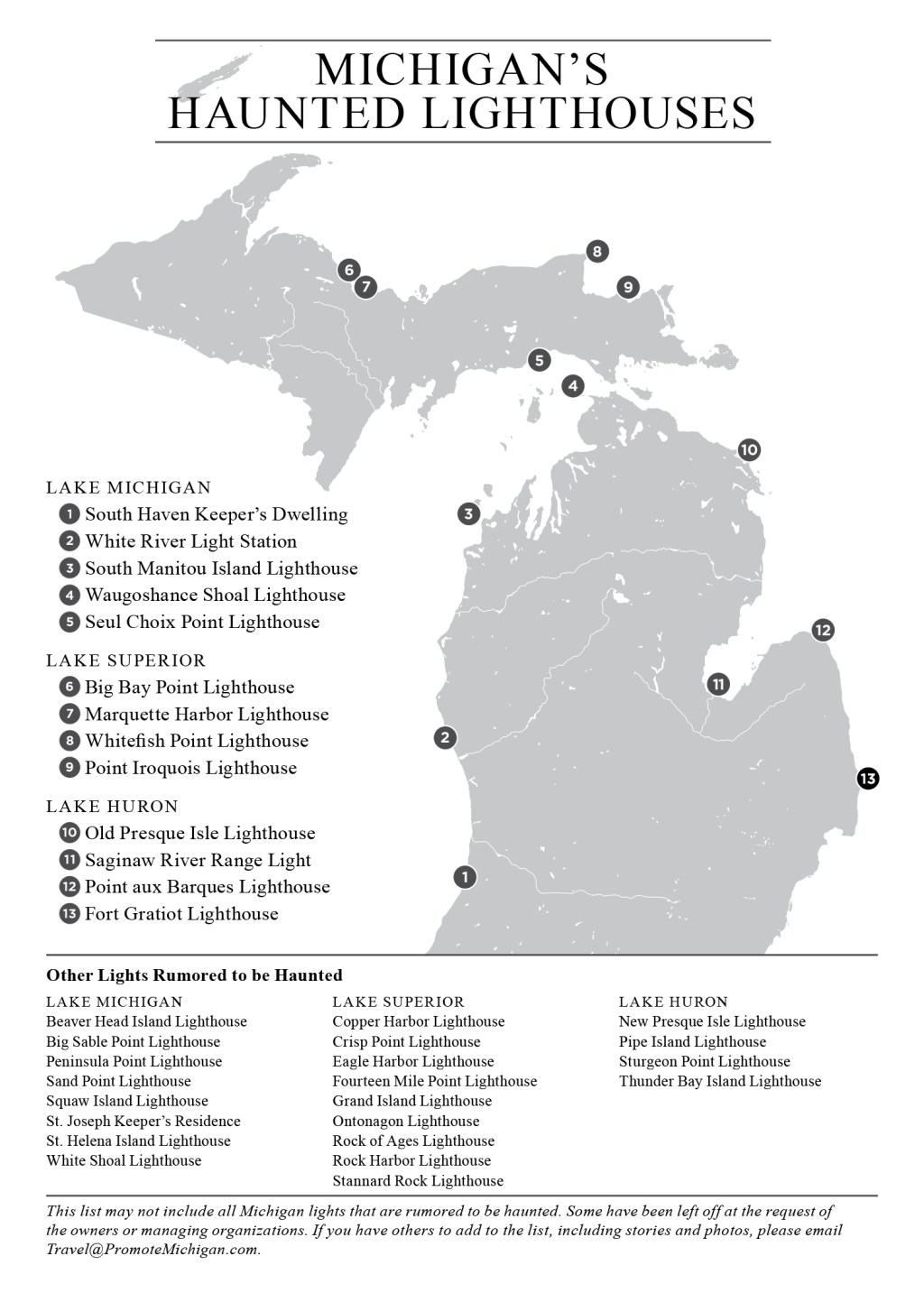
    Michigan is home to more lighthouses than any other state and about 40 of those are rumored to be haunted by the spirits of former keepers, mariners and others with ties to these historic beacons.

    Inside the pages of Michigan’s Haunted Lighthouses, long-time researcher, writer and promoter of all things Michigan, Dianna Stampfler, shares stories of those who dedicated their lives — and afterlives — to protecting the Great Lakes’ shoreline. Her second book, Death & Lighthouse on the Great Lakes, Stampfler delves into the historic true crime cold case files that have baffled lighthouse lovers for as many as two centuries.

    Throughout the fall season, Stampfler will be speaking at libraries around the state, sharing her lively and upbeat presentation about these lights. Copies of her books will be available for purchase and signing at every program.

    Sun, Oct 9, 2022
    2:00 PM – 3:30 PM
    Michigan’s Haunted Lighthouses
    Elk Rapids District Library, Elk Rapids, MI
    Tue, Oct 11, 2022
    6:30 PM – 8:00 PM
    Michigan’s Haunted Lighthouses
    Rauchholz Memorial Library, Hemlock, MI
    Wed, Oct 12, 2022
    7:00 PM – 8:30 PM
    Michigan’s Haunted Lighthouses
    Northville District Library, Northville, MI
    Wed, Oct 19, 2022
    6:00 PM – 7:30 PM
    Michigan’s Haunted Lighthouses
    Reese Unity District Library, Reese, MI
    Thu, Oct 20, 2022
    7:00 PM – 8:30 PM
    Michigan’s Haunted Lighthouses
    Otsego District Library, Otsego, MI
    Sun, Oct 23, 2022
    3:00 PM – 4:30 PM
    Michigan’s Haunted Lighthouses
    Sanilac County Historic Village & Museum, Port Sanilac, MI
    Wed, Nov 2, 2022
    6:00 PM – 7:30 PM
    Death & Lighthouses on the Great Lakes
    St. Clair County Library – Main Branch, Port Huron, MI

    For the complete schedule of upcoming events (including other topics beyond lighthouses), visit the Promote Michigan Speaker’s Bureau online.

    About Michigan’s Haunted Lighthouses

    Michigan has more lighthouses than any other state, with more than 120 dotting its expansive Great Lakes shoreline. Many of these lighthouses lay claim to haunted happenings. Former keepers like the cigar-smoking Captain Townshend at Seul Choix Point and prankster John Herman at Waugoshance Shoal near Mackinaw City maintain their watch long after death ended their duties. At White River Light Station in Whitehall, Sarah Robinson still keeps a clean and tidy house, and a mysterious young girl at the Marquette Harbor Lighthouse seeks out other children and female companions. Countless spirits remain between Whitefish Point and Point Iroquois in an area well known for its many tragic shipwrecks.

    About Death & Lighthouses on the Great Lakes

    Losing one’s life while tending to a Great Lakes lighthouse — or any navigational beacon anywhere in the world for that matter — sadly wasn’t such an unusual occurrence. The likelihood of drowning while at sea or becoming injured while on the job ultimately leading to death were somewhat common back in the late nineteenth and early twentieth century.

    Death by murder, suicide or other unnatural and tragic causes, while rare, are not unheard of. In fact, more than dozen lighthouse keepers around the Great Lakes met their maker at the hands of others – by fire, poisoning, bludgeoning and other unknown means. A handful of these keepers, either because of depression or sheer loneliness, took their own lives. A few we may never know the true story, as the deaths now 100 or more years ago, weren’t subjected to the forensic scrutiny that such crimes are given today.

    In the pages of Death & Lighthouses of the Great Lakes: A History of Misfortune & Murder, you’ll find an amalgamation of true crime details, media coverage and historical research which brings the stories to life…despite the deaths of those featured.

    Stampfler has been professionally writing and broadcasting since high school. She holds a bachelor’s degree in English with emphasis in Community Journalism and Communications with emphasis in radio broadcasting from Western Michigan University. She is a member of the Midwest Travel Journalists Association, Historical Society of Michigan, Great Lakes Lighthouse Keepers Association, Great Lakes Maritime Museum, Association for Great Lake Maritime History, Great Lakes Shipwreck Historical Society, Michigan Maritime Museum, Friends of Pilot & Plum Island Lighthouse, National Museum of the Great Lakes and West Michigan Tourist Association.