“If you love to cook, are undaunted with unique ingredients, and want to capture the flavors of another land, accept the challenge and get cooking.”
In the late 1800s and early 1900s, chop suey houses were all the rage. Opening early and closing late, they were a place to get a good, cheap meal no matter what time of day or night. Over the following decades chop suey and chow mein remained the go-to dishes for those ordering Asian food. It wasn’t until the late 1960s that American diners discovered other regions of Chinese cuisine, Hunan and Szechuan being the first two major ones. For those who loved the flavors of Asia, Malaysian, Indian, Thai, Korean, and Vietnamese were also added to the selection of what to eat and cook. But Singapore gastronomic endeavors were often overlooked.
Not anymore.
To those in the know, Singapore cuisine has always been, as Terry Tan and Christopher Tan write in their introduction of the cookbook Singapore Cooking: Fabulous Recipes from Asia’s Food Capital (Tuttle Publishing), a topic of utmost importance.
“Some wag once said that the quickest way to start a debate in Singapore is to walk up to a random group of people and ask them “So where can I get the best chicken rice?” the two Tans write in the book’s foreword.
The great Anthony Bourdain also weighed in about the foods of this island nation saying, “New York may be the city that never sleeps, but Singapore’s the city that never stops eating. For a gastro-tourist, somebody who travels to eat, any kind of serious eater, Singapore’s probably the best place you can go . . .”
Looking through this glossy paged book with its full-color photos and 100 recipes including those for such dishes as Ayam Tempra–Chicken Braised in Spicy Sweet Soy, Gulai Prawns with Pineapple, Nangka Lemak Young Jackfruit Coconut Curry, and Coconut Pancakes with Banana Sauce, it’s easy to agree that Singapore gastronomy is all “shiok” or in other words “sublime and unspeakably wonderful.”
But though it all sounds delicious, this isn’t necessarily an easily accessible cookbook. Ingredients such as dried prawns, pandanus leaves, and tamarind may mean for many not only a search or special trip to an Asian grocery store but also an added expense and one where they’ll wonder when they might use the product again. Despite this, for anyone who wants to explore a multicultural cuisine that encompasses influences from many of the surrounding countries as well, it is very much worth the effort.
To make it easier for the novice, the authors have organized their book into chapters such as “Marinades, Chutneys, Sambals and Achars” and “Breads, Rice and Noodles” and included a nice glossary of ingredients (with photos!) as well as a brief history of Singaporeans cuisine.
If you love to cook, are undaunted with unique ingredients, and want to capture the flavors of another land, accept the challenge and get cooking.
About the Authors and Photographer
Terry Tan is a distinguished cooking teacher, food consultant, food historian, and writer who has been dishing up Singaporean delights to people around the world for many years. He writes and broadcasts regularly on Asian and Oriental food and cookery from his base in London.
Christopher Tan is an award-winning writer, cooking instructor, and photographer who contributes articles, recipes and pictures to numerous magazines in Asia. Singaporean by birth, he grew up in London and now hangs out anywhere there is good food. You can find his work at www. foodfella.com.
Edmond Ho is a noted food, travel, and lifestyle photographer based in Singapore. In the late 1990s, he introduced a new style of food photography in Singapore using extreme close-ups and blurred backgrounds together with natural lighting. He has done shots for more than 25 cookbooks.
Who is Dr. Kevin Schewe and why is he winning all these awards?
Shelf Life is lucky to have Guest Blogger Kathy Tretter, co-publisher and editor of the Ferdinand News and Spencer County Leader, two award winning newspapers in Southern Indiana, to answer that question. The following is from her column which ran in the Ferdinand News.
“If history was taught this way in school, everyone would be a scholar and educating ourselves not only about our accomplishments but the horrors of the past that should awaken and give insight to the path of a better future. A rare gem!” —David Holladay, MD, 5-Star
His wife Nikki, a radiation therapist, probably calls him Kevin, but his old friends know him as Bubble Butt!
Dr. Schewe discovered, rather late in life, that he possesses both a passion and a talent totally unrelated to the medical profession — and that talent is, quite literally, winning him accolades across the globe.
At last count he has been honored with over one-hundred international awards for his screenplay, Bad Love Tigers (he’s over 200 honors thus far) — not to mention raves for the four books he wrote on which the screenplay is based. Some of his awards include Best Original Story at the Cannes World Film Festival, Best Sci-Fi/Fantasy Screenplay at the Vegas Movie Awards, Best Screenplay at the London Classic Film Festival and Honorable Mention at the Los Angeles Movie Awards. Most recently he earned the Best Screenplay Award at the East Coast Movie Awards.
A partial list of his wins appears at the end of this article and the scope is quite simply astonishing.
According to his publicist, “In less than six months on the international screenplay circuit, Kevin Schewe’s Bad Love Tigers generated momentum on its whirlwind sweep of the globe, finding acclaim at film festivals spanning from Los Angeles to Hong Kong and dozens of locations in between.” That quote came at the end of June after the screenplay had amassed, by that point, 83 awards, and the list continued to grow from there.
So how did this all transpire? It’s not every day someone wholly ensconced in a profession as intense as medicine suddenly clicks on his brain’s right hemisphere (creative side) to become a novelist and screenwriter, although the left (logical) side is responsible for language and probably had something to do with both his careers.
Here’s what happened.
Dr. Schewe is a history buff and reads everything he can get his hands on concerning World War II. He came across a true military history story that happened on a late afternoon in November of 1944, as the war in the European Theater was starting to wane. A brand new B-17G Flying Fortress (four-engined heavy bomber with a 104 foot wing span), known as the Phantom Fortress, landed at a British air base in Belgium. These bombers were a proud symbol of American air strength during World War II and there were several iterations, the B-17G being the last.
As this colossus was coming toward the landing strip with no warning, the tower kept trying to radio the pilot, to no avail.
The landing had not been perfect. There was some damage to one engine when the bomber end-rolled in, touched down, spun around, dipped, and hit the runway, but it landed and came to a halt, the remaining three engines still turning.
Gunnery crews on the ground were scratching their heads trying to figure out what was going on. Was everyone inside dead? But then how did the bomber land? Was this a proverbial Trojan Horse, a trick of the Nazis?
Apparently British Lieutenant John Crisp drew the short straw and went out to the plane to investigate about half an hour later when no one disembarked. What he found was surreal. No one was in the cockpit or anywhere else in the bomber. Parachutes were lined up along the fuselage, while a leather flight jacket and candy bars littered the floor.
As could be expected, an investigation ensued. The man who was supposed to be piloting the B-17G (on only its third mission) was later located and said he and the crew had been en route to bomb the Leuna Synthetic Oil Refinery — Nazi Germany’s second largest synthetic oil plant and second biggest chemical operation — when an engine failed. The B-17 was losing altitude and destined to crash, so the crew abandoned the mission and bailed out in the clouds. But it didn’t crash — it landed on Allied soil and only one engine — the one damaged on landing — had failed.
Which, Dr. Kevin “Bubble Butt” Schewe realized made absolutely no sense. Why would the crew not have used parachutes and why would anyone depart without his jacket as the air outside would have been frigid? The only engine that failed was the one damaged during touchdown in Belgium.
Please note, B-17Gs were not drones, nor were they equipped to land themselves, so those facts alone would seemingly constitute a miracle. This is where the whole right brain/left brain scenario comes in — this true tale lit an imaginative spark in Dr. Schewe. His mind then took a slight right to his undergrad roots as a physics major. “When I read this story it was like I was struck by lightening,” he recalls. He sat down and began penning the first novel, developing the characters based on his childhood friends with a couple of fictional personages added for good measure.
What resulted is a superlative blending of fact and fiction, and it’s highly tempting to give everything away.
But here’s a taste.
Dr. Schewe grew up in St. Louis (his Dad served under General MacArthur in World War II) and his friends did indeed (and still do) call him Bubble Butt. Many of those friends appear in the books and script — their nicknames intact as well. The protagonist is Bubble Butt, but with a different surname. The action happens in Oak Ridge, Tennessee, which everyone who has read even a little bit of history knows was the epicenter for the Manhattan Project leading to the development of the atomic bomb.
The fiction is fascinating and partially based in reality, such as the discovery of exotic matter (a focus of Einstein’s Theory of Relativity), also a necessary component of time travel (oops, getting close to spilling the beans).
The year is 1974 and Bubble Butt and friends accidentally come across a secret, cavernous vault known during WWII as the White Hole Project near the Oak Ridge complex. This dynamic group of young adventurers, known as the Bad Love Gang, use a time machine to travel back to the World War II era. So there, you got it out of me.
One feature of the first book,Bad Love Strikes, will surely provide the soundtrack for the movie (if it gets made and surely it will). On the first pages Dr. Schewe gives a list of songs to play while reading every chapter, from “Born To Be Wild” in chapter one to “Shambala” in chapter 20. Each chapter also begins with a quote such as “Put your hand on a hot stove for one minute, and it seems like an hour. Sit with a pretty girl for an hour, and it seems like a minute. That’s relativity.” — Albert Einstein. Or the one prior to the epilogue, “OK, I will admit that I am having some memory issues. I can do pretty good with the past, it’s the future I’m having trouble remembering …” — Larry W. Schewe, father of the author when his memory was beginning to fail.
According to his publicist, “Schewe’s Bad Love Tigers is a feel-good, action-adventure, sci-fi blend of Stand by Me meets Raiders of the Lost Arkor Back to the Future meets Goonies. The energetic and fun screenplay has strong appeal and great potential to attract an audience of all ages to the big screen. This incredible display of worldwide interest shows that Bad Love Tigers is already a global phenomenon, crossing cultures and borders and demonstrating its potential to be a feel-great-again, big-screen blockbuster.”
Which is why it has garnered so many awards.
So who exactly is Kevin Schewe, physician author and screenwriter, and where did he come from?
He moved to Jasper after the clinic at which he had worked in Colorado changed hands. He was extremely attracted to the radiology equipment at Memorial, noting some very generous donors made the Cancer Clinic at the Jasper-based hospital top of the line. The fact the move would allow for more time to write also appealed as Bubble Butt has plotted eight more books in the series. “I plan to be here for the next seven years [until retirement],” he notes. Then with a cheeky smile adds, “Unless Stephen Spielberg calls.”
The 72 National and International Awards won (so far) by Bad Love Tigers (a partial list out of more than 200)
· Best Screenplay, Eastern Europe International Movie Awards (Izmir, Turkey) · Best Original Story, Cannes World Film Festival (Cannes, France) · Best Feature Screenplay, HALO International Film Festival (St. Petersburg, Russia) · Best Feature Script and Best Action Screenplay, Top Film Awards Film Festival · Best Feature Screenplay, Golden Nugget International Film Festival (London, UK) · Best Screenplay, 52 Weeks Film Festival (Thousand Oaks, CA) ·Best Original Story, Cannes World Film Festival (Cannes, France) Vegas Movie Awards (Las Vegas, NV) · Best Screenplay, Indo-Global 2022 Film Festival (Mumbai, India) · Best Sci-Fi Screenplay, Masters of Cinema International Film Festival (Rome, Italy) · Best Sci-Fi Screenplay, Stardust Films and Screenplays Festival (New York, NY) · Best Feature Screenwriting, Red Moon Film Festival (New York, NY) · Outstanding Achievement, Swedish International Film Festival (Arkiva, Sweden) · Best Script Award for Best Sci-Fi Screenplay, London Film Festival (London, UK) · Best Screenplay, The Gladiator Film Festival (Istanbul, Turkey) · Best Screenplay, Inca Imperial International Film Festival (Lima, Peru) · Best Unproduced Script, Indiefare International Film Festival · Best Sci-Fi Script, Hong Kong World Film Festival (Hong Kong) · Honorable Mention, Los Angeles Movie Awards (Los Angeles, CA) · Best Feature Script, New York Neorealism Film Awards (Rome, Italy) · Best Screenplay, London Classic Film Festival (London, UK) · Best Sci-Fi Screenplay, Stardust Films and Screenplays Festival , Best Original Screenplay, and Best Poster, Golden Giraffe International Film Festival (Nice, France) · Best Sci-Fi Short Script, Red Dragon Creative Awards (Dallas, Texas) · Best Short Screenplay, Silver Mask Live Festival (Los Angeles, California) · Best Script Written During Pandemic, Redwood Shorts & Scripts (Sunnyvale, California) · Critic’s Choice Award for Best Feature Script/Screenplay, International Motion Picture Festival of India (Pondicherry, India) · Best Sci-Fi Script, Mykonos International Film Festival (Mykonos, Greece) · Best Sci-Fi Screenplay, Thinking Hat Fiction Challenge (Punjab, India) · Outstanding Achievement for Feature Script, Luis Bunuel Memorial Awards (Kolkata, India) · Best Feature Screenplay, South Film and Arts Academy Festival (Rancagua, Chile) · Best Sci-Fi Script, Gold Star Movie Awards (Newark, New Jersey) · Best Sci-Fi Screenplay Award, BRNO Film Festival (Brno, Czech Republic) · Best Feature Screenplay, Filmmaker Life Awards (Hollywood, CA) · Best Story Screenplay Award, The Madrid Art Film Festival (Madrid, Spain) · Best Feature Screenplay, White Unicorn International Film Festival (Hong Kong, India, Japan) · Feature Script Audience Choice Award, Black Swan International Film Festival (Kolkata, India) · Best Feature Script/Screenplay, Indo French International Film Festival (Pondicherry, India) · Best Script, New York Independent Cinema Awards (New York, NY) · Best Script in a Feature Film, World Indie Film Awards (Chongqing, China) · Best Script (Sci-Fi), Los Angeles Film & Script Festival (Los Angeles, CA) · Best Screenplay for Young Adults, Bridge Fest Film Festival (Vancouver, Canada) · Best Thriller Screenplay, Adbhooture Film Festival (West Bengal, India) · Feature Script Outstanding Achievement Award, Royal Society of Television and Motion Picture (Kolkata, India)
About Kathy Tretter
Kathy Tretter with Indiana Governor Eric Holcomb .
Active in her community, Kathy Tretter is President, Editor/Co-publisher at Dubois-Spencer Counties Publishing Co., Inc., is former Chair of the Spencer County Chamber of Commerce, past president of the Hoosier State Press Association and remains on their board. An award winning editor, Tretter was the winner of the 2014 Rotary Club of Jasper’s ATHENA International Leadership award. The ATHENA Award, an international honor, recognizes women who have demonstrated excellence in professional leadership, community service, and the mentorship of future women leaders and also have been active in community service and show professional excellence.
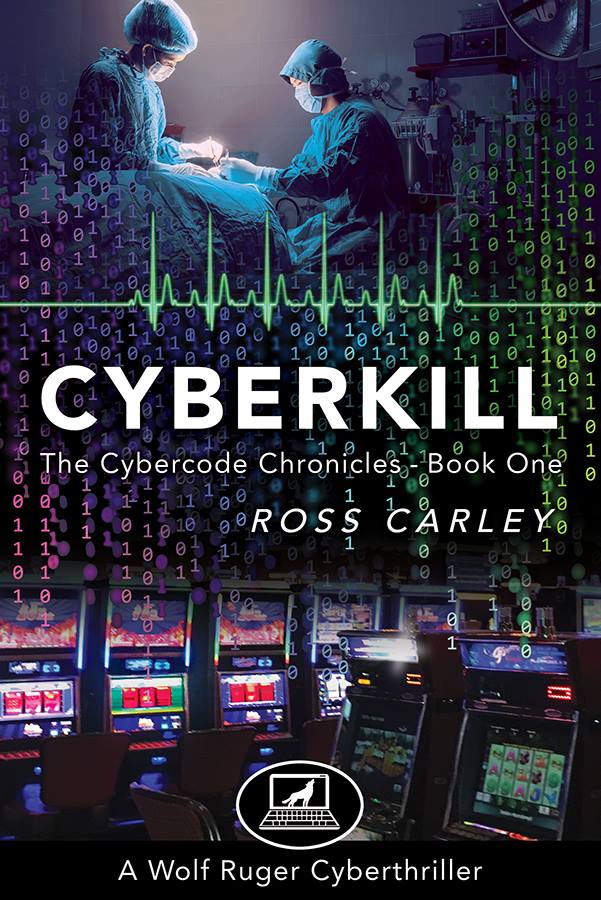
Ross Carley’s first four novels feature PI and computer hacker Wolf Ruger, an Iraq vet with PTSD. Dead Drive(2016) and Formula Murder, set in the formula racing industry (2017) are murder mysteries.
Cyberthrillers Cyberkill (2018) andCryptokill (2020) are books one and two of the Cybercode Chronicles. His fifth novel, The Three-Legged Assassin, featuring assassin Lance Garrett, was released in February 2022. Ross is an artificial intelligence and cybersecurity consultant. He and Francie split their time between Indiana and Florida.
Ross Carley, a former engineering professor who served as a military intelligence officer and was the CTO of a defense contractor, is also the author of four books in the computational intelligence area.






 Shelf Life