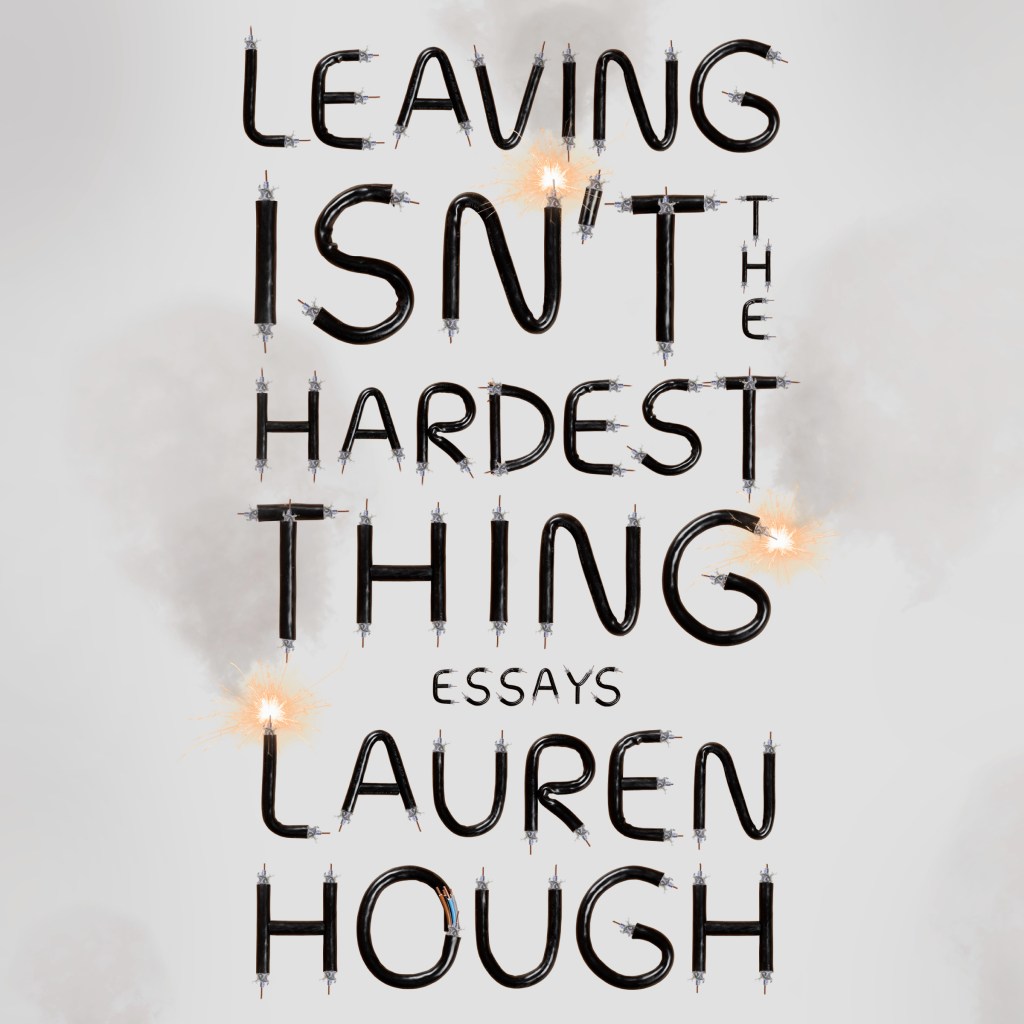
Category: Audiobooks

  • Leaving Isn’t the Hardest Thing

    Leaving Isn’t the Hardest Thing

    Lauren Hough’s parents were members of The Children of God, so she told people they were missionaries instead of belonging to that infamous cult. A student at a conservative Catholic High School, she hid her sexuality. As a member of the U.S. Airforce she visited gay bars using the name Ouiser Boudreaux, taken from the character Shirley MacLaine played in “Steel Magnolias” so that no one on the base would learn her real identity—and sexual orientation.

    In other words she was always someone she wasn’t, trying to be what others expected of her.

    “I’d learned to survive by becoming what they wanted me to be, as best I could,” Hough writes in her collection of essays, “Leaving Isn’t the Hardest Thing.” “And when I couldn’t, I hid, erasing those parts of me that offended.”

    The collection includes an essay she wrote for HuffPost titled “I Was a Cable Guy.” I Saw the Worst of America” which went viral. One reader reached out to Hough to tell her how much she liked it. That person was Academy Award winner, Cate Blanchett. The two struck up a friendship and when “Leaving Isn’t the Hardest Thing,” Hough texted her to ask if she would read several of book’s eleven essays.

    “Surreal is also a good word to being able to text Cate and ask her is she’s ever considered doing an audiobook,”  says Hough describing the entire experience not only of partnering with Blanchett in producing the audiobook but her life’s journey and how she ended up as a published writer corresponding with a movie star. As for Blanchard, she said yes.

    “My conversations with Lauren over the last several years have been honest, raw, and sidesplittingly funny, and I treasure her friendship and penmanship beyond measure,” she writes.

    Hough says she wrote many of her essays in the dark, just hoping to connect, if only to yourself. Growing up, her family had moved frequently, and she lived in seven countries including Switzerland, German and Ecuador, and Texas just to name a few placed, experienced violence and been abused. In adulthood, she’d worked a series of jobs—bartending, bouncer in a gay bar, livery driver, U.S. Airman, barista, and, of course, a cable installer.

    Describing Hough as having hypnotic power as a storyteller, Blanchett says when she spoke Hough’s words in the audiobook that in “speaking her words, I truly understood the rhythmic heartbeat alive in every phrase. Aching to connect. Aching to be heard.”

    In her long search for belonging and being connected, Hough’s writings seem to have forged the connectiveness she sought.

  • WIN! By Harlan Coben

    WIN! By Harlan Coben

    He’s incredibly handsome, impeccably dressed, totally urbane, interested only in no-strings relationships, and so amazingly rich that it’s hard to remember when anyone in his family has ever worked besides, that is, practicing their golf swings. Of course, Windsor “Win” Horne Lockwood III is totally obnoxious or would be if he didn’t recognize and make fun of all those traits. He knows he was born into money not for any reason but the wining of the genetic lottery. Ditto for the looks. He doesn’t have to wear—gasp—hoodies but can instead with all that dough attire himself in sartorial splendor. As for the relationships or lack of them, well, Win has issues that started in childhood so you can’t really blame him for that.

    CANNES, FRANCE – APRIL 7: Writer Harlan Coben is photographed for Self Assignment, on April, 2018 in Cannes, France. (Photo by Olivier Vigerie/Contour by Getty Images). (EDITOR’S NOTE: Photo has been digitally retouched).

              What he’s never had before is a mystery novel all about him. But now he does in “Win” (Grand Central 2021; $18.98 Amazon price) written by Harlan Coben, the bestselling author who has 75 million books in print in 45 languages as well as multiple number of Netflix series including “The Stranger” and “The Woods” with two more “The Innocent” and “Gone for Good” out soon.

              Up until now, Win has been a sidekick to Coben’s main character, Myron Bolitar, a sports agent who moonlights—often unintentionally—as a private detective.  Coben never intended to make Win the main character in a novel but that changed.

              “I came up with a story idea involving stolen paintings, a kidnapped heiress, and a wealthy family with buried secrets – and then I thought, ‘Wow, this should be Win’s family and his story to tell’,” says Coben.  “Win is, I hope you agree when you read the book, always a surprise.  He thrives on the unexpected.”

              The kidnapped heiress is Win’s cousin Patricia, who was  abducted by her father’s murderers and held prisoner until she managed to escape. She now is devoted to helping women who are being victimized by men. The stolen paintings include a Vermeer that was taken when Patricia was kidnapped. That painting along with another appear to have been stolen by a former 1960s radical turned recluse who was murdered in his apartment after successfully hiding from authorities for more than a half century.

              But keep in mind, that this is a Coben novel, so nothing is ever as it seems. The plots are devious, and the twists and turns are many. As Win goes on the hunt for the painting he has to deal with other difficulties that arise as well. His proclivity for vigilante justice (he knows, he tell us in one of the many asides he makes to readers, that we may not approve) has led to retaliation by the man’s murderous brothers who almost manage to kill him. The hunt for the Vermeer gets him involved with a treacherous mobster who is determined to find the last remaining radical of the group of six who he believes was responsible for his niece’s death.

              “Win has been Myron’s dangerous, perhaps even sociopathic, sidekick and undoubtedly the most popular character I’ve ever written,” says Coben.  “That said, you don’t have to read a single Myron book to read “Win.”  This is the start of a new series with a whole new hero.”  

              Coben decided to write a novel when he was working in Spain as a tour guide. Did he get the job because he’s fluent in Spanish? Not exactly.  

              “My grandfather owned the travel agency,” says Coben. “While I was there, I decided to try to write a novel about the experience.  So I did.  And the novel was pretty terrible as most first novels tend to be – pompous, self-absorbed – but then I got the writing bug and started to write what I love – the novel of immersion, the one that you get so caught up in you can’t sleep or put the book down.”

              With “Win” he has certainly done just that.  

    What: Harlan Coben, New York Times bestselling author, discusses his new book “Win” with moderator and author Shari Lapena.

    When: Thursday, March 25 at 7 p.m.

    FYI: Hosted by the Book Stall in Chicago, the event is free and open to the public. To register, visit the events page on the store’s website, www.thebookstall.com

  • President Obama’s Annual List of Favorites

    “As 2020 comes to a close, I wanted to share my annual lists of favorites,” Barack Obama, the 42nd President of the United States, tweeted to his 127.5 million followers. “I’ll start by sharing my favorite books this year, deliberately omitting what I think is a pretty good book – A Promised Land – by a certain 44th president. I hope you enjoy reading these as much as I did.”

    Somehow, the President forgot to include adding one of my books to his list again. Well, there’s always next year.

    Jack by Marilynne Robinson

    Caste by Isabel Wilkerson

    Luster by Raven Leilani

    Sharks in the time of Saviors by Kawai Strong Washburn
    Twilight of Democracy by Anne Applebaum

    Homeland Elegies by Ayad Akhtar
    The Undocumented Americans by Karla Cornejo Villavicencio
    Long Bright River by Liz Moore
    Memorial Drive Natasha Trethewey
    Deacon King Kong by James McBride
    Missionaries by Phil Klay
    The Vanishing Half by Britt Bennett
    The Ministry for the Future by Kim Stanley Robinson
    The Glass House by Emily St. John Mandel
  • “Central Indiana Interurban” chronicles the state’s electric trains

    There was a time when electric railroads, called interurbans, crisscrossed the state, connecting the small villages and large cities of Indiana.

    “I was about 10 when my mother first started letting me take the interurban on my own,” recalls Lorraine Simon, who was born in East Chicago in 1911. “My mother would put me on the train and I’d go to Chicago and get off and walk to where my grandmother worked sewing linings into hats for a millinery company.”

    Interurban in Valparaiso. Photo from the Steve Shook Collection

    Also, according to Simon, the interurban she rode, known as the South Shore, also served food — for awhile. “But that didn’t last long,” she says.

    Interior of the Muncie Meteor, Courtesy of Internet Archive Book Images.

    With names like the Marion Flyer and the Muncie Meteor, the electric-powered interurban railway was the first true mass transit in Indiana in the 20th century. Coined interurban by Anderson, Ind., businessman and politician Charles Henry in the early 1900s, the name meant between towns or urban areas.

    Photo courtesy of the Shore Line Interurban Historical Society.

    “Before the interurban, public transportation in central Indiana relied upon mules or horses to pull crudely fashioned passenger wagons,” says Robert Reed, author of “Central Indiana Interurban” (Arcadia, 2004, $19.95). The interiors of these passenger wagons were piled high with straw for warmth in the winter and candles were used after sunset to light the interior. It was, as can be imagined, less than an optimal way to travel.

    “The genius at work was the idea of using electrical power, on the pavement beneath the tracks or on overhead lines, to power existing traction cars,” writes Reed in his book.

    Muncie Meteor. Courtesy of the Internet Archive Book Images.

    Though the book’s title would seem to indicate a focus on the interurbans in Central Indiana, Reed points out that it encompasses many of the interurban lines that ran through Northwest Indiana.

    “Indianapolis may have had the busiest interurban terminal in the world early in the 20th century but Chicago laid claim to the busiest corner in the world at State and Madison streets,” he writes. “Clearly interurban and cars were jammed in with all other traffic. The Chicago and Indiana Air Line Railway was established in 1901 at a cost of $250,000. Through reorganizations and acquisitions it grew from just over three miles of coverage in the beginning to nearly 70 miles of routes as the Chicago, Lake Shore and South Bend Railway, a decade and a half later. Eventually, encircled by its transportation lines were East Chicago, Indiana Harbor, Gary, Michigan City and Hammond.”

    Photo courtesy of the Steve Shook Collection.

    The Gary and Interurban Railroad provided 50-minute service between Gary and Hammond, according to Reed, and 60-minute service between Gary and Indiana Harbor. “In the years before the 1920s,” writes Reed, “one of their major routes began at Hammond and continued on to Indiana Harbor, Gary, East Gary, Garyton, Woodville Junction, Chesterton, Sheridan Beach, Valparaiso, Westville and LaPorte. Variations of the Gary and Interurban Railroad routes commenced at Valparaiso, Chesterton and LaPorte. Typically more than 20 different interurban cars from that line arrived and departed from Gary each day.”

    From the Steve Shook Collection.

    To highlight the popularity of the interurban throughout the state, Reed mentions how in 1908 the French Lick and West Baden Railroad Company connecting the West Baden Springs Hotel and the French Lick Resort & Springs, about a one mile route, carried 260,000 passengers.

    From the Steve Shook Collection.

    The book, filled with black-and-white photos from the interurban era as well as timetables and postcards from the routes, came about after Reed, a former magazine editor, wrote a book called “Greetings from Indiana” which showed the state’s history through early postcards. As Reed collected the postcards, he noticed that many were of the towns on the interurban route. “

    From the Steve Shook Collection.

    It made sense that people riding the interurban would send postcards of their stops and that these postcards were often of the interurban terminals,” says Reed who specializes in writing about antiques and collectibles. “I really became fascinated with interurbans because they were so much a part of Indiana.”

    Laying tracks for the interurban was an expensive proposition. “It eventually got to where it was about $144,000 a mile,” Reed says. “And they reached a point where it was too expensive to expand.” Besides, by then Henry Ford had introduced his Model T and people were starting to drive more and more. “A lot of old timers say that if the interurban had survived until after World War II, they would be popular today,” Reed says. The one interurban to survive, the South Shore Railroad, did so because Samuel Insull, the utility magnate whose holdings included Commonwealth Edison and the Northern Indiana Public Service Company, also owned the South Shore.

    Tracks in downtown Gary, Indiana. Photo courtesy of the Steve Shook Collection.

    In other words, he helped usher the South Shore into the era of public subsidies for passenger transport. That is considered to be the reason why the electric train, which still travels from Chicago to South Bend and back on a regular schedule, is the only interurban that successfully made the transition to a commuter railroad.

    Central Indiana Interurbans by Robert Reed.

    All the others are now just vestiges of history — abandoned track lines here and there, faded black-and-white or sepia-colored postcards, a few timetables and even fewer fragile memories.

    Beverly Shores Depot. Courtesy of Steve Shook Collection.
    Beverly Shores, Indiana today. Jane Simon Ammeson.
  • How Quickly She Disappears

    How Quickly She Disappears

                Intrigued by the tales his grandparents told of living in Tanacross, a small Alaskan village back in the late 1930s, Indiana author Raymond Fleischmann has woven a mystery set in that time frame and location.

                “I grew up hearing their stories about Alaska, the cold, the isolation, the long days and the long nights,” says Fleischmann, the author of the just released How Quickly She Disappears.  “So, the setting is very real though my characters are fictional and not based on my grandparents at all who were very much in love and married for over 60 years.”

                That part is probably good as Fleischmann’s novel is about Elisabeth Pfautz who is living in Alaska with her husband and young daughter. The marriage is joyless, but her daughter is her delight and, more forebodingly, a reminder and connection with her twin sister, Jacqueline, who when she was eleven, disappeared. No one has seen or knows what happened to her since then.

                  Haunted by her lost sister, experiencing reoccurring dreams of 1921 and the circumstances of the disappearance and saddened by the state of her marriage, Elisabeth is drawn to Alfred, a substitute mail pilot who lands in Tanacross. Elisabeth, who grew up a small German community in Pennsylvania, feels a kinship of sorts with Alfred, who is also of German heritage. But then things turn distinctly weird and terrifying. Albert murders another man, apparently in cold blood. But he also knows, he tells Elisabeth, what happened to her sister, something he will reveal to her at a cost.

                Fleischmann says he’s always been drawn to novels that are propelled by relatively simple, often violent acts, but do so in a way that’s careful, human, and deeply examined. From Alaska in 1941, Fleischmann takes us back to 1921 where we meet Jacqueline as well.

                “I thought it was important for people to know about her as well,” says Fleischmann, who earned an MFA from Ohio State University, “To me, at the time of her disappearance, Jacqueline is a lonely and somewhat stunted child who is having difficulty navigating the transition from adolescent to adult, just like many of us. So is Elisabeth and Jacqueline’s disappearance has left a big void in her life. As an adult she still feels very much alone without her sister and appears to suffer in many dysfunctional ways.”

                All this makes her vulnerable to Alfred’s cat and mouse game as does the voice she seems to hear, that of Jacqueline urging her to “come and find me.”

  • F. MURRAY ABRAHAM NARRATES NEW RECORDING OF HANS CHRISTIAN ANDERSEN’S FAIRY TALES

    F. MURRAY ABRAHAM NARRATES NEW RECORDING OF HANS CHRISTIAN ANDERSEN’S FAIRY TALES

    ACADEMY AWARD®-WINNING F. MURRAY ABRAHAM NARRATES NEW RECORDING OF HANS CHRISTIAN ANDERSEN’S FAIRY TALES ALONG WITH ENSEMBLE CAST

    HANS CHRISTIAN ANDERSEN’S FAIRY TALES is the newest installment in Listening Library’s Classics series that will be available as an audiobook download on March 27, 2018, in time to celebrate International Children’s Book Day, which has been celebrated on Andersen’s birthday (April 2) every day since 1967. Brought to life by Academy Award®-winning actor F. Murray Abraham (Amadeus, The Grand Budapest Hotel, Homeland) and a full cast of narrators, and featuring original music by Michael Bacon and original cover art by LeUyen Pham, this collection contains Hans Christian Andersen’s most beloved fairy tales, in addition to a selection of lesser-known favorites.

    In addition to F. Murray Abraham, a stellar cast contributes to this special new recording of timeless favorites:

    HANS CHRISTIAN ANDERSEN’S FAIRY TALES

    Read for you by F. MURRAY ABRAHAM with

    EDOARDO BALLERINI

    MARISSA CALIN

    CYNTHIA DARLOW,

    ARI FLIAKOS,

    DION GRAHAM,


    JANUARY LaVOY,

    JENNIFER LIM,

    EUAN MORTON,

    ROBERT PETKOFF,

    REBECCA SOLER

    and MARC THOMPSON

    Music by MICHAEL BACONStories include: The Princess and the Pea; Thumbelina; The Little Mermaid; The Emperor’s New Clothes; The Steadfast Tin Soldier; The Wild Swans; The Nightingale; The Ugly Duckling; The Snow Queen; The Little Match Girl; “The Will-o’-the-Wisps are in Town,” said the Bog Witch; The Rags; The Adventures of a Thistle; Luck Can Be Found in a Stick; The Days of the Week

    The audio collection features cover art by LeUyen Pham, who has illustrated more than 50 books, including Julianne Moore’s Freckleface Strawberry and Shannon and Dean Hale’s Princess in Black series. The music on the recording is by Emmy-winning composer for film and television, Michael Bacon.michaelbaconmusic.com

    Unlike the Brothers Grimm, who collected and retold folklore and fairy tales, Hans Christian Andersen adopted the most ancient literary forms and distilled them into a genre that was uniquely his own. His fairy tales are remarkable for their sense of fantasy, power of description, and vivid imagination. F. Murray Abraham lends his distinct voice as the narrator ofeach story, while the other 11 voices appear throughout as various characters, including Marc Thompson, beloved narrator of many bestselling Star Wars audiobooks, Euan Morton, who currently stars as King George in HamiltonJanuary LaVoy, known for her award-winning audiobooks from Libba Bray’s The Diviners series, and Dion Graham, 4-time Odyssey Award honoree.

    As a part of our Listening Library Classics program, this new recording of Hans Christian Andersen’s Fairy Tales will join our previous recordings of Grimm’s Fairy Tales read by a full cast, The Call of the Wild read by Jeff Daniels, The Wonderful Wizard of Oz read by Brooke Shields and Paul Ruddand 20,000 Leagues Under the Sea read by James Frain, among others—all with original cover art by illustrators including Jerry Pinckney, Carson Ellis, Brian Floca and Noelle Stevenson.

    ABOUT THE ILLUSTRATOR: LeUyen Pham is the New York Times bestselling illustrator of The Princess in Black series with Shannon and Dean Hale andFreckleface Strawberry with Julianne Moore.  She wrote and illustrated Big Sister, Little SisterThe Bear Who Wasn’t There, and is the illustrator of numerous other picture books, including The Boy Who Loved Math. She lives and works in Los Angeles with her husband and her two adorable sons.

    Listening Library Ÿ DN on sale 3/27/18 Ÿ CD on sale 5/1/18