The Most Popular Book Genre In Each State https://flip.it/wuMdQt
Category: Audio book
-

Author Erik Larson offers compelling acount of the start of the Civil War
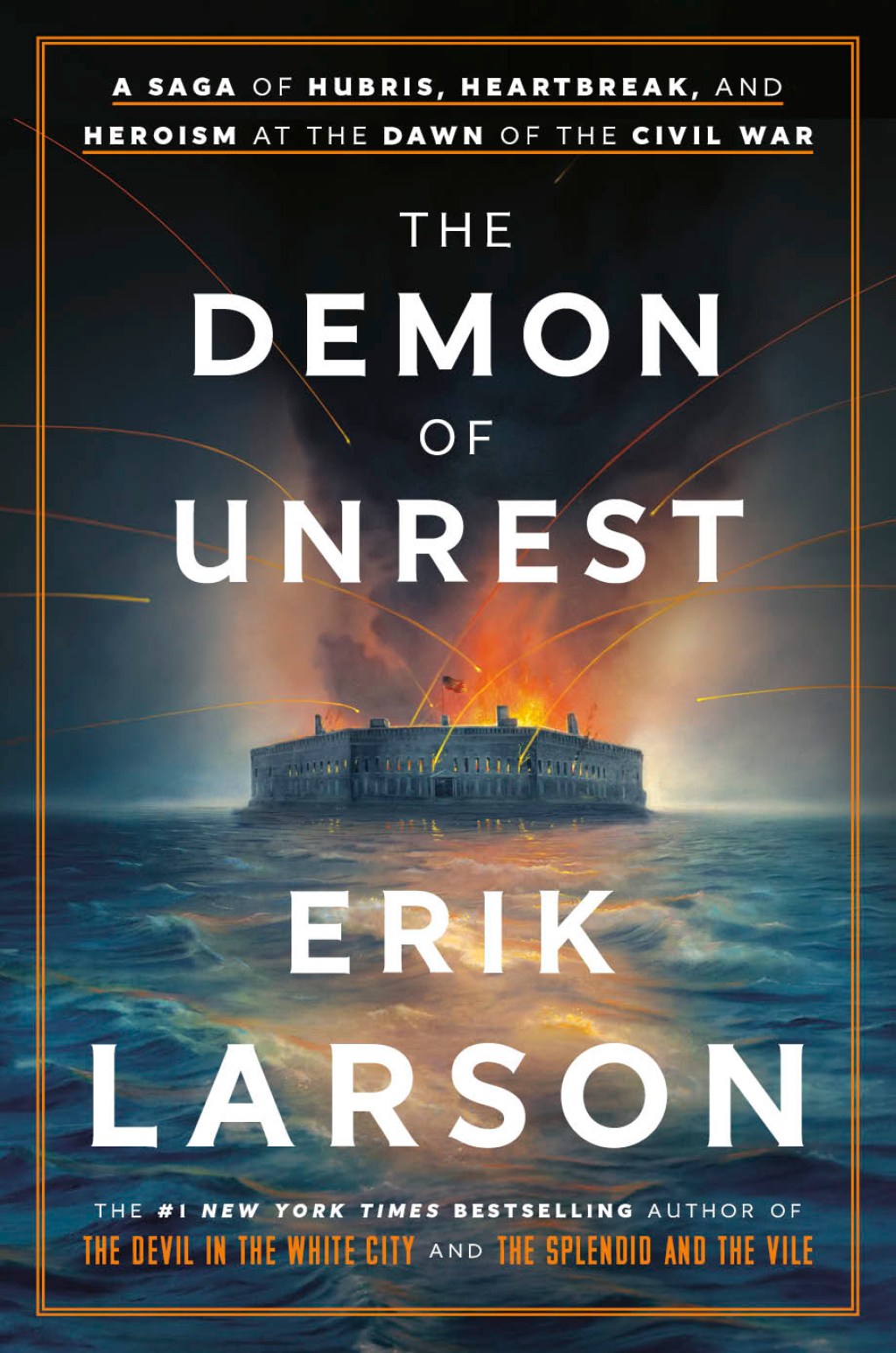
Only a master storyteller like Erik Larson could turn the five tumultuous months leading up to the Civil War into “The Demon of Unrest: A Saga of Hubris, Heartbreak, and Heroes at the Dawn of the Civil War” (Crown), a compelling, page-turning read, chock full of anecdotes, psychological profiles and obscure but compelling tidbits of history all set against a relentless march towards a conflict that would kill over 620,000 soldiers and devastate a nation.

Larson, the author of six New York Times bestsellers whose previous works include “The Devil in the White City: Murder, Magic, and Madness at the Fair That Changed America,” about a mass murderer and the 1893 Chicago’s World Fair, writes in a novelistic style that makes history come alive. He does so through his ability to weave together the familiar facts of history with information that can only be gleaned through relentless and extensive research.
Yes, most of us know that the Civil War began with the firing on Fort Sumter, which was located in Charleston Harbor and under the command of U.S. Army Major Robert Anderson. But did you know that Anderson had owned enslaved people and was a defender of slavery? That Lincoln often misspelled Sumter as Sumpter? Or, more importantly, South Carolina did not have to succeed because of Lincoln’s election, as he had no intention of outlawing slavery in the Southern states?
“When I started out doing this, one concern I had was that the Civil War has not exactly been underwritten,” Larson told me during a phone conversation earlier this week, noting that a quick Google indicated around 65,000. “I had vowed over the years never ever to write about the Civil War.”
That changed when, as he was looking for the topic of his next book and watching the events of the Jan. 6, 2021 assault on the U.S. Capitol, he began to consider the deep divide and unrest of our own times.
Faced with what he describes as an intimidating world of previous scholarship, Larson says “What I really wanted to do was to provide a rich sense, on an intimate level, of what the forces were and the motivations for the start of the Civil War.”
The magic of his writing is that he accomplishes this by immersing the reader in details, descriptions, and personalities mostly unknown to many of us, including “eight typical characters” such as Charleston society doyenne Mary Boykin Chestnut, who kept a detailed diary, and James Henry Hammond, a Charleston planter who was a leader of the secessionist movement and who later became a U.S. senator despite public knowledge of his sexual relationships with four nieces ages 13 to 19.
He also includes information about resolving issues regarding dueling, from “The Code of Honor or Rules for the Government Principals and Seconds in Dueling” and instructions for the “proper” way of whipping slaves as well as the going prices for selling human beings.
The Southern mindset among the owners of enslaved people of the time is best summed up in a letter written to President James Buchanan, president before Lincoln, by Arthur Peronneau Hayne, a U.S. senator from Charleston. In it, he writes that without slavery “our every comfort would be taken from us. Our wives, our children, made unhappy — education, the light of knowledge — all lost and our people ruined forever. “
“White southerners had persuaded themselves that slavery was a good thing for all concerned, especially for the enslaved blacks,” said Larson. He also notes that many of these same men were devoted readers of writers like Sir Walter Scott, author of “Ivanhoe,” and believed fervently in honor and the code of chivalry.
As outrageous and hypocritical as that seems today, Larson says when writing about a different era it’s important to consider the point of view of those times to accurately reflect how events unfolded.
“It gives a better sense of what the forces were that did lead to states like South Carolina succeeding from the Union and the Civil War,” he said, noting that understanding is not condoning, but historic context provides a lesson for the present and future as we struggle with political division today.
This article previously appeared in the Northwest Indiana Times.
-

Camino Ghosts by John Grisham
“what could be better than a cursed island, some supernatural happenings, and the righting of centuries of social wrongs?”
“It was a ship from Virginia, called Venus and it had around 400 slaves on board, packed like sardines,” bookstore owner Bruce Cable tells Mercer Mann, a writer who is looking for a new book subject. “Well, it left Africa with 400 but not all made it. Many died at sea. The conditions on board were unimaginable, to say the least. Venus finally went down about a mile to sea near Cumberland Island. Since the slaves were chained and shackled, almost all of them drowned. A few clung to the wreckage and washed ashore in the storm on Dark Island, as it became known. Or Dark Isle. It was unnamed in 1760. They were taken in by runaways from Georgia, and together they built a little community. Two hundred years went by, everybody died or moved away and now it is deserted.”
One of the many facets of John Grisham’s enthralling fiction is his ability to take complex social issues and weave them into the fabric of his novels so that they make for a compelling read.
In Camino Ghosts, the third book in the Camino series, he does it again with his compelling story of Lovely Jackson, an 80-year-old Black woman who is determined to save Dark Isle, the now deserted island once settled by both shipwrecked Africans kidnapped into slavery and escaped slaves. Lovely is the last of those who settled on the island, and she stopped living there when she was 15, only returning to tend to the cemetery where her ancestors are buried.
For years no one wanted the island, an inaccessible and unfriendly barrier island of impenetrable jungle, poisonous snakes, and prowling panthers. But Hurricane Leo has changed the island’s topography and rabid land developers with politicians in their pocket see Dark Isle as the place to build a sprawling casino and resort complex.
But Lovely is determined, believing she is the sole owner of Dark Isle and the protector of her ancestors’ history and graves. She also happens to be the only one who can lift the curse of her great, great, great grandmother, Nalla, a woman who was kidnapped from her village in Africa, taken away from her husband and only child, chained in the hold of a ship as it crossed the Atlantic, and raped repeatedly by the crew members. No white man who has stepped on the island has survived.
Camino Ghosts is the third in the series about bookstore owner Bruce Cable, who likes fine wine, good food, pretty women (he and his wife, an importer of French antiques, have an open marriage), and books. But he is more than a bon vivant and purveyor of tomes, he likes to intervene in the island’s business to produce the best outcomes and is extremely supportive of his writers. Good at pulling strings, he is the force uniting the factions fighting the development and is also helping his former lover, Mercer Mann, a bestselling author with writer’s block, find her next subject. And what could be better than a cursed island, some supernatural happenings, and the righting of centuries of social wrongs?
This article originally appeared in the New York Journal of Books and the Northwest Indiana Times.
-

Fiendishly Noir: Friend Indeed by Elka Ray

“How far would you go for a friend in need if it meant your life and liberty might come crashing down upon you?”
“Jo crawls over the bench and squats beside me. One sharp yank get the motor going. ‘I’ll drive,” she says tightly. ‘Move to the middle. And keep an eye out for debris.’
“I crawl to the central bench and sink down. Jo turns us toward shore. Distant lights twinkle. Wind catches my hair.
“It’s a relief to be moving, to flush my lungs with cold air.
“I pull my hands into my sleeves. I’m wet through and chllled. My teeth chatter. For some minutes, we ride in silence.
“’Dana?’ Although she’s driving slowly we’ve started to bounce again. Jo sounds ill.
“’Did you love him?
“I look back over my shoulder, toward my huddled friend and the black knuckles of islands. I find the spot we left Stan. I bite my lip, hard and spin the way we’re headed.
“’Yes. I still love him.’”

Two best friends, always there for each other. When Jo is fired from her job and her husband files for divorce, empties their bank account, and leaves her and their daughter homeless, she turns to Dana, married to Stan and living the life of an affluent wife in a ritzy subdivision in Texas. Dana is there for her, encouraging Jo to move back to Texas and gets her a job at the posh private school her children attend, even though Jo is without references.
So, of course, when Dana calls in the middle of the night needing help, Dana gets into her dilapidated car with her daughter and speeds over. But while Jo’s situation had been dire, the trouble Dana is in takes it to a whole other level. She killed her husband during a domestic assault. Stan, she tells Jo, has been abusive throughout their marriage and she was defending herself. Is that true? It’s difficult to know at first.

Dana has lived a life many women dream of—a handsome, filthy rich husband, a beautiful house, three children, and all the accoutrements that go with such a set-up. But Jo owes Dana big time and though she wants to call the police, Dana begs her to help dispose of the body. So the two trundle Stan down stairs and into a boat, weigh the body down, and drop him in the water and then return to the house to scrub, hopefully, everything clean. Exhausted, Jo gets her sleeping daughter into the car to head home and accidentally blows a stop sign causing a speeding motorist to swerve and hit a pedestrian walking her dog. He speeds on but Jo stops and calls 911 though she knows it will tie her to a location near Dana’s home.
It is not a good evening any way you look at it, but what will happen next will only get worse as Jo and Dana seem to be surrounded by vultures including malicious gossiping neighbors, zealous cops wanting to crack the case, and a blackmailer. Will the two women, who have known each other for 30 years, withstand all these external forces coupled with their own horror at what happened and what they’ve done?
Friendship is one thing but author Elka Ray, who was born in Canada, raised in the United Kingdom, and now lives in Central Vietnam, writes suspense novels, often with a touch of noir and poses intricate questions and situations. Her previous books include Divorce is Murder and Killer Coin. In her latest, A Friend Indeed (Blackstone Publishing), she asks, How far would you go for a friend in need if it meant your life and liberty might come crashing down upon you?
This article originally appeared in the New York Journal of Books.
-

The Instruments of Darkness by John Connolly
“Moxie Castlin was easy to underestimate, but only on first impression. He was overweight by the equivalent of a small child, didn’t use one word in public when five others were loitering nearby with nothing better to do, and had a taste for the reminiscent of the markings of poisonous insects or the nightmares of LSD survivors. He subsisted largely on fried food, coffee, and the Maine soda that had given him a nickname, now long since passed into common usage: since he had been christened Oleg. Moxie sounded better to him. He lost cases, but not many, and his friends far outnumbered his enemies.”
And so, in the first chapter of The Instruments of Darkness (Atria/Emily Bestler Books), the 21st book in the Charlie Parker series by international and New York Times bestselling author, John Connolly, we meet Moxie who is defending Colleen Clark, a mother accused of abducting and possibly murdering her two-year-old son Henry. It’s a heinous case and everyone, the police and general public, and especially the politicians who have an election coming up, think Colleen is guilty. After all, she was home, supposedly asleep when Henry disappeared. Her husband, Henry’s father, had been away on a business trip.
But it doesn’t matter if the world is against you when you have Moxie and Charlie Parker, a private investigator
Everyone does seem to be against Colleen, including Henry’s father, Stephen Clark, who stirs the pot. Because of his outspoken concerns, the police search Colleen’s car and discover a blanket soaked in Henry’s blood in the wheel well of her car. Rumors about Colleen begin to circulate and as Parker, who narrates the story, wryly says they were unfounded, but that is no obstacle as unfounded rumors are the best kind.
The book lives up to its title, there is definitely darkness surrounding the case and the community. Others have disappeared without a trace. And there’s a touch of the supernatural to give the readers a few shivers as Parker tries to help Moxie take on a case where even before the trial a guilty verdict has been decided.
Connolly, who lives in Dublin, Ireland, has written more than 30 books, is the author of several series including the Samuel Johnson trilogy, the Lost Things stories, and (with @JennieRidyard), the Chronicles of the Invaders. He writes long, weaving a complex mystery-thriller full of twists and turns, and peopled with intriguing characters, some benign and eccentric, others scary including a gang of fascists who are readying for war; and a psychic who says that the dead, including a woman named Verona Walter, frequently appeal to help from Walter, who, it seems, is dead and buried but still in contact with the living.
But there’s more to deal with than fascists and a psychic that talks to the dead, there’s the house, seemingly in ruins, deep in the dark Maine woods and exerting an unnatural and dangerous force.
As Connolly describes an interaction between two people as they approach the isolated home.
“Pinnette tried to tear his gaze away from the house but found he could not. While it might have looked abandoned, he was not convinced it was quite empty. Certain structures, while appearing uninhabited, retained about them a sense of occupation, as though a latent presence had infused the very boards. As he and Unger observed the house, Pinette could not help but feel that the house was observing them in turn: not someone in the house but the house itself.”
It will take all of Parker’s detective skills to overcome the obstacles he faces to help Moxie with his client, all the while trying to stay safe.
This review first appeared in the New York Journal of Books.