Category: Adventure

  • Finding hope while studying penguins

    Finding hope while studying penguins

    A quirky adventure following an unusual heroine, “How the Penguins Saved Veronica” tells the story of wealthy 85-year-old Veronica McCreedy, who lives alone in a Scottish mansion. Feisty, stubborn and at times whimsical, McCreedy decided to use her large inheritance in funding a group of scientists who study penguins in Antarctica.

    But all that money comes with one condition — she wants to meet the penguins.

    “The main inspiration of my book was a friend of mine who’s obsessed with penguins,” author Hazel Prior said. “When her husband died, she found an extraordinary strategy of coping with her grief: she decided to travel round the world visiting penguins, her aim to get photos of every penguin species in its native habitat. She’s had such fun with her mission. I’ve always felt that the natural world can bring us healing in many ways, but I decided a story about healing through penguins would be extra-special.”

    Prior said she decided to make Veronica older because she’s been incredibly inspired by people she knows who have started learning new things, from harp-playing to sky-diving, in their 80s and 90s.

    “I love their ‘it’s-never-too-late’ attitude,” she said. “And they have experienced so many changes in their lives. Having an octogenarian as my main character gave me the chance to delve back into wartime history, which is another interest of mine.”

    It’s also important for other reasons.

    “Our society leads us to believe that it’s better in every way to be young,” Prior said. “It would have us think that at 30 the best part of your life is over, at 40 nobody notices you anymore and from 50 onwards you may as well not exist — particularly if you’re a woman. This is so wrong. I admire people who are hungry for life, who go out and seek new experiences regardless of their age. For example, a friend of mine started learning the harp at the age of 90. And my neighbor’s father took up skydiving in his 80s. These are extreme examples, but we never stop dreaming, learning or having new adventures. Every year that passes adds to our rich bank of experiences. The logical conclusion is that the older you are, the more interesting you are — so wouldn’t an octogenarian be the perfect heroine?”

    Speaking of harps, when Prior was a student in Scotland, she found an old broken Celtic harp in a cupboard and decided to learn how to play it, which wasn’t quite as easy as it sounded.

    “But the harp has always been a source of magic and wonder for me,” she says. “It’s an instrument with a sound that’s just so evocative and moving. The Celtic harp was the inspiration for my debut novel, ‘Ellie And the Harp Maker.’”

    Asked if she has any special take-aways for readers, Prior answered that she would like to highlight the importance of caring for this planet that we share with so much amazing wildlife. Adélie penguins are just one of the many species threatened by climate change.

    “But overall, ‘How the Penguins Saved Veronica’ is a fun book,” she said. “Penguins are not only sweet and charming; they also set us a wonderful example of determination, gusto and cheerfulness in the face of hard conditions — a lesson that’s very relevant in our current times. If I could sum up the message of the book in one word, that word would be ‘hope.’”

  • The Last Voyageurs: Retracing La Salle’s Journey Across America: Sixteen Teenagers on an Adventure of a Lifetime
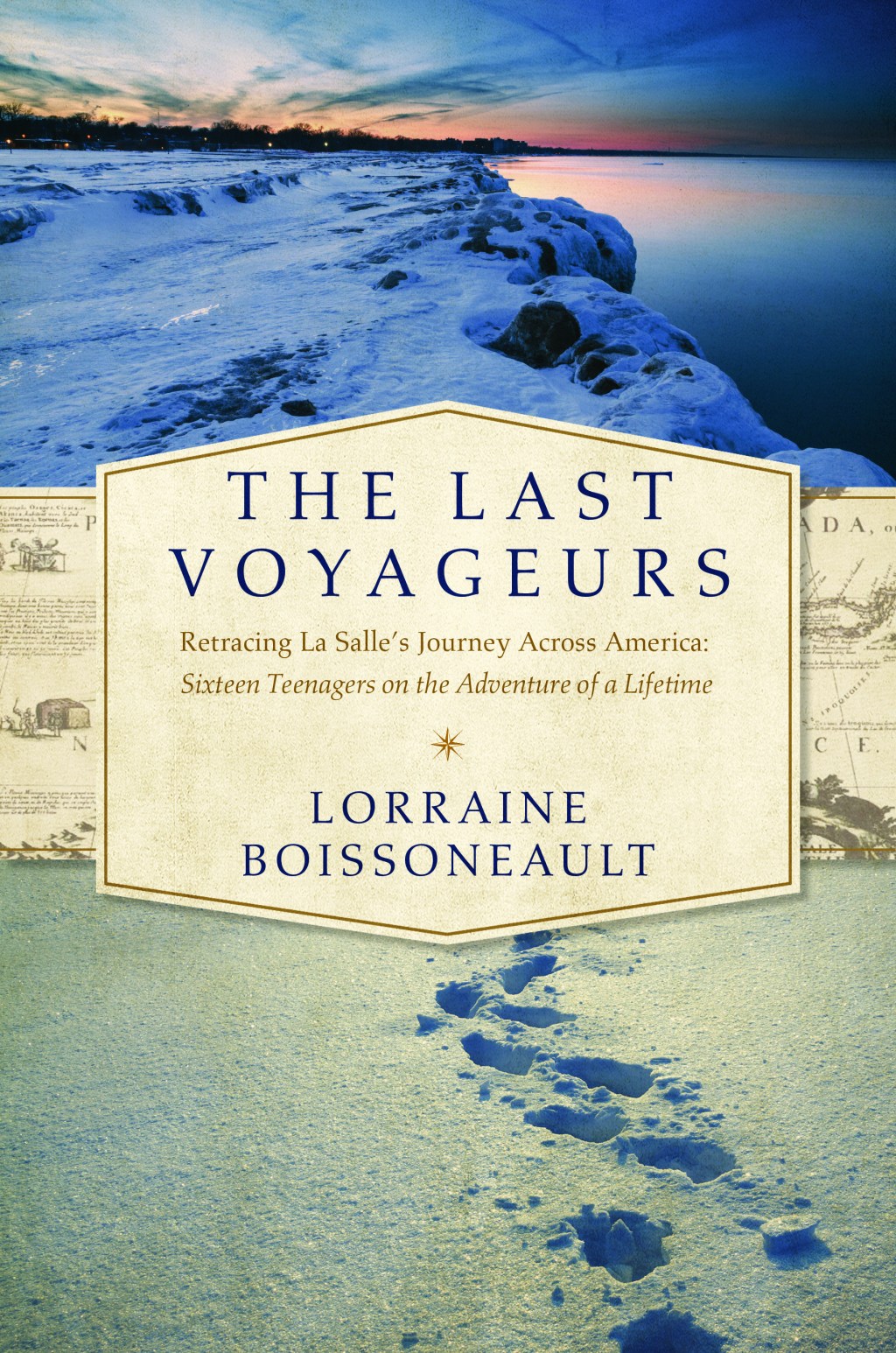
    The Last Voyageurs: Retracing La Salle’s Journey Across America: Sixteen Teenagers on an Adventure of a Lifetime

    In her last year of college, Lorraine Boissoneault, an avowed Francophile and writer who lives in Chicago, became interested in the French history of North America and the journey undertaken by René Robert Cavelier, Sieur de La Salle, the first European to travel from Montreal to the mouth of the Mississippi River.

    Her fascination with the great explorer led to a conversation with an underwater diver and thus to the story of La Salle’s Le Griffon (The Griffin), the first full-sized sailing ship on the upper Great Lakes which disappeared in 1679 with six crew members and a load of furs—also making it the first shipwreck in the Great Lakes. Luckily La Salle had disembarked before the ship made its final voyage. She also learned about a Reid Lewis, a French teacher who decided to re-enact La Salle’s trip, an eight-month, 3,300-mile expedition he undertook with 16 students and six teachers dressed in the period clothing from that time to celebrate the country’s Bicentennial.

    Interviewing the voyageurs as well as visiting places where La Salle had landed during the journey and reading original documents written in French (“nothing is ever quite the same in translation,” says Boissoneault), who wrote The Last Voyageurs: Retracing La Salle’s Journey Across America: Sixteen Teenagers on an Adventure of a Lifetime (Pegasus 2016; $27.95).

    “It’s amazing when you think of how much they could withstand,” she says, meaning both La Salle and Lewis’ crews.

    Indeed, Lewis and his group of students and educators had to trudge over 500 miles of Midwestern landscape during one of the coldest winters on record in the 20th century, paddle in Voyageur canoes across the storm tossed and freezing Great Lakes and, in keeping with their pledge to emulate La Salle, start their campfires with flint and wood.

    Of all the thousands of miles they retraced, Lewis’ voyageurs felt that Canada’s Georgian Bay on Lake Huron was most unchanged and therefore the closest they came to what La Salle would have experienced in terms of the water and landscape.     

    “We’re fascinated by history but you can’t go back no matter how hard you want to,” says Boissoneault noting she can’t imagine seeing Chicago without civilization as La Salle would have done. “The past is unobtainable. Most poignant for me is their walk across the Midwest. They were doing the same thing La Salle did and wearing the same clothes but nothing was like how it would have been in La Salle’s day.”

  • American Wolf

    American Wolf

    Nate Blakeslee has created more than a moving tribute to Yellowstone wolves. American Wolf: A True Story of Survival and Obsession in the West (Crown 2017; $28) is truly a crossover genre, science with a human face. Or, should I say, a genuinely intelligent book that connects man and beast in a way that is evocative of what Harvard’s E. O. Wilson calls “Biophilia”.

    I read this outstanding volume after reading an utterly vacuous and didactic animal book, so I was predisposed to expect it to be a soppy, sentimental and anthropomorphic look at Canis Lupus. Mercifully, it is not.

    American Wolf has beauty as well as brains. And it pierces the heart only after skillfully penetrating the neocortex.  I recommend it, without reservation.

  • The Girl Who Takes an Eye for an Eye

    The Girl Who Takes an Eye for an Eye

    Lisbeth Salander, computer hacker extraordinaire, social misfit and martial arts expert, is back in The Girl Who Takes an Eye for an Eye.  The fifth in the Stieg Larsson’s Millennium series, Salander sentenced to prison for several months after she protects an autistic child in her typical law-breaking but righteous way. But even prison bars can’t stop Salander from assisting muckraking journalist Mikael Blomkvist as he investigates The Registry, a secret group of doctors conducting illegal experiments on twins.  It’s all personal for Salander, who has an evil twin named Camilla.

    The investigation is also a chance for Salander to learn more about her abusive past. But there are, as always, barriers in the way. A prison gang leader has put a hit order on her, the Russian mafia and religious fundamentalists are after her and Camilla  is back and more treacherous.

    Fans of The Girl with the Dragon Tattoo, the first novel in the Millennium series started by Stieg Larsson and, after his death continued by David Lagercrantz, will be happy that Salander and Blomkvist have teamed up again in this thriller set in Sweden.

    For Lagercrantz, a well-established journalist and novelist, the chance to take over the Millennium series was an exciting opportunity. It was also rather daunting as Larsson’s Millennium trilogy sold more than 80 million copies worldwide.

    “If I have a gift it is probably to have the ability to write in many ways,” says Lagercrantz. “My sister who is an actor sometimes calls me an actor-writer, I go in to roles. My journalism past helped me a lot. I always say if you want to write good journalism use literary techniques, and if you want to write good fiction use journalistic research. Of course, it helped me to understand the life of Michael Blomkvist. In my heart, I am always a reporter.”

    To successfully channel the characters Larsson created, Lagercrantz read the original three books over and over and thought about the characters’ universe day and night.

    “My key to writing the book was passion,” he says. “It was the thrill of my life.”

    That passion showed. The Girl in the Spider Web, his first book for the series, was a best seller.

    Beyond giving his readers an enjoyable story, Lagercrantz wants to help people become more tolerant and understanding than we currently are.

    “It is so sad to see the society getting more and more divided,” he says. “Hate is obviously growing, thanks to terrible leaders, and if I can bring just some of us a little tiny bit closer I would be so happy.”


  • Hauntings of the Underground Railroad: Ghosts of the Midwest

    Before the Civil War, a network of secret routes and safe houses crisscrossed the Midwest to help African Americans travel north to escape slavery. Although many slaves were able to escape to the safety of Canada, others met untimely deaths on the treacherous journey—and some of these unfortunates still linger, unable to rest in peace.

    The author in front of an Underground Railroad stop said to be haunted.

    In Hauntings of the Underground Railroad: Ghosts of the Midwest, Jane Simon Ammeson investigates unforgettable and chilling tales of these restless ghosts that still walk the night. This unique collection includes true and gruesome stories, like the story of a lost toddler who wanders the woods near the Story Inn, eternally searching for the mother torn from him by slave hunters, or the tale of the Hannah House, where an overturned oil lamp sparked a fire that trapped slaves hiding in the basement and burned them alive. Brave visitors who visit the house, which is now a bed and breakfast, claim they can still hear voices moaning and crying from the basement.

    Ammeson also includes incredible true stories of daring escapes and close calls on the Underground Railroad. A fascinating and spine-tingling glimpse into our past, Hauntings of the Underground Railroad will keep you up all night.

  • Before the Fall: A Riveting Mystery by Noah Hawley

    A Great Beach Read!

    I wasn’t sure that I’d like Noah Hawley’s “Before the Fall”(Grand Central 2016; $26) because I already knew it involved a plane crash and that didn’t sound too appealing. But this mystery about a rich media titan and his family and friends is so absorbing, I kept turning the pages way after it should have been lights out.

    Only two people survive plane crash — Scott Burroughs, a once very promising artist and now a recovering alcoholic barely able to make ends meet, and the mogul’s 4-year-old son. Both end up in the dark Atlantic waters, and Burroughs, who has achieved sobriety by intensive swimming, pops the kid on his back and heads for land — an epic swim against currents and gigantic waves. But that’s the least of his problems.

    Once ashore, he’s hailed as a hero until the media titan’s star anchor concocts conspiracies about Burroughs’ part in the plane’s crash. It all ends very satisfying and the plot is mesmerizing. Just watch out for sunburn if you pick up this book.